What Is a Deep Plane Neck Lift? A Guide to Structural Rejuvenation
By Tseng Plastic Surgery
The secret to a truly youthful jawline isn't found in how tightly your skin is pulled; instead, it lies in how gracefully the underlying architecture is restored. If you've spent years searching for a solution to sagging jowls or a softened profile, you've likely felt the frustration of non-surgical treatments that offer only fleeting improvements. It's common to worry that surgery might leave you with a "wind-tunnel" or "operated" appearance that feels disconnected from your true self. Understanding what is a deep plane neck lift is the first step toward realizing that structural rejuvenation doesn't have to mean looking unnatural.
By releasing the deep ligaments and repositioning the platysma muscle, this technique achieves a refined, sharp jawline that remains harmonious with your features. In this guide, you'll discover how the deep plane approach creates a foundation for results that can last 10 to 15 years. We'll explore the balance of clinical precision and aesthetic artistry required to restore your confidence. You'll learn why addressing the neck's deep structures is the key to a refreshed look that feels both authentic and enduring. This methodical approach ensures you look like yourself, only better.
Key Takeaways
- Learn exactly what is a deep plane neck lift and how it targets the structural layers beneath the skin for a defined, elegant jawline.
- Understand the vital role of the SMAS and retaining ligaments in creating a firm, youthful scaffold that stands the test of time.
- Compare the vertical lift technique against traditional methods to see how a natural vector prevents the dreaded "wind-tunnel" effect.
- Prepare for your transformation with a clear timeline of the initial two-week recovery phase and what to expect during the healing process.
- Discover how the Minimal Invasive Preservation Face and Neck Lift philosophy prioritizes tissue health to ensure a safer and more efficient recovery.
What Is a Deep Plane Neck Lift? Defining the Modern Standard
To understand what is a deep plane neck lift, one must look past the surface of the skin. This procedure is a sophisticated surgical approach that reshapes the neck’s fundamental architecture from within. It targets the structural layers beneath the skin to create a crisp, elegant jawline that stands the test of time. In clinical terms, the deep plane is the specific anatomical space between the Superficial Musculoaponeurotic System (SMAS) and the deeper muscle fascia. This technique is often a central component of a comprehensive Rhytidectomy, as it provides the gold standard for submental contouring and long-term facial harmony. By focusing on these deeper anchors, surgeons achieve a transformation that looks inherently natural rather than surgically altered.
The Limitations of Surface-Level Tightening
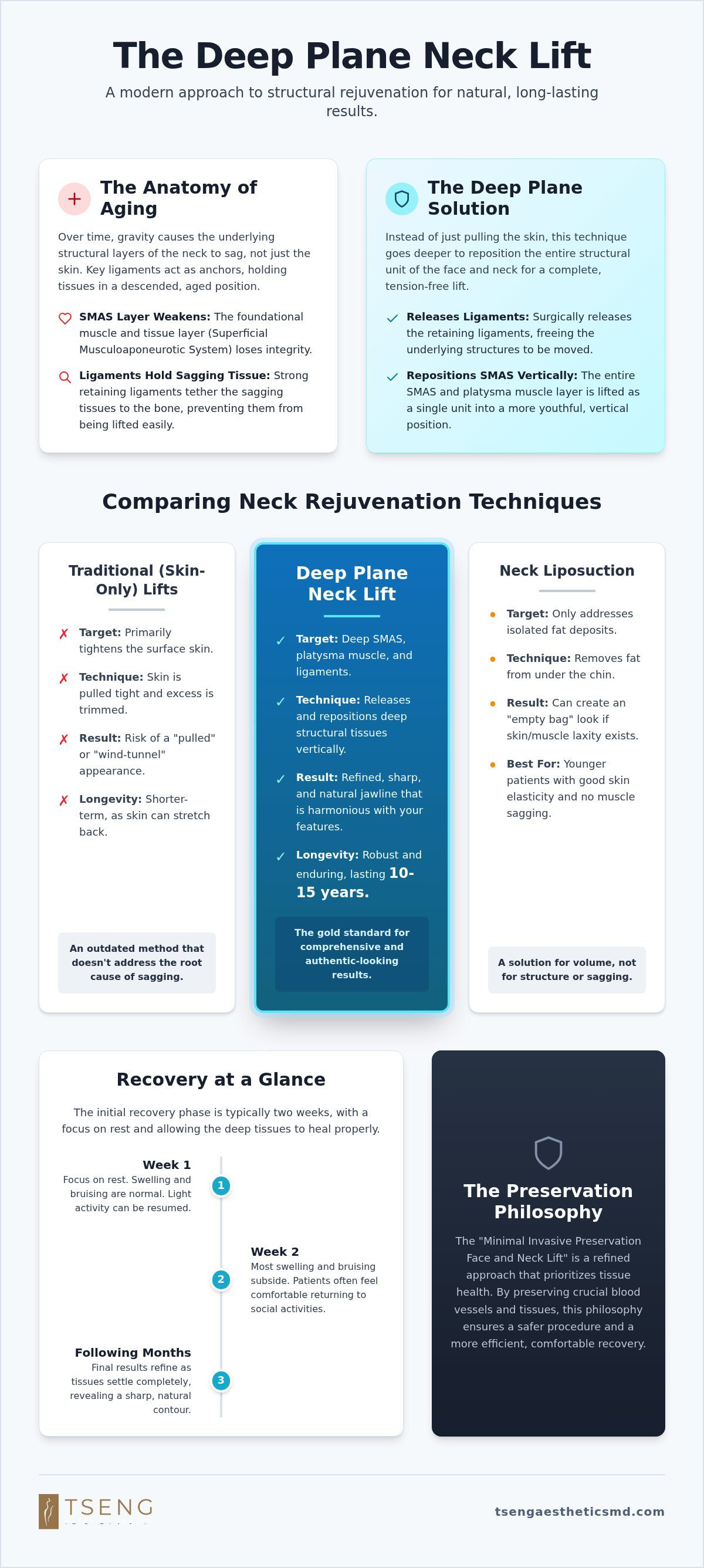
Older surgical techniques focused primarily on the skin. While skin possesses natural elasticity, it isn't designed to support the weight of the face or neck. When skin is pulled too tight to mask underlying sagging, the results often look distorted. This tension can lead to a flattened neck profile or an unnatural appearance around the mouth. A deep plane approach avoids these pitfalls by placing the lifting tension on the sturdy SMAS layer instead of the delicate skin surface. This ensures the skin can drape softly over a newly defined structure, maintaining the patient’s unique character and avoiding the "wind-tunnel" look of the past.
Neck Liposuction vs. Deep Plane Neck Lift
Many patients initially seek liposuction to address a "double chin," but fat removal alone is often insufficient for those with muscle laxity. If there is significant sagging, removing fat can create an "empty bag" effect. This happens when the skin appears even more deflated and wrinkled because the underlying volume was removed without tightening the structure. A deep plane neck lift addresses the root cause of a heavy profile. It doesn't just manage fat; it repositions the platysma muscle and addresses deeper tissues that contribute to a loss of definition.
Consider these key differences when evaluating your options:
- Liposuction: This is best suited for younger patients with excellent skin elasticity and isolated fat deposits under the chin.
- Deep Plane Lift: This is essential for patients with muscle banding, sagging skin, or "heavy" necks caused by structural descent rather than just fat.
- Comprehensive Results: The deep plane approach manages submandibular glands and muscle layers to create a sharp, youthful angle that liposuction cannot achieve on its own.
The Anatomy of a Lift: SMAS, Ligaments, and the Deep Plane
To appreciate the precision involved in this procedure, one must first understand the face's internal scaffolding. The Superficial Musculoaponeurotic System, or SMAS, is a continuous layer of fibrous tissue and muscle that connects the face and neck. Over time, gravity and the loss of structural integrity cause this layer to sag, pulling the overlying skin down with it. While traditional methods might simply pull the skin, understanding what is a deep plane neck lift involves looking at how the surgeon enters the space beneath this SMAS layer to reposition the foundation itself. This sophisticated approach is recognized by the American Academy of Facial Plastic and Reconstructive Surgery as a method that requires elite training and anatomical mastery.
The true "magic" of the deep plane technique lies in addressing the retaining ligaments. These are strong, fibrous bands that act as anchors, tethering the facial tissues to the underlying bone. Think of them as the fixed points that keep the mid-face and neck in a downward, aged position. By surgically releasing these anchors, a surgeon can move the entire structural unit of the face and neck as one. This allows for mobile, tension-free repositioning that restores the foundation of your appearance rather than just stretching the facade.
Releasing the Anchors: Why Ligament Release Is Key
When ligaments remain intact, any attempt to lift the face or neck results in resistance. This resistance is what often causes the "pulled" or "surgical" look associated with older techniques. Dividing these ligaments allows the deeper tissues to glide into a more youthful, vertical position without force. Because the tension is held by these deep, sturdy structures rather than the skin, the results are remarkably durable. This mechanical release is why deep plane results typically last 10 to 15 years, far outperforming surface-level treatments. If you are considering a refined rejuvenation journey, focusing on these structural anchors is essential for a natural outcome.
The Multi-Layered Approach to the Jawline
A sharp jawline requires more than just skin tightening; it requires sculpting the layers beneath the platysma muscle. This muscle is responsible for the vertical "neck bands" that often appear with age. During a deep plane lift, the platysma is meticulously repositioned and tightened. Beyond the muscle, the surgeon may also address subplatysmal fat and submandibular glands. By refining these deeper elements, the surgeon creates a crisp cervicomental angle, ensuring a harmonious transition between the jawline and the neck that feels both elegant and authentic.
Deep Plane vs. Traditional Neck Lifts: A Comparative Framework
When patients explore facial rejuvenation, the choice often comes down to the fundamental physics of the procedure. Traditional neck lifts frequently utilize a horizontal vector, pulling the skin sideways toward the ears to smooth out wrinkles. While this may offer an immediate change, it often fails to address the underlying cause of aging. Understanding what is a deep plane neck lift involves recognizing a shift toward a vertical vector. This vertical movement restores the tissues to their original, more youthful position, creating a result that is both elegant and anatomically correct.
The difference in incision quality is also significant. In traditional surgery, the skin bears the burden of the lift, which can lead to tension-related scarring or even a distorted earlobe shape. Because the deep plane technique anchors the weight of the lift to the sturdy SMAS layer, the skin drapes naturally without stress. This allows for finer, more discreet incisions that heal with a level of refinement expected in high-end aesthetic surgery. When considering the scope of these results, it's vital to consult with a surgeon who can explain how long does a deep plane facelift last and how that structural longevity applies to the neck.
Why Tension-Free Results Look More Natural
The dreaded "wind-tunnel" effect is almost always the result of excessive skin tension. When the skin is treated as the primary lifting mechanism, it loses its natural texture and looks unnaturally tight. Deep plane lifting eliminates this risk by ensuring the skin is completely tension-free. By using the SMAS to bear the structural weight, the surgeon allows the surface to remain soft and mobile. This mimics the way a youthful face moves, ensuring that your expressions remain authentic and your profile looks refreshed, not "operated on."
Longevity and Value: The Long-Term Investment
Traditional lifts may require a touch-up in as little as five years because skin is inherently elastic and will eventually stretch back out. The deep plane approach offers a "longevity gap" that provides stability for 10 to 15 years. This durability is biological; by releasing the retaining ligaments and repositioning the deeper foundation, the surgeon creates a new structural baseline that ages naturally with you. While the initial investment may be higher, the value of a single, comprehensive procedure often outweighs the cost and recovery time of multiple minor surgeries over a decade.
Candidacy and Recovery: What to Expect from the Journey
Choosing to undergo a surgical transformation is a deeply personal decision that requires a clear understanding of both the procedure and the healing process. When patients ask what is a deep plane neck lift, they're often seeking a solution that transcends the limits of surface-level treatments. This technique is designed for those who desire a profound yet natural change in their profile. While the surgery is technically complex, the recovery journey is often more manageable than patients anticipate, thanks to the lack of tension on the skin surface.
Who Should Consider a Deep Plane Procedure?
The ideal candidate for this procedure isn't defined solely by age but by the specific anatomical changes they wish to address. Many patients present with significant jowling or prominent platysmal bands that have become resistant to non-surgical interventions. However, we also see younger patients who have lived with a genetically blunted jawline or a "heavy" neck since their youth. For these individuals, a structural lift provides the definition that nature didn't. Additionally, this approach is the preferred choice for revision patients who are unhappy with the "pulled" or short-lived results of a previous traditional lift. If you're ready to explore your options, you can schedule a personalized consultation to discuss your specific goals.
It's a common misconception that deeper surgery equates to a more grueling recovery. In reality, because the weight of the lift is supported by the SMAS layer, the skin drapes without stress, which can actually facilitate a smoother healing process. For a more granular look at the post-operative journey, we recommend reviewing our facelift recovery timeline, which closely parallels the neck lift experience.
The Recovery Timeline: From Surgery to Social Ready
The first 48 hours after surgery are dedicated to rest and initial healing. Patients typically wear soft dressings to support the new contours and minimize swelling. While some bruising and swelling are expected, these effects usually peak within the first week and begin to subside rapidly. Most patients feel socially presentable and can return to non-strenuous activities within 10 to 14 days. The precision of the deep plane approach ensures that while you're healing, you're doing so with a foundation built for longevity.
Achieving the final, refined result is a gradual process. While the immediate improvement is visible once the initial swelling fades, it takes approximately three to six months for the tissues to fully settle and for the final definition to emerge. During this time, following specific protocols can enhance your comfort and results:
- Keep your head elevated, even while sleeping, for the first week to reduce fluid retention.
- Incorporate gentle movement and light walking as soon as permitted to promote healthy circulation.
- Avoid strenuous exercise or heavy lifting for at least three to four weeks to protect the deep structural work.
The Preservation Philosophy: Dr. Tseng’s Refined Approach
The hallmark of Dr. Mark Tseng’s practice is a commitment to the Minimal Invasive Preservation Face and Neck Lift. With over 20 years of experience, Dr. Tseng has refined a technique that moves beyond the aggressive pulling seen in traditional surgery. Instead, this approach focuses on maintaining the delicate balance of the facial tissues while achieving a profound structural correction. Understanding what is a deep plane neck lift in this context requires looking at the procedure as a form of master craftsmanship. It isn't just about removing excess; it's about artfully repositioning what is already there to reveal a version of yourself that feels both refreshed and entirely authentic.
This preservation philosophy prioritizes blood supply and tissue health to ensure the most efficient healing process possible. By working within the natural deep plane, the surgeon avoids disrupting the superficial blood vessels that nourish the skin. This clinical precision results in less bruising and a more vibrant, healthy glow during the recovery phase. For many patients, the modern facelift serves as a vital companion to the neck lift, ensuring that the rejuvenation of the jawline is mirrored in the mid-face for total facial harmony.
Why 'Preservation' Matters in Aesthetic Surgery
Preservation surgery is a departure from the destructive methods of the past. It emphasizes keeping the natural fat pads and contours that give the face its youthful volume. When these elements are preserved and lifted rather than removed, the result is a soft, graceful appearance that ages beautifully over time. This technique also treats the lymphatic system with extreme care. By reducing trauma to these drainage pathways, the practice minimizes long-term swelling and allows the refined contours of the jawline to emerge more quickly. A gentle surgical touch is the key to a result that doesn't just look good today, but remains stable for a decade or more.
Your Consultation: A Personalized Path to Refinement
Every journey toward rejuvenation begins with a patient-first mentality. During your consultation, Dr. Tseng performs a methodical evaluation of your unique anatomy, considering bone structure, skin quality, and the specific degree of muscle laxity. This thorough assessment ensures that the surgical plan is tailored specifically to your goals, rather than following a one-size-fits-all template. We understand that many patients come to us after feeling frustrated by the limitations of temporary fixes. If you're ready to transition from surgical vs. non-surgical facelift options to a permanent, structural solution, this personalized planning phase is your first step toward a lasting transformation. You'll leave the consultation feeling empowered, informed, and confident in the possibilities of your own rejuvenation.
Embarking on Your Journey to Refined Definition
Grasping the mechanics behind what is a deep plane neck lift reveals that true rejuvenation comes from within. By addressing the deep structural layers and releasing the ligaments that pull the jawline downward, this technique provides a level of definition and longevity that surface-level treatments simply can't match. You aren't just smoothing the skin; you're restoring the architectural balance of your face for results that typically last 10 to 15 years.
Dr. Mark H. Tseng combines over 20 years of specialized experience in facial aesthetics with a deep commitment to minimal invasive preservation techniques. His board-certified surgical precision is balanced by an artistic eye, ensuring your transformation is as subtle as it is profound. This patient-first approach prioritizes your tissue health and personal vision, creating a harmony between clinical expertise and your aesthetic goals. If you're ready to move beyond temporary solutions toward a permanent, natural transformation, we invite you to take the next step. Schedule a Consultation with Dr. Tseng to Explore Structural Rejuvenation. Your path to a more confident, youthful version of yourself begins with an expert conversation.
Frequently Asked Questions
Is a deep plane neck lift more painful than a traditional one?
Most patients report that discomfort is quite manageable. Since the procedure avoids high-tension skin pulling, there is typically less of the "stinging" sensation associated with traditional lifts. Dr. Tseng utilizes preservation techniques that minimize trauma to sensory nerves. While some tightness and soreness are expected during the first few days, these symptoms are generally well-controlled with standard medication. Most individuals find the recovery period surprisingly comfortable.
How long do the results of a deep plane neck lift typically last?
A well-executed procedure provides results that typically last between 10 and 15 years. This durability is due to the structural nature of the work, which repositions deep tissues rather than just tightening the skin. While your face will continue to age naturally, you'll do so from a more youthful baseline. Factors such as skin quality, genetics, and lifestyle choices like sun protection will ultimately influence how long your refined profile remains stable.
Will I have visible scars after a deep plane neck lift?
Incisions are meticulously placed in natural creases around the ears and sometimes under the chin to ensure they're as discreet as possible. Because the deep plane technique places all the lifting tension on the sturdy SMAS layer, the skin drapes without stress. This lack of tension is critical for high-quality healing, as it prevents scars from widening. Over time, these fine lines typically fade until they're nearly imperceptible to the naked eye.
What is the difference between a deep plane facelift and a deep plane neck lift?
While both address the deep plane, they target different anatomical zones. A facelift primarily rejuvenates the mid-face and jawline by lifting the malar fat pad. In contrast, understanding what is a deep plane neck lift involves focusing on the area below the jawline, specifically the platysma muscle and submental contours. Many patients choose to combine these procedures for a seamless transition and a harmonious, total facial rejuvenation that avoids any aesthetic disconnect.
Can a deep plane neck lift fix a 'double chin'?
Yes, this procedure is highly effective for correcting a "double chin," especially when the fullness is caused by more than just surface fat. While liposuction only removes fat above the muscle, understanding what is a deep plane neck lift involves addressing subplatysmal fat and even the submandibular glands. By sculpting these deeper layers and tightening the platysma muscle, we create a sharp, elegant cervicomental angle that non-surgical treatments can't achieve.
How much does a deep plane neck lift cost on average?
The investment for this surgery varies based on several factors, including the surgeon's experience, the complexity of your specific anatomy, and the facility's standards. Because each procedure is highly personalized, a formal consultation is necessary to provide an accurate estimate. When considering the cost, it's helpful to view it as a long-term investment in structural integrity. A comprehensive deep plane procedure often provides more value over a decade than multiple surface-level treatments.
What is the best age to get a deep plane neck lift?
There isn't a single perfect age, as candidacy depends more on anatomical changes than the date on a birth certificate. Most patients are in their 40s, 50s, or 60s when they notice significant laxity or neck bands. However, younger individuals with a genetically heavy neck or a lack of jawline definition also benefit greatly. The best time for surgery is when you feel your physical appearance no longer aligns with your internal vitality.
How long is the downtime before I can return to work?
Most patients feel ready to return to a professional setting and resume social activities within 10 to 14 days. By this point, the majority of swelling and bruising has significantly diminished and can often be camouflaged with light makeup. While you'll be socially ready quite quickly, you should wait at least three to four weeks before engaging in strenuous exercise or heavy lifting to ensure your internal structural work remains secure during the healing process.

