How Long Does a Deep Plane Facelift Last? Longevity and Results Guide
By Tseng Plastic Surgery
What if the true measure of a surgical transformation wasn't how much skin was removed, but how gracefully the results aged alongside you? Most people considering facial rejuvenation find themselves asking one pivotal question: how long does a deep plane facelift last? It's a valid concern, especially when you're seeking a balance between clinical precision and a soft, natural aesthetic. You likely want to avoid the tight, artificial look of traditional methods while ensuring your investment remains visible for years to come.
We understand that choosing surgery is a deeply personal journey, and it's natural to feel anxious about results fading too soon or appearing unnatural. This guide will show you how the deep plane technique secures the foundation of your face to provide a natural rejuvenation that lasts 10 to 15 years. We'll examine the science of ligament release, the benefits of modern preservation techniques, and the essential steps to maintain your elegant results for the long term.
Key Takeaways
- Discover why the clinical expectation for how long does a deep plane facelift last is typically 10 to 15 years.
- Understand the structural difference between surface pulling and deep ligament release to ensure a natural, tension-free result.
- Learn how individual tissue quality and consistent weight management play a critical role in the longevity of your surgical outcome.
- Explore how medical-grade skincare and non-surgical treatments can help preserve your rejuvenated appearance for the long term.
- Gain insight into Dr. Tseng's preservation-focused approach that leverages over 20 years of experience to create a balanced, lasting aesthetic.
The Realistic Timeline: How Long Does a Deep Plane Facelift Last?
Choosing a surgical path requires a clear understanding of what "forever" means in a biological context. When patients ask how long does a deep plane facelift last, they're typically looking for a guarantee of value and a sense of security. Clinical data and long-term patient follow-ups suggest that a well-executed deep plane lift offers between 10 and 15 years of visible rejuvenation. This timeline doesn't imply that the results suddenly vanish on the fifteenth anniversary. Instead, it marks the point where the natural, inevitable process of aging begins to subtly manifest again over the newly restored foundation.
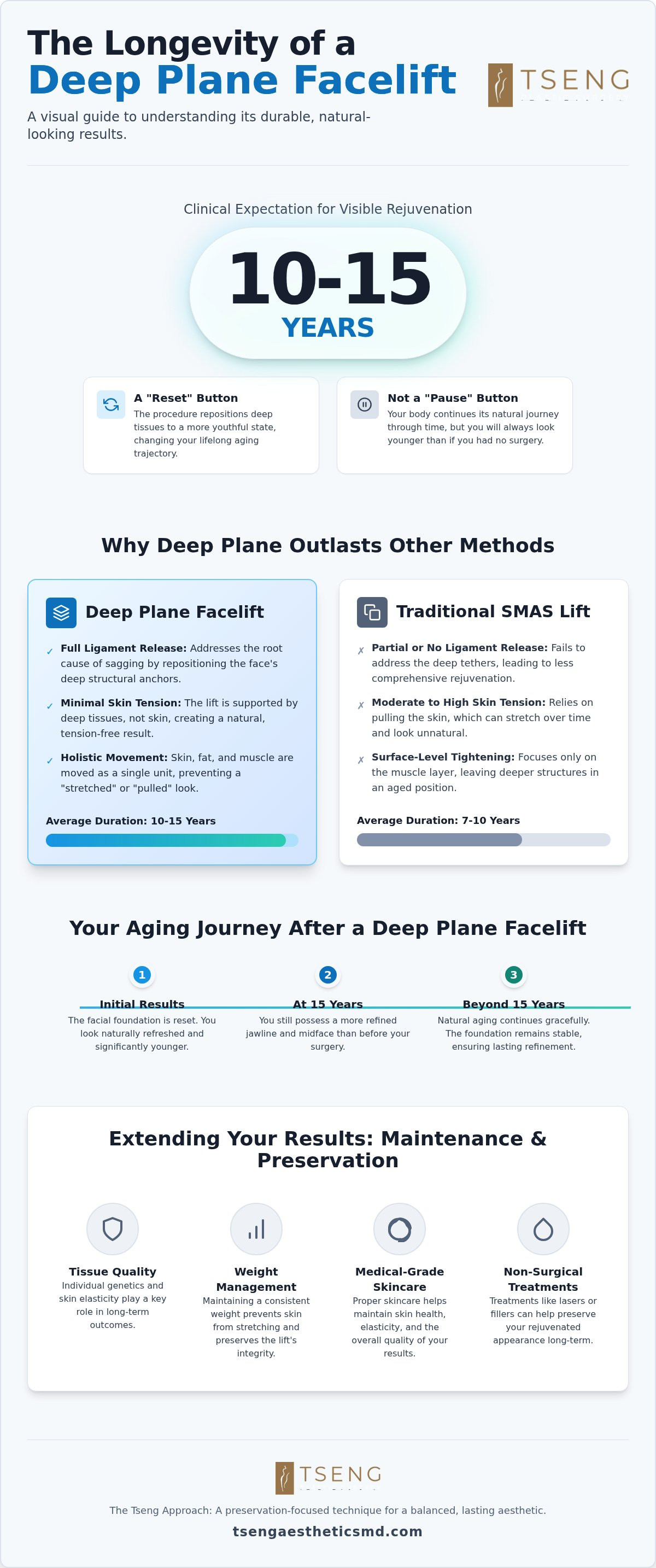
It's helpful to view facelift surgery as a reset button rather than a pause button. While the procedure repositions deep tissues to a more youthful state, your body continues its natural journey through time. Because the structural layers were physically moved and secured, you'll always look significantly younger than you would have without the intervention. Many patients find that at the 15-year mark, they still possess a more refined jawline and midface than they did before their surgery. This "new baseline" means you aren't just delaying aging; you're changing your lifelong trajectory.
The 10-15 Year Window Explained
In the world of aesthetic science, we define surgical longevity as the duration during which the primary corrections remain the dominant feature of your appearance. Deep plane results persist longer than traditional skin-only or SMAS lifts because they address the root cause of sagging: the release and repositioning of deep retaining ligaments. Surgical longevity is a biological reset of the facial foundation rather than a temporary surface fix. By securing the heavier soft tissues directly to the underlying structure, the lift resists the downward pull of gravity with much greater integrity than a surface-level tightening ever could.
What Happens After 15 Years?
As you move beyond the decade mark, the face continues to experience subtle changes. Gravity eventually affects the skin's elasticity. Meanwhile, natural bone resorption and fat volume loss continue to alter the facial contours. You might notice a slight softening of the jawline or a very gradual return of laxity in the neck. These changes aren't a failure of the surgery, but rather the ongoing story of natural maturation. Because a deep plane lift creates a permanent structural change, most patients never feel the need for a secondary full lift. The foundation remains stable, ensuring you age with a level of grace and refinement that wouldn't be possible otherwise.
The Mechanics of Longevity: Why Deep Plane Outlasts SMAS
Engineering a lasting result requires moving beyond the surface. In traditional surgery, the skin often bears the burden of holding the face up. This leads to the "windblown" look and premature sagging as the skin inevitably stretches under the weight of underlying fat and muscle. To understand how long does a deep plane facelift last, one must look at load distribution. By shifting the tension from the delicate skin to the sturdy, deep facial structures, we ensure the results remain stable for years without the risk of a "pulled" appearance.
Deep Plane vs. SMAS: A Structural Comparison
Traditional SMAS lifts focus on the superficial musculoaponeurotic system by tightening the muscle layer. While this is an improvement over skin-only lifts, it often fails to address the underlying anchors that keep the face tethered in an aged position. The deep plane approach goes beneath this layer. It allows the entire tissue block to move as one, preventing the "stretched" appearance because the skin isn't being pulled independently of the muscle and fat. This holistic movement is why deep plane results look natural from day one and remain that way for over a decade.
| Feature | Traditional SMAS | Deep Plane Facelift |
|---|---|---|
| Skin Tension | Moderate to High | Minimal to None |
| Ligament Release | Partial or None | Full Release |
| Average Duration | 7-10 Years | 10-15+ Years |
The Science of Ligament Release
The secret to durability lies in the zygomatic and masseteric ligaments. These are the biological "anchors" that hold facial tissues in place. If they aren't released, any lifting is temporary; the ligaments will eventually pull the tissue back down to its previous position. Releasing these anchors allows for a complete, tension-free repositioning of the midface and jawline. This thorough release is the primary reason why the deep plane technique is the gold standard for longevity, as it removes the resistance that causes other lifts to fail prematurely.
Repositioning the malar fat pad is equally vital for a durable midface. In a youthful face, this volume sits high on the cheekbones. As we age, it slides downward, creating deep nasolabial folds. By lifting this volume vertically rather than horizontally, we achieve a natural look that lasts. This vertical vector mimics the way the face naturally ages in reverse. If you're ready to discuss a legacy investment in your appearance, Dr. Tseng's expertise in the minimal invasive preservation face and neck lift ensures a balanced and enduring result that respects your unique anatomy.
Factors That Influence Your Personal Facelift Longevity
While the surgical technique is the primary driver of durability, the answer to how long does a deep plane facelift last also depends on the biological canvas provided by the patient. We distinguish between chronological age and biological age; the latter reflects the actual health and vitality of your tissues. Genetics play a significant role in determining the rate of collagen depletion and the inherent strength of your dermal matrix. Some individuals naturally possess thicker, more resilient skin that holds a lift with greater tenacity over time. Understanding how long does a deep plane facelift last requires looking at both the skill of the surgeon and the lifestyle of the patient. Balancing genetic predispositions with proactive lifestyle choices is the key to extending your results well into the second decade.
Tissue Quality and Pre-Surgical Health
The integrity of your skin's elasticity, often measured by the degree of solar elastosis, dictates how well the surface responds to deep structural repositioning. Chronic sun damage can leave the skin brittle, making it less capable of "snapping back" into place. Smoking remains one of the most detrimental habits for surgical longevity. It constricts blood flow and degrades the very collagen fibers necessary for a stable, long-lasting result. Similarly, poor nutrition can lead to a "hollowed" appearance that surgery alone cannot fix. Maintaining a stable, healthy BMI is equally critical. Significant weight fluctuations after surgery can stretch the skin or cause fat pads to shift, potentially compromising the sharp jawline definition achieved during your procedure. Staying within a five to ten pound range of your surgical weight helps maintain the harmony of the midface and neck.
The Role of Post-Operative Care
Your commitment to recovery protocols in the first few months is vital for preventing early tissue displacement. While the deep plane technique is structurally superior, the initial healing phase is when the tissues "set" into their new, rejuvenated positions. This period requires patience and adherence to activity restrictions to ensure the internal sutures and tissue planes heal without unnecessary strain. Beyond the immediate recovery, long-term UV protection is the single most important external factor in preserving your skin's quality. Chronic sun exposure breaks down the dermal matrix, leading to fine lines and laxity that can mask the beautiful structural work underneath. Essentially, the surgeon builds the house, but the patient must maintain the exterior to ensure the legacy of the investment remains intact.
Extending the Results: Maintenance and Preservation
Protecting a surgical investment requires a shift in mindset from correction to active preservation. While the physical structure of the face is fundamentally altered during surgery, the biological processes of aging continue their quiet work. Understanding how long does a deep plane facelift last involves recognizing that longevity is a shared responsibility between the surgeon's precision and the patient's lifestyle. Integrating non-surgical treatments allows you to address the ongoing changes in skin texture and muscle activity that surgery alone cannot stop. For example, the strategic use of neuromodulators like Botox can soften the downward pull of muscles in the lower face, protecting the crisp, refined jawline established during your procedure.
The Role of Minimal Invasive Preservation
Dr. Tseng emphasizes a philosophy where clinical expertise meets long-term tissue health through minimal invasive preservation. By utilizing techniques that respect the natural blood supply and minimize trauma, we ensure the tissues remain vibrant and resilient. This approach is particularly relevant for patients who are navigating the choice between a Surgical vs. Non-Surgical Facelift: The Comprehensive 2026 Guide. In the years following a deep plane procedure, a "less is more" strategy often yields the most sophisticated results. Because the foundation is already secure, you only need subtle refinements to maintain a balanced and youthful aesthetic.
Medical-grade skincare acts as the daily insurance policy for your surgical outcome. Using formulations rich in retinoids and growth factors helps maintain the density of the dermal matrix, preventing the thinning that can make skin look fragile over time. As natural fat volume continues to shift over a decade, precise volume restoration with fillers or fat grafting can keep the midface looking supple and light-reflective. These minor adjustments work in harmony with the deep plane structure, ensuring that the question of how long does a deep plane facelift last is met with a result that remains elegant well into the second decade. If you're looking to enhance your surgical journey, exploring our range of injectables can provide the subtle maintenance needed for enduring beauty.
Annual Maintenance Checklist
Maintaining the integrity of your results is most effective when approached with a methodical, unhurried routine. Consider this annual checklist to protect the harmony of your appearance:
- Daily: Application of broad-spectrum SPF 50 and stabilized Vitamin C to combat oxidative stress and prevent collagen degradation.
- Bi-annually: Targeted neuromodulators to relax the depressor muscles that pull at the corners of the mouth and neck.
- Annually: Fractional laser or light-based therapies to address surface pigmentation and refine the skin's overall texture.
- Every 2-3 years: A professional assessment to determine if subtle volume refinement is needed to maintain midface fullness and cheek contour.
The Tseng Approach to Durable Facial Rejuvenation
Dr. Tseng's philosophy is rooted in the belief that a surgical transformation should be a legacy investment in one's appearance rather than a fleeting correction. With over 20 years of clinical experience, he approaches every procedure as both an artist and a scientist, ensuring that the precision of the deep plane technique is balanced by a keen eye for aesthetic harmony. When patients ask how long does a deep plane facelift last, the answer is often found in the customization of the vertical vector. By lifting tissues in a strictly upward direction rather than a horizontal pull, Dr. Tseng respects the natural anatomy of the face. This creates a result that doesn't just look younger today but continues to age with a level of grace and refinement that traditional methods simply cannot match.
Sophisticated Techniques for the Modern Patient
Modern facial rejuvenation has moved far beyond the generic, one-size-fits-all approaches of the past. Dr. Tseng balances his clinical authority with a patient-centric journey, recognizing that every individual possesses a unique skeletal structure and tissue quality. This personalized touch ensures that the repositioning of the malar fat pad and the release of deep ligaments are tailored to your specific aging pattern. For those seeking deeper procedural insight into these advanced methods, our Modern Facelift Guide explores how we achieve the subtle, high-quality improvements that define our practice. We prioritize the preservation of your natural character, avoiding the trauma of over-correction while securing a foundation that stands the test of time.
Your Journey Toward Lasting Confidence
A consultation with Dr. Tseng is a deliberate and unhurried process where your personal vision takes center stage. We view this meeting as the first step in a 15-year journey toward lasting confidence. During your visit, we'll perform a thorough evaluation of your facial foundation to provide a realistic perspective on how long does a deep plane facelift last for your specific biological profile. This transparency builds a foundation of trust and integrity, ensuring you feel empowered in your decision. We understand that physical changes are deeply connected to your emotional well-being and quality of life. By focusing on natural-looking, balanced results, we help you achieve an appearance that reflects your inner vitality. If you're ready to explore the possibilities of a custom-tailored rejuvenation, we invite you to schedule your consultation with Tseng Plastic Surgery today and take the first step toward a refined, enduring future.
Investing in a Timeless Aesthetic
Choosing a surgical path is a significant step toward aligning your outer appearance with your inner vitality. We've examined how the structural integrity of the deep plane technique provides a durable foundation that surface-level lifts simply cannot match. While biological factors and lifestyle choices influence how long does a deep plane facelift last, the clinical standard of 10 to 15 years offers a reliable window of rejuvenation. This procedure doesn't just tighten; it restores harmony to your features by securing the deep tissues where they belong.
Dr. Tseng combines over 20 years of surgical expertise with a specialized focus on deep plane and preservation techniques to ensure your results are both natural and balanced. We believe that true artistry lies in the subtle refinements that allow you to age with quiet confidence. If you're ready to explore a personalized plan for your facial journey, we invite you to Schedule Your Consultation with Dr. Tseng to Discuss Your Lasting Rejuvenation. Your path to a refreshed, enduring version of yourself begins with a single, expert conversation.
Frequently Asked Questions
Is a deep plane facelift more permanent than a mini facelift?
Yes, it is significantly more durable because it addresses the deep structural layers rather than just the surface skin. A mini facelift typically lasts 5 to 7 years because it focuses on a smaller area with less structural repositioning. In contrast, the deep plane technique targets the underlying ligaments and fat pads, providing a comprehensive rejuvenation that lasts twice as long. It represents a more profound investment in long term facial harmony.
Can I get a second deep plane facelift if my results fade after 15 years?
Yes, a secondary procedure is possible, although many patients find they only require minor refinements rather than a full redo. Because the initial deep plane lift creates a permanent structural change, your face will always look younger than if you hadn't had the surgery. If significant laxity returns after 15 years, a skilled surgeon can safely perform a revision by navigating the existing surgical planes with precision and care.
Does a deep plane facelift stop the aging process entirely?
No, surgery does not stop biological aging, but it resets your appearance to a much more youthful baseline. While we can physically reposition tissues and secure ligaments, your skin and bones will continue to maturate naturally. The primary benefit is that you'll continue to age from this new, rejuvenated starting point. You'll always maintain a 10 to 15 year advantage over your chronological age, even as the decades pass.
How much longer does a deep plane lift last compared to a SMAS lift?
A deep plane lift typically lasts about 5 years longer than a standard SMAS lift due to its tension-free approach. While a SMAS lift might provide 7 to 10 years of rejuvenation, the question of how long does a deep plane facelift last is usually answered with a 10 to 15 year window. By releasing the deep facial ligaments, we eliminate the resistance that often causes SMAS lifts to settle prematurely.
What is the best age to get a deep plane facelift for maximum longevity?
Most surgeons recommend the late 40s to early 60s as the ideal window for maximizing results. During this period, the skin still possesses enough inherent elasticity to heal beautifully, yet the signs of deep structural sagging are present enough to justify the intervention. While we've performed successful lifts on patients in their 70s, earlier intervention often allows for a more seamless preservation of your natural aesthetic as you maturate.
Do lifestyle choices like diet and exercise affect how long my facelift lasts?
Absolutely, your daily habits are the most significant external factors in protecting your surgical investment. A diet rich in antioxidants and lean proteins supports collagen production, while regular exercise maintains the healthy circulation necessary for tissue vitality. Conversely, significant weight fluctuations can stretch the skin and displace fat pads. Maintaining a stable weight and avoiding chronic sun exposure are essential for ensuring your facial contours remain crisp and refined.
Will my face look 'stretched' as the deep plane facelift ages?
No, the deep plane technique is specifically designed to avoid the stretched look common with older methods. Because we move the entire tissue block together, the skin remains under zero tension. As you age, your face will soften naturally and symmetrically. You won't experience the artificial pulling that occurs when skin is used as the primary anchor for the lift, ensuring a graceful maturation that respects your unique facial character.
How do I know when my facelift results have finally 'worn off'?
Results don't wear off in a literal sense; rather, the natural aging process eventually becomes visible again. You'll know it's time for a professional assessment when you notice a gradual return of jowls at the jawline or a softening of the midface volume. When considering how long does a deep plane facelift last, remember that even when new signs of aging appear, you will still look significantly more refreshed than your un-operated peers.

