Surgical vs. Non-Surgical Facelift: The Comprehensive 2026 Guide to Facial Rejuvenation
By Tseng Plastic Surgery
You might assume that the choice between a surgical vs non-surgical facelift is merely a question of how much time you can spend in recovery. However, the most successful transformations aren't just about "tightening" the skin; they're about the sophisticated restoration of facial harmony. It's common to feel overwhelmed by the sheer volume of non-invasive technologies or to fear an unnatural, "wind-swept" surgical result that doesn't feel like you.
We understand that you're seeking a refreshed appearance that looks like a younger version of yourself rather than a different person entirely. This 2026 guide bridges the gap between clinical precision and aesthetic artistry, offering you a clear roadmap for your aesthetic journey. You'll discover how to balance the longevity of a minimal invasive preservation face and neck lift with the subtle refinement of modern injectables. We'll preview the expected investments and results for each path, ensuring you feel empowered to choose a safe, expert-led plan that honors your unique features and long-term goals.
Key Takeaways
- Gain clarity on how aging affects different facial layers, allowing you to distinguish between surface-level skin concerns and deeper structural shifts.
- Evaluate your unique anatomy and desired downtime to navigate the critical differences in a surgical vs non-surgical facelift effectively.
- Explore the benefits of a minimal invasive preservation face and neck lift, a technique designed to restore structure while maintaining your natural facial character.
- Learn why a hybrid approach, combining surgical precision with non-surgical refinement, often yields the most balanced and enduring rejuvenation.
Understanding the Spectrum of Facial Rejuvenation
Choosing between a surgical vs non-surgical facelift isn't a matter of finding a superior treatment. It's about matching a specific clinical solution to your unique anatomy. Facial aging is a multifaceted process that occurs across several distinct layers. While one person may only require surface-level refinement, another might need deep structural repositioning to achieve a natural, refreshed look. Understanding where your concerns originate is the first step in your aesthetic journey.
The Anatomy of an Aging Face
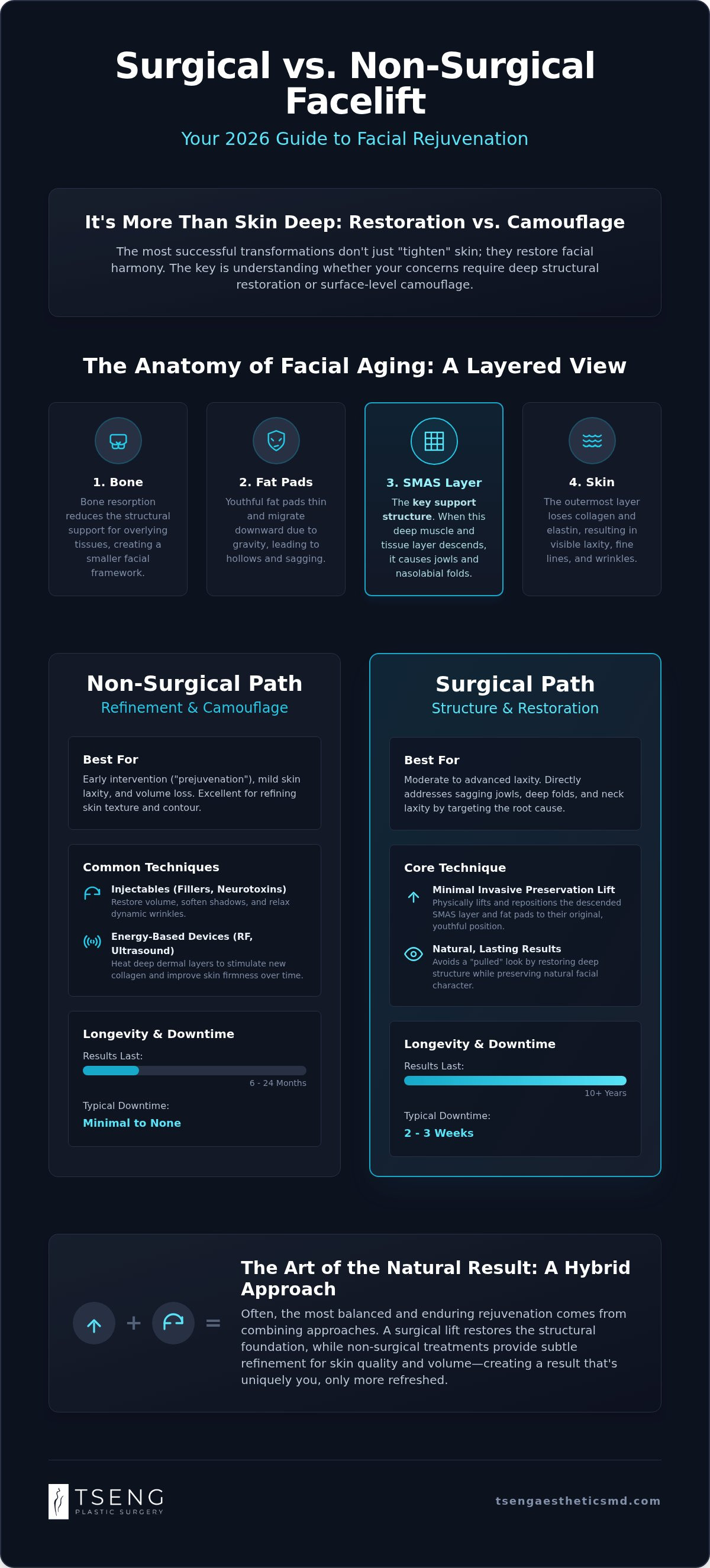
Time affects the face in a predictable, layered sequence. First, we experience subtle bone resorption, which reduces the structural support for the tissues above. Next, the facial fat pads, which provide youthful fullness, begin to thin and migrate downward due to gravity. Finally, the skin loses its elastic fibers, resulting in visible laxity and fine lines. Surface-level treatments like chemical peels or light lasers can improve texture, but they cannot fix the deep-tissue sagging caused by these shifting foundations.
The key to a truly lasting and natural result lies in the SMAS (Superficial Musculoaponeurotic System). The SMAS is a sophisticated layer of connective tissue and muscle that acts as the primary support structure for the midface and neck. When this layer descends, it creates the jowls and nasolabial folds that many patients find frustrating. Because non-invasive tools rarely reach this depth with significant force, they often fall short for patients with moderate to advanced laxity.
Restoration vs. Camouflage
We often categorize treatments as either restoration or camouflage. Non-surgical options, such as injectables, provide "camouflage" by filling in hollows or softening shadows. They're excellent for early intervention or "prejuvenation." However, relying solely on fillers to lift heavy tissues can lead to an overfilled, unnatural appearance. True restoration involves a surgical facelift (rhytidectomy), which physically moves the descended SMAS and fat pads back to their original, youthful positions.
Dr. Mark H. Tseng applies over 20 years of expertise to help patients distinguish between these needs. He views every face as a unique landscape where science and art must harmonize. For many, a minimal invasive preservation face and neck lift offers the ideal middle ground. This technique focuses on preserving the natural ligaments and tissues while restoring the structural foundation. This approach avoids the "pulled" look of traditional surgery, ensuring you look like a rested version of yourself rather than a different person entirely.
Roundup: Leading Non-Invasive Skin Tightening Procedures
For many patients, the journey of facial rejuvenation begins with non-invasive options. These treatments provide a sophisticated bridge between early prevention and definitive structural changes. When weighing the benefits of a surgical vs non-surgical facelift, it's vital to view non-surgical modalities as essential tools for maintenance and refinement. In 2020 alone, over 13 million minimally invasive cosmetic procedures were performed in the U.S., reflecting a massive shift toward "prejuvenation" and subtle enhancement.
Injectables and Dermal Volumizers
The "liquid facelift" remains a cornerstone of non-surgical care. This approach uses a curated combination of injectables to address volume loss and dynamic wrinkles. Dermal fillers are particularly effective at restoring the youthful contours of the cheeks and temples, providing an internal scaffold that gently lifts the skin. Neurotoxins complement this by smoothing the forehead and "lifting" the brow area through targeted muscle relaxation. A patient decision-making study highlights that immediate gratification and minimal downtime are primary drivers for these choices. However, the artistry lies in a conservative application. Dr. Tseng prioritizes a "less is more" philosophy, ensuring that your results look refreshed rather than overfilled.
Energy-Based Skin Tightening
While injectables handle volume, energy-based devices focus on skin quality and "snap-back." Technologies such as Radiofrequency (RF) and Ultrasound trigger the body’s natural healing response by heating the deeper layers of the dermis. This process stimulates new collagen and elastin production, which improves skin firmness over several months. Popular modalities like Morpheus8 or Sofwave are excellent for patients with mild laxity who aren't yet ready for the operating room. It's important to remember that these tools improve the skin's texture but don't move the underlying muscle. For a deeper look at when your needs might shift toward structural repair, The Modern Facelift: A Comprehensive Guide to Natural Facial Rejuvenation offers valuable insights.
The modern landscape also includes regenerative therapies like PRP (platelet-rich plasma) and biostimulatory fillers that promote long-term skin health. These aren't "one-and-done" solutions; they require a consistent maintenance schedule to preserve the glow. This ongoing commitment is a significant factor in the surgical vs non-surgical facelift comparison. If you're interested in a plan that evolves with you, exploring our non-surgical facelift options is a wonderful place to start your aesthetic journey.
The Surgical Standard: Structural Shifts and Longevity
While non-surgical options offer excellent maintenance, surgery remains the gold standard for correcting significant tissue descent and deep structural aging. When evaluating a surgical vs non-surgical facelift, it's essential to understand that surgery addresses the root cause of aging by physically repositioning the underlying anatomy. Dr. Mark H. Tseng leverages over 20 years of expertise to provide results that aren't just tighter, but fundamentally restored. This approach ensures that the transformation feels authentic to your unique features rather than looking like a mask.
Deep Plane and SMAS Techniques
Modern surgery has moved far beyond the "skin-only" lifts of previous decades. By accessing the SMAS (Superficial Musculoaponeurotic System), a surgeon can lift the underlying muscle and fat pads as a single unit. This creates a balanced, harmonious look that avoids the tell-tale "pulled" appearance of the past. When comparing facelift options, longevity is a primary differentiator; surgical results typically last between 10 and 15 years. Because the tension is placed on the deep muscle layer rather than the skin, the resulting incisions heal under minimal stress. Deep-tissue restoration allows for nearly imperceptible scars because the skin is simply draped over a newly secured foundation rather than being used to hold the weight of the face.
The Minimal Invasive Preservation Edge
For many patients, the "Minimal invasive preservation face and neck lift" represents the next evolution in facial rejuvenation. This technique adheres to a preservation philosophy, which focuses on maintaining the natural retaining ligaments while carefully repositioning the deep tissues. It's a sophisticated bridge for those who desire the permanence of surgery but want to minimize the physical trauma associated with traditional methods. Smaller incisions and the careful handling of tissues naturally lead to a more comfortable postoperative period. Understanding the nuances of Facelift Recovery is vital, as this preservation approach often allows patients to return to their social lives with a refined, natural glow much sooner than expected.
This artist-scientist approach ensures that every procedure is tailored to the individual. We don't believe in a one-size-fits-all solution; instead, we focus on the harmony between professional expertise and your personal vision. By choosing a path that respects your natural anatomy, you can achieve a refreshed appearance that looks like a younger version of yourself, free from the fear of an over-tightened or "wind-swept" result.
Surgical vs. Non-Surgical: A Framework for Comparison
Choosing between a surgical vs non-surgical facelift requires an honest assessment of your biological age, tissue laxity, and lifestyle commitments. It's about identifying the point where maintenance no longer provides a meaningful return on your investment. To help you determine your ideal path, consider this general framework for decision-making:
- Early Rejuvenation (Ages 30-45): Focus on non-surgical maintenance. Mild laxity and fine lines respond best to injectables and energy-based collagen induction to delay future aging.
- Moderate Aging (Ages 45-55): This is the "bridge" phase. You may still see results from non-invasive tools, but a minimal invasive preservation lift becomes a viable option for long-term structural correction.
- Advanced Restoration (Ages 55+): Surgical intervention is typically necessary to address significant jowling and neck laxity. Non-surgical tools shift to a supportive role to maintain skin texture and glow.
Downtime and Recovery Expectations
Non-surgical treatments are often celebrated for their "lunchtime" convenience. You can typically return to work or social activities immediately with only minor, temporary swelling. Surgical options, however, involve what we call "social downtime." While you aren't confined to bed, you'll likely want 10 to 14 days away from the public eye. This period allows the initial bruising to fade and the internal tissues to settle into their new, harmonious positions. Many patients find value in maximizing this recovery window by addressing other areas of concern simultaneously. For example, combining facial surgery with Arm Liposuction can help create a more youthful, balanced silhouette across the entire body.
Longevity and Value Over Time
The primary objection to surgery is often the upfront cost compared to the accessible price of a single filler session. However, when you analyze the investment over a decade, the perspective often shifts. Relying solely on injectables to "lift" sagging skin can eventually lead to "filler fatigue." This occurs when the skin becomes over-stretched by excessive product, resulting in a heavy or unnatural appearance. A surgical facelift provides a structural reset that typically lasts 10 to 15 years. It eliminates the need for aggressive filling and allows your skin to age more gracefully on a stable foundation. Investing in a surgical outcome is a commitment to your long-term confidence and a more sustainable aesthetic journey.
If you're ready to discover which approach aligns with your vision, we invite you to explore our comprehensive facial rejuvenation services to begin your personalized transformation.
The Art of the Natural Result: Your Aesthetic Journey
The debate regarding a surgical vs non-surgical facelift often presents these options as mutually exclusive paths. In reality, the most sophisticated aesthetic outcomes usually emerge from a hybrid approach that respects the strengths of both modalities. While surgery provides the necessary structural reset, non-surgical treatments act as the finishing touches that maintain skin vitality and prolong your investment. This harmony between science and art ensures that you don't just look younger, but that your skin reflects a healthy, vibrant quality of life. For those seeking to support their aesthetic results with internal health, the services at Feel Your Best Self offer a complementary naturopathic perspective.
A successful minimal invasive preservation face and neck lift creates a stable foundation, but it doesn't stop the biological clock entirely. To extend the life of your surgical result, we often integrate a maintenance plan featuring neurotoxins to prevent new dynamic lines and medical-grade skincare to support dermal thickness. This longitudinal care is a core part of the patient experience. The process begins with an unhurried, methodical consultation with Dr. Mark H. Tseng. His approach is characterized by a patient-centric focus, where listening to your personal vision takes precedence over simply recommending a procedure. It's during these quiet, professional conversations that the most effective and personalized strategies are born.
Choosing Your Path
Deciding on your next step is an empowering moment of self-care. It's helpful to approach the decision with a clear checklist of your goals and lifestyle needs. Ask yourself these questions before moving forward:
- Are you looking for a permanent structural reset or a temporary surface refinement?
- Does your current schedule allow for a 10 to 14 day window of social downtime?
- Are you seeking to correct deep tissue descent or primarily address volume loss?
- What is your five-year vision for your aesthetic maintenance?
Our practice remains dedicated to the highest standards of safety and elite training, positioning us as a compassionate guide for your transformation. With over 20 years of experience, Dr. Tseng views the surgical vs non-surgical facelift choice as a collaborative decision between surgeon and patient. Whether you choose the definitive results of a minimal invasive preservation face and neck lift or the subtle enhancements of injectables, the goal remains the same: a refreshed, authentic version of yourself that radiates quiet confidence.
Embarking on Your Personal Transformation
The choice between a surgical vs non-surgical facelift is a significant milestone in your self-care journey. It represents a commitment to aligning your outward appearance with your inner vitality. We've explored how non-invasive tools provide essential maintenance while surgical interventions, particularly the minimal invasive preservation face and neck lift, offer a definitive structural reset. Success lies in the harmony between clinical precision and your unique aesthetic vision. By understanding the layered nature of aging, you can move beyond temporary camouflage toward lasting restoration.
Dr. Mark H. Tseng brings over 20 years of aesthetic excellence to every patient interaction. As a board-certified clinical authority and a specialist in preservation facelift techniques, he ensures your results are a refined reflection of your natural character. Whether you choose the subtle glow of injectables or the enduring elegance of a surgical lift, you deserve a path that prioritizes your safety and long-term confidence.
Your journey toward a refreshed and authentic self is filled with possibility. We're honored to guide you through every step of that transformation.
Frequently Asked Questions
What is the main difference between a surgical and non-surgical facelift?
The primary distinction lies in the depth of intervention: surgical procedures reposition the structural SMAS layer, while non-surgical options focus on surface refinement and volume restoration. A surgical vs non-surgical facelift comparison highlights that only surgery can physically lift descended tissues. Non-invasive treatments like injectables or energy devices primarily camouflage hollows or improve skin texture. While non-surgical paths offer convenience, they don't provide the foundational restoration achieved through a minimal invasive preservation face and neck lift.
How long do the results of a non-surgical facelift typically last?
Non-surgical results vary by modality, typically lasting from several months to a few years. Neuromodulators generally require maintenance every three to four months, while dermal fillers may last between six and eighteen months depending on the product used. Energy-based treatments like Morpheus8 or Sofwave stimulate collagen that matures over six months, providing a refreshed look for about a year. These are maintenance-focused solutions that require a consistent schedule to preserve your aesthetic harmony.
Is a non-surgical facelift effective for significant sagging or jowls?
Non-surgical options have limitations when addressing advanced skin laxity or heavy jowls. While fillers can temporarily mask mild sagging by adding volume, they cannot physically lift heavy, descended tissue. Attempting to fix significant laxity with non-invasive tools often leads to an overfilled, unnatural appearance. For patients with moderate to severe sagging, a minimal invasive preservation face and neck lift is the most effective way to restore a crisp, youthful jawline and neck profile.
At what age should I consider a surgical facelift over non-invasive options?
There isn't a single correct age, as the decision depends on your unique anatomy and the degree of tissue descent. It's common for patients to consider a surgical vs non-surgical facelift in their late 40s or early 50s when non-invasive tools no longer provide a meaningful lift. However, younger patients with hereditary laxity may benefit from early intervention. Dr. Tseng focuses on your structural needs rather than a chronological number to ensure the most natural rejuvenation.
What is the typical recovery time for a minimal invasive preservation facelift?
Most patients return to their social lives within 10 to 14 days following a minimal invasive preservation face and neck lift. This technique's focus on maintaining natural ligaments and careful tissue handling often results in less swelling and bruising than traditional methods. While you'll feel comfortable moving around within a few days, you should plan for two weeks of social downtime to allow the initial healing process to settle into a refined, refreshed glow.
Can a non-surgical facelift be combined with surgical procedures later on?
Yes, non-surgical treatments can absolutely be combined with or followed by surgical procedures. Many patients use injectables for years as part of a prejuvenation strategy before transitioning to a surgical lift. Once you've had a preservation facelift, non-invasive tools like lasers or light fillers become excellent maintenance options to prolong your results. This hybrid approach ensures your skin quality remains vibrant while your facial structure stays fundamentally restored and youthful.
Is a non-surgical facelift safer than a surgical one?
Both paths are safe when performed by a board-certified clinical authority like Dr. Tseng. Non-surgical treatments carry lower immediate risks since they don't require general anesthesia or incisions. However, surgery is a controlled, precise environment led by a surgeon with over 20 years of experience. We prioritize a patient-first mentality, ensuring every procedure adheres to the highest safety standards. Your personal medical history and goals will dictate which path is the safest and most effective for you.
How do I know if I am a better candidate for surgery or injectables?
You're likely a better candidate for surgery if you have visible jowling, significant neck laxity, or filler fatigue from previous non-invasive attempts. Injectables are ideal for those seeking to soften fine lines or restore minor volume loss in the cheeks and temples. The best way to determine your path is through a methodical, unhurried consultation. We'll examine your skin elasticity and bone structure to create a plan that aligns with your lifestyle and self-vision.

