The Modern Facelift: A 2026 Guide to Natural Facial Rejuvenation
By Tseng Plastic Surgery
What if the most successful cosmetic surgery is the one that nobody actually notices? For many considering a facelift, the primary hesitation isn't the procedure itself but the fear of losing the unique character of their own face. You likely worry about looking over-tightened or "fake," and the technical jargon surrounding SMAS versus Deep Plane techniques only adds to the confusion. It's completely natural to feel anxious about surgical downtime or the visibility of scars when your goal is simply to look like a rested, vibrant version of yourself.
This guide clarifies the evolution of facial rejuvenation in 2026, showing how artistic precision now prioritizes the restoration of deep tissue rather than the stretching of skin. You'll discover how modern surgical mastery can redefine your jawline and neck for results that last over a decade. We'll explore the sophisticated preservation methods that minimize recovery time while ensuring your appearance remains harmoniously balanced and entirely your own. By the end of this article, you'll understand how science and artistry converge to create a refreshed look that feels as authentic as it looks.
Key Takeaways
- Learn why modern rejuvenation focuses on structural repositioning of deep tissues rather than stretching the skin to avoid an artificial appearance.
- Understand the technical nuances between SMAS and Deep Plane techniques to determine which facelift approach best aligns with your unique anatomy.
- Discover the practical limits of non-surgical treatments and when surgical intervention becomes the superior choice for restoring structural integrity.
- Gain insights into the recovery timeline and pre-operative optimization strategies that support a smooth and comfortable healing process.
- Learn how to evaluate a surgeon’s portfolio to ensure their aesthetic philosophy matches your desire for a refined, balanced outcome.
What is a Modern Facelift? Redefining Facial Rejuvenation in 2026
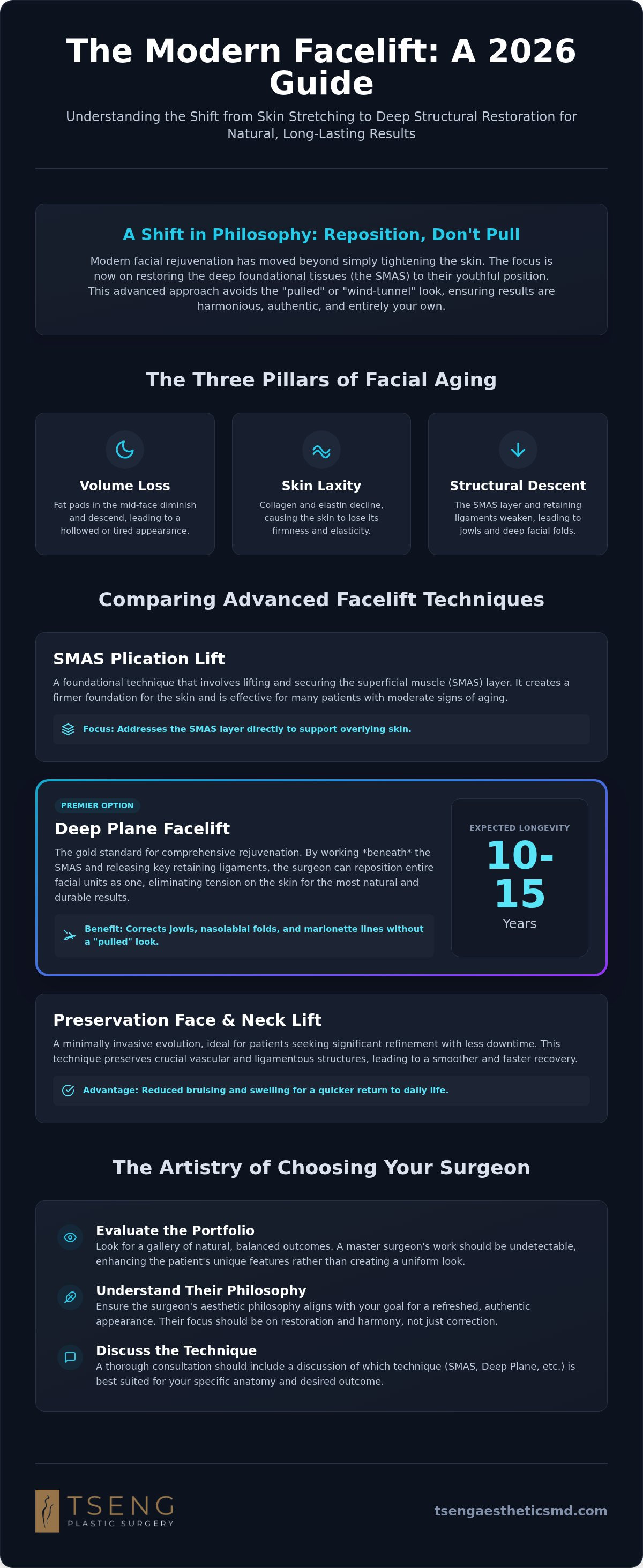
The era of the "wind tunnel" look has long passed, replaced by a surgical philosophy that honors the unique architecture of the individual face. In 2026, a successful outcome is measured by what observers cannot see. It's about closing the gap between the vibrant energy you feel internally and the reflection you see in the mirror. This shift from "pulled" to "repositioned" ensures that expressions remain fluid and natural. Aging is a multifaceted process involving the three pillars of volume loss, skin laxity, and structural descent. Addressing just one while ignoring the others often leads to the "operated on" look that patients rightfully fear when considering a facelift. Modern surgery creates harmony by treating these layers as an integrated system.
The Anatomy of Facial Aging
Underneath the skin lies a critical layer known as the SMAS (Superficial Musculoaponeurotic System). This fibrous network acts as the foundation for your facial features. Over decades, the SMAS loses its resilience, and the retaining ligaments that once held tissues firmly in place begin to slacken. When these ligaments fail, the fat pads of the midface descend, creating jowls and deepening the folds around the mouth. Skin-only lifts fail because they attempt to support the weight of these deep structures using only the surface layer. This leads to widened scars and a distorted appearance. High-end rejuvenation requires a master craftsman to navigate these deep layers, releasing the tension on the skin and placing it back on the stronger, underlying tissues.
Facelift vs. Face Lift: Understanding the Terminology
Terminology in aesthetic medicine can be confusing, especially when the name is used as a catch-all term. When researching What is a Facelift, many patients are surprised to learn the procedure primarily targets the lower two-thirds of the face, specifically the cheeks, jawline, and neck. It isn't a procedure for the forehead or the eyes, though it's often paired with those treatments for a total refreshed look. By integrating the neck into the procedure, surgeons can restore a crisp, defined profile that looks elegant from every angle. It's a precise, personalized journey that prioritizes your unique anatomy over a one-size-fits-all template. A facelift is fundamentally a structural repositioning of the underlying anatomy rather than a surface-level tightening of the skin.
Comparing Advanced Techniques: SMAS, Deep Plane, and Preservation Lifts
Selecting the optimal surgical method is a delicate balance of clinical science and individual aesthetic goals. While the previous section explored the general anatomy of aging, the specific technique used during your facelift determines both the longevity of the result and the ease of your recovery. Your unique bone structure, skin quality, and degree of tissue descent dictate whether a traditional SMAS approach or a more advanced Deep Plane method is appropriate. Understanding these facelift procedure steps allows you to enter your consultation with confidence and clarity.
The SMAS plication has served as a cornerstone of facial surgery for decades. It involves lifting and securing the superficial muscle layer to create a firmer foundation for the skin. While effective for many, it sometimes lacks the comprehensive mid-face rejuvenation that modern patients demand. This is where more advanced, deep-tissue techniques offer a distinct advantage in achieving a balanced, harmonious profile.
The Deep Plane Advantage
The Deep Plane Facelift is widely regarded as the premier option for addressing the mid-face and jawline. By working beneath the SMAS layer and releasing the key retaining ligaments, the surgeon can reposition entire facial units without creating tension on the skin. This lack of tension is what prevents the "pulled" look, allowing for a soft, natural restoration of the nasolabial folds and marionette lines. You might wonder, how long does a deep plane facelift last? Because it addresses the deep structural layers rather than just the surface, results often remain elegant for ten to fifteen years.
Preservation Techniques: The Future of Surgery
For patients seeking a refined intervention with significantly less downtime, the Minimal Invasive Preservation Face and Neck Lift is a transformative option. This technique focuses on maintaining the integrity of the blood supply and lymphatic vessels, which are often disrupted in more aggressive surgeries. By preserving these natural pathways, swelling is minimized and the healing process is accelerated. The ideal candidate for a preservation-style lift is typically in their 40s or early 50s, showing early signs of jowling but retaining good skin elasticity. This patient-first approach prioritizes a gentle touch, ensuring that the transition to a refreshed appearance is as seamless as possible. Exploring these options during a personalized consultation helps ensure your surgical plan reflects your specific vision of beauty.
Surgical vs. Non-Surgical Facelifts: Managing Expectations
The popularity of non-invasive aesthetics has never been higher, with neurotoxins and fillers accounting for approximately 80% of all aesthetic procedures performed in 2026. While these tools are excellent for addressing fine lines and subtle volume loss, they eventually reach a point of diminishing returns. Many patients fall into the trap of "filler fatigue," where excessive amounts of product are used to compensate for sagging skin. This often leads to a heavy, over-volumized appearance that obscures the natural bone structure rather than refining it. A well-timed facelift is frequently more cost-effective over a decade than the continuous cycle of high-volume injectables that fail to address structural descent.
Energy-based treatments, such as radiofrequency or ultrasound skin tightening, serve a vital role in maintaining skin quality and collagen production. However, these technologies focus on the surface and dermis; they cannot reposition the deep muscle layers or release the retaining ligaments discussed in previous sections. True rejuvenation requires the steady hand of an artist-scientist who understands that while heat can tighten, only surgery can truly restore facial harmony by moving tissues back to their youthful positions.
When is it Time for Surgery?
Determining the right moment to transition from the injector's chair to the surgical suite involves looking for specific clinical signs. If you find yourself using your fingers to pull your skin upward and backward to achieve the look you want, you've likely surpassed what non-surgical options can provide. You can perform a simple "pinch test" at home: if you can easily grasp and pull away more than an inch of skin along the jawline or neck, the laxity has reached a surgical stage. For a deeper dive into these differences, explore our Surgical vs. Non-Surgical Facelift: The Comprehensive 2026 Guide. When the return on investment for fillers begins to decline, surgery offers a definitive, long-lasting solution.
The Role of Injectables Post-Surgery
A surgical foundation doesn't make non-surgical treatments obsolete; instead, it makes them more effective. After a surgical procedure, injectables act as the finishing touches on a masterwork. Neurotoxins can be used with greater precision to maintain a serene brow position, while small amounts of filler can fine-tune surface-level nuances. Many modern procedures also incorporate fat grafting, which uses your own biological tissue to restore the soft, youthful glow that surgery alone cannot replicate. This integrated approach ensures that the physical transformation is supported by healthy, vibrant skin, allowing you to age with grace and quiet confidence.
The Facelift Journey: Preparation, Procedure, and Recovery Timeline
A successful facelift begins long before you arrive at the surgical suite. It's a biological process as much as a logistical one, requiring a commitment to optimizing your nutritional intake and adjusting lifestyle habits to ensure your body is primed for efficient tissue repair. On the day of your procedure, you'll be welcomed into a sophisticated clinical environment designed for your total comfort and safety. Modern anesthesia techniques allow for a serene experience, ensuring you remain resting and pain-free while your surgeon applies master-level precision to your transformation. This methodical approach prioritizes your well-being from the moment you enter the practice.
The first 48 hours post-surgery are the most critical for managing swelling and ensuring a smooth recovery. You'll likely feel a sense of tightness rather than sharp pain, as the repositioned tissues begin to integrate into their new foundation. Having a supportive environment and following a personalized post-operative plan are essential for minimizing inflammation during this window. This early investment in rest pays significant dividends in the clarity and refinement of your final result, allowing the healing process to proceed without unnecessary stress on the delicate tissues.
Week-by-Week Recovery Roadmap
Healing is a gradual progression that rewards patience with elegance. During the first week, your focus is on managing sutures and the initial stages of bruising, which typically begin to fade quickly. By the second week, most patients find they are "socially presentable" and can return to light activities or restaurant dining with confidence. Between one and three months, any residual firmness resolves, and the final contours of your rejuvenation become clear. For a deeper look at this process, read our Facelift Recovery: A Comprehensive Guide to Healing to understand every nuance of the journey.
Scar Management and Longevity
Artistic incision placement is what separates a premier procedure from a standard one. Incisions are meticulously hidden within the natural contours of the ear and along the hairline, ensuring that even with your hair pulled back, the signs of surgery remain your secret. While a facelift can turn back the clock by a decade or more, lifestyle choices like hydration and consistent skin care determine the longevity of your results. Advanced scar therapies and strict sun protection are vital during the first year to ensure scars mature into nearly invisible lines. If you're ready to take the first step toward a more refreshed version of yourself, contact us today for a private consultation.
The Artistry of Facial Harmony: Choosing the Right Surgeon
Selecting the right surgeon is arguably the most critical decision in your rejuvenation journey. While board certification serves as a mandatory baseline of safety and training, it isn't the finish line for excellence. You're seeking a specialist who views the facelift not just as a medical procedure, but as a masterwork of restoration. This level of expertise is found in a surgeon who has dedicated decades to the subtle complexities of the face. When you evaluate "Before and After" galleries, look beyond the immediate change. Search for a consistent thread of naturalness and facial harmony across a diverse range of patients. You want to see evidence that the surgeon respects the unique character of each individual rather than applying a repetitive, cookie-cutter technique.
A truly successful outcome relies on a surgeon who balances clinical authority with a genuine, patient-centric focus. The consultation shouldn't feel like a sales pitch; it should be an unhurried educational exchange. It's during this time that you can gauge if the surgeon truly listens to your anxieties about looking "fake" or over-tightened. This dialogue is where the plan for your specific anatomy begins to take shape, blending your personal vision with the surgeon's professional expertise. A master craftsman understands that the goal isn't to change who you are, but to reveal the most vibrant version of yourself.
The Surgeon as Artist-Scientist
A premier surgeon operates at the intersection of biology and beauty, using an understanding of facial proportions and the "Golden Ratio" to guide every incision and repositioning. By focusing on conservative, precise adjustments to the deep tissues, they can restore the structural integrity that has been lost to time. This scientific approach ensures longevity, while the artistic touch ensures the results look soft and fluid in motion. The best surgery is the one that remains a secret to everyone but the patient. It's this commitment to subtlety that allows you to step back into your life feeling refreshed and empowered without the need for explanation.
Personalized Care at Tseng Plastic Surgery
At our practice, we believe that high-end care is rooted in a legacy of experience and a dedication to the individual. With over 20 years of surgical expertise, Dr. Tseng prioritizes a methodical and thorough approach to patient education, ensuring you feel informed and stable throughout the process. We take great care to tailor every facelift to respect and enhance your unique ethnic and gender-specific features. This personalized touch ensures that the harmony of your face is preserved, resulting in a look that is as authentic as it is youthful. If you're ready to partner with a compassionate guide on your path to rejuvenation, schedule your personalized consultation with Dr. Tseng today.
Embrace Your Most Vibrant Reflection
A journey toward facial rejuvenation is deeply personal, and the modern facelift has evolved to honor that individuality. By shifting the focus from surface-level tightening to the sophisticated repositioning of deep tissues, today’s techniques offer a path to looking rested rather than "operated on." You've learned that the longevity of your results depends on the precision of the surgical approach and the unique artistry of your chosen surgeon. True harmony is achieved when clinical expertise meets a gentle, personalized touch, ensuring your results remain your own secret while reflecting the energy you feel within.
With over 20 years of specialized surgical experience, Dr. Tseng provides board-certified expertise dedicated to achieving natural, balanced outcomes. We prioritize your comfort and vision at every stage, from the initial unhurried consultation through the entire healing process. If you're ready to take the next step toward a more youthful and confident profile, we’re here to guide you with quiet confidence and integrity.
Refine your profile and restore your confidence; consult with Tseng Plastic Surgery today.
You deserve to feel as vibrant as you look, and the possibility of a refreshed, balanced appearance is closer than you think.
Frequently Asked Questions
What is the best age to get a facelift?
The ideal time for a facelift depends more on your unique facial anatomy and tissue laxity than a specific birthday. Most patients seek this procedure between their late 40s and mid-60s when structural descent becomes more prominent. Younger patients often opt for minimal invasive preservation techniques to maintain their appearance early on. The goal is to intervene when you still have good skin elasticity to support the underlying structural repositioning.
How long does a facelift typically last?
A modern facelift typically provides refined results that last between 10 and 15 years. While the natural aging process continues, you'll always look younger than you would've without the surgery. Techniques like the deep plane lift offer greater longevity because they secure the heavier muscle layers rather than relying on the skin. Maintaining a stable weight and following a disciplined skin care regimen further extends the lifespan of your rejuvenation.
What is the difference between a mini facelift and a full facelift?
A mini facelift primarily targets early jowling and the jawline through shorter incisions and less extensive tissue dissection. It's a focused approach for those with moderate aging signs. A full or traditional procedure comprehensively addresses the mid-face, lower face, and the neck integrated into a single surgical plan. Your surgeon will recommend the technique that best restores your natural facial harmony based on the degree of volume loss and skin laxity.
Will a facelift address my forehead wrinkles and eyelids?
A standard facelift doesn't address the forehead, brow, or eyelids. It's specifically designed to rejuvenate the lower two-thirds of the face, including the cheeks, jawline, and neck. If you're concerned about heavy brows or tired-looking eyes, these areas require separate procedures like a brow lift or blepharoplasty. Many patients choose to combine these surgeries with their facial lift to achieve a total, balanced rejuvenation across the entire face.
How much does a facelift cost in 2026?
The total investment for a facelift in 2026 varies significantly based on the complexity of the technique and the surgical facility used. Total costs generally encompass the surgeon's professional fee, anesthesia, and operating room expenses. While industry averages provide a broad range, your specific anatomical needs and aesthetic goals will determine the final amount. A personalized consultation is essential to receive a comprehensive quote that reflects the master-craftsmanship and individualized care provided during your journey.
Are the scars from a facelift visible?
Incisions are meticulously placed within the natural contours of the ear and along the hairline to ensure they remain virtually invisible. As an artist-scientist, the surgeon uses advanced suturing techniques to minimize tension on the skin, which is the primary cause of widened scars. Most scars mature into fine, pale lines that are easily hidden by your hair or the natural shadows of your face. Following all post-operative scar management instructions ensures the most discreet result.
Can I have a facelift if I've had fillers or threads before?
You can certainly undergo surgery if you've had fillers or thread lifts in the past. It's vital to disclose these treatments during your consultation, as threads can create internal scar tissue that your surgeon must navigate. Fillers may also mask the true degree of skin laxity, so some patients are advised to let them dissolve before surgery. This transparency allows for a more precise surgical plan that accounts for your previous aesthetic history.
What are the primary risks associated with facelift surgery?
Primary risks associated with this surgery include hematoma, infection, and temporary numbness around the incision sites. While rare, more significant complications like nerve injury or skin healing issues can occur, particularly in patients who smoke. Choosing a surgeon with over 20 years of experience and a dedicated focus on safety significantly mitigates these concerns. A thorough pre-operative screening process ensures that you're a healthy candidate for the procedure and helps optimize your recovery.

