How to Get Rid of Jowls: Jawline Rejuvenation Guide 2026
By Tseng Plastic Surgery
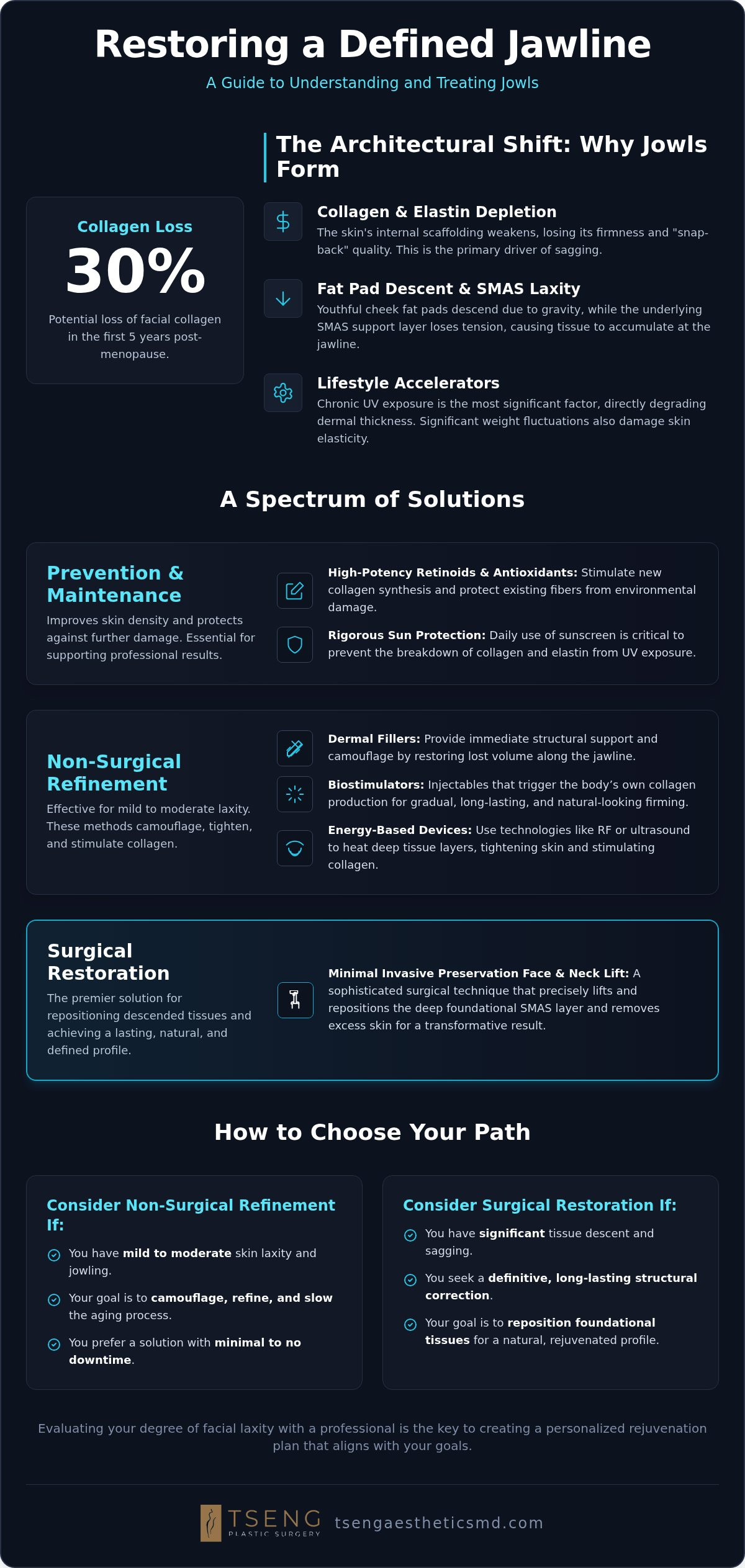
Did you know that postmenopausal women can experience a 30% loss of facial collagen in just the first five years? This rapid structural decline often manifests as a softening of the lower face, leaving many individuals searching for how to get rid of jowls while maintaining their natural character. It's a common frustration to feel that your reflection looks more tired or aged than you feel inside, especially when the jawline loses the crisp definition of youth.
We understand that the path to rejuvenation can feel overwhelming. You've likely encountered a confusing landscape of quick fixes and conflicting advice, ranging from topical serums to complex surgical procedures. It's natural to desire a result that looks refreshed rather than "done," prioritizing harmony and balance over drastic changes.
This guide serves as your professional roadmap, revealing the most effective surgical and non-surgical pathways to restore a defined jawline through advanced aesthetic science. You'll discover how to evaluate your options with confidence and clarity.
We will examine the latest innovations in biostimulators and injectables, alongside the sophisticated artistry of the minimal invasive preservation face and neck lift. By the end of this article, you'll understand the structural causes of jowling and the personalized treatments available to help you reclaim a refined, elegant profile.
Key Takeaways
- Understand the structural causes of jowling, ranging from the natural depletion of collagen and elastin to the architectural descent of facial fat pads.
- Discover the most effective professional strategies for how to get rid of jowls, including the use of dermal fillers for camouflage and energy-based devices for skin tightening.
- Learn why the minimal invasive preservation face and neck lift is considered a premier solution for repositioning tissues while maintaining a natural, balanced appearance.
- Identify how to assess your specific degree of facial laxity to determine whether non-surgical refinement or surgical restoration best aligns with your personal goals.
- Clarify the essential role of high-potency retinoids and antioxidants in maintaining skin density and protecting the longevity of your aesthetic results.
Understanding the Anatomy of Jowls: Why the Jawline Blurs
To truly understand how to get rid of jowls, one must first look beneath the surface at the complex architectural changes occurring within the face. Jowls are defined as the sagging skin and displaced fat that descend below the mandibular border, effectively blurring the once-sharp transition between the face and neck. This isn't merely a topical concern; it's the result of a multi-layered structural shift involving skin, fat, and the underlying foundational tissues.
The primary drivers of this change are the gradual depletion of collagen and elastin. These essential proteins provide the skin with its resilience and "snap-back" quality. As their production slows, the skin loses its internal scaffolding. For many, this process accelerates during certain life stages; research indicates that postmenopausal women can lose approximately 30% of their skin's collagen in the first five years alone. Without this support, the skin becomes more susceptible to the relentless pull of gravity.
Deep within the midface, the malar fat pad, which provides the youthful fullness of the cheeks, begins its slow descent toward the jawline. This movement is compounded by changes in the Superficial Musculoaponeurotic System (SMAS). The SMAS is a sophisticated layer of fibrous tissue and muscle that acts as the face's primary support structure. When the SMAS loses its tension, the overlying fat and skin follow, accumulating at the jawline to form jowls. Understanding this layer is critical when evaluating Surgical Solutions for Jowls, as lasting results often require the precise repositioning of this deep foundation.
The Role of Facial Ligaments and Gravity
Retaining ligaments act as the face's suspension system, anchoring the soft tissues to the underlying bone. Over time, these ligaments stretch and weaken, allowing the facial compartments to shift downward. This loss of support is often exacerbated by bone resorption in the jaw, where the mandible actually loses volume and height. As the bony frame shrinks, the overlying soft tissue has less surface area to cling to, leading to a surplus of skin. A "mandibular notched" appearance is a clinical sign of jowling that occurs when the tissue sags around the fixed points of the facial ligaments.
Lifestyle Factors That Accelerate Jowl Formation
While genetics play a significant role, external factors often dictate the speed of these changes. Chronic UV exposure is perhaps the most significant contributor, as it directly degrades dermal thickness and destroys the elastic fibers that keep the jawline taut. Significant weight fluctuations also take a toll; the repeated stretching and shrinking of the skin can permanently damage its elasticity. While many people worry about "Tech Neck" from looking at devices, the reality is that poor posture creates repetitive skin tension that may exacerbate the appearance of laxity, though it isn't the primary cause of structural jowling. Knowing how to get rid of jowls effectively requires a plan that addresses both these lifestyle impacts and the deep structural shifts already in motion.
At-Home and Lifestyle Strategies: Prevention and Maintenance
Managing expectations is the first step in any successful aesthetic journey. While many over-the-counter products claim to lift the face, it's vital to recognize that topical treatments primarily improve skin texture and density rather than repositioning deep, descended tissues. Lifestyle changes are significantly more effective for prevention than for the correction of established jowls. Once the structural ligaments have stretched and the malar fat pad has shifted, at-home remedies cannot mechanically reverse these internal changes. They do, however, provide the skin with the resilience needed to support professional interventions later on.
High-potency retinoids and antioxidants are the cornerstones of maintaining skin density. Retinoids stimulate the synthesis of new collagen, while potent antioxidants like Vitamin C protect existing fibers from oxidative stress and environmental damage. When combined with rigorous, daily sun protection, these ingredients help preserve the dermal thickness required to keep the jawline defined. Understanding the causes and treatments for jowls helps patients realize that while medical-grade skincare supports the skin's surface, it doesn't address the underlying SMAS layer. Maintaining this surface integrity is essential, but it remains a separate concern from the structural restoration of the lower face.
The Reality of Facial Exercises and Massage
Many patients ask about "face yoga" or facial exercises as a natural method for how to get rid of jowls. Clinical data supporting these techniques for structural lifting remains scarce. In fact, repetitive and excessive facial movements can actually contribute to the formation of dynamic wrinkles around the mouth and eyes. Lymphatic drainage massage and gua sha may offer a temporary solution for facial puffiness or fluid retention, giving the illusion of a sharper jawline for a few hours. However, these methods lack the mechanical force required to reverse true skin sagging or tissue descent. They are relaxing rituals that improve circulation, but they aren't a substitute for clinical rejuvenation.
Nutrition and Supplements for Skin Health
Dietary choices provide the essential building blocks for facial integrity. Vitamin C and specific amino acids are vital precursors for natural collagen production, ensuring the body has the resources it needs to repair the dermal matrix. Regarding oral collagen peptides, 2026 research suggests some benefit for skin hydration and elasticity, though the body often prioritizes these nutrients for vital organs and joints first. Proper hydration also plays a subtle yet important role; well-hydrated skin maintains better turgor, which can soften the appearance of fine lines along the jaw. While these strategies form a strong foundation, they often work best as a complement to professional expertise. If you're noticing significant changes in your profile, a personalized consultation can clarify whether your needs are structural or superficial.
Non-Surgical Interventions: From Injectables to Energy Devices
For those exploring how to get rid of jowls without undergoing a full surgical procedure, the modern aesthetic landscape offers a diverse array of non-surgical interventions. These treatments generally fall into two categories: those that add volume to camouflage the jowl and those that use energy to tighten the existing skin. While surgical restoration remains the gold standard for significant tissue descent, these minimally invasive options provide excellent refinement for patients with mild to moderate laxity. Success in this area requires a nuanced understanding of facial balance, ensuring that we enhance the jawline without creating an over-volumized or "heavy" appearance.
Dermal Fillers: The Pros and Cons of Camouflage
One of the most common ways to address early jowling is through a technique known as camouflage. By strategically placing dermal fillers in the pre-jowl sulcus, the small dip that forms between the chin and the jowl, we can create the illusion of a straight, continuous jawline. This approach effectively masks the protrusion of the jowl by filling the surrounding hollows. However, this technique must be applied with extreme precision. There's a significant risk of adding too much "heaviness" to a lower face that's already sagging, which can lead to a distorted, unnatural look often referred to as "filler fatigue."
To avoid a "pillow face" effect, it's essential to view non-surgical facelift techniques as a method of subtle refinement rather than a way to lift heavy tissue. In addition to fillers, we often employ biostimulators like Sculptra or Radiesse. These injectables don't just provide immediate volume; they encourage the body to produce its own collagen over several months, resulting in a more natural thickening of the dermis that provides better structural support for the jawline.
Energy-Based Skin Tightening
Energy-based devices offer a different pathway by stimulating collagen deep within the skin's layers. Micro-focused ultrasound (HIFU), such as Ultherapy, and Radiofrequency (RF) treatments, like Morpheus8, deliver controlled heat to the foundational tissues. This thermal energy triggers a healing response that tightens the skin and improves its overall elasticity. These devices are ideal for patients who have good skin quality but are beginning to notice a loss of crispness along their profile.
It's important to maintain realistic expectations regarding the degree of lift achievable through energy alone. While these treatments can provide a visible "shrink-wrap" effect, they cannot reposition the deep SMAS layer or remove excess skin. We also frequently incorporate neurotoxins into these plans. A "Nefertiti Lift" uses Botox to relax the platysmal bands in the neck that pull downward on the jawline, allowing the upward-pulling muscles to reclaim their position and subtly sharpen the lower face. This multi-modality approach ensures that every layer of the aging process is addressed with care and artistic intent.
Surgical Solutions: Restoration Through Advanced Techniques
While non-surgical methods provide temporary camouflage, they cannot physically relocate the structural tissues that have migrated over time. For patients seeking a definitive answer on how to get rid of jowls, surgery remains the only pathway that addresses the deep anatomical descent of the SMAS and malar fat pads. A modern facelift represents the gold standard in lower facial rejuvenation; it provides a level of architectural restoration that energy devices and fillers simply cannot replicate. These procedures offer a sense of permanence and structural integrity that far exceeds the capabilities of repetitive injectable treatments.
The Preservation Lift: A Modern Approach
The Minimal invasive preservation face and neck lift is a sophisticated technique designed for those who desire significant improvement with a focus on a rapid return to daily life. Unlike traditional methods that may involve aggressive tissue excision, this approach emphasizes the preservation of natural facial ligaments and blood supply. This meticulous technique ensures a result that looks inherently "un-operated," maintaining the unique character of your face while restoring a crisp jawline. Most patients find that recovery from a minimal invasive preservation procedure is notably efficient, with many returning to social activities within 10 to 14 days. It's an ideal middle ground for patients who want the longevity of surgery without the extensive downtime of more traditional methods.
Deep Plane and SMAS Techniques
For advanced laxity, deep plane facelift surgery addresses the root cause of jowling by releasing and repositioning the entire SMAS layer as a single unit. This allows for a vertical lift that mimics the natural positioning of youthful tissue, avoiding the dated "wind tunnel" look associated with horizontal pulling. By working beneath the muscle layer, the surgeon can tension the foundation of the face rather than the skin itself, which results in a softer, more natural appearance. The longevity of results depends on the surgical plane addressed, as deep plane and preservation techniques offer structural stability that often lasts a decade or more.
With over 20 years of experience, Dr. Tseng applies these advanced methods to achieve a seamless harmony between clinical precision and aesthetic artistry. If you're ready to explore a permanent solution for your profile, schedule a consultation to discuss which surgical approach best aligns with your anatomy and personal vision.
Choosing Your Path: Creating a Personalized Rejuvenation Plan
Determining how to get rid of jowls effectively depends on a precise assessment of your current facial anatomy and the degree of tissue laxity present. Facial aging generally follows a predictable progression, though every individual's journey is unique. Mild laxity often manifests as a slight softening of the jawline, where the skin begins to lose its youthful "snap." Moderate cases involve visible sagging and the distinct formation of a pre-jowl sulcus. Advanced laxity features significant skin redundancy and heavy tissue descent that obscures the transition between the face and neck. Identifying where you sit on this spectrum is the first step in creating a roadmap that aligns with your expectations.
True rejuvenation requires an appreciation for facial balance. Jowls rarely exist in isolation; they're almost always accompanied by changes in the neck, such as platysmal banding or submental fullness. Treating the jawline while ignoring the neck can create an unnatural, unbalanced appearance. During a professional consultation, we evaluate the harmony between these regions to ensure a seamless, elegant transition. You'll also need to weigh your priorities regarding downtime versus longevity. While non-surgical options offer immediate results with zero recovery, they lack the structural permanence provided by a minimal invasive preservation face and neck lift.
Combining Modalities for Superior Results
The most sophisticated outcomes often arise from a blend of surgical precision and non-surgical maintenance. Surgery repositions the deep foundational layers, but it doesn't address the loss of subcutaneous fat that occurs with age. We frequently incorporate fat grafting alongside a surgical lift to restore youthful volume to the midface and temples. This dual approach addresses both the "drape" and the "volume" of the face. Once the structural work is complete, a dedicated post-operative skincare regimen is essential. High-potency antioxidants and retinoids protect your surgical investment, ensuring the skin remains thick and resilient for years to come.
Selecting the Right Surgeon for Your Journey
Your choice of surgeon is the most critical factor in achieving a result that feels both transformative and authentically yours. Board certification is a non-negotiable baseline, but specialized experience in facial rejuvenation is what ensures safety and refinement. During your consultation, ask specific questions about the surgeon's approach to jowl correction. Do they prioritize the deep SMAS layer, or do they rely on skin tension? A surgeon who functions as an artist-scientist will focus on harmony and subtle improvements rather than drastic, "operated" changes. This patient-first philosophy ensures that your personal vision remains the guiding force of the entire experience.
Reclaiming Your Refined Profile
Restoring a youthful jawline is a journey that blends the precision of modern science with the delicate touch of an artist. We've explored the structural complexities of aging, from collagen depletion to the descent of the SMAS layer, and compared the various pathways for correction. Understanding how to get rid of jowls effectively requires looking beyond the surface to address the deep facial architecture. Whether you choose the subtle refinement of biostimulators or the definitive restoration of a Minimal invasive preservation face and neck lift, the goal remains a result that feels naturally you.
Dr. Tseng brings over 20 years of specialized surgical experience to every patient, focusing on harmonious outcomes that respect your unique features. His expertise in minimal invasive preservation techniques ensures that your transformation is both elegant and lasting. We invite you to Schedule a personalized consultation to discuss your jawline rejuvenation goals. You're deserving of a reflection that matches your inner vitality; with the right guidance, a crisp, elegant profile is well within reach.
Frequently Asked Questions
Can you really get rid of jowls with facial yoga or exercises?
Facial yoga and exercises cannot structurally reposition the descended fat and skin that define jowls. While these movements might improve muscle tone slightly, they don't address the underlying laxity of the SMAS layer or the depletion of collagen. In some cases, repetitive facial straining can even worsen dynamic wrinkles around the mouth. For those looking at how to get rid of jowls, clinical interventions that target the deep facial architecture are necessary for visible results.
What is the best non-surgical treatment for sagging jowls in 2026?
The most effective non-surgical approach in 2026 involves a multi-modality strategy. Combining biostimulators like Sculptra with ultrasound-based energy devices provides a dual benefit of skin thickening and subtle tightening. Biostimulators encourage the body's own collagen production to restore dermal density, while energy treatments help "shrink-wrap" the existing tissue. For those researching how to get rid of jowls without surgery, this combination is ideal for patients with mild laxity who want a more defined jawline.
At what age should I consider a surgical lift for my jowls?
There is no specific chronological age for a surgical lift, as the decision depends entirely on your unique anatomy and the degree of tissue descent. Many patients begin to notice significant jowling in their late 40s or early 50s due to hormonal shifts and collagen loss. If non-surgical treatments no longer provide the desired crispness along the jawline, a surgical consultation can determine if you're ready for more definitive restoration through a preservation technique.
How long do the results of a preservation facelift last?
Results from a preservation facelift typically last a decade or longer, depending on your lifestyle and skin quality. Because this technique repositions the deep SMAS layer rather than just pulling the skin, it provides a stable foundation that resists the immediate effects of gravity. While the natural aging process continues, you'll always look younger than you would have without the procedure. Maintaining these results requires consistent sun protection and a medical-grade skincare regimen.
Will dermal fillers make my jowls look heavier or worse?
Dermal fillers can make jowls look heavier if they're used excessively or placed incorrectly. This often occurs when a practitioner tries to "lift" heavy tissue by simply adding more volume, leading to an over-filled or "pillow face" appearance. When applied conservatively, fillers can camouflage early jowling by smoothing the pre-jowl sulcus. However, for moderate to advanced sagging, adding more filler often compromises facial harmony and fails to address the structural root of the problem.
What is the recovery time for a minimal invasive preservation face and neck lift?
Most patients return to their normal social activities within 10 to 14 days following a Minimal invasive preservation face and neck lift. This specialized technique prioritizes the integrity of natural ligaments and blood supply, which significantly reduces post-operative swelling compared to traditional methods. While some subtle residual swelling may persist for a few weeks, the initial healing phase is remarkably efficient. This allows you to enjoy your refreshed results with minimal interruption to your lifestyle.
Are jowls hereditary, and can they be prevented entirely?
Genetics play a significant role in determining your bone structure and the rate at which your skin loses elasticity. If your parents developed prominent jowls, you may be more predisposed to similar changes. While you can't prevent jowls entirely, you can certainly delay their appearance through rigorous sun protection, a nutrient-dense diet, and avoiding significant weight fluctuations. Early use of medical-grade retinoids also helps maintain the dermal thickness necessary to support the lower face.
How do I know if I need a full facelift or just a mini lift for my jawline?
The choice between a full facelift and a mini lift depends on the extent of your skin laxity and whether the neck requires treatment. A mini lift primarily addresses mild sagging along the jawline, making it suitable for younger patients with localized concerns. If you have significant skin redundancy or visible banding in the neck, a more comprehensive approach is usually required. A personalized consultation is the only way to accurately assess your structural needs and ensure facial harmony.

