The Deep Plane Facelift: A Comprehensive Guide to Structural Rejuvenation
By Tseng Plastic Surgery
True facial rejuvenation isn't about stretching the skin tighter; it's about returning the underlying structure to where it once belonged. Many individuals worry about the "wind-swept" look of older surgical methods, yet they still feel the frustration of a softening jawline and deepening nasolabial folds. The deep plane facelift offers a sophisticated alternative that prioritizes harmony over tension. By focusing on the deeper layers of the face, this technique avoids the artificial tightness associated with traditional procedures, allowing for a result that feels both authentic and refined.
It's natural to want a reflection that matches your internal vitality, and you likely recognize that superficial fixes often fall short of providing a lasting change. This guide will show you how structural repositioning provides a refreshed, younger version of yourself with results that typically endure for 10 to 15 years. We will examine the surgical artistry behind the deep plane approach, the recovery journey, and how this personalized path can restore your self-confidence through subtle, meaningful transformation.
Key Takeaways
- Understand why the deep plane facelift is the gold standard for restoring mid-face volume and defining the jawline without artificial skin tension.
- Learn the technical difference between traditional SMAS methods and advanced ligament release to achieve a truly tension-free result.
- Discover how elevating deeper facial structures restores the youthful heart-shaped contour while avoiding the "wind-swept" appearance.
- Plan your recovery with a realistic timeline of when you'll feel socially presentable.
- Explore the philosophy behind a minimally invasive preservation face and neck lift, where surgical precision meets a commitment to your personalized aesthetic journey.
Understanding the Deep Plane Facelift: The Modern Gold Standard
The deep plane facelift represents the pinnacle of surgical refinement in facial aesthetics. Unlike traditional methods that focus primarily on the skin's surface, this technique addresses the face's foundational layers with artistic precision. Specifically, the "deep plane" refers to the anatomical space located between the SMAS-platysma complex and the deeper muscles of facial expression. By entering this specific layer, a surgeon can reposition the entire facial structure as a single, cohesive unit. This approach marks a fundamental shift from the outdated philosophy of skin-tightening toward a more sophisticated model of structural volume restoration. Understanding the Deep Plane Facelift requires looking at the history of rhytidectomy; early procedures only pulled the skin, often leading to a "wind-swept" look that lacked longevity. The modern deep plane approach has revolutionized the field over the last decade by providing results that are both durable and indistinguishable from natural youthfulness.
The Anatomy of Facial Aging
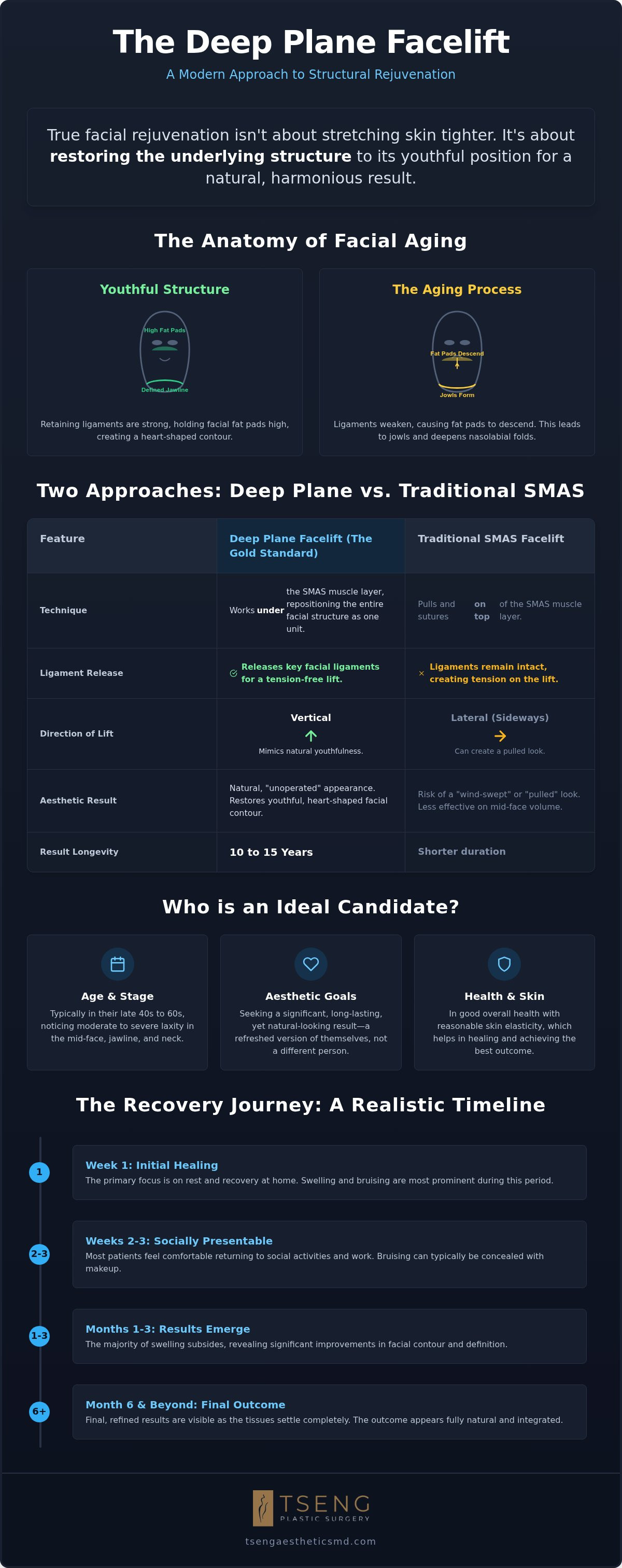
Facial aging is not merely a matter of thinning skin. It's a complex process involving the laxity of retaining ligaments. These ligaments act like anchors, holding facial fat pads in their youthful positions. As they weaken, the malar fat pad in the mid-face begins to descend. This migration leads to the formation of jowls and the deepening of nasolabial folds. Because these changes occur deep within the tissue, surface-level treatments like lasers or fillers cannot fully correct the underlying sagging. The deep plane facelift is uniquely effective because it releases these tethering ligaments, allowing the mid-face and jawline to be lifted without creating tension on the skin.
Who is the Ideal Candidate for This Procedure?
Most candidates seek a deep plane facelift when they notice moderate to severe laxity in the mid-face and neck. While patients in their 50s and 60s remain the traditional demographic, there is a growing trend of "pre-juvenation" among individuals in their late 40s. These younger patients choose the procedure to maintain their structural integrity before significant aging occurs. Ideal candidates possess good skin elasticity and a clear understanding of their aesthetic goals. Dr. Tseng emphasizes a personalized journey, ensuring each patient's medical history and skin quality are thoroughly assessed to achieve a balanced, harmonious outcome. This procedure is particularly effective for those who want to avoid the "operated-on" look and prefer a refreshed version of their natural selves.
Deep Plane vs. SMAS Facelift: Which Technique is Right for You?
Choosing the right surgical approach requires a clear understanding of how facial tissues are manipulated. While the SMAS facelift has been a reliable standard for decades, it primarily involves pulling and suturing the Superficial Musculoaponeurotic System without altering the underlying attachments. This technique provides a lateral improvement that tightens the jawline but often fails to effectively address the mid-face or deep nasolabial folds. In contrast, the deep plane facelift enters the space beneath the SMAS to release tension at its source. This distinction is vital for patients seeking a comprehensive restoration of the lower and middle face. Detailed clinical comparisons, such as those found in this overview of Deep Plane vs. SMAS Facelift, highlight how the deep plane approach allows for more significant movement of the malar fat pad and jawline without creating an artificial appearance.
The Technical Advantage of Releasing Ligaments
The secret to a truly natural result lies in the surgical release of the zygomatic and mandibular ligaments. These fibrous bands act as anchors that hold facial tissues in place. If they aren't released, any attempt to lift the face results in a "pulled" look because the skin and muscle are fighting against these fixed points. By releasing these anchors, the entire tissue unit can be moved vertically. This vertical repositioning mimics the natural state of youth rather than stretching the face laterally toward the ears. It's this specific maneuver that eliminates the "wind-swept" look and ensures the results remain harmonious with your unique features.
Comparing Recovery and Surgical Complexity
Because this technique involves navigating near delicate facial nerves and deep structures, it requires a surgeon with profound anatomical mastery. Dr. Tseng utilizes over 20 years of experience to perform these intricate releases with extreme care. While the operative time is slightly longer than a traditional lift, the benefits in longevity are substantial. Most patients find that a deep plane facelift provides a more elegant "sweep" of the neck and jawline, with results typically lasting 10 to 15 years. You should expect some initial swelling as the deep tissues settle, but this is a temporary phase on the path to a lasting, confident transformation. If you're ready to see if this structural approach aligns with your vision, a personalized consultation can provide the clarity you need to move forward.
The Aesthetic Result: Achieving a Natural, Unoperated Appearance
The most successful surgical outcome is one that remains invisible to the casual observer. A deep plane facelift achieves this by prioritizing structural harmony over skin tension. When older techniques rely on pulling the skin to smooth wrinkles, they often create a flattened, "plastic" appearance that lacks the depth of a youthful face. This occurs because the skin isn't meant to bear the weight of the underlying facial structures. By repositioning the deeper tissues, we remove the burden from the skin entirely. This allows the surface to drape softly and naturally over newly restored contours, ensuring that your results look like a refreshed version of yourself rather than a different person altogether.
Restoring the "Heart-Shaped" face of youth is a central goal of this advanced approach. In our younger years, volume is concentrated in the mid-face and cheekbones, tapering down to a refined jawline. Gravity eventually inverts this triangle, causing volume to pool along the jaw and neck. Elevating the mid-face through the deep plane technique returns that lost volume to the cheeks. This structural shift ensures that facial expressions remain fluid and natural. Because the skin and the underlying muscle layers move as a single unit, you won't experience the stiff or mask-like quality often associated with more aggressive, skin-only procedures.
Eliminating the "Wind-Swept" Stigma
The dreaded "wind-swept" look is almost always the result of a horizontal vector of lift. When tissue is pulled laterally toward the ears, it distorts the corners of the mouth and can even pull the earlobes out of place, creating what surgeons call a "pixie ear" deformity. The vertical vector serves as the essential key to reversing the effects of gravity without compromising the natural contours of the face. By lifting upward rather than backward, we preserve the natural shape of the tragus and ensure the mouth remains expressive and undistorted. This subtle shift in direction makes a profound difference in the authenticity of the final result.
Integrating the Neck for a Seamless Profile
Total facial harmony is impossible without addressing the relationship between the jawline and the neck. A crisp, defined submental angle is a hallmark of vitality, and it requires more than just removing excess skin. The platysma muscle, which spans the neck, often becomes lax or banded over time. By integrating the neck into the structural lift, we can tighten this muscle layer to create a smooth, firm foundation. This creates a seamless transition from the face to the décolletage, providing a sharp jawline and a refined profile that looks elegant from every angle. Dr. Tseng's commitment to this level of detail ensures that the transformation feels complete and balanced.
The Patient Experience: Recovery Timeline and Longevity
Understanding the recovery journey is essential for managing expectations and ensuring a peaceful healing process. During the first 48 hours after a deep plane facelift, patients typically focus on rest while managing minor discomfort and surgical drains. Swelling and bruising are natural responses that usually peak between days 2 and 4. While the initial days require patience, the "socially presentable" milestone often arrives within 10 to 14 days. At this point, most individuals feel comfortable returning to desk work or casual social settings. It's a period of quiet transition where the internal structural changes begin to manifest as a refreshed, external glow.
A Week-by-Week Recovery Breakdown
- Week 1: The priority is gentle suture care and ample rest. Most patients find that staying upright and following specific post-operative protocols helps minimize early swelling.
- Week 2: Bruising begins to fade significantly. This is often when makeup can be applied to camouflage any remaining discoloration as you return to your daily routine and light social obligations.
- Month 1: By the end of the fourth week, you can typically resume light exercise. Strenuous physical activity is usually safe after 4 to 6 weeks, allowing you to re-engage with your full lifestyle with renewed confidence.
How Long Does a Deep Plane Facelift Last?
The durability of a deep plane facelift is one of its most compelling advantages. Because the procedure repositions the underlying structural layers rather than just stretching the skin, the results are remarkably stable. Statistical data suggests these improvements last between 10 and 15 years, which is a significant increase over the 5 to 7 years typically seen with less invasive mini-lifts. While genetics, sun exposure, and lifestyle choices continue to influence the skin's quality, the surgery essentially "sets the clock back" permanently. You will always look younger than you would have without the intervention.
Long-term healing is a gradual, rewarding process. While you'll look refreshed within weeks, the final results truly settle over 6 to 12 months as the deep tissues fully integrate and the last remnants of internal swelling dissipate. Protecting this investment requires a commitment to professional skincare and diligent sun protection to maintain the skin's vitality. If you're ready to begin your own transformation, you can schedule a consultation with Dr. Tseng to discuss your personalized recovery plan and long-term aesthetic goals.
The Art of Preservation: Why Tseng Plastic Surgery is the Premier Choice
Choosing a surgeon for a deep plane facelift is a decision that extends beyond technical skill; it's about finding a master craftsman who understands the delicate balance between clinical science and aesthetic artistry. Dr. Tseng’s philosophy centers on the idea that surgical intervention should never be obvious. Instead, it should reveal a version of yourself that feels both familiar and revitalized. By focusing on "Preservation" techniques, the practice ensures that every procedure minimizes trauma to the tissues while maximizing the longevity of the results. This approach is specifically embodied in the Minimal invasive preservation face and neck lift, a specialized method designed to address facial detail with extreme care and precision.
A Legacy of Experience and Patient-First Care
With over 20 years of specialized aesthetic practice, Dr. Tseng has cultivated a reputation for "quiet confidence." This reputation isn't built on aggressive marketing, but rather on the foundation of thousands of successful procedures and satisfied patients who value subtle, high-quality improvements over drastic changes. We recognize that facial rejuvenation is a deeply personal journey. Our team prioritizes your emotional well-being alongside your physical transformation, ensuring that you feel heard and supported at every stage. We don't believe in a one-size-fits-all approach; we believe in a harmonious result that respects your unique anatomy and honors your personal vision of beauty.
Your Consultation: The First Step Toward Transformation
The path to structural rejuvenation begins with an advanced facial analysis. During your initial visit, Dr. Tseng performs a comprehensive assessment of your bone structure, tissue quality, and the specific ways your face has aged over time. This isn't a standard checklist; it's a collaborative session where we establish a shared vision for your outcome. We use this time to map out the precise vectors of lift needed to restore your natural contours while maintaining the fluidity of your expressions. This methodical preparation is why our patients achieve such consistent, elegant results. If you're ready to explore how structural restoration can enhance your confidence, the next step is simple. You can Schedule your personalized consultation with Dr. Tseng to begin your own journey toward a more refreshed and authentic reflection.
Your Path to Lasting, Harmonious Rejuvenation
Reclaiming your youthful profile is a journey that requires both surgical precision and an artistic eye. By choosing a deep plane facelift, you prioritize the structural integrity of your face, ensuring that volume is restored where it belongs rather than simply pulling the skin. This approach not only provides a more harmonious and natural appearance but also offers the longevity you deserve, with results that typically endure for 10 to 15 years. You don't have to settle for the artificial tightness of the past when modern techniques allow for such refined, elegant transformations.
At Tseng Plastic Surgery, we combine board-certified expertise with over 20 years of experience to deliver preservation-focused outcomes. Our high-end, patient-centric environment is designed to ensure your comfort and privacy as you pursue your aesthetic goals. We believe that true rejuvenation is about quiet confidence and subtle, high-quality improvements that honor your unique identity. Every detail of your care is personalized to reflect your vision and enhance your natural beauty.
Begin your journey toward natural rejuvenation; book a consultation with Tseng Plastic Surgery today. It's time to discover a refreshed version of yourself and move forward with a renewed sense of possibility.
Frequently Asked Questions
How is a deep plane facelift different from a mini facelift?
A deep plane facelift differs from a mini facelift by repositioning the deeper structural layers of the face rather than focusing solely on the skin. While a mini facelift addresses mild sagging in the lower face with shorter incisions, it doesn't offer the same longevity or mid-face restoration. The deep plane approach provides a more comprehensive rejuvenation that typically lasts 10 to 15 years, whereas mini-lifts often require revision much sooner.
What is the best age to get a deep plane facelift?
There is no single "best" age for this procedure, as the decision depends entirely on your unique anatomy and the degree of facial laxity. Most patients seek this treatment in their late 40s to early 60s when they notice significant sagging in the mid-face and jawline. However, some younger patients choose this method for "pre-juvenation" to maintain their structural integrity before aging becomes more pronounced.
Will I have visible scars after a deep plane facelift?
Surgical incisions are hidden within the natural contours of the ear and the hairline to ensure they remain inconspicuous once healed. Because this technique releases internal tension, the skin can be closed without the pulling that often causes scars to widen or distort. Most patients find that their fine lines become nearly invisible after the healing process, allowing them to wear their hair up with complete confidence.
Is the deep plane facelift safer than traditional methods?
When performed by a board-certified specialist, the deep plane facelift is a highly safe and advanced surgical option. This technique actually preserves the skin's blood supply more effectively than traditional methods because the skin remains attached to the underlying muscle layer. It also avoids the excessive tension that can lead to poor wound healing or an unnatural, operated-on appearance.
How much does a deep plane facelift typically cost?
The total investment for this procedure depends on several factors, including the surgeon's experience and the geographical area. As of July 2026, the median cost in the United States is approximately $55,000, with most specialist fees ranging between $35,000 and $75,000. This figure typically encompasses the surgical fee, facility use, and anesthesia, though you should confirm all inclusions during your consultation.
Can I combine a deep plane facelift with other procedures like an eyelid lift?
It is quite common to combine this surgery with other procedures, such as an eyelid lift or brow lift, to achieve a more balanced rejuvenation. Addressing multiple areas in a single session ensures that the upper and lower face age harmoniously together. During your consultation, Dr. Tseng will help you determine if a multi-layered approach is appropriate for your specific aesthetic goals and recovery timeline.
What kind of anesthesia is used for a deep plane facelift?
Most surgeons perform this surgery under general anesthesia or deep intravenous sedation to ensure your complete comfort and safety throughout the procedure. This allows for the precise manipulation of deeper facial structures without any sensation of pain. Our surgical team prioritizes a gentle anesthetic experience, focusing on a smooth transition into recovery while minimizing post-operative nausea or grogginess.
How do I know if my surgeon is qualified to perform a deep plane facelift?
Selecting a surgeon requires verifying their board certification and specific experience with advanced structural techniques. You should look for a specialist who demonstrates a profound understanding of facial anatomy and a history of achieving balanced, natural results. Dr. Tseng brings over 20 years of experience to his practice, focusing on a patient-first approach that prioritizes your individual goals and long-term well-being.
Your best experience begins here
Schedule your consultation with Dr. Mark Tseng, Bellevue’s trusted cosmetic plastic surgeon.
Relax in a luxurious, private environment where we focus on ensuring you are comfortable, cared for, and love your results.
Hours:
Mon, Tues, Thurs, Fri: 8:00 AM - 6:30 PM
Every other Wednesday 8:00 AM - 6:30 PM
Saturday - Sunday: Closed

