Breast Augmentation Recovery Timeline: A Guide to Refined Healing in 2026
By Tseng Plastic Surgery
What if the most unsettling phase of your aesthetic transformation is actually the most vital sign of your body's successful evolution? Many patients experience a wave of anxiety when they first observe the "high and tight" appearance of their implants, fearing that this initial rigidity is a permanent result rather than a fleeting stage of surgical settling. It's completely natural to feel a sense of urgency for your results to soften, yet true refinement requires a patient, methodical approach to healing.
We promise to help you navigate this journey from the operating room to final aesthetic harmony with an expert-led, week-by-week breast augmentation recovery timeline. By understanding the science of tissue relaxation and the precision of modern 2026 aftercare protocols, you can replace post-operative confusion with a sense of calm authority over your own progress. We will preview the essential milestones of the first month, clarifying exactly when you can safely resume exercise, manage discomfort with ease, and finally see your implants settle into a natural, graceful contour that complements your unique proportions.
Key Takeaways
- Navigate the essential milestones of your breast augmentation recovery timeline to understand how initial inflammation evolves into refined, natural contours.
- Learn when to transition from clinical support to professional re-entry, including the proper use of specialized compression garments for optimal tissue stability.
- Discover the physiological timing of the "drop and fluff" phase, ensuring you know exactly when to expect your implants to settle into their final, graceful position.
- Master long-term scar management and tissue refinement techniques that ensure your results remain subtle, high-quality, and aesthetically harmonious.
- Understand how advanced surgical techniques influence your personal healing rhythm and the safe resumption of cardiovascular activities.
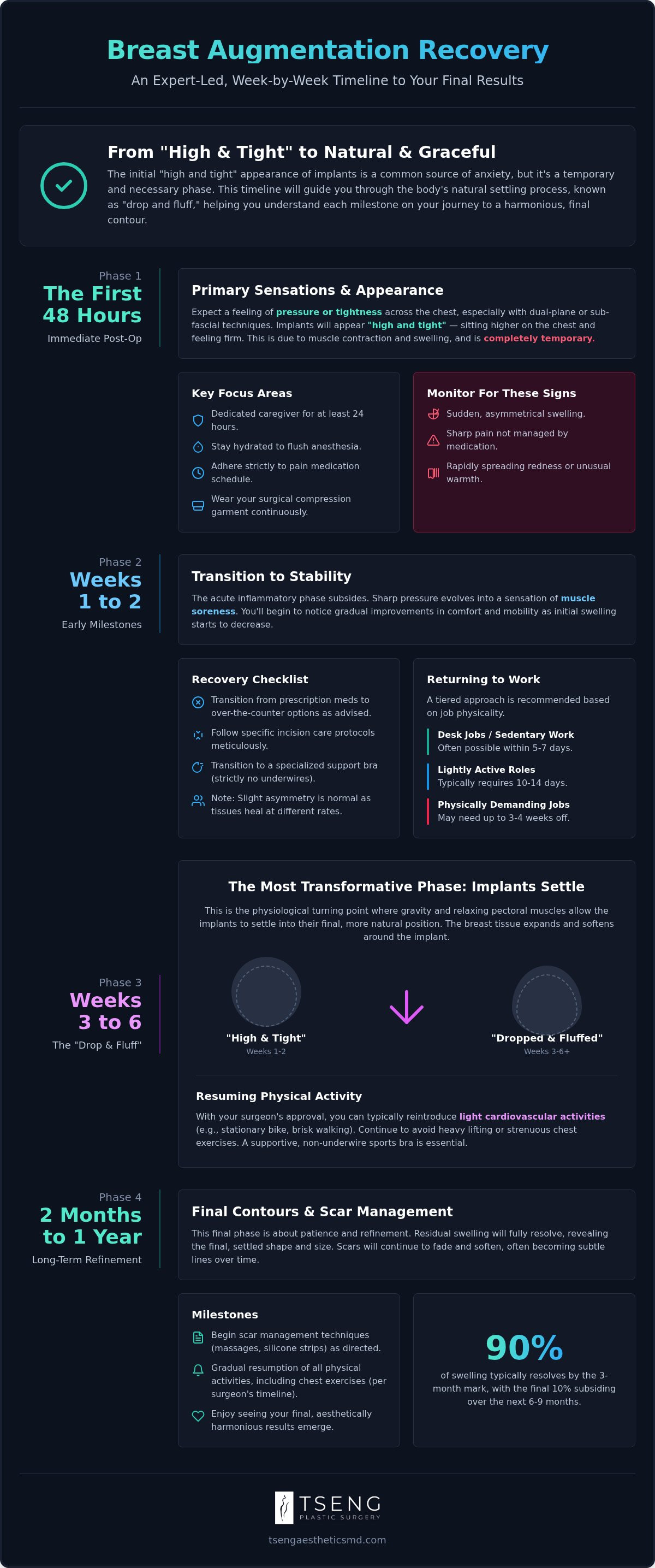
The Immediate Post-Operative Phase: The First 48 Hours
The transition from the surgical suite to the comfort of your home is a delicate bridge between clinical precision and personalized care. During these initial 48 hours, your body initiates a sophisticated inflammatory response, which is a necessary first step toward achieving your final aesthetic vision. You'll likely feel a distinct sensation of pressure across the chest. This is particularly pronounced if your implants were placed using a dual-plane or sub-fascial technique, as the surrounding tissues and muscles begin to adapt to their new volume. As we move through 2026, advanced monitoring and specialized garments have made this phase more predictable than ever, ensuring that your breast augmentation recovery timeline begins on a foundation of stability.
Anesthesia and the First 24 Hours
As the effects of general anesthesia gradually dissipate, you might feel a lingering sense of grogginess or fatigue. It's essential to have a dedicated caregiver present for at least the first 24 hours to assist with mobility and medication schedules. Staying hydrated is a priority. Sip water frequently to help your system process the anesthetic agents. Your initial pain management strategy will likely involve a combination of prescribed medications designed to maintain a baseline of comfort, allowing your body to focus entirely on the early stages of cellular repair. For a broader context on the procedure itself, a breast augmentation overview can provide additional perspective on the standard surgical journey and the physiological changes occurring within the breast pocket.
Understanding the 'High and Tight' Look
One of the most common sources of early anxiety in the breast augmentation recovery timeline is the initial appearance of the implants. They often sit higher on the chest wall than expected and feel remarkably firm to the touch. This "high and tight" look occurs because the pectoral muscles are experiencing a temporary state of contraction and swelling. They're essentially acting as a natural internal brace, holding the implants in a superior position before they eventually "drop and fluff" into a more natural teardrop shape. This phase is entirely temporary. It represents the master craftsman's work in progress rather than the final masterpiece.
Your surgical compression garment is your most important ally during this window. It provides the necessary stabilization to minimize internal shifting and control edema. While some bruising and swelling are standard, you should monitor for specific signs that require professional attention:
- Sudden, asymmetrical swelling where one breast is significantly larger than the other.
- A sharp increase in pain that isn't managed by your prescribed medication.
- Redness or unusual warmth that spreads rapidly across the skin surface.
By adhering to these initial protocols, you establish a partnership with your surgeon that supports the long-term refinement of your results. This unhurried approach during the first two days ensures that the delicate internal healing environment remains undisturbed as you prepare for the milestones of the coming weeks.
Weeks 1 to 2: Navigating Early Milestones and Professional Re-entry
The second week marks a pivotal shift in your breast augmentation recovery timeline. The initial intensity of the first 48 hours gives way to a more manageable rhythm, allowing you to focus on the gradual refinement of your results. Most patients find they can comfortably transition from prescription pain management to over-the-counter options during this window. This change isn't just about physical comfort; it represents your body moving past the acute inflammatory phase and into a period of stable healing. You'll likely notice that the sharp pressure from the first few days has evolved into a sensation more akin to muscle soreness after a strenuous workout.
Incision care remains a priority during these fourteen days. Adhering to your specific cleaning protocols ensures that the delicate tissue edges remain secure and protected. You will likely transition from your initial surgical compression garment into a specialized support bra. These garments are designed to provide stability without the restriction of underwires, which are strictly avoided to prevent irritation of the healing incisions. As the initial swelling begins to subside, you may notice subtle differences in symmetry. Don't worry. Tissues often heal at slightly different rates, and what you see now is merely a snapshot of a work in progress.
Returning to Work: A Tiered Approach
Resuming professional responsibilities requires a thoughtful, tiered approach that respects your energy levels. For those in desk-based roles, a return to work typically occurs between 5 and 7 days after surgery. This timeframe aligns with the ASPS recovery timeline, which suggests that most patients feel capable of light activity within a week. However, if your role involves standing for long periods or light movement, you might benefit from a few extra days of rest. It's common to experience a temporary "brain fog" or lower stamina during your first few days back. Listen to your body and prioritize hydration to maintain your focus.
The Psychological 'Settling' Phase
The emotional aspect of recovery is just as significant as the physical one. It's perfectly normal to experience a brief period of "post-op blues" or second-guessing as you adjust to your new silhouette while it's still in its "high and tight" phase. Remember that your current appearance is temporary. While you might feel anxious about the height or firmness of the implants, breast augmentation revision surgery is rarely considered this early because the tissues need months to truly settle. Focus on the long-term goal of aesthetic harmony. Establishing a light walking routine during this time can significantly boost your mood and promote healthy circulation. If you have specific questions about your progress, connecting with a professional guide can provide the reassurance you need to stay confident in your journey.
Weeks 3 to 6: The 'Drop and Fluff' and Physical Resumption
Between the third and sixth weeks, you'll enter the most visually rewarding phase of your breast augmentation recovery timeline. This period is defined by a physiological shift colloquially known as "drop and fluff." While the terms sound informal, they describe the critical moment when the pectoral muscles finally relax their grip on the implants. As this tension dissipates, the implants settle into the lower breast pocket, allowing the lower pole of the breast to round out while the upper portion develops a more natural, graceful slope. This transition marks the end of the initial "high and tight" look and the beginning of your final aesthetic harmony.
Your daily wardrobe and aftercare routine will also undergo a welcome evolution. Most patients graduate from rigid surgical garments to non-underwire supportive bras or soft bralettes. These options provide enough stability for daily movement without the risk of underwires irritating the still-maturing incision sites. This is also the stage where we initiate professional-grade scar management. In 2026, the standard protocol involves silicone-based gels infused with targeted peptides, which help the incisions transition from a pinkish hue to a pale, flat line that blends seamlessly with your natural skin tone.
Social Re-entry and Travel Timelines
As your energy levels stabilize, you'll likely feel ready to resume a more active social calendar. By the fourth week, most patients are cleared for national air travel, though you should still delegate the handling of heavy luggage to a companion. The sudden strain of lifting a suitcase into an overhead bin can put undue stress on the healing pectoral fascia. When attending social events, you'll begin to appreciate how your new silhouette fits into your favorite clothing. This is the window where the ideal C cup guide proportions truly begin to manifest as the residual internal swelling finally fades away.
Exercise and Upper Body Restrictions
Physical resumption must be handled with the precision of a master craftsman. While you can safely enjoy brisk walking or light stationary cycling, high-impact cardiovascular activities and chest-heavy weightlifting remain off-limits. A detailed recovery process emphasizes that premature strain on the upper body can lead to implant displacement or widened scars. You may begin to reintroduce light yoga, focusing on lower-body poses while avoiding any positions that require you to bear weight through your arms. Always listen to your body's biofeedback. If you experience a "pulling" sensation or localized tightness, it's a clear signal from your nervous system to scale back and allow for further tissue refinement.
The Long-Term Arc: 2 Months to 1 Year
The final stretch of the breast augmentation recovery timeline is characterized by subtle, almost imperceptible refinements. While you likely feel back to your normal self by the eight-week mark, your body continues to perform intricate cellular work beneath the surface. This final 10% of healing is where true aesthetic harmony is achieved. During this phase, the internal tissues fully integrate with the implants, and the inflammatory response completely resolves, allowing the breasts to take on their final, softest contour.
Your scars undergo a significant transformation throughout this year. They typically shift from a vivid pink to a pale, flat, and soft texture that blends into the surrounding skin. In 2026, we emphasize the continued use of medical-grade silicone sheeting or peptide-infused gels during months three through six to ensure the most discreet results possible. By the three-month mark, most patients receive clearance for full upper-body training and high-impact sports like running or HIIT. The internal support structures and the breast pocket have sufficiently matured to handle the dynamic forces of these activities without risk of displacement.
Final Aesthetic Harmony
It's best to wait until at least the six-month mark before judging your final results. During this window, the biological capsule that naturally forms around the implant begins to thin and soften, leading to a more natural feel and movement. The initial choice between saline vs. silicone implants plays a role in how this settling occurs. Silicone often mimics natural tissue more closely as it integrates, while saline may require slightly more time for the surrounding tissue to fully mask the implant edges. Regardless of the material, the "drop and fluff" process mentioned in previous stages reaches its peak refinement here.
Maintenance and Longevity
It's vital to recognize that breast implants are not lifetime devices. While modern 2026 technology has increased their durability and safety profiles, they will eventually show signs of aging over the coming decades. Results age most gracefully when you maintain a stable weight. Significant fluctuations can stretch the skin and potentially alter the position of the breast pocket, leading to a loss of the initial surgical precision. Annual check-ups serve as a proactive way to monitor the integrity of the implants and the health of the surrounding tissue. If you notice any changes in shape, firmness, or symmetry, it's best to consult your surgical team for a professional assessment to ensure your aesthetic harmony remains intact.
The Tseng Approach: Why a Refined Recovery Matters
The Tseng Approach is defined by a commitment to quiet confidence and clinical excellence. We believe that a superior aesthetic result isn't just achieved in the operating room; it's nurtured throughout the months that follow. Dr. Tseng brings over 20 years of surgical expertise to every procedure, ensuring that the initial precision of the surgery translates into a soft, natural look. The specific technique chosen, such as a sub-fascial or dual-plane placement, plays a critical role in how your body responds. These advanced methods are designed to respect the integrity of the pectoral muscle, which often leads to a more predictable and stable breast augmentation recovery timeline.
By prioritizing a "master craftsman" philosophy, we avoid the hurried pace of high-volume practices. We understand that tissue refinement cannot be rushed. Whether we are managing the initial inflammatory response or guiding you through the final stages of scar maturation, our focus remains on aesthetic harmony. This methodical progression ensures that the transition from the surgical suite to your daily life feels seamless, personalized, and safe.
Your Partnership in Healing
True refinement is a collaborative effort between the surgeon's artistry and the patient's dedication. While we provide the technical foundation, your adherence to post-operative constraints is what secures the longevity of your results. A conservative approach to physical activity during the first six weeks isn't about restriction; it's about protection. By allowing the internal support structures to mature without premature strain, you ensure that your implants settle into a position that feels both balanced and authentic to your frame. Every physiological response is unique, so we customize your milestones to match your body's specific rhythm of repair.
Preparing for Your Journey
Success begins before you enter our doors. We recommend setting up a "recovery sanctuary" at home where essentials are within easy reach. This includes a comfortable reclining space to keep your chest elevated, plenty of hydration, and your specialized support garments. Having these items ready allows you to focus entirely on rest and refinement. For those currently in the research phase, reviewing The Essential Guide to Breast Augmentation can provide valuable insights for your pre-operative planning.
Our goal is to guide you toward a version of yourself that feels empowered and naturally confident. We don't strive for drastic changes that feel out of place. Instead, we focus on subtle, high-quality improvements that honor your personal vision. As you move through 2026 and beyond, you'll find that this unhurried, patient-first approach delivers a result that is as enduring as it is beautiful.
Your Journey Toward Aesthetic Harmony
Achieving a natural and balanced silhouette is a gradual evolution that rewards patience and surgical precision. By understanding the breast augmentation recovery timeline, you can navigate the transition from initial post-operative tightness to the final "drop and fluff" phase with complete confidence. It's a roadmap that ensures every stage of healing, from the first 48 hours to the one-year mark, is managed with the care and expertise your body deserves.
With over 20 years of aesthetic surgical excellence, Dr. Mark H. Tseng provides board-certified expertise in breast and body contouring. Our practice remains dedicated to subtle, high-quality results that honor your unique proportions and personal vision. We invite you to schedule your personalized consultation with Dr. Tseng to discuss how our master craftsman approach can help you achieve a refined and natural-looking transformation. Your path to renewed confidence is a partnership we're honored to share, and we look forward to guiding you through every step of your recovery with personalized care.
Frequently Asked Questions
When can I drive after breast augmentation surgery?
You can typically return to driving once you've discontinued all prescription pain medications and regained a comfortable range of motion in your upper body. For most patients, this occurs between five and seven days after the procedure. It's essential to feel confident in your ability to react quickly and steer without discomfort. We recommend a short trial run in a quiet area before resuming your normal commute to ensure your physical responses are sharp and pain-free.
How soon can I sleep on my side or stomach?
We recommend sleeping exclusively on your back for at least four to six weeks to maintain the integrity of the breast pocket. This position prevents unnecessary pressure on the implants and ensures they settle symmetrically according to your breast augmentation recovery timeline. After the six-week mark, most patients can gradually transition to side sleeping. Stomach sleeping should be avoided for at least eight to twelve weeks to prevent displacement or discomfort during the final stages of tissue integration.
When is it safe to resume sexual activity after the procedure?
Most patients can safely resume light, intimate activity approximately two weeks after surgery. It's vital to avoid any positions that place direct pressure on the chest or require significant upper-body exertion. More vigorous activity should be postponed until the four to six-week mark when the internal healing is more stable. Listen to your body's signals and prioritize comfort; if any movement causes a pulling sensation or sharp pain, it's a sign to wait a bit longer.
How long do I need to wear the surgical bra?
You'll typically wear a specialized surgical or compression bra for the first four to six weeks of your recovery. This garment is essential for controlling swelling and providing the necessary stabilization for your implants as they settle. After this initial window, you can often transition to supportive sports bras without underwires. Consistent wear during the first month is a cornerstone of the breast augmentation recovery timeline, ensuring the tissues heal in their intended, harmonious position.
When can I return to the gym for high-impact workouts?
High-impact workouts and chest-specific exercises should be avoided for at least six weeks following your procedure. While light walking is encouraged early on, activities like running, jumping, or heavy lifting can cause implant displacement or widened scars. We recommend a gradual reintroduction of cardiovascular work starting with stationary cycling. By the eight-week mark, most patients can return to their full fitness routine, provided they continue to monitor their body for any signs of fatigue or localized soreness.
What should I do if I notice one breast is settling faster than the other?
Asymmetrical settling is a common and normal part of the healing process; it's rare for both breasts to heal at the exact same pace. One side may "drop and fluff" faster than the other due to differences in muscle tension or your dominant hand's activity levels. We ask that you remain patient during the first three months. If significant asymmetry persists after twelve weeks, we'll evaluate the results during your follow-up to ensure everything is progressing toward aesthetic harmony.
When can I wear an underwire bra again?
Most patients are advised to wait at least six to twelve weeks before wearing an underwire bra. The rigid structure of the wire can irritate healing incisions and potentially interfere with the final positioning of the implant. During this period, soft, supportive bralettes or high-quality sports bras are the preferred choice. Waiting until the tissues have fully softened ensures that your results remain refined and that your comfort is prioritized as you transition back to your favorite wardrobe pieces.
How long will the scars stay red or visible?
Scars typically remain pink or reddish for the first three to six months as the body directs blood flow to the area for repair. By the one-year mark, they'll usually fade to a pale, flat line that blends more naturally with your skin. Following our 2026 silicone-based aftercare protocols is essential for achieving the most discreet results. While the initial visibility can be concerning, the unhurried maturation of the scar tissue is a key step in achieving long-term aesthetic excellence.

