The Essential Guide to Breast Augmentation: Balancing Art and Science
By Tseng Plastic Surgery
The most successful breast augmentation isn't defined by how much volume is added, but by how seamlessly the results integrate with your unique anatomy. You may feel a sense of confusion when comparing saline versus silicone options, or perhaps you're worried that the final outcome will look artificial rather than refined. It's a common concern, especially when you're faced with a sea of technical surgical terms and complex safety data. You deserve a path that prioritizes both your physical safety and your personal vision of beauty.
This guide clarifies the journey ahead, offering the insights you need to choose the right implant with absolute confidence. We'll move past the clinical jargon to explore how a balance of medical precision and aesthetic artistry creates a natural, harmonious result. You will learn about current FDA safety protocols, the latest innovations in implant technology, and the surgical techniques that ensure a graceful silhouette. By the end, you'll understand how to achieve a look that feels as authentic as it does beautiful.
Key Takeaways
- Understand the nuances between saline and silicone gel implants, including how modern "gummy bear" textures provide a more natural feel and cohesive structure.
- Learn how the strategic selection of implant shapes and submuscular placement ensures your breast augmentation achieves long-term support and a refined silhouette.
- Discover the role of board-certified expertise and advanced 3D imaging in translating your personal vision into a predictable, safe surgical plan.
- Explore a surgical philosophy that prioritizes conservative adjustments to maintain the delicate balance and harmony of your body's natural proportions.
- Gain clarity on modern safety standards, including essential FDA-mandated protocols and the importance of periodic imaging for long-term health.
What is Breast Augmentation? Defining the Procedure
Breast augmentation, clinically known as augmentation mammoplasty, is a sophisticated procedure designed to enhance the volume, shape, and overall projection of the breasts. While some may equate the term solely with size, modern aesthetic science views it as a way to restore what time or life events have changed. It's distinct from reconstructive surgery, which typically follows a mastectomy or trauma; cosmetic augmentation focuses on refining an existing silhouette to better align with a person's ideal self-image. For a comprehensive overview of breast augmentation and its history, looking at established clinical definitions helps ground the conversation in medical reality.
The primary goals of the procedure often involve more than just adding volume. Many patients seek to improve symmetry or enhance their body's overall proportions. Today, the industry has shifted away from the "bigger is better" mindset of previous decades. Instead, there's a profound focus on the "Natural Look," where the result complements the patient's athletic build or frame rather than dominating it. Achieving this requires a deep understanding of how physical changes affect a person's confidence and quality of life. For those seeking non-surgical ways to support their transition and natural growth, you can check out Transfemme for specialized feminization supplements.
The Intersection of Biology and Aesthetics
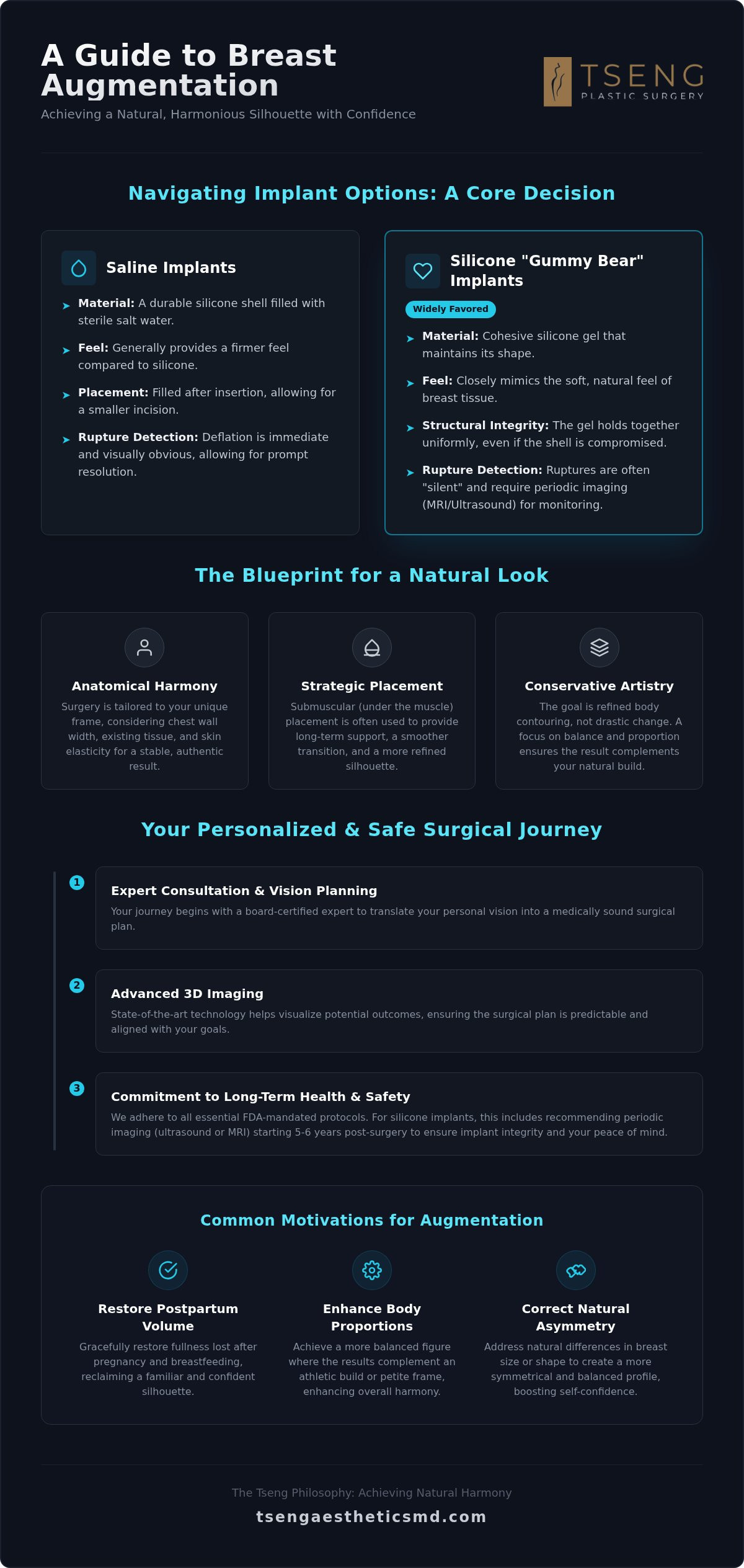
Successful surgical planning begins with a deep understanding of your unique anatomy. We don't just look at the breasts in isolation; we consider the width of the chest wall and the existing glandular tissue. These biological markers dictate the maximum width and projection an implant should have to remain stable and look authentic over time. If an implant is too wide for the chest wall, it can lead to complications or an unnatural appearance.
Skin elasticity also plays a crucial role in how the body supports new volume. If the skin is thin or has lost its resilience, the surgical approach must be more conservative to prevent visible rippling or sagging. This is where the artist-scientist approach becomes vital, often incorporating advanced skin rejuvenation technologies like those found at RJ Clinic. It requires the precision of a surgeon to ensure safety and the eye of an artist to envision how the final result will move and feel. We aim for high-quality improvements that look subtle and refined.
Common Motivations for the Procedure
Life transitions often prompt the desire for change. Many women choose breast augmentation to address postpartum changes, such as the loss of volume that occurs after pregnancy and breastfeeding. These physical shifts can leave the breasts feeling "empty," and a carefully planned procedure can restore that lost fullness with grace. It's about reclaiming a version of yourself that feels familiar.
Others may have lived with natural asymmetry their entire lives. Correcting a noticeable difference in size or shape can create a much more balanced profile, leading to a boost in self-confidence. By focusing on refined body contouring rather than drastic changes, you can achieve a look that feels like a natural extension of yourself. This patient-first mentality ensures that the journey is as personalized as the final outcome.
Navigating Implant Options: Materials and Profiles
Choosing the right implant is a pivotal moment in your surgical journey. It's the point where technical precision meets your personal aesthetic vision. Modern technology offers a sophisticated range of options that allow for a highly customized result, ensuring the outcome feels as natural as it looks. When planning your breast augmentation, the choice between saline and silicone is often the first major decision, followed closely by the selection of the ideal implant profile.
Saline vs. Silicone: Which is Right for You?
The tactile difference between these two materials is often the deciding factor for many patients. Silicone gel implants are widely favored for their ability to mimic the feel of natural breast tissue. Modern silicone options, often referred to as "gummy bear" implants, utilize cohesive gel technology. This means the gel maintains its shape even if the shell is compromised, providing an added layer of structural integrity. In contrast, saline implants consist of a silicone shell filled with sterile salt water. They offer a slightly firmer feel but allow for a smaller incision because they're filled after being placed in the body.
Safety and monitoring are equally important considerations. If a saline implant leaks, the deflation is immediate and obvious, allowing for quick resolution. Silicone ruptures are often "silent," meaning they may not be visible to the naked eye. Because of this, the FDA guide on breast implant risks recommends periodic imaging, such as an ultrasound or MRI, starting five to six years after surgery. It's also worth noting that FDA guidelines specify age requirements: saline implants are approved for patients 18 and older, while silicone gel implants are approved for those 22 and older.
Choosing the Right Implant Profile
The "profile" of an implant refers to how far it projects forward from the chest wall. This choice significantly impacts your final silhouette. A low profile implant has a wider base and provides a subtle, gentle curve, making it ideal for patients with a broader chest who want a modest enhancement. Conversely, a high profile implant has a narrower base and offers maximum projection. This is often the preferred choice for those seeking a more dramatic change or who have a narrower natural chest width.
Selecting the correct profile isn't just about desired size; it's about anatomical harmony. Your surgeon will measure your natural chest diameter to ensure the implant fits within your body's frame without extending too far toward the armpits. Aligning these technical measurements with your aesthetic goals is essential for a refined result. Discussing these nuances during a personalized consultation helps ensure your choice supports a balanced, elegant silhouette that feels authentically you.
The Art of Shape and Placement
The silhouette you achieve through breast augmentation depends heavily on the interplay between implant shape and its placement relative to your anatomy. This is where the "artist-scientist" approach is most visible. Choosing between a round or teardrop shape isn't just about preference; it's about how the material behaves under your specific tissue and muscle structure to create a balanced result.
Round vs. Teardrop: Finding Your Ideal Contour
Round implants remain the most frequent choice due to their inherent versatility. They provide superior pole fullness, which creates a more "lifted" and youthful projection. One practical advantage is that if a round implant rotates within its pocket, the aesthetic shape of the breast remains consistent. Teardrop, or anatomical, implants are specifically designed to mimic the natural slope of the breast, with more volume concentrated at the base. While they offer a very sloped look, they often require textured surfaces to stay in place. Since the use of textured implants has largely ceased since 2020 due to safety refinements, many patients find that round implants, when placed skillfully, achieve a similarly natural result with fewer long-term concerns.
Implant Placement Strategies
Where the implant sits significantly affects the final texture and longevity of the result. Submuscular placement, where the device is tucked under the pectoralis major muscle, has become increasingly common. It rose from 22% to 56% of procedures between 2005 and 2020. This method is often preferred because the muscle provides an extra layer of coverage, which helps disguise the edges of the implant and reduces the risk of visible rippling. According to the American Society of Plastic Surgeons, the choice of placement should be tailored to your body type and activity level.
A "dual-plane" technique is frequently used to combine the benefits of different placements. In this approach, the top of the implant is covered by the muscle for a smooth transition, while the bottom is supported by glandular tissue to allow for natural movement. If you're a high-impact athlete, you might discuss whether subglandular placement, sitting over the muscle, is appropriate to avoid muscle interference, though it offers less coverage. Finally, the choice of incision location, such as the inframammary fold, which is used in 80% of modern cases, ensures the surgeon has the precision needed to create a balanced and refined silhouette.
Preparing for Your Aesthetic Journey: The Consultation
The consultation is more than a clinical appointment; it's the start of a collaborative partnership. It's the moment where your vision for breast augmentation meets professional expertise. This phase ensures your goals are technically feasible and aesthetically sound. A compassionate guide will lead you through this process with transparency, helping you move from uncertainty to quiet confidence.
Evaluating Surgeon Credentials
Certification is the first benchmark of quality. You should ensure your surgeon is certified specifically by the American Board of Plastic Surgery. This credential signifies elite training and a commitment to the highest safety standards in aesthetic science. Reviewing before-and-after galleries is also vital. It helps you find a consistent aesthetic style that resonates with your personal taste. Look for a practice that prioritizes listening over a one-size-fits-all approach. With over 20 years of surgical experience, Dr. Tseng emphasizes this patient-first mentality to build a foundation of trust before any procedure begins.
Safety extends beyond the surgeon's individual skill. You should always ask about the accreditation of the surgical facility and the qualifications of the anesthesia provider. As of 2026, the FDA mandates thorough patient checklists to ensure informed consent is comprehensive. These measures are designed to ground your decisions in safety and long-term well-being, ensuring you're fully aware of how modern implants perform over time.
Sizing and Expectations
Communicating your desired look can be challenging. "Wish pictures" and sizing bras are excellent tools to bridge the gap between your vision and the surgical plan. However, it's essential to move beyond the concept of "cup sizes," which vary significantly between clothing brands. Surgeons rely on more precise metrics to achieve the balance and harmony you desire. CC (cubic centimeters) is the volumetric measurement used for implant sizing.
This standard allows for precise planning that accounts for your unique ribcage width and skin elasticity. 3D imaging often supports this process, providing a visual preview of how different volumes interact with your existing anatomy. Understanding the limitations of your physical structure is part of achieving a refined result that looks authentic. Ready to begin your transformation? Schedule your personalized consultation to discuss your goals with an expert who values your unique journey.
The Tseng Philosophy: Achieving Natural Harmony
At the heart of our practice lies a commitment to balance that transcends the boundaries of standard surgical care. We believe that the most successful breast augmentation is one that integrates so seamlessly with your anatomy that it leaves others wondering if you've had surgery at all. This philosophy is rooted in the principle of conservative adjustments. It's about enhancing your existing proportions rather than creating a silhouette that feels disconnected from your frame. By focusing on the "Natural Look," we ensure that your results remain timeless and elegant—a standard of care that is also championed by aesthetic experts such as Cosmetic Facial in their approach to non-surgical skin rejuvenation.
Our approach to body contouring is uniquely informed by advanced facial rejuvenation techniques. Just as a facelift requires a delicate hand to maintain natural expressions, breast surgery requires a meticulous eye to ensure the result moves and feels like part of your own body. For patients looking to complement their surgical results with non-invasive neck and facial care, SBLA BEAUTY provides science-backed insights on effective anti-aging solutions. Meticulous surgical precision is the cornerstone of our work. We often integrate the procedure with liposuction to achieve total body balance. This allows us to refine the surrounding areas, ensuring that your new volume is supported by a harmonious and balanced silhouette.
For those seeking professional clinical options for facial lifting and contouring that align with this philosophy of natural harmony, you can check out SLC Clinic for their expertise in advanced non-surgical treatments.
A Legacy of Experience and Care
With over 20 years of surgical experience, Dr. Tseng provides a legacy of care that translates into a safer, more predictable patient journey. This depth of expertise allows us to anticipate individual needs and tailor every step of the process. We don't rely on aggressive sales tactics; instead, we offer a quiet confidence that builds trust through proven results. We prioritize subtle, high-quality improvements over the drastic, unnatural changes that have historically dominated the industry. This patient-first mentality ensures that your goals are heard, respected, and met with the touch of a master craftsman.
Your Path to Refined Confidence
The connection between physical transformation and emotional well-being is profound. When your physical appearance aligns with your internal vision of yourself, your confidence radiates in every aspect of your life. We view our role as a compassionate guide, supporting you through the surgery and the critical post-operative phase. Long-term maintenance of your results is essential, and we provide the guidance needed to ensure your silhouette remains refined for years to come. Our dedication to harmony extends beyond body surgery. You can Learn how we apply this same philosophy to The Modern Facelift: A Comprehensive Guide to Natural Facial Rejuvenation to see how we maintain a consistent standard of excellence across all aesthetic procedures.
Embracing Your Vision for Refined Harmony
Choosing to undergo breast augmentation is a deeply personal decision that blends clinical safety with your unique aesthetic aspirations. Throughout this guide, we've explored how selecting the right implant material and understanding the nuances of anatomical placement are essential for achieving a result that feels authentically yours. By prioritizing harmony and balance over sheer volume, you ensure a silhouette that remains timeless and sophisticated. The journey is most successful when it's guided by professional expertise and a commitment to subtle, high-quality improvements.
With over 20 years of surgical experience, Dr. Mark H. Tseng offers the quiet confidence of a board-certified plastic surgeon who views every procedure as a fusion of art and science. This legacy of care provides you with a predictable, safe path toward the refined results you desire. We invite you to Schedule a Personalized Consultation with Dr. Tseng to discuss your goals in a supportive, patient-centric environment. You're not just choosing a procedure; you're choosing a partner dedicated to your long-term confidence and well-being. Your path to a more balanced and refined self begins with a single, informed step.
Frequently Asked Questions
How long do breast implants typically last?
Breast implants are not considered lifetime devices and typically require replacement or removal after 10 to 20 years. While some patients maintain their results longer, the risk of complications increases over time. The FDA recommends periodic imaging starting 5 to 6 years after your initial surgery to monitor for silent ruptures. Regular checkups with your surgeon ensure the integrity of the implants and the continued harmony of your aesthetic results.
Is breast augmentation surgery painful during recovery?
Most patients describe the recovery as a period of significant tightness and muscle soreness rather than sharp pain. This discomfort is typically manageable with prescribed medication and tapers off within the first week. If your implants are placed under the muscle, you may experience more initial tenderness as the tissue adjusts. Following a methodical recovery plan helps ensure a smooth transition back to your daily routine with confidence.
Will I still be able to breastfeed after getting implants?
Most women can successfully breastfeed after undergoing breast augmentation, especially when the surgeon uses an inframammary incision. This approach, used in 80% of modern procedures, avoids disrupting the milk ducts and nerves essential for lactation. While no surgery can guarantee breastfeeding ability, choosing a technique that preserves the glandular tissue is a priority for patients planning future families. Your surgeon will tailor the procedure to protect these functions.
What is the difference between a breast lift and an augmentation?
A breast augmentation focuses on increasing volume and improving shape, whereas a breast lift addresses skin laxity and nipple position. If you desire fuller breasts, implants are the solution. However, if your primary concern is sagging or a "drooping" appearance, a lift is necessary to reposition the tissue. Many patients choose to combine these procedures to achieve both a youthful elevation and a refined, voluminous silhouette.
How do I know if I need saline or silicone implants?
The choice between saline and silicone depends on your age, your desired feel, and your anatomy. Silicone gel implants are approved for patients 22 and older and are favored for their natural, soft texture. Saline implants are available to those 18 and older and offer a slightly firmer feel. During your consultation, we'll evaluate your tissue thickness and aesthetic goals to determine which material provides the most harmonious and balanced result.
Can breast augmentation correct sagging breasts?
Breast augmentation can correct very minor sagging by filling out the breast envelope, but it cannot resolve significant skin laxity. If the nipple has fallen below the breast fold, an implant alone may actually worsen the appearance by adding weight to already stretched skin. In these cases, a mastopexy (breast lift) is required alongside the augmentation to restore a firm, elevated, and youthful profile that complements your frame.
What are the most common risks associated with breast surgery?
The most common risks include capsular contracture, implant rupture, and temporary changes in nipple sensation. Capsular contracture occurs when the scar tissue around the implant becomes unusually firm, potentially affecting the shape and comfort of the breast. Modern cohesive gel technology and refined surgical techniques have significantly reduced these occurrences. Your surgeon will provide a detailed FDA-mandated checklist to ensure you understand all safety considerations before your procedure.
How soon can I return to exercise after my procedure?
You can typically resume light walking immediately after surgery, but you must avoid strenuous exercise for four to six weeks. Light cardiovascular activity is often permissible after two weeks, provided it doesn't involve high-impact movement. Full weightlifting and intense upper-body workouts require more time to ensure the internal tissues have healed and the implants have settled. Adhering to this deliberate pace protects your long-term results and ensures a safe recovery.

