Saline vs. Silicone Implants: A Comprehensive Guide to Choosing Your Ideal Result
By Tseng Plastic Surgery
What if the most important factor in your breast augmentation isn't the size you choose, but how the implant material interacts with your body's natural tissue over time? When weighing the choice between saline vs silicone implants, many women worry that a desire for enhancement might lead to a result that looks or feels artificial. You aren't just looking for a change; you're seeking a refined version of yourself that offers both physical harmony and absolute peace of mind.
It's natural to feel a sense of hesitation when faced with technical details about silent ruptures or the long-term maintenance of different materials. This guide provides the clarity you need by exploring the essential differences in feel, safety, and longevity. We'll examine the latest FDA standards for screening, the specific age requirements for different materials, and how modern cohesive gel technology offers a sophisticated alternative for those seeking a natural silhouette. You'll learn how the artistry of a master craftsman turns these clinical options into a personalized path toward your ideal result.
Key Takeaways
- Understand the tactile differences between materials and how silicone mimics natural breast tissue more closely than the firmer profile of saline.
- Navigate the specific safety and monitoring requirements for saline vs silicone implants, including the necessity of periodic imaging to detect silent ruptures.
- Learn why the traditional 10-year rule is a myth while acknowledging that implants aren't lifetime devices and require long-term maintenance.
- Discover how incision placement and your unique anatomy play a critical role in choosing a material that ensures a refined, natural-looking silhouette.
- Identify how a personalized consultation balances your aesthetic goals with the technical precision required for lasting harmony.
Understanding the Fundamentals: What Are Saline and Silicone Implants?
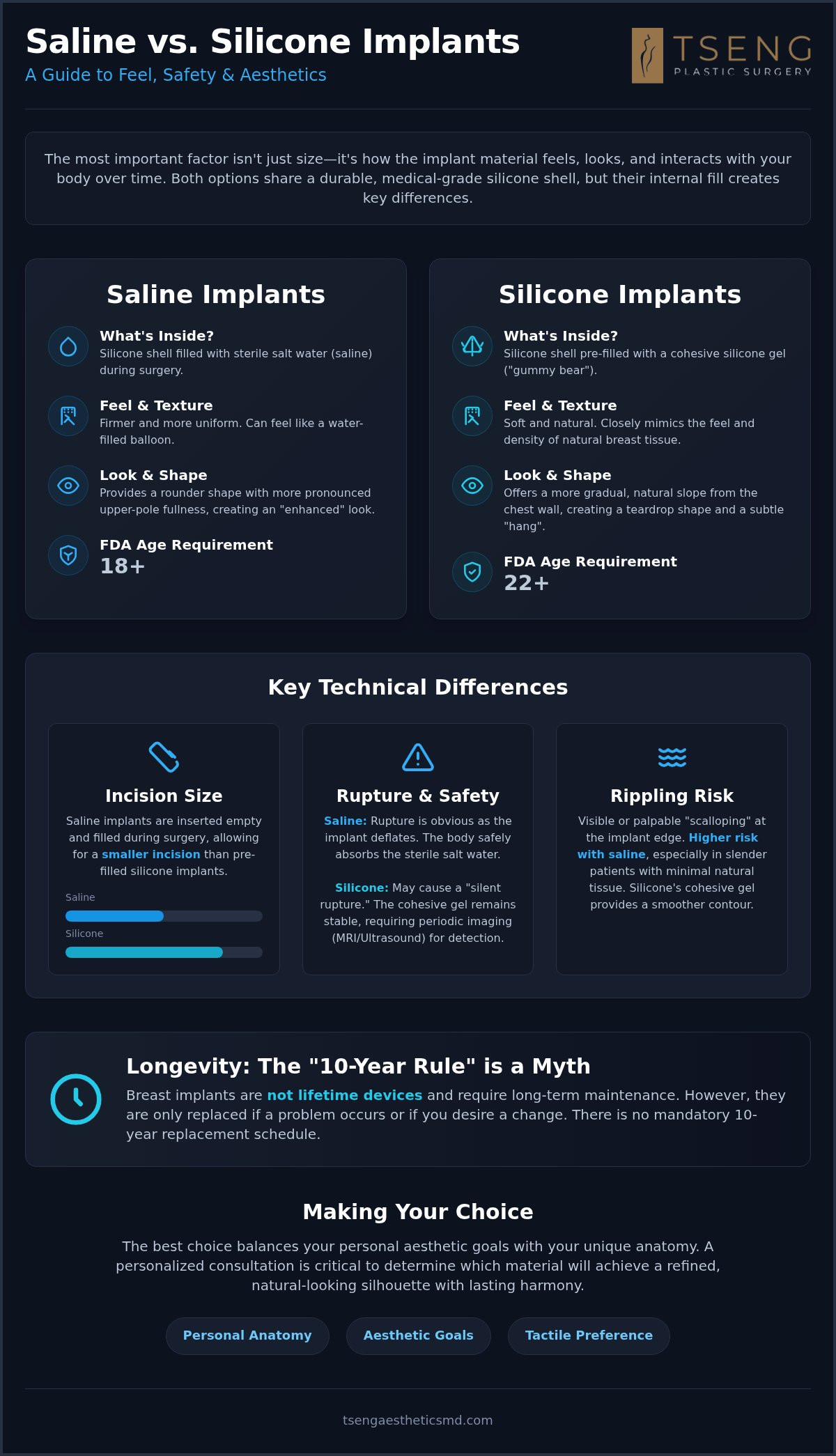
Choosing the right enhancement begins with a clear understanding of the materials involved. While the discussion regarding saline vs silicone implants often focuses on the internal fill, both options share a vital foundation: a medical-grade silicone elastomer shell. This outer layer is engineered for durability and biocompatibility, serving as the refined interface between the implant and your natural anatomy. For those seeking a deeper technical perspective on these devices, resources like Wikipedia offer a neutral look at What Are Saline and Silicone Implants? and their historical development within aesthetic medicine.
Regulatory standards also play a critical role in your initial selection process. The FDA currently mandates that patients must be at least 18 years old for saline augmentation and at least 22 years old for silicone. These guidelines reflect decades of clinical data, ensuring that a patient's physical development aligns with the specific characteristics of their chosen device. It's a safety-first approach that grounds the artistry of the procedure in established medical science.
The Mechanics of Saline Implants
Saline implants consist of a silicone shell that the surgeon fills with sterile salt water during the procedure. This "fill-at-surgery" technique offers a distinct advantage in surgical precision. Because the shell is inserted while empty, it requires a significantly smaller incision than a pre-filled device. This often results in more discreet, well-concealed scars. Surgeons can also fine-tune the volume of the implant while you're on the operating table. This allows for subtle adjustments to ensure symmetry and balance. Modern "structured" saline options have also emerged. These use internal baffles to provide a more natural movement that bridges the gap between traditional saline and gel-based alternatives.
The Science of Modern Silicone Gels
The evolution of silicone has moved away from the liquid fills of the past toward highly cohesive gels, frequently referred to as "gummy bear" implants. When evaluating saline vs silicone implants, the primary appeal of modern gel is its ability to mimic the density of natural breast tissue. These materials are defined by their "cohesivity," a property that ensures the gel remains as a stable, unified mass even if the outer shell is compromised. This stability prevents gel migration and maintains the implant's shape over time. The transition to these solid-state gels represents a significant leap in both safety and aesthetic harmony. It provides a result that's as resilient as it is beautiful.
Aesthetic and Tactile Comparisons: Look, Feel, and Rippling
Choosing between saline vs silicone implants often comes down to a simple sensory preference: how the result feels to the touch and how it moves with your body. Silicone gel is engineered to mimic the density and "give" of natural breast tissue, making it nearly indistinguishable from natural fat in many cases. Saline, by contrast, behaves more like a water-filled balloon. It offers a firmer, more pressurized feel that some patients prefer for its distinct volume and projection.
Visual dynamics also differ significantly between the two materials. Saline tends to provide more pronounced upper pole fullness, which can create a more "enhanced" look that many find desirable. Silicone gel, especially in form-stable varieties, provides a more gradual slope and a natural "hang" because the weight of the gel is distributed more uniformly throughout the shell. While focusing on these aesthetic nuances, it's essential to understand the regulatory insights provided by the FDA regarding How Long Do Breast Implants Really Last? to ensure your visual goals align with long-term expectations.
Slender patients must also consider the "rippling" factor, which is a common concern in aesthetic surgery. Because saline is a liquid, it can sometimes create visible "scalloping" or ridges along the edges of the implant, particularly in women with minimal natural tissue to mask the device. Silicone's cohesive nature makes it much more resistant to this effect, providing a smoother, more seamless transition from the implant to the chest wall. This difference is often the deciding factor for those with a petite frame.
Achieving Natural Results with Silicone
Silicone is frequently the preferred choice for patients seeking subtle rejuvenation and a soft, organic feel. Its cohesive gel structure maintains its shape even under the pressure of chest wall muscles, preventing the "collapsing" that can sometimes occur with liquid fills. The "Gummy Bear" advantage is particularly relevant here; these form-stable implants ensure a consistent silhouette that doesn't shift or distort over time. This provides a reliable and elegant outcome for those starting with very little natural breast tissue.
The Saline Advantage in Specific Anatomies
Saline remains a powerful tool for correcting minor asymmetries and achieving a specific aesthetic "pop." Because the volume can be adjusted during surgery, a surgeon can add slightly more or less fluid to each side to achieve perfect balance. For patients who desire a firmer profile, saline delivers a level of projection that silicone sometimes lacks. When placed submuscularly, the surrounding tissue can often mask potential rippling, making it a viable and safe option for many body types. A master craftsman can help you determine which material complements your unique frame during a personalized consultation.
Longevity and Safety: How Long Do Breast Implants Really Last?
One of the most persistent myths in aesthetic surgery is the "10-year rule," which suggests that implants have an expiration date like a gallon of milk. In reality, modern devices are engineered for exceptional durability. Many patients enjoy their results for 15 to 20 years or even longer without any significant changes in the integrity of the shell. While they aren't lifetime devices, the decision to replace them is usually driven by changes in the patient's body over time or elective aesthetic updates rather than a mechanical failure of the device itself.
When comparing saline vs silicone implants, the way a rupture presents is a primary consideration for long-term peace of mind. Saline offers what's often called "instant notification." If the shell leaks, the sterile salt water is harmlessly absorbed by the body, and the breast deflates quickly. Silicone ruptures are often "silent." Because the cohesive gel maintains its shape, you might not notice a change in the mirror or during a physical exam. This is why the FDA recommends periodic imaging, such as an MRI or ultrasound, starting 5 to 6 years after the initial surgery to ensure the shell remains intact.
Understanding Implant Lifespan Factors
Wear and tear on an implant can be influenced by your unique lifestyle and activity levels. High-impact physical activity or significant weight fluctuations can place stress on the surrounding tissue, potentially affecting how the implant sits over time. Another critical factor is capsular contracture, where the scar tissue around the device tightens. If this occurs, it may lead to discomfort or a change in the breast's shape, necessitating Breast Augmentation Revision Surgery: A Guide to Restoring Aesthetic Harmony to restore the desired look and feel. Regular follow-ups allow your surgeon to monitor these changes carefully.
The Safety Profile of Modern Materials
Safety data from the American Society of Plastic Surgeons provides detailed Aesthetic and Tactile Comparisons that underscore the resilience of today's materials. If a cohesive silicone gel implant shell were to break, the gel stays within the pocket rather than migrating. This stability is a hallmark of "gummy bear" technology. Regardless of whether you choose saline vs silicone implants, long-term safety relies on selecting a board-certified surgeon who prioritizes a patient-first approach. Regular screenings, ideally every two to three years following the initial five-year check, ensure that your aesthetic harmony is preserved and that any subtle changes are addressed before they become concerns.
Surgical Considerations: Incision Placement and Recovery
The technical nuances of your procedure are often dictated by the physical properties of the materials you select. When evaluating saline vs silicone implants, one of the most immediate surgical differences lies in the size and placement of the incision. Because saline shells are inserted empty and filled once they're positioned within the breast pocket, they can be rolled tightly like a small straw. This allows for a "keyhole" approach, utilizing smaller incisions that can sometimes be placed in more discreet locations, such as the umbilical area or a very narrow periareolar opening.
Silicone implants are pre-filled by the manufacturer to ensure the integrity of the cohesive gel. This requires a slightly longer incision, typically along the inframammary fold (the crease under the breast), to accommodate the device's volume. While the incision is larger, a master craftsman uses meticulous suturing techniques to ensure the resulting scar is fine and well-hidden within the natural contours of your body. Your personal history of scarring and your aesthetic goals for minimal visible marks will play a significant role in determining which approach aligns with your vision of refinement.
Matching Choice to Your Lifestyle
Your daily routine and physical ambitions are just as important as your anatomy. For competitive athletes or those with high-intensity fitness regimens, the interaction between muscle movement and implant weight is a vital consideration. Silicone's cohesive nature often provides a more stable silhouette during vigorous activity, whereas saline's liquid fill may exhibit more movement. Additionally, if you're planning future pregnancies or anticipate weight fluctuations, you should consider how these changes might affect skin elasticity and the long-term positioning of your implants. Understanding these variables is key to The Essential Guide to Breast Augmentation: Balancing Art and Science, ensuring your results remain harmonious for years to come.
Post-Operative Care and Refinement
Recovery is a gradual process of transformation often referred to as the "drop and fluff" phase. During this time, the breast tissue relaxes and the implants settle into their final position. Silicone implants tend to feel integrated and natural more quickly because the gel is soft from the moment of placement. Saline implants may initially feel firmer or sit higher on the chest wall, requiring a bit more time for the tissue to accommodate the internal pressure. Whether you choose subpectoral or subglandular positioning, the goal is always a balanced silhouette that feels like a natural extension of yourself. To explore which surgical path best suits your frame, you can schedule your surgical consultation to discuss a personalized plan.
Navigating Your Choice: The Role of Anatomy and Aesthetic Goals
The final decision between saline vs silicone implants marks the moment where technical data meets your personal vision of beauty. A "Patient-First" approach requires more than a simple preference; it demands a thorough evaluation of your unique physical landscape. Dr. Tseng views this consultation as a master-craftsman evaluation, where skin elasticity and breast base width are measured with surgical precision. This ensures the chosen implant doesn't just add volume but enhances your natural silhouette with refined elegance and quiet confidence.
The Tseng Philosophy prioritizes subtle, high-quality improvements over drastic or unnatural changes. We believe that true beauty lies in balance, and the choice of material should reflect your specific aesthetic goals. If your primary objective is customizable volume and projection, saline may be the ideal tool for your transformation. However, if you prioritize a texture that mimics the soft nuance of natural tissue, silicone gel offers unparalleled harmony. Balancing the lower upfront cost of saline with the long-term, tactile benefits of silicone is a personal calculation of value that we guide you through with professional integrity. For those who wish to extend this philosophy of balance to non-surgical facial rejuvenation, Monday Aesthetics & Consulting, PLLC provides expert treatments that complement your surgical results with the same commitment to natural-looking elegance.
Anatomical Assessment: The Surgeon’s Perspective
During your evaluation, we meticulously assess your parenchymal tissue and the shape of your chest wall. A wider breast base or thinner skin may favor the cohesive stability of silicone to prevent visible edges, while a patient with more natural tissue might find saline provides a beautiful "pop" without compromising the look. This level of detail is essential for achieving the Ideal C Cup Guide: Proportions and Augmentation, where the goal is a result that feels as natural as it looks. Your anatomy provides the canvas, and our role is to select the medium that best brings your vision to life.
Finalizing Your Decision
Visualizing the outcome is a vital part of the process. We utilize sizers and advanced 3D imaging to help you see the subtle differences in profile and projection before you ever enter the operating room. This removes the anxiety of the unknown and replaces it with a sense of possibility. The "right" choice isn't a universal standard; it's the one that aligns with your personal vision of harmony and your lifestyle needs. By the end of this journey, you'll feel empowered and informed, ready to step into a refined version of yourself with total peace of mind.
A complete sense of confidence often extends beyond a single procedure to include other aspects of your appearance. For those interested in enhancing their smile alongside their physical silhouette, paddendental.com provides specialized restorative and cosmetic dental solutions that can help complete your aesthetic transformation.
In addition to dental health, professional skin rejuvenation can play a significant role in your overall confidence. For those seeking high-end aesthetic treatments, exoticaskincare.com offers boutique medical spa services that help maintain a youthful and radiant appearance post-transformation.
Embracing a Refined Version of Yourself
The decision between saline vs silicone implants is a deeply personal choice that balances clinical safety with your unique vision of aesthetic harmony. Whether you prioritize the customizable projection of saline or the soft, organic feel of cohesive gel, the most successful outcome is one that honors your anatomy and long-term well-being. By understanding the nuances of implant longevity and the necessity of proactive monitoring, you can approach your transformation with quiet confidence. To maintain your radiant look with professional-grade products, you can learn more about Devotion Beautique and their curated skincare and beauty solutions.
With over 20 years of surgical expertise, Dr. Tseng provides sophisticated, patient-centric care that prioritizes natural-looking rejuvenation. Every procedure is a blend of medical precision and artistic vision. It's our mission to enhance your silhouette while maintaining the subtle elegance you desire. You're invited to Begin Your Personalized Aesthetic Journey with Dr. Tseng and discover the possibilities of refined transformation. Your path toward a more confident self starts with a commitment to quality and a master's touch.
Frequently Asked Questions
How long do breast implants last on average?
Breast implants typically last between 15 and 20 years, although they aren't considered lifetime devices. While many patients enjoy their results for two decades or longer, you should expect to undergo a replacement or revision surgery at some point. Factors like physical activity levels and natural changes in skin elasticity influence the device's lifespan. Regular monitoring ensures that any subtle shifts in the integrity of the shell are addressed before they impact your silhouette.
Do silicone implants look more natural than saline?
Silicone implants generally provide a more natural mimicry of breast tissue because the cohesive gel mimics the density and movement of organic fat. This material offers a softer feel and a more gradual "hang" than the liquid fill found in saline. When comparing saline vs silicone implants, silicone is often the preferred choice for slender patients with minimal natural tissue. Saline can still look natural when placed submuscularly by an expert surgeon.
What is the "silent rupture" associated with silicone implants?
A silent rupture is a breach in the implant shell that occurs without causing visible deflation or physical symptoms. Because modern cohesive silicone is a solid-state gel, it holds its shape even if the outer layer is compromised. This differs from saline, which deflates immediately upon leaking. Because you can't feel or see a silent rupture, the FDA mandates periodic imaging like an MRI to ensure the device remains intact over time.
Is there a price difference between saline and silicone implants?
Silicone implants involve a higher upfront cost than saline because the manufacturing process for cohesive gel technology is more complex. Saline options are typically more affordable since the shells are filled with sterile salt water during the procedure. While the initial investment varies, many patients prioritize the long-term tactile benefits and natural movement of silicone. Your consultation will include a detailed discussion of value to ensure your choice aligns with your personal goals.
Can I switch from saline to silicone later if I change my mind?
You can switch from saline to silicone at any time through a breast revision procedure if your aesthetic goals evolve. This transition is common for patients who initially chose saline but later desire the softer, more natural feel that cohesive gel provides. The process involves removing the old devices and placing new silicone implants, often using the same incision sites. It's an excellent way to refresh your results while addressing concerns like visible rippling or firmness.
Which implant type is safer for long-term health?
Both saline and silicone implants are FDA-approved and have established safety profiles for long-term use in augmentation. Saline is often considered a "low-maintenance" safety choice because a rupture is immediately obvious and the salt water is harmlessly absorbed. Silicone is equally safe but requires more diligent monitoring through imaging to detect silent ruptures. Your choice should be grounded in a "patient-first" philosophy that balances these technical safety features with your lifestyle and comfort.
Do I need an MRI if I have silicone implants?
The FDA recommends that patients with silicone implants receive periodic imaging to check for silent ruptures. You should have your first MRI or ultrasound screening 5 to 6 years after your initial surgery, followed by additional screenings every 2 to 3 years. These scans provide a level of detail that a physical exam simply cannot reach. This proactive approach is a vital part of long-term care, ensuring your peace of mind and the continued harmony of your results.
How often should I have my implants checked by a surgeon?
You should have your implants evaluated by a board-certified surgeon at least once a year during a routine breast exam. These annual visits allow Dr. Tseng to monitor the tissue for signs of capsular contracture or changes in the implant's position. While annual checks are the standard, you should book an appointment immediately if you notice any sudden changes in firmness, shape, or comfort. Consistent follow-ups are the best way to preserve your aesthetic rejuvenation over time.

