The Vertical Facelift Technique: A Masterclass in Natural Facial Rejuvenation
By Tseng Plastic Surgery
True facial rejuvenation isn't an act of tension, but a careful restoration of harmony. Many patients feel a growing disconnect between their internal vitality and a reflection that seems weighed down by time. You likely want to look refreshed, yet you might hesitate because of the "pulled" results often associated with traditional methods. By focusing on the vertical facelift technique, we can address these concerns through a lens of artistry and medical precision.
This approach offers a sophisticated alternative by shifting facial tissues upward rather than outward. It reverses the descent caused by gravity to restore cheek volume and define the jawline without the telltale signs of surgery. You'll discover how this masterclass in aesthetic science prioritizes your personal vision and emotional well-being. We will explore the precision of vertical lifting, the benefits of preservation, and how a tailored plan can help you achieve a look that your friends will admire without ever suspecting a procedure took place.
Key Takeaways
- Understand why lifting tissue against the natural vector of gravity avoids the "windblown" look, ensuring your results remain authentic to your unique features.
- Learn how the vertical facelift technique utilizes the SMAS layer to restore youthful volume and define the jawline with clinical precision.
- Discover the importance of releasing retaining ligaments to achieve a tension-free elevation that feels as natural as it looks.
- Explore the benefits of the Minimal invasive preservation face and neck lift, which focuses on refined outcomes and a patient-centric recovery process.
- See how mapping your unique facial vectors during an unhurried consultation creates a harmonious appearance that friends will notice only as a refreshed glow.
Understanding the Vertical Facelift Technique: Gravity vs. Lateral Pull
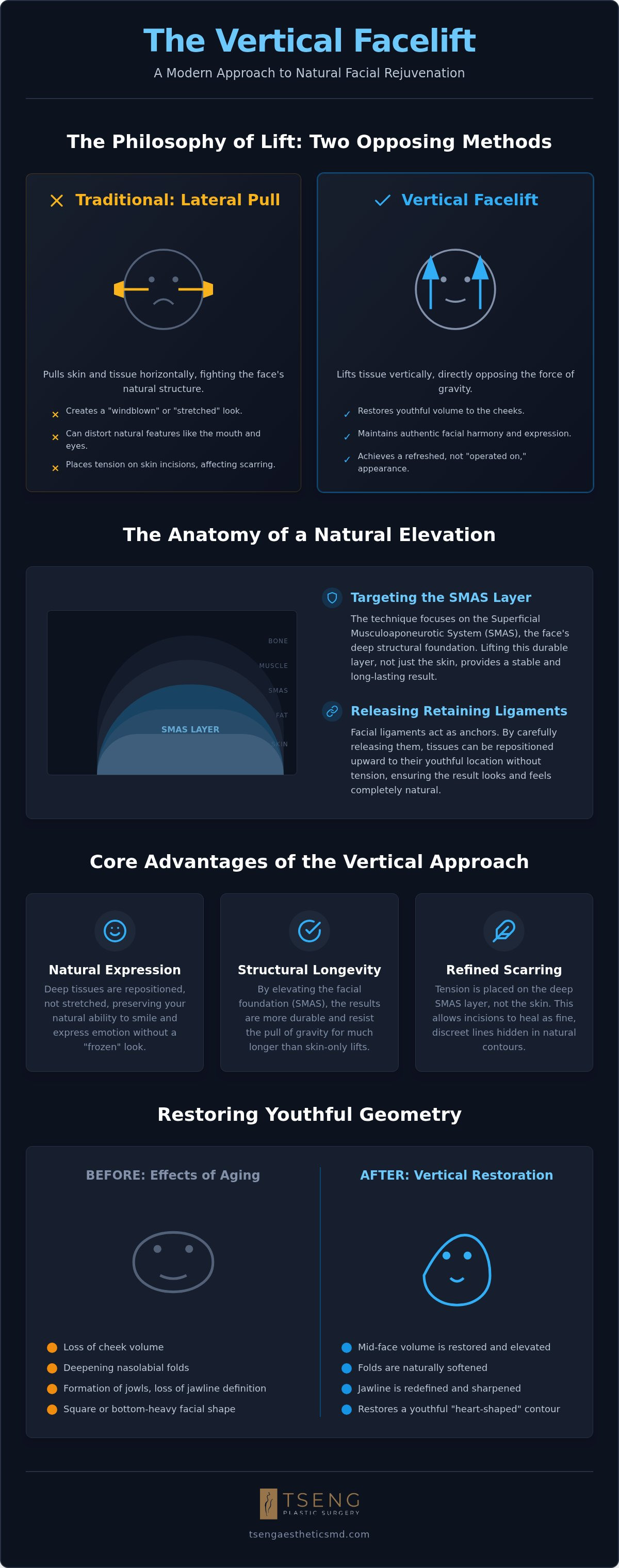
Rejuvenation is a matter of restoring what time has displaced. For decades, the standard approach to facelift surgery (rhytidectomy) often relied on a horizontal pull. This lateral tension, while effective at smoothing skin, frequently created the "windblown" appearance where the mouth looks wide and the eyes appear unnaturally tight. The vertical facelift technique represents a fundamental shift in surgical philosophy. It recognizes that facial aging isn't a horizontal stretching but a vertical descent. By lifting tissues directly against the pull of gravity, we can achieve a result that looks remarkably untouched by a surgeon's hand.
The Physics of Facial Aging
Aging is a three-dimensional process that happens deep beneath the surface. Over time, the internal support structures, including the malar fat pads and retaining ligaments, begin to sag. This vertical drop leads to the formation of jowls and the deepening of nasolabial folds. When a surgeon attempts to fix this by pulling horizontally, it creates a "swept" look that ignores the face's natural geometry. A vertical vector restores the youthful heart-shaped contour. It places volume back onto the cheekbones where it lived in your youth, rather than stretching the skin across the midface. This approach ensures that the face remains balanced and harmonious.
Key Benefits of the Vertical Approach
Choosing a vertical path offers several distinct advantages for the patient seeking a subtle, high-quality improvement. It's a method that prioritizes the integrity of your features while addressing the signs of time.
- Natural Expression Preservation: Because the deep tissues are repositioned rather than stretched, your face retains its ability to move naturally. You won't look "frozen" or "surprised" when you laugh or speak.
- Structural Longevity: The vertical facelift technique focuses on elevating the deep structural layers of the face. Lifting the foundation provides a much more durable result than simply tightening the skin, which inevitably stretches back out.
- Refined Scarring: Vertical tension is distributed across the deep layers of the face. This removes the stress from the skin incisions, allowing them to heal as fine, discreet lines that are easily hidden within the natural contours of the ear and hairline.
The shift from skin-only tension to structural elevation is the hallmark of a master craftsman. It requires a deep understanding of anatomy and a commitment to the patient's long-term well-being. By moving tissue where it belongs, we don't just change how you look; we restore the confidence that comes with a refreshed, authentic appearance.
The Anatomy of Elevation: How Vertical Vectoring Restores Youthful Geometry
True rejuvenation requires more than a surface-level adjustment; it demands a sophisticated restructuring of the facial foundation. While early surgical methods focused solely on the skin, the vertical facelift technique prioritizes the deep-tissue architecture. By addressing the underlying layers, we can restore the natural geometry of the face that time and gravity have altered. This process is less about "pulling" and more about "repositioning" the structural elements to their original, youthful coordinates.
The SMAS Layer and Vertical Tension
The Superficial Musculoaponeurotic System, or SMAS, acts as the vital foundation of your face. It's a fibrous network that connects facial muscles to the skin. In a vertical lift, we secure this layer and elevate it along a strictly upward vector. This prevents the "flat" or "hollowed" look that often occurs when tissues are stretched horizontally. Because the SMAS is more durable than skin, it can hold the weight of the facial tissues securely. This creates a natural contour where the muscles and skin move in perfect harmony. Research into the Minimally Invasive Vertical Endoscopic Facelift technique demonstrates how precisely targeting these deep layers can achieve significant elevation with minimal disruption.
Releasing the retaining ligaments is the secret to a truly tension-free result. These ligaments act like anchors, tethering the SMAS to the facial bones. If they aren't carefully released, any attempt to lift the face will look restricted or "bunched." By freeing these points, the surgeon can glide the tissue into a higher position without force. This creates the soft, unhurried appearance that characterizes elite aesthetic work.
Addressing the Midface and Nasolabial Folds
One of the most profound benefits of the vertical approach is its impact on the midface. As we age, the malar fat pad (the cheek) descends vertically. This creates a hollowed look under the eyes and contributes to heavy nasolabial folds and marionette lines. Lifting this fat pad directly upward restores volume to the cheekbones and softens the transition from the lower eyelid to the cheek. It effectively eliminates the need for excessive dermal fillers, which can sometimes lead to an over-filled or "puffy" appearance.
This single vertical vector also addresses jowling far more effectively than traditional methods. By lifting the lower face and neck simultaneously, we redefine the jawline with a crisp, clean edge. During a personalized consultation, we map these specific vectors to ensure your results feel entirely your own. The result is a refreshed appearance that respects your anatomy and preserves your unique identity.
Vertical Facelift vs. Traditional SMAS and Deep Plane Techniques
Choosing the right surgical path requires an understanding of nuance, as the terminology used in facial rejuvenation can often feel overlapping. While many procedures aim to address aging, the results they produce vary significantly based on the vector of the lift. Traditional SMAS procedures often prioritize a lateral or horizontal pull. This tension might smooth the skin, but it fails to address the underlying vertical descent of the facial fat pads. It's often why some patients look "different" or "tight" rather than truly younger. In contrast, the vertical facelift technique specifically refines the vector of elevation to ensure the midface and jawline are restored to their precise youthful coordinates.
The deep plane facelift is another sophisticated method that releases deeper tissues to allow for significant movement. While it incorporates verticality, the vertical technique focuses intensely on the upward repositioning of the foundation. Many patients also ask about a "mini lift," which is often marketed as a quick fix. However, a mini lift typically lacks the depth of a full vertical procedure. It's a compromise that may not provide the comprehensive rejuvenation or the structural integrity required for a lasting transformation. By 2026, the vertical approach has become the gold standard for those who value an authentic, un-operated appearance.
Technical Distinctions and Outcomes
The differences between these techniques extend to both the surgical execution and the long-term results. Traditional skin-only or superficial SMAS lifts often have a longevity of 5 to 7 years because the skin eventually stretches under tension. Structural lifts, such as the vertical facelift technique, offer a much more durable outcome, often lasting 10 to 15 years. This is because the weight of the face is supported by the deep fibrous layers rather than the delicate surface skin. Ideal candidates are typically those who notice significant jowling or a hollowed midface, where only a deep-tissue elevation can restore the lost volume and definition.
Combining Techniques for Refinement
A master craftsman understands that structural lifting is often one part of a larger aesthetic puzzle. To achieve a truly harmonious result, Dr. Tseng may combine vertical lifting with facial fat grafting to restore the soft, youthful fullness that surgery alone cannot replicate. This combination addresses both the position of the tissues and the volume they have lost over time. Additionally, a neck lift is frequently integrated to complete the silhouette, ensuring the transition from the jawline to the collarbone is as crisp and elegant as the rest of the face. We also address skin texture through complementary treatments, ensuring the surface reflects the renewed vitality of the underlying structure.
The Patient Experience: Preparation, Procedure, and Refined Recovery
The journey toward a more youthful reflection begins with an unhurried, meticulous consultation. During this time, Dr. Tseng maps your unique facial vectors to determine exactly how the vertical facelift technique will be applied to your specific anatomy. This isn't a one-size-fits-all procedure; it's a bespoke plan designed to restore your natural contours while maintaining the integrity of your expressions. We prioritize safety and comfort, utilizing advanced anesthesia protocols in a state-of-the-art surgical environment to ensure a smooth, sophisticated experience for every patient.
Understanding the distinction between physical healing and social downtime is essential for a stress-free recovery. While your body begins the biological process of repair immediately, "social downtime" refers to the period before you feel comfortable returning to public life or professional engagements. This unhurried approach to healing ensures that the final result is as refined as the technique itself, allowing you to return to your routine with quiet confidence.
Preparing for Your Transformation
Success in the operating room is often a result of preparation in the weeks prior. We focus on pre-operative health optimizations, such as nutritional support and skin health, to ensure superior healing. Managing expectations is equally vital. The goal of the vertical approach is to make you look refreshed and vibrant, not different or "operated on." To assist with your comfort, we recommend preparing a home recovery suite with essentials like extra pillows for elevation, cold compresses, and easy-to-prepare meals.
The Recovery Timeline: What to Expect
The first 48 hours are dedicated to rest and managing initial swelling. Most patients report a sense of tightness rather than significant pain. Between days 7 and 14, we typically perform suture removal, and many individuals find they are ready to return to social activities with the help of light camouflage makeup. By the end of the first month, the majority of swelling has subsided, though the tissues continue to settle into their final, youthful positions over the next three months. For a more detailed look at the healing process, you can read our full guide on facelift recovery for more detail.
If you are ready to begin your personalized journey toward restoration, we invite you to schedule a consultation with our expert team to discuss your aesthetic goals.
Achieving Natural Harmony with Minimal Invasive Preservation Techniques
The vertical facelift technique has fundamentally changed how we view restoration, but the most refined results come from combining this vector with a preservation mindset. At Tseng Plastic Surgery, we specialize in the Minimal invasive preservation face and neck lift. This advanced approach moves beyond just lifting; it focuses on protecting the delicate internal structures of the face while achieving significant rejuvenation. It represents the logical conclusion of the vertical evolution, where the goal is a look that feels entirely authentic and untouched. By shifting the focus from tension to preservation, we ensure that the face's natural character remains the primary focus.
The Science of Preservation
Traditional surgery often relies on aggressive tissue removal and wide dissection, which can lead to prolonged swelling and a "surgical" appearance. In contrast, the philosophy behind the Minimal invasive preservation face and neck lift is to maintain the integrity of facial tissues while repositioning them. By utilizing smaller, strategic incisions and targeted dissection, we significantly reduce trauma to the blood vessels and nerves. This precision not only facilitates a faster healing process but also ensures the final result is virtually untraceable to the naked eye. You aren't just looking younger; you're looking like a more vibrant version of yourself, with the underlying anatomy preserved rather than disrupted. This methodical approach creates a sense of stability and reliability that's essential for patients seeking high-end aesthetic care.
Your Journey with Tseng Plastic Surgery
Choosing a surgical path is a deeply personal decision that requires a "patient-first" mentality. Dr. Tseng, who possesses over 20 years of surgical experience, approaches every face as a unique canvas where science meets artistry. We believe that conservative, thoughtful adjustments lead to the most balanced and harmonious results. Our unhurried consultation process allows us to listen to your goals and craft a plan that respects your individual vision. Many of our national patients appreciate this personalized touch, as it ensures the physical transformation aligns with their emotional well-being. Whether you are seeking a full restoration or are still deciding between paths, it's helpful to learn more about the surgical vs non-surgical facelift to see which path fits you.
True elegance lies in the details. By prioritizing preservation alongside the vertical facelift technique, we offer a pathway to rejuvenation that honors your past while embracing your future. The personality of our practice is built on integrity and a dedication to subtle, high-quality improvements. When you're ready to take the next step, we invite you to schedule a personalized consultation to explore the possibilities of refined facial artistry. This is your opportunity to empower yourself with information and discover a refreshed appearance that feels as good as it looks.
Restoring Harmony Through Vertical Artistry
Choosing the right path for facial rejuvenation is a decision that balances clinical science with your personal vision of beauty. We've explored how the vertical facelift technique moves beyond the limitations of traditional horizontal pulling by working in harmony with your natural anatomy. By addressing the deep structural descent caused by gravity, this approach restores youthful geometry while preserving the unique expressions that make you who you are. The shift toward preservation ensures that your results are not only durable but also virtually untraceable.
With over 20 years of surgical expertise, Dr. Tseng remains dedicated to achieving balanced, natural-looking results through the Minimal invasive preservation face and neck lift. This commitment to refined artistry means you'll look refreshed and vibrant without the fear of appearing "operated on." If you're ready to align your reflection with the vitality you feel inside, we invite you to Schedule a Consultation with Dr. Tseng to Discuss Your Vertical Rejuvenation. Your journey toward a more confident, harmonious appearance is a possibility that starts today.
Frequently Asked Questions
Is a vertical facelift more expensive than a traditional facelift?
The investment for a vertical procedure often reflects the increased complexity and specialized expertise required to navigate deep tissue layers. While specific fees vary based on your unique anatomy and aesthetic goals, this approach is a sophisticated investment in long-term restoration. Patients often find that the durability and natural quality of the results provide a superior value compared to less comprehensive methods that might require earlier revision or frequent maintenance over time.
How long do the results of a vertical facelift technique typically last?
The results of the vertical facelift technique typically last between 10 and 15 years, which is significantly longer than traditional skin-only procedures. This longevity is due to the elevation of the SMAS and deep structural layers rather than relying on skin tension alone. While your face will continue to age naturally, you'll always look younger than you would've without the surgery. Maintaining a healthy lifestyle further supports these enduring aesthetic improvements.
Will I have visible scars after a vertical facelift?
Incisions are meticulously placed within the natural contours of the ear and hairline to ensure they remain discreet. Because the vertical vector distributes tension across the deep structural layers, the skin edges can be closed without force. This tension-free closure is the key to fine, flat scars that fade significantly over time. Most patients find that once they've healed, their friends and family cannot identify the surgical entry points even upon close inspection.
Can the vertical facelift be performed under local anesthesia?
While some minor modifications can be performed with local anesthesia, a comprehensive lift is usually performed under general anesthesia for patient safety and comfort. This ensures a controlled surgical environment where Dr. Tseng can apply his master craftsman approach with absolute precision. We prioritize a stable experience that allows for thorough deep-tissue work, whether you're receiving a traditional procedure or our signature Minimal invasive preservation face and neck lift, while ensuring you remain comfortable.
At what age should I consider a vertical facelift technique?
There isn't a single correct age, as the decision depends more on your unique anatomical changes than a number on a calendar. Most patients consider the vertical facelift technique when they notice significant jowling, a hollowed midface, or a loss of jawline definition. Whether you're in your 40s or your 60s, the goal is to address the vertical descent of facial tissues before the skin loses too much of its natural elasticity for optimal restoration.
How does the vertical facelift differ from a 'ponytail lift'?
A ponytail lift is often a marketing term for a less invasive procedure that primarily tightens the skin at the temples. In contrast, a vertical facelift is a comprehensive surgical restoration that repositions the deep SMAS layer and fat pads. While a ponytail lift might provide a temporary lifted look for younger patients, it doesn't address the structural descent of the midface or neck. The vertical approach offers a more profound and lasting transformation.
Can I combine a vertical facelift with non-surgical treatments like Botox?
Yes, combining surgical restoration with injectables often produces the most harmonious and balanced results. While the facelift addresses the structural foundation and sagging tissues, treatments like Botox or fillers target surface-level concerns such as fine lines and dynamic wrinkles. This dual approach ensures that the underlying architecture is youthful while the skin remains smooth and vibrant. We often integrate these options into a personalized plan to achieve your specific vision of rejuvenation and confidence.
What is the primary advantage of the vertical vector over the lateral vector?
The primary advantage is the restoration of natural volume without the pulled look associated with horizontal tension. A lateral vector stretches the skin outward, which can distort the mouth and flatten the cheeks. A vertical vector moves the descended fat pads directly upward to where they lived in your youth. This restores the heart-shaped face and defines the jawline, ensuring your results look authentic and move naturally when you smile, laugh, or speak.

