Lower Face and Neck Lift: A Comprehensive Guide to Refined Jawline Rejuvenation
By Tseng Plastic Surgery
A truly elegant rejuvenation isn't about pulling the skin tighter, but rather about restoring the underlying architecture that time has gently shifted. Many patients look in the mirror and notice the once-sharp angle of their jawline softening into jowls, or the appearance of vertical bands that make the neck feel like a separate entity from the face. It's natural to worry that surgery might result in a "windswept" or artificial look that betrays your desire for subtlety. If you've found yourself tilting your head or adjusting your collar to hide these changes, you aren't alone in seeking a more permanent, refined solution through a lower face and neck lift.
We understand that your goal isn't to look like a different person, but to look like a well-rested version of yourself. This guide explores how an integrated lower face and neck lift restores a crisp jawline and youthful neck contour while maintaining your natural anatomical harmony. We'll examine the preservation techniques that prioritize natural movement, the specific concerns addressed by an integrated approach, and the methodical steps involved in achieving a result that feels both transformative and entirely yours.
Key Takeaways
- Understand why jowls and neck bands are structurally linked and why treating the lower third as a single anatomical unit is essential for a harmonious result.
- Explore how a lower face and neck lift utilizes minimal invasive preservation techniques to reposition deeper tissues while avoiding an artificial or over-tightened appearance.
- Learn the key differences between targeted lower rejuvenation and full facelifts, including how sophisticated incision placement ensures your results remain discreet.
- Identify if you are an ideal candidate by evaluating the role of skin elasticity and underlying bone structure in achieving a crisp, enduring jawline contour.
- Discover the "Artist-Scientist" philosophy that guides Dr. Tseng's approach, ensuring your transformation reflects a perfect balance of clinical precision and natural symmetry.
Understanding the Lower Face and Neck as an Anatomical Unit
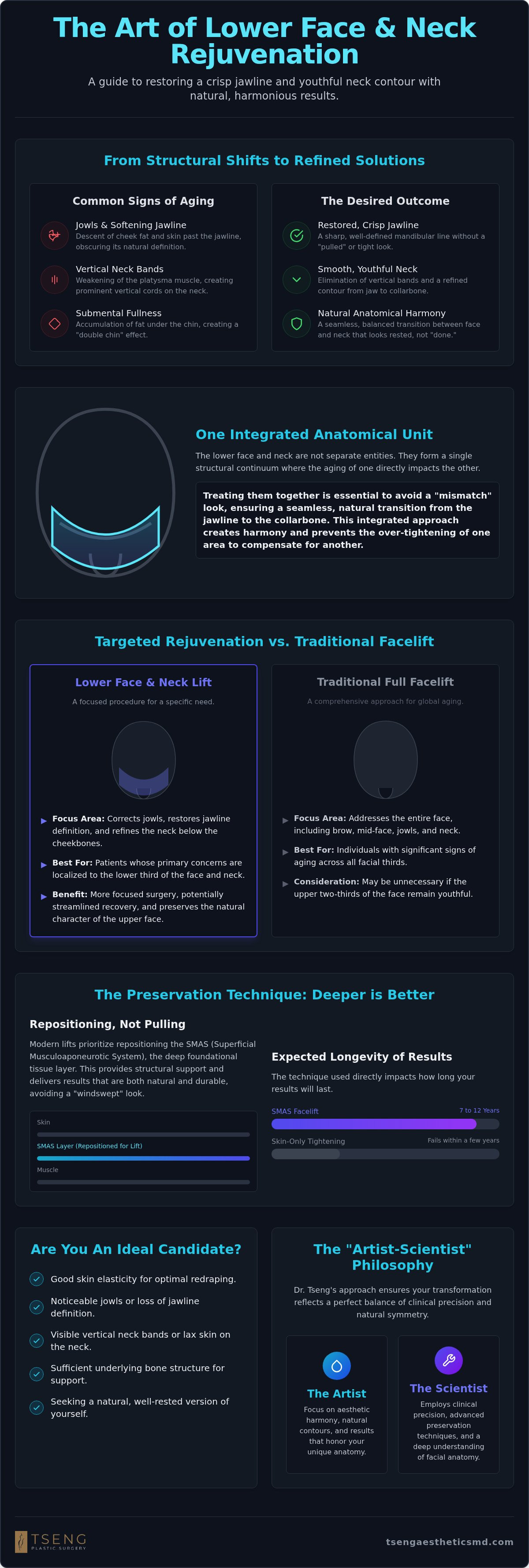
Facial aging is rarely a localized event. Instead, it's a structural shift that occurs across the lower third of the face, an area spanning from the base of the nose to the collarbone. While many consider the jawline and the neck as separate aesthetic concerns, they function as a singular structural continuum where the descent of one inevitably impacts the other. This is why treating them in isolation often leads to a "mismatch" look, where a tight jawline sits atop a lax neck, or vice versa. A comprehensive lower face and neck lift acknowledges this reality by addressing the entire unit to ensure a seamless, natural transition.
Choosing to treat the lower face and neck together prevents the artificial appearance that often stems from over-tightening a single area to compensate for another. Many competitors treat these as separate surgical codes, yet the most refined results come from understanding their shared anatomy. When we reposition the deeper layers of the lower face, the tension is distributed evenly, creating the "artist-scientist" balance that defines sophisticated rejuvenation. A technical Rhytidectomy (facelift) provides the framework for this work, but the specialized focus on the lower third is what restores the crisp, youthful profile patients desire.
The Anatomy of the Jawline and Neck
The foundation of a youthful neck is the platysma muscle, a thin sheet of tissue that supports the contour of the throat. Over time, this muscle can weaken or separate, leading to the formation of vertical bands. Simultaneously, fat compartments in the lower face don't simply disappear; they migrate downward due to gravity and the loosening of retaining ligaments. A lower rhytidectomy is a surgical procedure specifically designed to correct the transition between the jawline and the neck by repositioning these underlying tissues. By restoring these structures to their original positions, we can achieve a sharp mandibular line without the need for excessive skin tension.
Common Signs of Lower Facial Aging
The most frequent concern for patients is the development of jowls, which occurs when the skin and fat of the cheeks descend past the jawline. This loss of mandibular definition is often accompanied by submental fat accumulation, creating a "double chin" effect even in patients who haven't gained weight. Skin elastosis, or the loss of structural proteins like collagen and elastin, further complicates this by allowing vertical neck cords to become prominent. Addressing these signs through an integrated lower face and neck lift ensures that every element of the lower profile is harmonized, resulting in a look that is rested rather than "done."
Lower Face and Neck Lift vs. Traditional Facelift
Distinguishing between a targeted lower rejuvenation and a full facelift is a matter of anatomical necessity and aesthetic goals. While a traditional facelift addresses the entire face, including the brow and mid-face, a lower face and neck lift focuses specifically on the area below the cheekbones. This includes the correction of jowls, the restoration of a sharp mandibular line, and the refinement of the neck. For many patients, the upper two-thirds of the face remain youthful, making a full procedure unnecessary and potentially over-treated.
The technical difference lies in the depth of the work. Modern surgical standards prioritize the SMAS layer, the deep tissue system that provides structural support. By repositioning this layer rather than merely pulling the skin, we achieve results that last significantly longer. Research indicates that a traditional SMAS facelift can provide rejuvenation for 7 to 12 years, whereas skin-only tightening often fails within a few years as the tissue stretches. Incisions for a lower procedure are meticulously placed around the ear and into the hairline, ensuring they remain virtually invisible once healed.
Why Choose a Targeted Lower Procedure?
Choosing a targeted procedure allows you to address the most visible signs of aging without altering the natural character of your eyes or forehead. It's an ideal solution for those who feel their neck and jawline no longer match the vitality of their upper face. Because the surgical scope is more focused, patients often benefit from reduced time under anesthesia and a more streamlined recovery process. This precision ensures you look like yourself, only more refined and rested. If you are beginning to explore your options, a private assessment can help determine which procedure aligns with your anatomical requirements.
When a Full Facelift is More Appropriate
A full facelift becomes the preferred choice when aging affects the mid-face and brow in addition to the jawline. If you notice significant volume loss in the cheeks or a heavy, sagging brow that creates a tired appearance, a comprehensive approach is required to maintain facial balance. Addressing only the lower third when the mid-face has descended can sometimes create an unnatural transition between the cheeks and the jawline. You can read more about these broader techniques in our article on The Modern Facelift: A Comprehensive Guide to Natural Facial Rejuvenation.
Preservation Techniques: The Minimal Invasive Edge in 2026
Modern facial rejuvenation has moved away from aggressive tissue excision toward a philosophy of architectural respect. A minimal invasive preservation lower face and neck lift represents the pinnacle of this evolution, focusing on the careful manipulation of existing structures rather than their removal. Instead of wide undermining that can disrupt blood supply and lymphatic drainage, this approach works within natural tissue planes. By respecting these biological boundaries, surgeons achieve significant structural repositioning with minimal trauma to the surrounding area, ensuring the face retains its essential vitality.
The "un-operated" look is the ultimate goal of this refined methodology. It relies on maintaining the structural integrity of the face by keeping the natural scaffolding intact. When the underlying layers are moved as a cohesive unit, the skin follows naturally without the need for excessive pulling. This results in a jawline that looks crisp and a neck that appears smooth, yet the results remain entirely harmonious with your unique anatomy. Patients often report that friends notice they look rested and refreshed, yet cannot quite place the reason why.
The Preservation Philosophy
The core of this philosophy is the belief that moving tissue is superior to removing it. Traditional methods often relied on significant skin excision to create tension, which frequently resulted in visible scarring or a "pulled" appearance. Preservation techniques focus on releasing and gliding the deeper layers into a more youthful position while retaining the essential ligaments that provide natural support. Preservation techniques are the preferred choice for 2026 aesthetic patients because they offer a sophisticated balance of structural longevity and a remarkably gentle recovery process.
Comparing Preservation to SMAS Plication
While SMAS plication involves folding or bunching the muscle layer to create lift, preservation techniques work with the deeper layers to release the structures that have sagged over time. This reduces the "bulkiness" sometimes seen with plication and avoids the extensive surgical trauma associated with more aggressive procedures. Because the natural vascularity is preserved, patients experience significantly less swelling and a faster return to their daily lives. Results remain stable because the tension is placed on the deep, non-stretching layers rather than the skin surface.
Longevity is a primary concern for anyone considering a lower face and neck lift. While some industry perspectives suggest that only the most invasive techniques provide lasting results, preservation methods prove that structural integrity and subtlety are not mutually exclusive. By maintaining the face's natural support systems, the results age gracefully. For those comparing different surgical approaches and their expected lifespans, our guide on How Long Does a Deep Plane Facelift Last? Longevity and Results Guide provides a detailed breakdown of what to expect from modern rejuvenation techniques.
Candidacy and The Path to Refined Results
Determining if you are an ideal candidate for a lower face and neck lift involves more than just a general health screening. While physical wellness is foundational, aesthetic candidacy depends heavily on your underlying bone structure and current skin quality. Patients with a well-defined mandible often see the most dramatic results, as the bone provides a strong anchor for the repositioned tissues. If skin elasticity remains relatively good, the "drape" over the newly defined jawline will be smooth and natural. Conversely, if there is significant sun damage or extreme skin thinning, we may need to discuss pre-treatment protocols to optimize the surgical outcome.
Managing expectations is a vital part of the unhurried patient journey. Surgery excels at correcting structural descent, such as heavy jowls and vertical neck bands, but it doesn't stop the biological clock or erase every fine surface line. Understanding what a lower face and neck lift can and cannot achieve ensures that you feel empowered rather than surprised during your transformation. This is why a thorough dialogue with a board-certified surgeon is essential to align your personal vision with clinical reality. To begin this journey, you can schedule a personalized consultation to discuss a plan tailored specifically to your goals.
Preparing for Your Journey
Preparing for surgery in 2026 involves sophisticated health optimizations that go beyond basic blood work. We focus on nutritional protocols that support collagen synthesis and minimize post-operative inflammation. During your consultation, it's helpful to ask about the specific preservation techniques used and how they impact your unique anatomy. Most patients should plan for approximately 10 to 14 days of social downtime, though the unhurried rhythm of recovery varies for everyone. This period is a time for quiet reflection and physical healing as your new contours settle into place.
Complementary Non-Surgical Enhancements
While surgery restores the architecture, non-surgical treatments can provide the finishing touches. Injectables are often used months after a procedure to refine subtle volume loss in the lips or around the mouth, areas surgery doesn't directly address. Laser treatments can further enhance the result by improving surface texture and addressing pigment issues that surgery cannot fix. To understand how these options work in tandem, you can explore our Surgical vs. Non-Surgical Facelift: The Comprehensive 2026 Guide to Facial Rejuvenation.
The Tseng Approach: Artistry in Facial Rejuvenation
Choosing a surgeon for a lower face and neck lift is a decision rooted in trust and a shared vision of refinement. Dr. Mark H. Tseng brings over 20 years of surgical experience to every procedure, blending technical precision with an innate sense of aesthetic balance. This "artist-scientist" framework ensures that every preservation lift is customized to the patient's unique anatomy, rather than following a rigid, universal template. It's about respecting the existing character of your face while gently restoring the architectural harmony that has softened over time.
At the heart of this practice is a commitment to unhurried, patient-centric care. We believe that the best results come from a deep understanding of your personal goals, which requires time, listening, and a methodical approach to surgical planning. By prioritizing the individual's journey, we ensure that the transformation feels personal and significant, yet entirely natural. Our focus remains on achieving symmetry and grace, positioning the practice as a premier choice for those who value quality over drastic change.
Why Experience Matters in Lower Face Surgery
The lower third of the face contains a complex network of nerves and vessels that require a master craftsman's touch to navigate safely. A successful lower face and neck lift relies on the nuanced tightening of the platysma muscle, a process known as platysmaplasty, to eliminate banding without creating a stiff appearance. Dr. Tseng's extensive background allows him to manage these delicate structures with the highest level of care. Achieving a seamless balance between the face and neck is an intricate task, and it's here where two decades of experience make the most visible difference in the longevity and quality of your result.
Next Steps Toward Rejuvenation
Your path to a more refined profile begins with a private consultation, a dedicated time for you to share your concerns and explore the possibilities of modern rejuvenation. During your first visit, you'll experience our sophisticated and welcoming environment, where we conduct a thorough anatomical assessment and discuss your aesthetic aspirations. We'll outline a personalized plan that respects your timeline and comfort level. Refined aging isn't about stopping time, it's about moving through it with a sense of confidence and vitality that reflects how you feel on the inside. We invite you to contact our practice to take the next step toward a more youthful, harmonized version of yourself.
Embracing a Refined Version of Yourself
Restoring the lower third of the face is a delicate balance of clinical precision and artistic vision. By treating the jawline and neck as a single anatomical unit, a lower face and neck lift can resolve jowls and vertical banding while preserving your unique character. Modern preservation techniques ensure that you look refreshed and rested, avoiding the over-tightened results of the past. Dr. Mark H. Tseng brings over 20 years of surgical experience and board-certified expertise to every procedure, focusing on subtle outcomes that honor your natural anatomy.
This unhurried approach allows for a transformation that feels both significant and entirely yours. If you're ready to explore how a tailored surgical plan can restore your confidence, we invite you to take the next step. Schedule your personalized consultation with Dr. Tseng today to begin your journey toward a more youthful, harmonized profile. Refined aging is within reach, and we look forward to guiding you through every step of this empowering process.
Frequently Asked Questions
What is the difference between a mini facelift and a lower face and neck lift?
A mini facelift typically addresses early signs of aging in the lower face with shorter incisions and less tissue manipulation. In contrast, a comprehensive rejuvenation corrects both the sagging jawline and the underlying muscle bands in the neck. This dual approach ensures a harmonious transition between the face and the neck, whereas a mini lift often leaves the neck concerns unaddressed, resulting in a potential aesthetic mismatch.
How long does the recovery take for a lower face and neck lift in 2026?
Most patients can expect approximately 10 to 14 days of social downtime before feeling comfortable in public settings. During the first week, mild swelling and bruising are common, though modern preservation techniques significantly reduce these side effects compared to traditional methods. While you'll look refreshed within two weeks, the final internal healing and refinement of the surgical contours continue for several months as the tissues settle into their new positions.
Will I have visible scars after a preservation neck lift?
Incisions are meticulously placed in the natural creases around the ear and within the posterior hairline to ensure they remain virtually imperceptible once healed. The preservation approach minimizes tension on the skin, which is a critical factor in preventing the widening or thickening of scars. Over time, these fine lines fade and blend into your natural skin tone, allowing you to wear your hair up with complete confidence in your results.
Can a lower face lift fix my double chin without liposuction?
If your double chin is caused by muscle laxity or sagging skin, a lower face and neck lift can effectively restore a sharp profile by tightening the platysma muscle. However, if the concern is primarily due to localized fat deposits, liposuction may be recommended as a complementary procedure. During your consultation, an anatomical assessment will determine whether structural repositioning or fat removal is the most appropriate path to achieve your desired jawline definition.
How long do the results of a lower face and neck lift typically last?
Results from a preservation-based procedure typically last between 7 and 12 years, depending on your lifestyle and skin quality. While surgery cannot stop the natural aging process, it effectively resets the clock by restoring the underlying structural architecture of the lower third. Patients who maintain a healthy lifestyle and follow a consistent medical-grade skincare regimen often enjoy their refined contours for even longer, aging more gracefully than they would have without intervention.
Is a lower face and neck lift performed under general anesthesia?
Most integrated facial procedures are performed under general anesthesia or deep sedation to ensure patient comfort and surgical precision. This allows the surgeon to meticulously address the deeper muscle layers and retaining ligaments without any distress to the patient. Your safety is our highest priority, and a board-certified anesthesiologist monitors you throughout the entire process to maintain a stable and controlled environment during your transformation journey.
What is the ideal age to consider a lower face and neck rejuvenation?
There is no single correct age, but most patients begin considering these procedures in their late 40s to early 60s when jowls and neck laxity become prominent. Some individuals with genetic predispositions toward a heavy neck or weak jawline may seek rejuvenation earlier. The decision is based on anatomical changes rather than chronological age, focusing on when non-surgical treatments can no longer provide the structural support needed for a crisp profile.
How does a preservation lift differ from a traditional facelift?
The preservation approach differs from a traditional procedure by prioritizing the integrity of the facial retaining ligaments and vascular supply. Instead of wide undermining and significant tissue removal, this technique glides deeper layers into a more youthful position within natural anatomical planes. This ensures a lower face and neck lift results in less swelling and a more natural look, as the skin is never pulled under tension, maintaining the soft character of your unique features.

