Is a Mini Facelift Worth It? A Surgeon’s Guide to ROI and Results (2026)
By Tseng Plastic Surgery
What if the most effective way to maintain your youthful profile isn't to wait for a total transformation, but to preserve your natural anatomy before it significantly shifts? Many patients find themselves questioning if a mini facelift is worth it when compared to more invasive options or temporary injectables. You likely desire a refined jawline and a refreshed appearance, yet you're understandably worried that a mini procedure won't offer lasting value or might leave you looking unnaturally tight. It's common to feel confused by surgical terminology and the fear of an overdone result.
This guide provides a surgeon's perspective on the true return on investment for early intervention, focusing on how modern preservation techniques offer a sophisticated balance of longevity and artistry. We'll analyze the surgical precision of repositioning the SMAS layer, compare the physical investment to traditional alternatives, and explore why high patient satisfaction rates reflect the shift toward subtle, high-quality improvements. Discover how a methodical approach to facial rejuvenation can provide the natural, unhurried results you deserve.
Key Takeaways
- Understand that "mini" describes the focused surgical scope and shorter incisions rather than a compromise in technique or aesthetic quality.
- Evaluate the long-term ROI by comparing the five-to-ten-year lifespan of a surgical lift against the cumulative costs of fillers to decide if a mini facelift is worth it for your goals.
- Learn the anatomical differences between a mini and full facelift, including how a targeted approach on the jowls can reduce your social downtime to just one week.
- Assess your candidacy for the "Mini Lift Zone" by reviewing specific markers of skin elasticity and early lower-face aging.
- Explore the preservation philosophy that prioritizes natural facial harmony to maximize the longevity of your results and minimize the need for future revisions.
Defining the Mini Facelift: More Than Just a "Lesser" Procedure
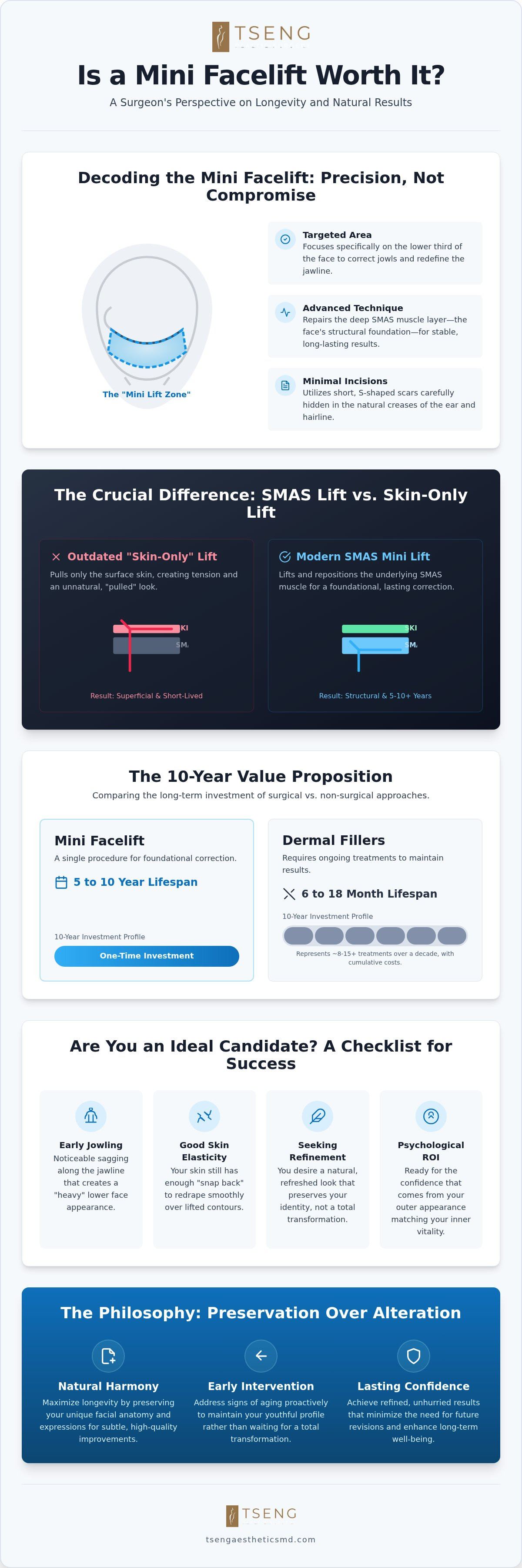
A mini facelift is often misunderstood as a diluted version of a standard procedure, yet it represents a highly specialized approach to facial harmony. This technique focuses specifically on the lower third of the face, targeting the early signs of jowling and jawline laxity before they require more extensive intervention. When patients ask is a mini facelift worth it, the answer often depends on the depth of the surgical technique rather than the length of the incision. While the clinical term for a facelift is Rhytidectomy, a modern mini lift specifically manipulates the Superficial Musculoaponeurotic System, or SMAS. This underlying tissue layer provides the essential structural support for your face. Simply pulling the skin, a method known as a "skin-only" lift, rarely yields the sophisticated, long-lasting results that justify the investment. By repositioning the SMAS, a surgeon can achieve a refined, youthful contour that remains stable for years.
The Anatomy of the Mini Lift Incision
The hallmark of a masterfully executed mini lift is the "S-lift" or short-scar technique. These incisions are meticulously placed within the natural creases of the ear and hairline to ensure they remain virtually invisible once healed. Precision in placement is vital; it allows the surgeon to access deeper tissues without creating the "pulled" look associated with outdated methods. By focusing on deep-tissue structural changes, we minimize tension on the skin itself. This approach not only promotes faster healing but also prevents the wide, visible scarring that can occur when skin is forced to do the heavy lifting of facial support. It's a delicate balance of science and artistry that preserves your natural expressions while refining your profile.
Mini Facelift vs. The "Weekend Lift": Avoiding Gimmicks
It's vital to distinguish between a medical procedure and a marketing brand. Terms like the "Weekend Lift" or "Quick Lift" are often non-medical labels designed to overpromise convenience at the expense of longevity. To ensure is a mini facelift worth it for your specific anatomy, you must look beyond these gimmicks and focus on surgical expertise. A customized surgical plan, performed by a board-certified plastic surgeon, accounts for your unique bone structure and skin quality. Unlike one-size-fits-all branded lifts, a personalized preservation approach focuses on your individual vision of yourself. This level of care ensures that the transformation feels like a natural extension of your identity rather than a temporary, superficial fix. High-quality facial rejuvenation requires a methodical, unhurried approach that prioritizes your safety and long-term satisfaction.
The Surgical ROI: Analyzing the Worth of Results and Longevity
When assessing the financial and emotional commitment of facial surgery, many patients rightfully ask, is a mini facelift worth it over the long term? Unlike non-surgical alternatives that require maintenance every few months, a well-executed mini lift typically provides a refreshed appearance for five to ten years. This longevity creates a significant "cost per year" advantage when compared to high-volume fillers. While injectables offer temporary volume, they can't resolve the structural tissue laxity that causes jowling. Over a decade, the cumulative investment in temporary treatments often exceeds the one-time cost of a surgical procedure. This makes the mini lift a more sustainable choice for those seeking permanent jawline refinement.
Beyond the financial analysis, the psychological ROI is profound. There's a quiet confidence that comes from looking in the mirror and seeing a jawline that reflects your inner vitality. This emotional well-being is a core part of the candidates for facelift evaluation. The procedure addresses physical concerns that often impact social and professional interactions, leading to a more vibrant sense of self. When you feel your exterior matches your internal energy, the value of the procedure extends far beyond the operating room.
Longevity Factors: What Makes the Result Last?
The staying power of your results depends on a harmony of biological factors and surgical precision. While genetics and skin quality play a role, the technical approach is the most critical variable. Manipulating the SMAS layer provides a much higher ROI than skin-tightening alone because it addresses the foundation of the face. To protect this investment, we emphasize a methodical post-operative regimen. This includes diligent sun protection and medical-grade skincare. An unhurried approach to recovery ensures the tissues settle naturally, maintaining the balance between science and artistry for years to come.
The Cost of Waiting: Why Earlier May Be Better
Choosing a mini lift in your 40s, a concept often called "prejuvenation," can be more effective than waiting for advanced aging. Younger, healthier tissue has better elasticity. This often leads to more seamless outcomes and faster healing. By intervening early, you can maintain your natural contours and potentially delay the need for a more invasive full facelift later in life. If you're curious about how this compares to more extensive options, you can read about how long does a deep plane facelift last to understand the full spectrum of surgical value. For those ready to explore their options, a personalized consultation can clarify the best path forward for your unique anatomy.
Mini Facelift vs. Full Facelift: Evaluating the Value Gap
Choosing between a mini and a full facelift isn't merely a matter of cost; it's a strategic decision based on your unique anatomical needs. While both procedures aim to restore a youthful appearance, they target different territories of the face. A full facelift is comprehensive, addressing the mid-face, cheeks, and significant neck laxity. In contrast, the mini lift focuses its precision on the lower third, specifically the jawline and jowls. For a younger patient seeing the first signs of gravity, is a mini facelift worth it when a full lift offers more "coverage"? Often, the answer lies in the balance of results versus recovery. A full lift requires general anesthesia and two to three weeks of downtime, whereas a mini lift is frequently performed under local anesthesia with sedation, allowing patients to return to their social lives in about seven days.
The price differential between these two options reflects the complexity and time spent in the operating room. For someone in their 40s or early 50s with isolated lower-face concerns, paying the premium for a full facelift may not yield a justifiable "extra" result. The American Society of Plastic Surgeons explains the mini facelift procedure as a modified version that provides significant impact with less surgical trauma. By matching the procedure to the specific degree of aging, you ensure that your investment is both efficient and effective.
Lower Face Focus: When the Mini Lift Wins
The mini lift excels when aging is localized. If your primary frustrations are early jowling or a softening jawline, this targeted approach offers the highest value. It eliminates the "heavy" look of the lower face without the extensive recovery associated with mid-face or neck work. This procedure is the superior choice for patients who want to maintain their current look rather than undergo a drastic change. To see how this fits into the broader spectrum of facial surgery, you can explore our guide to The Modern Facelift for a deeper look at full rejuvenation techniques.
When a Mini Lift is NOT Worth It
Transparency is essential in aesthetic surgery, and a mini lift has clear limitations. It's not designed to correct a heavy "turkey wattle" or severe skin folds in the neck. Choosing a mini lift when your anatomy requires a full neck and face lift often leads to the frustration of under-correction. This is where the question of is a mini facelift worth it becomes a "no," as the results won't meet your expectations. A thorough consultation is the only way to avoid the wrong investment. We prioritize a methodical assessment to ensure the surgical plan aligns with your physical needs and your vision of a refreshed, natural self.
Identifying the Ideal Candidate: A Checklist for Success
Determining your candidacy is a vital step in answering the question: is a mini facelift worth it for your unique anatomy? Success in facial rejuvenation isn't just about the surgeon's skill; it's about matching the right technique to the right patient. The ideal candidate typically possesses good skin elasticity and is experiencing early to moderate signs of aging in the lower third of the face. If your skin still has the resilience to "snap back" but you've noticed your jawline losing its crisp definition, you're likely in the prime zone for this procedure. We prioritize a patient-first consultation to ensure your vision aligns with what a preservation-focused surgery can realistically achieve.
To help you evaluate your own needs, consider this self-assessment checklist:
- Do you have visible jowls that disrupt the smooth line of your jaw?
- Are marionette lines becoming more prominent at the corners of your mouth?
- Is your skin still relatively firm with minimal sagging in the mid-neck area?
- Are you looking for a subtle, natural refinement rather than a drastic change?
Realistic expectations are the foundation of surgical satisfaction. A mini lift won't stop the clock entirely, but it resets it with grace. It's about refinement rather than a total overhaul. When you understand that the goal is a refreshed, unhurried version of yourself, the investment feels profoundly worth it. This clarity of purpose is what we establish during our methodical consultation process, ensuring every patient feels empowered and informed.
Physical Indicators for a Mini Lift
You can perform a simple "Finger Test" at home to gauge your potential. Place your fingers at the base of your jawline and gently lift the skin toward your ears. If this subtle movement smooths your jowls and restores a refined contour, a mini lift may be your most effective solution. This procedure specifically targets jowl formation and the deepening of marionette lines. However, if you find yourself needing to pull significant amounts of skin from the neck to see a change, you may have surpassed the scope of a mini approach. In such cases, is a mini facelift worth it? Likely not, as it may result in under-correction of the neck area.
The Role of Non-Surgical History
Many patients arrive at our practice after years of using injectables. While fillers are excellent for volume, there comes a point where "filler fatigue" sets in. This happens when the volume required to lift sagging tissue starts to look unnatural or becomes a recurring financial burden. Transitioning to surgery often becomes the more logical choice at this stage. You can weigh these options further by reviewing our comparison of a Surgical vs. Non-Surgical Facelift. When you're ready to stop chasing temporary fixes and invest in a permanent structural change, a consultation with Dr. Tseng is the next unhurried step toward your transformation.
The Tseng Philosophy: Maximizing Worth Through Minimal Invasive Preservation
The ultimate value of a surgical procedure is found in its ability to endure without losing its natural character. At Tseng Plastic Surgery, we believe that a mini facelift is worth it when it serves as a tool for preservation rather than just correction. This philosophy centers on maintaining your unique facial harmony by respecting the underlying anatomy. By avoiding excessive tension and focusing on structural integrity, we prevent the need for future revision surgeries that often arise from aggressive or unnatural techniques. Dr. Mark H. Tseng applies over 20 years of experience to ensure every adjustment is methodical and unhurried. This approach prioritizes your long-term aesthetic health over a quick, superficial fix.
The journey toward rejuvenation begins with a deep understanding of your personal vision. We treat every patient as an individual, moving away from a one-size-fits-all mentality to focus on personalized care. This careful, unhurried progression from the initial consultation to the final, refined result ensures that the physical transformation supports your emotional well-being. When the science of surgery meets the sensitivity of art, the result is a refreshed appearance that feels entirely like you. It's about achieving a version of yourself that looks rested and vital, not "worked on."
Artistry Meets Clinical Authority
A surgeon's "eye" for balance is the invisible factor that determines the final worth of any procedure. We focus on achieving a sense of "quiet confidence" through subtle, high-quality improvements that don't scream for attention. This approach treats your face as a cohesive whole, ensuring that every refinement contributes to a balanced, youthful profile. It's an investment in your long-term aesthetic identity. By choosing a path of refinement, you allow yourself to age with grace while maintaining the core features that make you unique. Precision and artistry must work in tandem to create results that are as durable as they are beautiful.
Next Steps: Your Personalized Aesthetic Journey
Your specialized facial rejuvenation consultation is a collaborative experience designed to build trust and clarity. It's a time to explore your goals and align them with surgical reality through a patient-first lens. We encourage you to prepare questions that focus on the return on your investment and the expected natural outcomes. Ask about how the preservation technique applies to your specific bone structure and what your individual recovery timeline will look like. This transparent, unhurried dialogue ensures you feel empowered and informed before making any decisions. To begin this methodical process, you can schedule a consultation with Tseng Plastic Surgery and discover the possibilities for your own rejuvenation.
Embracing Your Refined Future Through Preservation
Choosing to rejuvenate your appearance is a deeply personal decision that balances scientific precision with your unique aesthetic vision. We've explored how the structural integrity of the SMAS layer and the artistry of incision placement define the long-term success of facial surgery. For many, the question of is a mini facelift worth it is answered by the enduring confidence that comes from a naturally refined jawline and minimal downtime. By prioritizing preservation over drastic change, you ensure your results remain harmonious with your identity for years to come.
Your journey deserves the guidance of a board-certified clinical authority who understands the delicate relationship between form and function. With over 20 years of surgical expertise, Dr. Mark H. Tseng specializes in minimal invasive preservation techniques that honor your natural anatomy. This methodical approach provides the quiet confidence you seek without the "pulled" look of traditional methods. We invite you to begin your journey toward natural rejuvenation with Dr. Tseng today. Take the first unhurried step toward a refreshed version of yourself that feels as vital as you feel inside.
Frequently Asked Questions
How much does a mini facelift typically cost in 2026?
The financial investment for a mini lift in 2026 depends on several variables, including the surgeon's experience, the complexity of your anatomy, and the facility fees. While industry averages fluctuate based on regional demand and economic shifts, the most accurate way to understand the cost is through a personalized consultation. This ensures you receive an itemized quote tailored to your specific goals. Prioritizing surgical expertise and safety over the lowest price is essential for achieving a high-quality result.
What is the recovery time for a mini facelift compared to a full one?
Recovery for a mini lift is significantly shorter, with most patients returning to social activities within 7 to 10 days. A full facelift usually requires two to three weeks of downtime due to more extensive tissue manipulation. While initial swelling and bruising subside quickly in the mini procedure, full tissue recovery continues for several months. This reduced recovery time is a major factor when deciding if a mini facelift is worth it for those with busy lifestyles.
Will I have visible scars after a mini facelift?
Incisions are strategically placed within the natural contours of the ear and hairline to ensure scars remain discreet and well-hidden. Modern surgical techniques focus on minimizing tension on the skin, which prevents the widening of scars during the healing process. Most patients find that their marks become virtually invisible once they fully mature. Precise placement and meticulous closure are the keys to maintaining a natural, unoperated appearance that preserves your aesthetic identity and confidence.
Can a mini facelift be performed under local anesthesia?
Yes, a mini lift is frequently performed using local anesthesia combined with oral or IV sedation. This approach avoids the risks and prolonged grogginess associated with general anesthesia, which is typically required for a more invasive full facelift. Patients often appreciate the faster wake-up time and reduced post-operative nausea. This choice contributes to a safer, more comfortable experience and allows for a quicker transition into the initial stages of the recovery process.
Is a mini facelift better than thread lifts or fillers?
A mini lift provides structural changes to the SMAS layer that thread lifts and fillers simply cannot replicate. While injectables add volume and threads offer a temporary lift, their results often last only 6 to 18 months. A surgical mini lift offers a permanent repositioning of tissue that lasts five to ten years. This longevity often makes the surgical route a more logical financial investment when evaluating if a mini facelift is worth it compared to recurring non-surgical costs.
At what age is a mini facelift most effective?
The procedure is most effective for patients in their 40s and 50s who are experiencing early signs of jowling and lower-face laxity. At this stage, skin elasticity is usually still high, which allows for more seamless and long-lasting results. Engaging in prejuvenation helps maintain a youthful profile before more significant aging occurs. While there's no perfect age, the best outcomes happen when the technique matches the biological state of the facial tissues.
Does a mini facelift also address the neck area?
A mini lift focuses primarily on the lower third of the face and the jawline, providing only modest improvements to the upper neck. If you're concerned about significant skin laxity or heavy neck bands, a dedicated neck lift or a full preservation facelift may be necessary. The mini procedure is designed for those with minimal neck laxity. A thorough assessment ensures that the chosen technique aligns with your physical needs and aesthetic goals.
How do I know if I need a deep plane facelift instead of a mini lift?
You likely need a deep plane facelift if you have significant sagging in the mid-face, deep nasolabial folds, or heavy skin laxity in the neck. A mini lift is a targeted procedure for early jowling, whereas the deep plane technique addresses the entire facial structure. During a methodical consultation, we evaluate your bone structure and tissue quality to determine which level of intervention will provide the most balanced and natural-looking rejuvenation.

