When Can I Exercise After Liposuction? A Safe, Surgeon-Guided Timeline
By Tseng Plastic Surgery
Your workout calendar isn’t the safest measure of recovery. If you’re asking, “when can I exercise after liposuction,” the answer depends on more than how many days have passed. Your healing and your surgeon’s recommendations for your procedure matter, too.
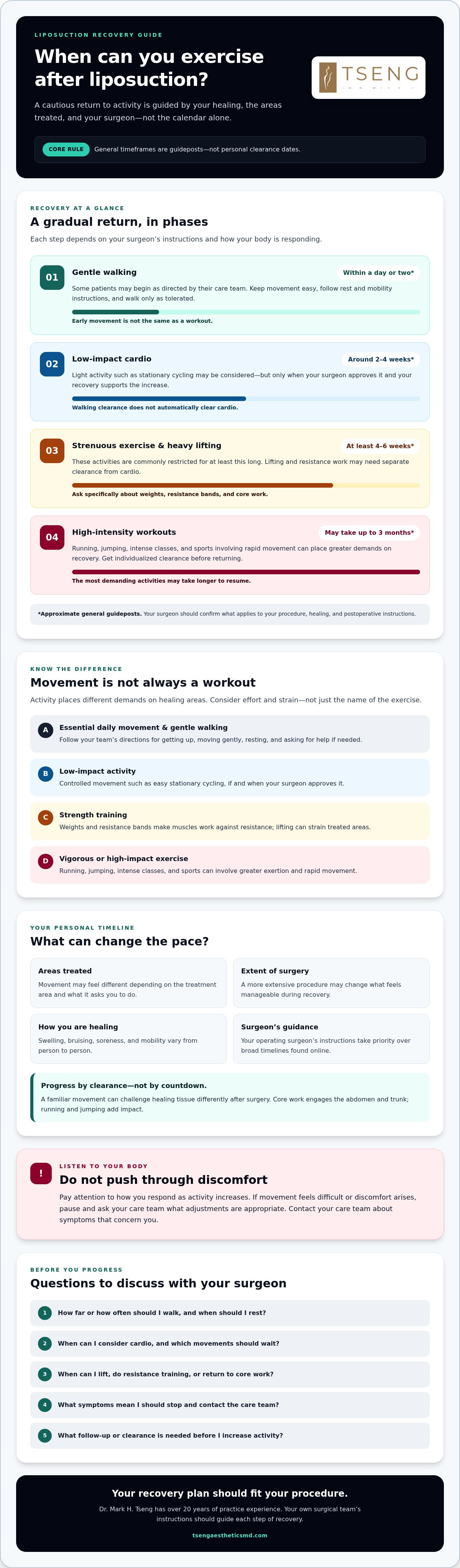
It’s understandable to want a clear date, especially when general advice can seem inconsistent. Light walking may begin within a day or two, while low-impact cardio is often considered around 2-4 weeks. Strenuous exercise and heavy lifting are commonly restricted for at least 4-6 weeks, and high-intensity workouts may take longer. These timeframes are general guideposts, not personal clearance dates.
This article covers a cautious, phased return to activity, factors that may affect your timeline, and symptoms that mean you should pause and contact your care team. You’ll also find questions to ask your surgeon before progressing. Dr. Mark H. Tseng has over 20 years of practice experience, and your own surgical team’s instructions should guide each step of recovery.
Key Takeaways
- When can I exercise after liposuction depends on your healing, the areas treated, and your surgeon’s guidance, not a date on the calendar alone.
- Distinguish gentle movement from cardio and strength training, and confirm what to do before progressing to each.
- Return to activity gradually and pay attention to how your body responds rather than pushing through discomfort.
- Know which symptoms should prompt you to stop exercising and contact your care team.
- Prepare specific questions about walking, workouts, lifting, and follow-up clearance so your recovery plan reflects your procedure.
When can you exercise after liposuction? Start with the type of activity
There isn’t one exercise date that applies to everyone after liposuction. Timing depends on how you’re healing, which areas were treated, the extent of surgery, and your surgeon’s clearance. If you’re asking, “when can I exercise after liposuction,” first distinguish gentle movement during early recovery from a planned workout that raises your heart rate or strains healing areas.
Liposuction removes fat from selected areas of the body, but the procedure and recovery plan can differ from patient to patient. For a general overview, see Liposuction. That background isn’t a substitute for postoperative advice. Your operating surgeon’s instructions take priority over broad timelines found online.
Why there is no single exercise date after liposuction
Activity guidance can vary depending on the treatment area and extent of the procedure. Movement that feels manageable after treatment in one area may be uncomfortable after a more extensive procedure or treatment in an area involved in bending, reaching, or walking. Swelling, bruising, soreness, and mobility also vary, so the same workout can place different demands on recovery. Treat general timeframes as context, and ask your surgical team what applies to your procedure.
What counts as exercise during recovery?
Not every kind of movement is a workout. Follow your surgeon’s instructions for essential daily movement and gentle walking. These are different from a planned fitness activity. As recovery progresses, consider activity by the effort and strain it involves:
- Low-impact activity: Controlled movement such as easy stationary cycling, if and when your surgeon approves it.
- Strength training: Lifting weights or using resistance bands, which asks muscles to work against resistance.
- Vigorous or high-impact exercise: Running, jumping, intense classes, or sports involving rapid movement and greater exertion.
These categories don’t provide clearance. Even a familiar exercise can challenge healing tissue differently after surgery. Lifting can strain the treated area, core work engages the abdomen and trunk, and running or jumping adds impact. Before restarting, ask your surgeon which movements are appropriate, which should wait, and how to modify activities for the areas treated. A gradual plan based on your own recovery is safer than following someone else’s timeline.
Liposuction exercise timeline: progress through recovery milestones
Think of recovery as a sequence of clearances, not a countdown to a guaranteed return date. The milestones below are general guideposts, not a personal prescription. Your surgeon should confirm that each timeframe and activity fits your procedure, healing, and current postoperative instructions. MyHealth Alberta offers general advice about recovery and returning to normal activities, but your operating surgeon’s guidance takes priority.
Early recovery: movement is not the same as a workout
In the first days, follow your surgical team’s directions for getting up and moving gently. Walking may be encouraged as tolerated, but ask how far or how often to walk, when to rest, and whether you’ll need help moving around. Walking doesn’t replace prescribed follow-up, garment use, wound care, or other postoperative instructions. If movement feels difficult, ask your team what adjustments are appropriate instead of pushing through.
Resuming low-impact and strenuous exercise
Being cleared to walk doesn’t automatically mean you’re ready for cardio, weights, or a demanding class. General clinical guidance often gives these approximate ranges. Your surgeon should confirm how they fit your recovery:
- Gentle walking: Some patients may begin within a day or two, as directed by their care team. Keep it easy and follow instructions about rest and mobility.
- Low-impact cardio: Stationary cycling or similar light cardio may be considered around 2-4 weeks, provided your surgeon clears it and your recovery supports the increase.
- Strenuous exercise and heavy lifting: These are typically restricted for at least 4-6 weeks. Returning to high-intensity workouts may take up to 3 months.
These ranges aren’t deadlines. The treatment area, extent of surgery, discomfort, swelling, and individual healing can all affect the plan. Strength training may require separate clearance from cardio, particularly for lifting or movements that engage the treated area. Ask about core work and high-impact exercise as well.
Once your surgeon approves a new activity, restart gently rather than returning to your previous intensity. Increase effort in small steps and pay attention to how you feel during and after activity. If discomfort or swelling worsens, stop and contact your care team before trying again. For guidance specific to your procedure, a discussion with the surgical team at Tseng Plastic Surgery can help clarify which recovery milestones apply to your liposuction plan.
Walking, cardio, and strength training: what changes before each workout?
Feeling more comfortable is encouraging, but it doesn’t automatically mean every workout is safe to resume. Activities differ in impact, effort, and demands on treated areas. Ask your surgeon about each type rather than treating “exercise” as a single clearance. The American Society of Plastic Surgeons’ Liposuction recovery guidance provides general context. Your postoperative instructions should determine your next step.
Gentle walking versus planned cardio
Walking around your home as directed is different from scheduling a cardio session. Everyday movement can be brief and adjusted as needed. Planned cardio, such as using a stationary bike, is usually more sustained and may require more exertion. Don’t set a walking schedule or add intensity without your care team’s approval. Ask what pace and duration are appropriate, how to build up, and which symptoms mean you should stop and check in.
Before progressing, clarify any restrictions related to the areas treated. A distance or pace that feels manageable for one patient may not suit another. Feeling comfortable during an activity doesn’t confirm that healing tissue is ready for greater effort.
Strength training, core work, and high-impact exercise
Resistance exercise asks muscles to work against a load. Core movements recruit the trunk, while high-impact activities add force through running, jumping, or rapid changes of direction. These activities place different demands on your body than gentle walking. Ask your surgeon when to reintroduce weights, abdominal exercises, and impact-based training, and whether particular movements need modification.
The area treated matters. For example, ask whether bending, twisting, reaching, or bracing your abdomen affects your plan. Liposuction and a tummy tuck address different concerns and involve different procedures. This liposuction and tummy tuck comparison explains the distinction, but it can’t determine your exercise restrictions.
Use this comparison as a discussion aid, not personal clearance:
- Gentle walking: Lower exertion and impact. Confirm when to begin, how much is appropriate, and when to rest.
- Planned cardio: Sustained effort, usually with more exertion than routine movement. Ask which activity and intensity are approved.
- Strength and core training: Resistance or concentrated muscle engagement. Confirm timing, movements, and any limits on lifting.
- High-impact exercise: Repeated impact or vigorous movement. Get explicit clearance before returning.
If you’re wondering “when can I exercise after liposuction,” bring the specific workout you want to resume to your follow-up discussion. A precise question about your routine helps your surgical team tailor guidance to your procedure and recovery.
How to return to exercise safely after liposuction
A careful return to exercise follows a simple sequence: follow your restrictions, get your surgeon’s clearance for each type of activity, restart gently, and reassess how you feel. A date on the calendar or temporary improvement in comfort isn’t enough to establish readiness. If you’re asking, “when can I exercise after liposuction,” discuss the specific workout you want to resume with the team that knows your procedure and recovery.
A surgeon-led checklist before restarting workouts
At a postoperative appointment, describe the activity you want to resume. Approval for light cardio, for example, doesn’t necessarily include lifting weights or doing core exercises. Before increasing activity, ask:
- Which activities can I do now, and what intensity or duration should I start with?
- When should I ask for separate clearance for weights, core work, or high-impact exercise?
- Do my treated areas, incisions, compression garment, or medications affect how I should exercise?
- Which changes in discomfort or swelling mean I should pause?
Write down your questions and any new or changing symptoms before contacting your practice. Follow your postoperative instructions, including scheduled follow-up. Exercise is one part of recovery, not a replacement for recommended care.
When to pause exercise and contact your care team
Stop exercising if it brings on concerning symptoms or makes existing symptoms worse. Unexpected or increasing pain, swelling, bleeding, or changes around an incision are examples to report. This list isn’t exhaustive and can’t identify the cause of a symptom. Contact your surgical team for individualized advice, using the contact instructions they provided. Don’t restart the workout until you’ve received guidance.
Some symptoms need urgent assessment rather than a routine question to the practice. Seek urgent medical care for severe or rapidly worsening symptoms, such as difficulty breathing, chest pain, fainting, or heavy bleeding. If you believe there’s an immediate emergency, use your local emergency service. Online information can help you prepare questions, but it can’t assess your condition or replace postoperative medical advice.
A measured progression helps you notice how your body responds, while clear communication with your surgical team keeps activity decisions connected to your recovery. If you’re considering liposuction or want to discuss procedure-specific recovery questions, request a personalized liposuction consultation.
Your liposuction recovery plan: get individualized exercise guidance
The most reliable answer to “when can I exercise after liposuction” comes from your healing progress and explicit guidance from your surgical team. General timelines can help you prepare, but they can’t account for your treated areas, procedure details, or how your recovery is unfolding. Discuss each activity as a separate step rather than assuming clearance for one workout means you’re ready for every kind of exercise.
Questions to ask before returning to your routine
Bring a short list to your follow-up so you leave with practical direction, not just a general instruction to take it easy. Ask:
- Which activities are appropriate for me now, including gentle walking or cardio?
- Do lifting, core exercises, or high-impact workouts require a later follow-up or separate clearance?
- How should I adjust activity if swelling, soreness, or mobility changes?
- Do my compression garment, incisions, or medications affect exercise instructions?
- Who should I contact if a recovery question comes up between appointments?
Share any new symptoms and describe the movement that brings them on. Clear details can help your team give advice that fits your current recovery. Continue following your postoperative instructions and scheduled follow-up, even if you feel ready to return to your usual routine.
Discuss liposuction goals and recovery with a surgeon
The location treated can influence which movements feel challenging and what restrictions your surgeon recommends. If you’re considering treatment in the arms, review arm liposuction and body-contouring considerations as a starting point for questions, not as a personalized activity plan.
Tseng Plastic Surgery offers liposuction, and Dr. Mark H. Tseng has been in practice for over 20 years. An individualized discussion can address your goals alongside procedure-specific recovery questions, including how to approach activity under your surgeon’s instructions. It won’t replace follow-up or guarantee a particular recovery timeline, but it can help you understand what to ask and how to plan for your care.
If you’re exploring liposuction or would like to discuss your goals, you can discuss liposuction with Tseng Plastic Surgery.
Make your return to exercise a guided next step
The answer to “when can I exercise after liposuction” depends on your healing, the areas treated, and your surgeon’s clearance. Gentle movement differs from cardio, strength training, and high-impact exercise, so ask about each activity rather than relying on a single date. When you resume workouts, begin only after approval, increase effort gradually, and pause if symptoms worsen or feel unexpected.
Your operating surgeon’s instructions should be the foundation of your recovery plan. Use follow-up appointments to clarify what’s appropriate now, what should wait, and whom to contact with questions between visits. A thoughtful, individualized approach keeps healing at the center as you plan your return to activity.
Tseng Plastic Surgery offers liposuction as a body-contouring service, and Dr. Mark H. Tseng has been in practice for over 20 years. To discuss your liposuction questions and personal goals, connect with Tseng Plastic Surgery. Take recovery one step at a time, with your surgical team’s guidance.
Frequently Asked Questions
When can I walk after liposuction?
Gentle walking may be encouraged within a day or two after liposuction, but follow your surgeon’s specific instructions about when and how to move. Early walking is different from a fitness walk, so keep activity gentle and don’t push through discomfort. Ask whether you need help moving around, when to rest, and which symptoms mean you should stop and contact your care team.
How long after liposuction can I work out?
Light, low-impact cardio is often considered around 2-4 weeks after surgery, while strenuous exercise and heavy lifting are typically restricted for at least 4-6 weeks. Returning to high-intensity workouts may take up to 3 months. These are general guideposts, not clearance dates. Your procedure, treated areas, and healing can change the timeline, so get your surgeon’s approval before resuming workouts.
Can I lift weights after liposuction?
Wait for your surgeon to clear weight training. Lifting can strain healing areas, and appropriate timing may depend on the areas treated and the extent of surgery. General guidance often restricts heavy lifting for at least 4-6 weeks, but that range doesn’t mean you’re automatically ready then. Ask when to restart, which movements to avoid, and whether to begin with lighter resistance.
Can I do cardio after liposuction?
Low-impact cardio, such as easy stationary cycling, may be considered around 2-4 weeks after liposuction, but only if your surgeon approves it for your recovery. A cardio session is more sustained than ordinary movement, so confirm the activity, effort level, and how to progress. Running, vigorous classes, and other high-intensity exercise may need to wait longer than gentle cardio.
What happens if I exercise too soon after liposuction?
Returning before your body is ready may worsen swelling or discomfort and could contribute to fluid buildup or delayed healing. Stop if activity causes new or increasing symptoms, and contact your surgical team for individualized advice rather than trying to diagnose the cause yourself. Seek urgent medical attention for severe symptoms, such as difficulty breathing, chest pain, fainting, or heavy bleeding.
How do I know when I am ready to exercise after liposuction?
Readiness means your surgeon has cleared the specific activity, not simply that you feel better or have reached a particular date. Ask about walking, cardio, weights, core work, and high-impact exercise separately. As you return, start gently and pay attention to changes in pain, swelling, or mobility. If symptoms worsen or feel unexpected, pause and contact your care team before continuing.

