Liposuction vs. Tummy Tuck: A Surgeon’s Guide to Choosing Your Path
By Tseng Plastic Surgery
The procedure you think you need might actually be the wrong solution for your unique anatomy. Many individuals spend years researching liposuction for belly fat, believing that simply removing localized volume will restore their confidence and contour. However, the reality is that physical transformation often requires more than just extraction. When the underlying muscles have weakened or the skin has lost its natural elasticity, even the most precise fat removal cannot achieve the refined, graceful profile you envision.
It's understandable to feel frustrated when dedicated exercise and a disciplined diet fail to address a stubborn midsection. You deserve a result that feels both authentic and sophisticated, yet the overlap between surgical names often leads to unnecessary confusion. This guide will help you discover the critical differences between fat removal and structural repair to determine which procedure aligns with your aesthetic vision. We'll explore the science of skin laxity, the necessity of muscle restoration, and how a tailored approach ensures your results look naturally harmonious rather than surgically forced.
Key Takeaways
- View your midsection as a three-dimensional landscape where the harmony of skin, fat, and muscle determines the ultimate success of your contour.
- Distinguish how liposuction for belly fat serves as a precise tool for silhouette refinement rather than a substitute for weight loss.
- Identify when structural repair, such as muscle tightening and skin excision, is required to achieve a firm and youthful abdominal profile.
- Evaluate the recovery expectations and surgical objectives of each path to make an informed decision that honors your personal vision.
- Learn how a hybrid surgical approach can integrate the benefits of both procedures to deliver a more comprehensive and naturally balanced result.
The Abdominal Architecture: Understanding Skin, Fat, and Muscle
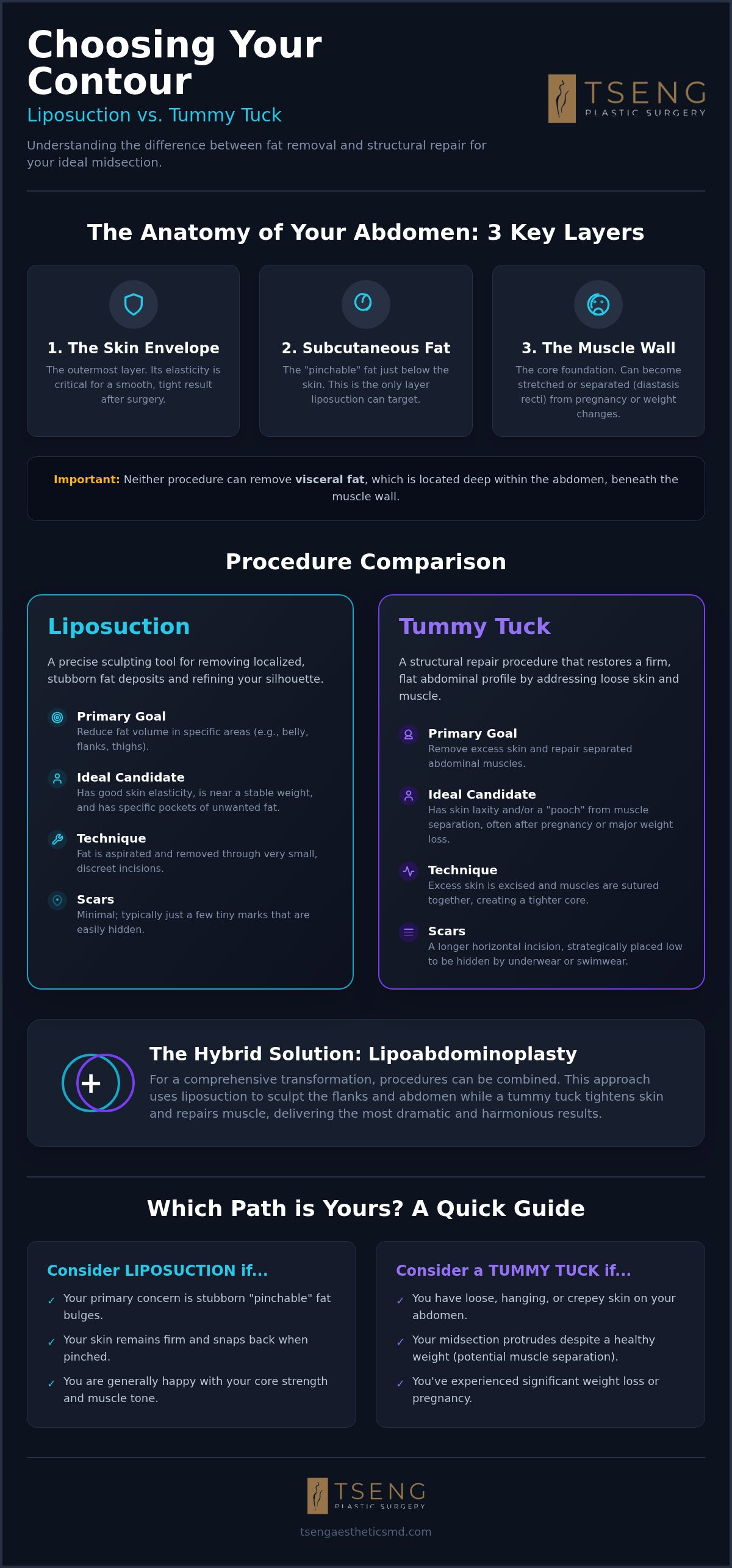
To achieve a refined midsection, we must view the abdomen as a three-dimensional landscape rather than a simple surface. This anatomical region consists of three distinct layers: the skin envelope, the subcutaneous fat layer, and the underlying muscle wall. Each layer plays a specific role in your final silhouette. When a patient explores Liposuction, they're often focusing on the middle layer, yet the success of the procedure depends entirely on the integrity of the layers above and below it. A master craftsman understands that true beauty arises from the harmony of these three components working in concert.
The Fat Layer: Subcutaneous vs. Visceral
Not all fat is created equal, and understanding the difference is vital for setting realistic expectations. Subcutaneous fat sits directly beneath the skin; it's the "pinchable" tissue that creates soft curves or stubborn bulges. This is the only layer addressed when performing liposuction for belly fat. In contrast, visceral fat resides deep within the abdominal cavity, surrounding your internal organs. Because this fat is located beneath the muscle wall, it cannot be safely reached or removed through surgical aspiration. If your midsection feels firm yet protrudes, the cause is often visceral fat or muscle laxity rather than a surplus of subcutaneous tissue. Fat removal alone is rarely a comprehensive solution when the primary concern is internal volume or structural weakness.
The Muscle and Skin: The Structural Foundation
The deepest layer of our abdominal architecture is the muscle wall, primarily the rectus abdominis. Life events like pregnancy or significant weight fluctuations can cause these muscles to stretch and separate, a condition known as diastasis recti. This separation creates a permanent "pooch" that no amount of dieting or liposuction for belly fat can flatten. Without surgically repairing this internal corset, the midsection will remain convex despite the removal of surface fat. This is why a thorough consultation is necessary to determine if your concerns are based on volume or a compromised foundation.
Finally, we must consider the skin, which acts as the aesthetic envelope for the entire procedure. High-quality results require skin with enough elasticity to retract over the newly sculpted contours. In older patients or those who've experienced massive weight loss, the skin may have lost its "snap," leading to a deflated or wrinkled appearance after fat is removed. True body contouring isn't just about what we take away; it's about the structural integrity and the lasting balance of what remains.
Liposuction: The Art of Precision Silhouette Sculpting
Liposuction represents the intersection of surgical precision and aesthetic vision. It's not a shortcut for weight loss but a sophisticated method for refining the body's natural lines. By utilizing fat aspiration, a surgeon selectively removes localized deposits that remain resistant to even the most disciplined lifestyle. This technique focuses on preserving the surrounding vascular and connective tissues, which facilitates a smoother recovery and maintains the structural health of the area. Reviewing Liposuction procedure details provides a helpful foundation for understanding how these modern techniques prioritize patient safety and aesthetic outcomes.
The true hallmark of a master craftsman is the ability to create a result that looks entirely un-operated. This is achieved through "feathering," a technique where the surgeon meticulously blends the treated area into the surrounding untreated tissue. Without this delicate blending, the results can appear disjointed or artificial. This level of detail is particularly important when performing flank liposuction, as the goal is to create a seamless, elegant transition from the abdomen to the lower back, ensuring your silhouette is balanced from every angle.
Ideal Candidates for Liposuction Alone
Success with liposuction for belly fat depends heavily on the quality of your skin. Ideal candidates possess high skin elasticity, meaning the skin has the resilience to retract smoothly over the new, slimmer contours. If the skin is already loose or thin, removing fat may leave it looking deflated rather than firm. Additionally, being at or near a stable goal weight is vital. Liposuction is most effective for addressing specific, localized fat deposits rather than generalized abdominal fullness, ensuring the results remain consistent with your long-term health goals.
Recovery and Expectations for Sculpting
The journey toward your final result is a methodical and unhurried process. Immediately following the procedure, you'll experience a period of swelling and bruising as your body begins its natural healing cycle. During this time, the use of medical-grade compression garments is essential. These garments provide the necessary support to mold the tissues and minimize fluid retention, directly influencing the crispness of your final result. While you'll notice a change in your proportions almost immediately, it takes several months for the internal tissues to fully soften and for the final, refined silhouette to reveal its true grace. If you're ready to see how a personalized plan can reflect your vision, a private consultation is the next step in your transformation.
The Tummy Tuck: Restoring Integrity to the Core
While liposuction for belly fat excels at removing stubborn volume, it cannot address the structural failures that often follow pregnancy or significant weight loss. An abdominoplasty, or tummy tuck, is fundamentally a reconstructive procedure designed to restore the abdominal architecture. Dr. Tseng approaches this surgery as a master craftsman, focusing on three primary pillars: muscle restoration, skin excision, and aesthetic repositioning. By addressing these deeper layers, the procedure achieves a level of firmness and core integrity that fat removal alone simply cannot provide.
The necessity of this comprehensive approach becomes clear when abdominal liposuction isn't enough to resolve a protruding midsection. In 2026, data from the American Society of Plastic Surgeons highlighted the enduring popularity of this technique, with 171,064 procedures performed as patients increasingly seek structural repair over simple volume reduction. For many, the ultimate goal is a flatter, more youthful profile that reflects their internal vitality. In some cases, combining liposuction with a tummy tuck allows for a more holistic transformation, addressing both the fat layer and the underlying foundation in a single, unhurried session.
Addressing Diastasis Recti and Muscle Laxity
A persistent "pooch" is often the result of diastasis recti, a condition where the vertical abdominal muscles have separated. This structural gap cannot be closed through exercise or diet; it requires surgical muscle plication. During this step, internal sutures act as a permanent corset, pulling the muscles back into their original, tight alignment. This repair offers functional benefits beyond aesthetics, often improving posture and core stability. It's a vital step for restoring the flat, athletic profile that many patients desire but cannot achieve through lifestyle changes alone.
Managing the Skin Envelope
Once the foundation is secure, the surgeon must address the skin envelope. This involves the meticulous removal of excess, hanging skin and often the elimination of stretch marks located below the navel. Strategic scar placement is a priority; the incision is carefully positioned low on the abdomen so it remains hidden within most swimwear or undergarments. Depending on the extent of skin laxity, a patient may benefit from a Mini Tummy Tuck, which focuses on the area below the navel, or a Full Abdominoplasty, which involves a more comprehensive tightening of the entire abdominal wall and the repositioning of the belly button for a natural, balanced appearance.
Liposuction vs. Tummy Tuck: A Comparative Framework
Choosing between these two paths requires a clear understanding of your anatomical needs versus your aesthetic desires. Liposuction for belly fat focuses primarily on volume reduction, removing the fat cells that create stubborn bulges. In contrast, a tummy tuck provides structural tightening, addressing the muscle and skin layers that fat removal alone cannot fix. While both procedures offer permanent changes, the nature of those changes differs. Liposuction removes the cells themselves; a tummy tuck removes the physical envelope of excess skin, providing a level of firmness that lasts even as you age.
The trade-off often comes down to the surgical footprint and the rhythm of healing. Liposuction involves minimal, puncture-like incisions that fade significantly over time. A tummy tuck requires a more extensive, low-profile horizontal incision. However, this incision is strategically placed to remain hidden within swimwear. Recovery also follows different timelines. Liposuction allows for a quicker return to daily life, while a tummy tuck demands an unhurried healing phase to ensure the internal muscle repairs remain secure and the skin heals without tension.
The Candidacy Self-Test
You can perform a simple "Pinch and Lean" test at home to begin your self-assessment. Lean forward and pinch the tissue at your midsection. If you can pinch more than an inch of soft tissue but your skin feels resilient and snaps back, you may be an ideal candidate for liposuction. If the tissue feels thin but hangs loosely, or if a "pooch" remains even when you engage your core muscles, structural repair is likely necessary. The primary reason patients shift from a plan for liposuction for belly fat to a tummy tuck is the realization that their concerns are rooted in skin laxity or muscle separation rather than fat alone.
Recovery Realities and Lifestyle Impact
Managing your expectations for the weeks following surgery is essential for a stress-free experience. Most patients return to desk work within two weeks after a tummy tuck, though full physical activity is restricted for at least six weeks to protect the integrity of the repair. Liposuction recovery is generally swifter, yet both procedures require a stable weight to maintain the artistry of the results. Significant weight fluctuations can stretch the skin or create new fat deposits, potentially obscuring the refined silhouette achieved through surgery. If you're ready to move beyond self-testing and receive a professional anatomical assessment, schedule a personalized consultation to determine the most effective path for your goals.
The Synergy of Lipoabdominoplasty: A Holistic Approach
The most elegant results aren't typically found in a single technique but in the thoughtful integration of complementary procedures. Lipoabdominoplasty, the combination of fat aspiration and structural repair, represents the pinnacle of modern body contouring. While many patients initially research liposuction for belly fat to address localized volume, they soon discover that a comprehensive transformation requires a more nuanced strategy. By integrating these methods, we can simultaneously remove stubborn fat and reconstruct the underlying foundation, ensuring the result is as firm as it is slender.
This hybrid approach allows for superior waistline narrowing that a standard tummy tuck cannot achieve on its own. The Tseng philosophy centers on balancing the precision of medical science with the refined eye of an artist to produce a look that's naturally graceful. We aim for a silhouette that appears un-operated and inherently yours. For those seeking total body harmony, this philosophy extends beyond the midsection; integrating arm liposuction can further balance your proportions, creating a cohesive aesthetic from the shoulders to the hips.
Why Combining Procedures is Often the Gold Standard
Achieving a flatter stomach is only one part of the equation; true beauty lies in the harmony of the entire trunk. By adding liposuction for belly fat to the flanks and love handles during a tummy tuck, we ensure the transition from the front of the abdomen to the back is seamless and tapered. This holistic method addresses the entire midsection in a single session, which is often more efficient and provides a more balanced recovery experience. It's about sculpting the three-dimensional form rather than just treating a single isolated area.
Consulting with a Master Craftsman
Navigating these complex surgical choices requires more than just technical data; it requires a compassionate guide who prioritizes your individual vision. During a comprehensive evaluation with Dr. Mark H. Tseng, you'll experience a thorough anatomical assessment that considers every layer of your midsection. With over 20 years of surgical experience, Dr. Tseng focuses on subtle, high-quality improvements that honor your personal goals. This unhurried process empowers you to make an informed decision, ensuring you feel confident and secure as you choose the path that best reflects your vision of yourself.
Your Journey Toward a Refined Silhouette
Choosing the right path for your midsection is a pivotal step toward reclaiming your confidence and physical comfort. Whether your anatomy requires the targeted volume reduction of liposuction for belly fat or the comprehensive structural repair of a tummy tuck, the goal remains a result that feels authentically you. You now understand that a flatter, firmer profile depends on addressing the specific needs of your skin, fat, and muscle layers in a way that respects your body's natural proportions.
With over 20 years of aesthetic surgery experience, Dr. Mark H. Tseng brings board-certified clinical authority and an artist's eye to every procedure, focusing on refined, natural-looking outcomes that avoid a surgically forced appearance. Schedule your personalized body contouring consultation with Dr. Mark H. Tseng to explore which approach aligns with your vision.
Transformation is a partnership between your personal goals and a surgeon's expertise. It's an unhurried process that starts with clear information and ends with a silhouette that empowers you. You don't have to navigate these choices alone; expert guidance is ready to help you reveal your most vibrant self.
Common Questions Regarding Abdominal Contouring
Can liposuction replace a tummy tuck if I have a small amount of loose skin?
Liposuction is designed to address volume, not skin laxity. If your skin has already lost its natural resilience, removing the underlying fat can leave the area looking deflated or wrinkled. A master craftsman evaluates the "snap" of your skin to ensure fat removal won't compromise your aesthetic result. While a mini tummy tuck is a more involved path, it's often the only way to achieve a truly firm and smooth profile.
Will a tummy tuck remove my stretch marks?
A tummy tuck can permanently eliminate stretch marks, but only those located on the skin that is physically removed during the procedure. Typically, the skin between the navel and the pubic region is excised, taking any associated marks with it. Marks located higher on the abdomen will remain, though they're often pulled lower and appear less prominent. This surgical excision provides a level of skin clarity that non-invasive treatments cannot match.
How long do I need to wait after pregnancy to have these procedures?
Most surgeons recommend waiting at least six months after childbirth and three to six months after you've finished breastfeeding. This unhurried timeline ensures your weight has stabilized and your skin has had time to retract naturally. It's essential that your body has returned to its baseline state before you pursue structural repair or liposuction for belly fat, as lingering hormonal changes can influence your final surgical outcome and healing rhythm.
Is the recovery from liposuction significantly easier than a tummy tuck?
Recovery from fat aspiration is generally swifter because it involves a smaller surgical footprint and no muscle reconstruction. Most patients return to a desk job within a few days, whereas a tummy tuck requires about two weeks of initial downtime. Because an abdominoplasty involves internal sutures to repair the muscle wall, you must avoid strenuous activity for six weeks. Both paths require dedicated patience to allow the internal tissues to heal with integrity.
Can I get a tummy tuck if I plan to have more children in the future?
While you can technically have the procedure, it's best to wait until your family is complete. A future pregnancy will inevitably stretch the abdominal wall and skin again, which can undo the precise muscle plication and skin tightening achieved during surgery. To protect the longevity of your results and ensure your flatter profile remains intact for years to come, we recommend scheduling your consultation once you've reached a stable, post-childbearing lifestyle.
Will my fat come back in other areas after liposuction?
Liposuction permanently removes fat cells from the treated area, and those specific cells won't return. However, your body still maintains the ability to store fat in the remaining cells throughout your frame. If you experience significant weight gain, those surviving cells will expand, potentially altering your new proportions. Maintaining a balanced lifestyle is vital to preserving the refined silhouette created during your session of liposuction for belly fat and ensuring long-term harmony.
What happens if I lose weight after a tummy tuck?
Minor weight loss after your procedure often enhances the crispness of your results, making your new contours appear even more defined. However, losing a significant amount of weight can lead to new skin laxity, which might obscure the firm foundation created during surgery. Dr. Tseng recommends being at or near your goal weight before the procedure. This ensures the skin excision is tailored to your most stable anatomy for a lasting and balanced profile.
Which procedure provides the most natural-looking results?
Both procedures deliver exceptionally natural results when the surgeon prioritizes balance over drastic change. The most authentic choice depends on whether your concerns are rooted in volume or structure. Liposuction offers subtle refinement for those with high skin elasticity, while a tummy tuck restores a youthful, athletic architecture for those with muscle laxity. Often, a hybrid approach provides the most harmonious result, blending fat removal and structural repair to create an un-operated appearance.

