The Essential Guide to Injectables: Science, Options, and Natural Results in 2026
By Tseng Plastic Surgery
The secret to enduring facial rejuvenation isn't chasing every fine line or freezing natural expression; it's treating facial anatomy as an architectural canvas. When administered with surgical-level precision, modern cosmetic injectables serve as delicate structural supports that elevate your innate features rather than alter your identity. If you've ever hesitated over fears of looking puffy, distorted, or overtly changed, your caution is entirely justified. Between rapid market growth and endless product choices, it's easy to feel overwhelmed by conflicting advice and uncertain about which treatments will truly safeguard your natural appearance.
This guide is designed to replace that hesitation with clarity. You'll discover how modern cosmetic injectables restore facial harmony, soften dynamic lines, and replenish volume with refined, natural precision. We'll demystify the scientific distinctions between neurotoxins, dermal fillers, and biostimulators, examine essential practitioner safety standards, and outline realistic recovery timelines so you can make informed, confident choices that honor your individual character.
Key Takeaways
- Understand the distinct biological mechanisms separating neurotoxins, dermal fillers, and biostimulators to match treatments precisely to your structural anatomy.
- Discover how physician-led micro-adjustments with modern injectables prevent overfilling while preserving dynamic facial expression and personal character.
- Learn why dynamic anatomical analysis and structured consultation protocols are essential for predictable, safety-focused outcomes.
- Recognize the clinical boundaries of non-surgical rejuvenation and when advanced tissue laxity requires looking beyond volume restoration alone.
- Explore proactive maintenance strategies designed to sustain cellular tissue health and natural facial harmony over time.
What Are Cosmetic Injectables: Understanding the Spectrum of Facial Rejuvenation
Cosmetic injectables represent a sophisticated class of minimally invasive medical procedures engineered to modulate underlying facial architecture, restore structural equilibrium, and refine surface contours. At a cellular and structural level, cosmetic injectables function by precisely altering muscle kinetics or replenishing dermal matrix density to achieve calibrated tissue support. Decades ago, aesthetic treatments often relied on heavy, localized corrections that produced rigid, uniform contours. Today, clinical practice centers on three-dimensional tissue modulation, respecting individual anatomical planes to deliver outcomes that remain imperceptible to the untrained eye.
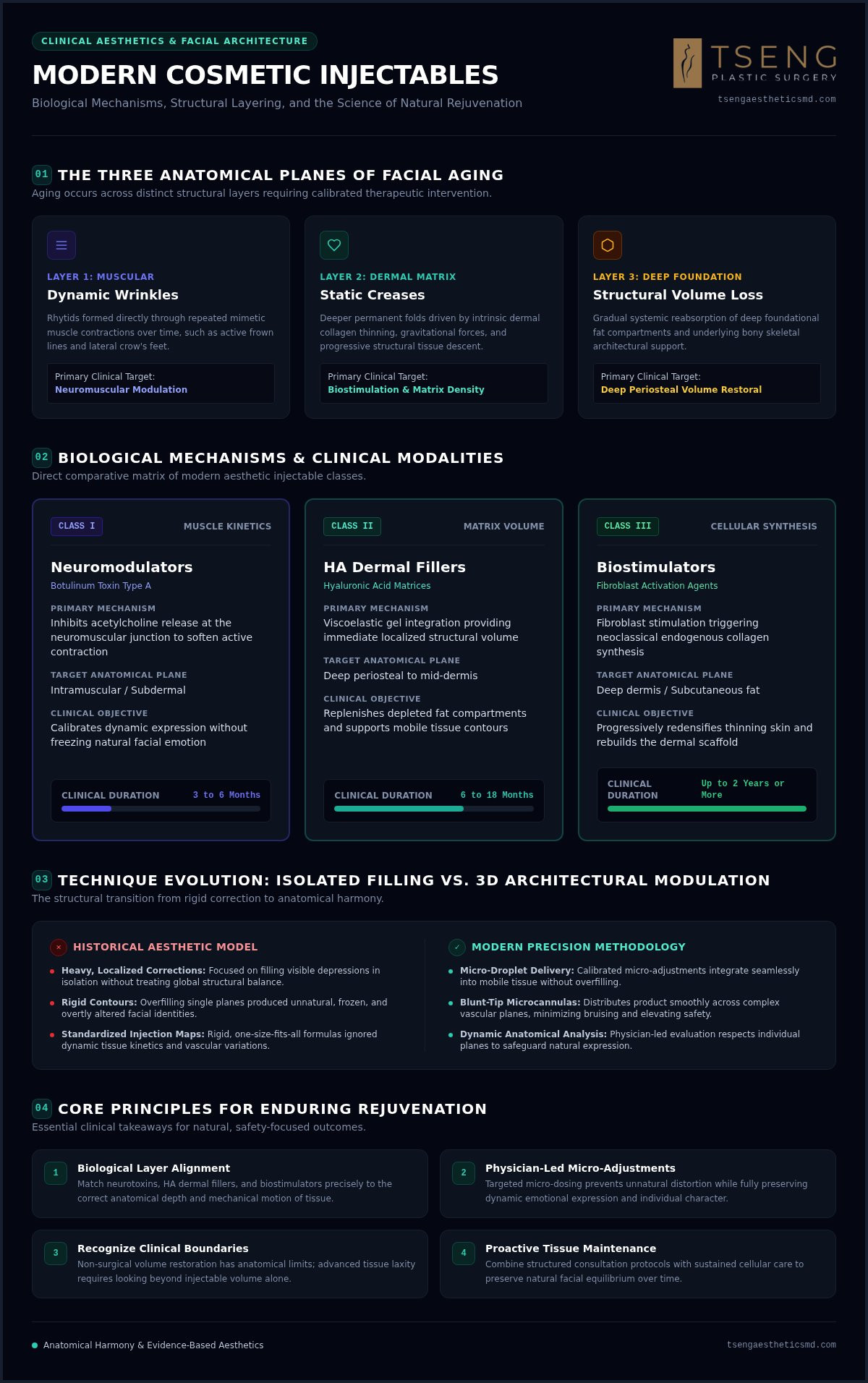
Facial aging doesn't occur along a single plane. Instead, it involves an interplay between dynamic expression lines, static creases, and deep volume depletion:
- Dynamic wrinkles: Rhytids formed through repeated mimetic muscle contraction, such as frown lines or crow's feet.
- Static folds: Deeper creases caused by dermal collagen loss, gravity, and tissue descent.
- Structural volume loss: The gradual absorption of deep fat pads and skeletal support over time.
The Evolution of Modern Non-Surgical Aesthetics
Early interventions focused on filling visible depressions in isolation. Modern techniques instead prioritize supple integration within mobile facial tissue. Rather than relying solely on sharp needles, practitioners utilize micro-droplet delivery and flexible, blunt-tip microcannulas to distribute product smoothly across complex vascular planes. An injectable filler placed with this level of structural precision minimizes bruising, enhances safety, and moves seamlessly with your natural expressions. A physician-led evaluation ensures that every micro-adjustment serves your broader facial harmony, avoiding the artificial results that often stem from standardized, one-size-fits-all injection maps.
Addressing Dynamic Lines Versus Structural Volume Depletion
Harmonious facial rejuvenation requires matching the right clinical modality to each specific anatomical layer. Dynamic lines stem directly from active muscular movement, meaning they respond best to agents that gently modulate neuromuscular tension without freezing emotional expression. Conversely, static creases and hollowed contours reflect intrinsic dermal thinning and structural descent. Treating these changes demands targeted biostimulation or deep volume restoration to rebuild foundational support. When a skilled practitioner addresses each layer individually, the result is effortless balance rather than superficial alteration.
Neurotoxins, Dermal Fillers, and Biostimulators: Mechanisms and Differences
Achieving refined aesthetic balance requires understanding how modern injectables interact with specific physiological planes. Clinicians categorize these treatments into three distinct modalities: neuromodulators that calibrate dynamic muscular movement, hyaluronic acid matrices that restore lost structural volume, and biostimulatory agents that rebuild the dermal scaffold from within. Biostimulators function by triggering neoclassical collagen synthesis through controlled, subclinical fibroblast activation to progressively redensify thinning skin. Selecting the right modality depends entirely on the unique mechanical properties of your tissues, balancing local skin thickness against the continuous motion of underlying muscles.
| Modality | Primary Mechanism | Target Anatomical Plane | Clinical Duration |
|---|---|---|---|
| Neuromodulators | Inhibits acetylcholine release to soften contraction | Intramuscular / Subdermal | 3 to 6 months |
| HA Dermal Fillers | Viscoelastic gel integration for structural volume | Deep periosteal to mid-dermis | 6 to 18 months |
| Biostimulators | Fibroblast stimulation yielding endogenous collagen | Deep dermis / Subcutaneous fat | Up to 2 years or more |
Neuromodulators: Softening Muscular Contraction
Neuromodulators use purified botulinum toxin type A to selectively block acetylcholine release at the neuromuscular junction. This temporary signal interruption allows overworked mimetic muscles to rest, smoothing stubborn glabellar frown lines, transverse forehead furrows, and lateral canthal crow's feet. Clinical effects emerge within three to fourteen days and typically maintain their softened aesthetic for three to four months before normal neurotransmission gradually resumes.
Hyaluronic Acid Fillers: Precision Volume and Contouring
Hyaluronic acid gels leverage distinct cross-linking technologies to achieve tailored viscoelastic properties, ranging from fluid cohesivity for delicate perioral lines to firm structural support. Experienced practitioners position FDA-approved dermal fillers along deep bony foundations, such as the pyriform aperture, zygomatic arch, and mandibular angle, to recreate architectural lift without distending mobile superficial layers. Because these cross-linked sugars remain fully dissolvable with injectable hyaluronidase, they represent the gold standard in non-surgical procedural safety.
Biostimulatory Injectables: Activating Endogenous Collagen
Unlike hyaluronic matrices that provide immediate volume, biostimulatory microparticles—such as poly-L-lactic acid (PLLA) and calcium hydroxylapatite (CaHA)—act as sustained regenerative scaffolds. Over several months, they prompt your fibroblasts to replace the temporary carrier gel with dense, native type I collagen. This progressive redensification makes biostimulators particularly well-suited for individuals experiencing broad midface deflation or structural hollows rather than localized crease formation. Exploring an individualized physician consultation can clarify which regenerative strategy best preserves your authentic facial architecture.
The Art of Natural Results: Avoiding Overfilling and Honoring Anatomy
The greatest apprehension patients voice about modern aesthetic medicine is the fear of losing themselves. Nobody wants the telltale signs of over-treatment: pillow-like cheeks, a frozen upper face, or an altered smile. True aesthetic refinement never seeks to mask your identity or impose artificial geometric contours onto dynamic living tissue. Instead, sophisticated cosmetic rejuvenation relies on anatomical restraint. By placing conservative micro-adjustments directly within deep structural planes, an experienced injector enhances innate harmony while preserving the subtle nuances of your authentic expressions.
Unnatural results rarely happen by accident. They stem from a fundamental misunderstanding of tissue biomechanics. When superficial layers are repeatedly flooded with dense product, the delicate balance between skin and muscle breaks down. Injectables should respect this mechanical equilibrium, not overload it.
Anatomical Precision and Danger Zones
Every face conceals an intricate, high-stakes vascular network. Deep clinical training is essential to navigate critical danger zones such as the facial, angular, and superficial temporal arteries. Accidental intravascular injection risks severe vascular compromise, making strict clinical protocols non-negotiable. Qualified practitioners routinely aspirate prior to extrusion, utilize micro-aliquots rather than large boluses, and employ blunt microcannulas in vulnerable planes. Intimate knowledge of deep fat compartments ensures that products provide foundational support beneath the mimetic musculature, eliminating the risk of unnatural dynamic distortions.
The Problem of Overfilling and Volume Chasing
Pillow-face syndrome and product migration occur when volume is added without regard for underlying tissue limits. Chasing every superficial line with dermal fillers distorts the way light bounces across the midface, creating an unnatural flattening or prominent "shelf effect" along the lower eyelids and perioral rim. These complications underscore why patients must rely on licensed medical experts using authentic FDA-approved dermal fillers rather than seeking high-volume shortcuts.
Anatomical restraint marks the true difference between commercialized volume chasing and master-level facial sculpting. While non-surgical options excel at restoring modest deflations, they cannot correct significant tissue laxity. Pushing fillers past their biological threshold simply stretches the cutaneous envelope. When structural laxity becomes pronounced, an experienced aesthetic surgeon will guide you toward surgical lifting rather than over-treating with product, ensuring your results remain balanced, elegant, and unmistakably natural.
The Treatment Journey: From Anatomical Consultation to Smooth Recovery
A predictable aesthetic outcome relies on a methodical clinical journey rather than a rushed injection session. True refinement demands an unhurried process that links your personal aesthetic goals directly to your underlying skeletal and soft-tissue architecture. Rather than treating injectables as a casual lunchtime indulgence, a physician-led private medical practice conducts a comprehensive medical evaluation to ensure complete safety and lasting structural balance.
Every successful treatment path moves through distinct, disciplined milestones:
- Dynamic medical imaging: Standardized baseline photography captured at rest and during full animation to map expressive muscle pull.
- Clinical health intake: A thorough review of past aesthetic history, healing capacity, and antiplatelet medications or supplements.
- Calibrated administration: Precise anatomical placement using micro-droplets and smooth microcannulas for maximum comfort.
- Post-care integration: Monitored tissue settling across a structured two-week healing window.
Comprehensive Assessment and Aesthetic Mapping
The consultation begins by evaluating bony support, fat-pad distribution, and dermal elasticity across the entire face. Your physician assesses how tissues shift when you speak, smile, and frown, ensuring chosen modalities harmonize with dynamic movement. Medical clearance requires reviewing items that increase bruising risk, including blood thinners, fish oil, high-dose vitamin E, and NSAIDs. Instead of attempting complete correction in a single sitting, a tailored plan often phases adjustments across multiple appointments, allowing tissues to integrate gracefully without distorting native proportions.
Procedure Comfort, Post-Treatment Care, and Downtime
Modern clinical protocols make injectable procedures remarkably comfortable. Formulations pre-compounded with local lidocaine, high-potency topical numbing agents, and gentle microcannula glides minimize tissue trauma and vascular disruption. Social downtime is generally minimal, though minor swelling and discrete pin-point bruising can occur.
For the first 48 hours following your procedure, adhere strictly to protective guidelines to ensure clean product integration:
- Avoid strenuous cardiovascular exercise and heavy weight lifting to limit localized blood pressure spikes.
- Refrain from thermal exposure, including saunas, steam rooms, and direct hot-water immersion.
- Sleep in an elevated, supine position to discourage fluid retention and avoid direct lateral pressure on treated areas.
Initial swelling typically subsides within 48 to 72 hours, with final tissue integration reaching its peak refinement around day fourteen. To develop a personalized plan that honors your features with surgical precision, schedule an anatomical consultation with our physician team.
Sustaining Rejuvenation: Longevity, Maintenance, and Aesthetic Care Synergy
Enduring facial harmony requires a long-term vision rather than sporadic, high-volume interventions. When approached methodically, modern injectables serve as continuous structural guardians, preserving skin elasticity and supporting deep soft-tissue architecture as your facial framework naturally evolves. Non-surgical options offer remarkable versatility, yet they operate within definite biological boundaries. Partnering with a dedicated physician ensures your aesthetic plan adapts gracefully over time, preserving authentic character while avoiding the trap of cumulative over-treatment. Outside the clinical setting, complementing non-surgical enhancements with professional hair and personal care at destinations like Tanya’s Image & Wellness Salon helps maintain a polished, cohesive aesthetic that frames refined facial contours.
Designing a Balanced Long-Term Maintenance Strategy
A proactive, conservative cadence delivers the most stable results across decades. Maintaining low-dose neuromodulators every three to four months prevents repetitive muscular folding from etching permanent grooves into thinning skin. Dermal fillers demand an even more measured rhythm. Instead of re-injecting on a rigid calendar schedule, an experienced practitioner spaces touch-ups conservatively, evaluating residual matrix integration to prevent insidious volumetric buildup. This disciplined restraint protects your natural facial proportions, allowing your skin to mature with quiet refinement. In synergy with clinical rejuvenation, holistic aesthetic care often includes precision eyebrow and lash styling to harmoniously frame refreshed facial features; read more about how dedicated beauty studios approach cohesive styling.
Knowing When to Transition to Surgical Interventions
Every non-surgical treatment encounters an anatomical tipping point where further filling becomes counterproductive. Dermal gels and biostimulatory agents excel at replenishing deflated fat compartments, but they possess zero tensile capacity to lift redundant skin. Attempting to lift heavy jowls, deep platysmal neck bands, or pronounced midface descent with soft-tissue fillers simply distorts facial contours and accelerates tissue sagging under added weight.
Recognizing this distinction is why surgical oversight remains paramount. When structural laxity reaches a stage where non-surgical modalities reach their limit, patients evaluating options can explore surgical vs non-surgical facelift approaches to determine which pathway aligns with their anatomy. In an advanced practice, surgery and non-surgical care operate in complete synergy: surgical lifting repositions the underlying muscular framework and removes lax skin, while conservative injectables fine-tune delicate perioral lines, temple transitions, and dynamic expressions.
Sustaining natural beauty across a lifetime requires the discerning hand of a master craftsman who knows precisely when to inject, when to pause, and when to lift. Dr. Mark H. Tseng brings over 20 years of clinical and surgical expertise to every patient evaluation, ensuring your care plan respects individual anatomy and structural symmetry. To explore a refined, physician-led approach tailored to your facial architecture, schedule a personalized consultation with Dr. Mark H. Tseng today.
Embracing Refined Facial Harmony for the Future
Enduring aesthetic confidence begins with a philosophy centered on anatomical restraint, biological respect, and structural balance. Rather than chasing fleeting volume trends or altering individual character, modern cosmetic injectables allow you to soften dynamic tension and restore foundational support while protecting your authentic expressions.
Achieving these subtle, balanced outcomes demands the discerning eye and steady hand of an experienced specialist. As a physician-led private practice, Tseng Plastic Surgery unites over two decades of clinical experience in advanced facial plastic surgery with bespoke, patient-centered care. We seamlessly integrate precise non-surgical treatments with surgical excellence, ensuring every subtle refinement honors your native facial architecture.
You deserve aesthetic care that prioritizes your safety and long-term well-being above all else. When you're ready to explore what's possible for your features, schedule a personal aesthetic consultation with Dr. Mark H. Tseng to begin your treatment journey with complete confidence.
Frequently Asked Questions
How long do common cosmetic injectables typically last before requiring maintenance?
Longevity varies by product category, ranging from 3 to 4 months for neurotoxins up to two years or more for biostimulators. Hyaluronic acid dermal fillers generally maintain structural integrity for 6 to 18 months depending on cross-linking density and placement depth. Biostimulators like poly-L-lactic acid promote endogenous collagen that endures beyond the initial carrier absorption. Individual metabolic rates, muscle dynamics, and injection areas also play significant roles in touch-up timing.
Can cosmetic injectables make my face look frozen, puffy, or unnaturally stiff?
No, cosmetic injectables won't distort your appearance when placed conservatively by an experienced physician. Unnatural stiffness or pillow-like swelling occurs when unqualified injectors chase lines superficially or administer excessive product volumes. Physician-led anatomical precision ensures neuromodulators gently relax hyperactive muscles while leaving expressive movement intact. Dermal fillers placed deep against the facial skeleton provide discrete structural support rather than surface puffiness.
What is the key difference between neurotoxins like Botox and dermal fillers?
Neurotoxins relax muscular contraction, while dermal fillers physically restore lost volume and contour. Neuromodulators target dynamic wrinkles formed by repetitive facial expressions, temporarily blocking nerve signals to the underlying mimetic muscles. In contrast, dermal fillers consist of biocompatible gels designed to replenish depleted structural fat pads and support deep bone contours. Both modalities address distinct aging mechanisms and often complement each other within a comprehensive treatment plan.
Is there significant downtime or recovery time required after receiving injectables?
Most patients resume normal daily routines immediately following treatment with modern injectables. You might notice subtle swelling, minor redness, or discrete pin-point bruising at the injection sites, but these effects generally resolve within two to three days. Sticking to simple post-care protocols, such as avoiding strenuous workouts, intense heat, and direct pressure on treated areas for 48 hours, ensures rapid recovery and optimal product settling without disrupting your schedule.
Can dermal fillers be safely dissolved if I am unsatisfied with my results?
Yes, hyaluronic acid dermal fillers can be completely dissolved using an enzyme called hyaluronidase. If an injection produces asymmetry, overfilling, or vascular complications, a practitioner can inject hyaluronidase directly into the area to break down the synthetic sugar matrix within 24 to 48 hours. However, non-hyaluronic acid biostimulators cannot be chemically reversed, making extensive anatomical expertise essential when choosing and placing long-lasting regenerative products.
How do I know whether I need non-surgical injectables or facial surgery?
Non-surgical treatments address surface creases and modest volume deflation, whereas facial surgery corrects structural skin and muscle laxity. If you have significant skin sagging along the jawline, deep jowls, or loose neck tissue, soft-tissue fillers cannot lift those structures without causing distortion. An experienced plastic surgeon can assess your facial architecture to determine whether targeted modalities or a procedure like a facelift offers the most harmonious, lasting result.
Are cosmetic injectable treatments painful during the actual procedure?
Injections cause minimal discomfort because modern clinical protocols prioritize patient comfort throughout the procedure. Most commercial dermal fillers come pre-mixed with lidocaine, which numbs the local tissue immediately upon contact. Practitioners also apply high-grade topical anesthetic creams prior to treatment and frequently use smooth, blunt microcannulas instead of sharp needles. These combined techniques ensure you experience only mild, brief pressure rather than sharp pain during your session.

