Skin Tightening vs. Facelift: Choosing Your Rejuvenation Path
By Tseng Plastic Surgery
What if the most effective path to a refreshed appearance isn't about pulling the skin tighter, but rather restoring the structural harmony of your face? You've likely encountered a myriad of "lunchtime lifts" and miracle creams. Yet, the concern remains that these options might not offer the longevity you truly need. It's natural to feel hesitant about surgery when the fear of an unnatural result looms. It's equally frustrating to invest in non-invasive treatments that only provide fleeting changes. Deciding on a surgical vs non-surgical facelift requires a delicate balance of understanding your unique anatomy and your lifestyle expectations.
This comprehensive 2026 guide is designed to clarify the critical differences between these approaches. We'll help you determine which path aligns with your aesthetic vision. Drawing on over 20 years of surgical experience, we'll examine how a minimal invasive preservation face and neck lift offers lasting restoration with reduced recovery time. Alongside this, we'll detail how non-surgical injectables can refine your features with artistic precision. You'll gain the clarity needed to move forward with a safe, expert-led treatment plan that prioritizes your natural beauty over drastic, recognizable changes.
Key Takeaways
- Distinguish between the structural repositioning offered by surgery and the surface-level refinement achieved through non-invasive modalities.
- Evaluate the decision of a surgical vs non-surgical facelift by considering your specific anatomical needs, lifestyle constraints, and desired recovery timeline.
- Learn why the minimal invasive preservation face and neck lift is the modern standard for patients seeking structural restoration with sophisticated, natural results.
- Discover the advantages of a hybrid rejuvenation strategy that pairs surgical longevity with the artistic maintenance of high-end injectables.
- Understand how aging impacts deeper facial layers to set realistic expectations for the investment and duration of your aesthetic results.
Understanding the Spectrum of Facial Rejuvenation
Facial rejuvenation isn't a binary choice between a scalpel and a syringe; it's a spectrum of care tailored to how your unique anatomy evolves. When we discuss a surgical vs non-surgical facelift, we're contrasting two fundamentally different mechanical actions. Surgical intervention focuses on the structural repositioning of deep tissues to restore a youthful foundation. Non-surgical options prioritize surface refinement and volumizing to address texture and minor hollows. Understanding which path serves you best requires a look beneath the surface at the biological architecture of the face.
The Anatomy of an Aging Face
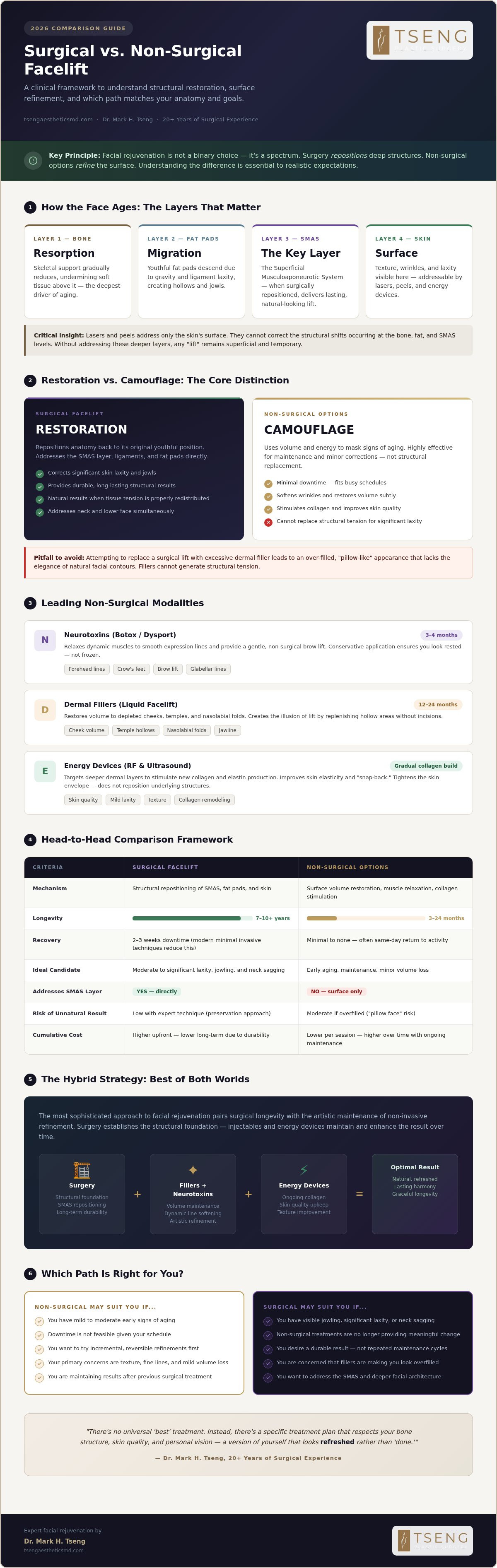
Aging is a multi-dimensional process that affects every layer of the facial structure. It begins with subtle bone resorption, which reduces the skeletal support for the soft tissues above. Simultaneously, fat pads that once provided youthful fullness begin to migrate downward due to gravity and ligament laxity. While lasers and peels can address the texture of the skin, they cannot bridge the gap created by these deep-seated shifts. The Superficial Musculoaponeurotic System (SMAS) is the deep fibromuscular layer of the face that, when surgically repositioned, provides the foundation for a durable and natural-looking lift. Without addressing this layer, any attempt to "lift" the face remains superficial and temporary.
Restoration vs. Camouflage
The primary distinction between these two paths lies in the difference between restoration and camouflage. A surgical procedure, such as the minimal invasive preservation face and neck lift, restores the anatomy to its original position. Non-surgical injectables, while highly effective for minor corrections, often act as camouflage. They use volume to mask the shadows created by sagging skin. A common pitfall in aesthetic medicine is the attempt to replace a surgical lift with excessive dermal filler. This often leads to an over-filled, "pillow-like" appearance that lacks the elegance of natural facial contours. When evaluating a surgical vs non-surgical facelift, it's vital to recognize that fillers cannot provide the structural tension needed for significant laxity.
Dr. Mark H. Tseng brings over 20 years of experience to this delicate decision-making process. He views each patient as a unique canvas where science and art must harmonize. There's no universal "best" treatment. Instead, there's a specific treatment plan that respects your bone structure, skin quality, and personal vision. Whether you require the longevity of a structural shift or the subtle touch of non-invasive refinement, the goal is always a version of yourself that looks refreshed rather than "done."
Roundup: Leading Non-Invasive Skin Tightening Procedures
Non-surgical treatments have evolved into sophisticated tools for those seeking refinement without the commitment of the operating room. When weighing the merits of a surgical vs non-surgical facelift, it's helpful to view non-invasive options as a series of maintenance rituals. These procedures don't offer the permanent structural shifts of surgery, but they excel at softening the visible signs of time through subtle, cumulative improvements. They provide a graceful way to refresh your appearance while maintaining the busy rhythm of your daily life.
Injectables and Dermal Volumizers
The "liquid facelift" utilizes a combination of neurotoxins and dermal fillers to address the two main pillars of aging: dynamic wrinkles and volume loss. Dermal fillers act as the volumizers of the aesthetic world, restoring the soft, rounded contours of the cheeks and temples that naturally deplete over time. By replenishing these hollow areas, we can lift the skin's appearance without a single incision. Neurotoxins complement this by smoothing dynamic lines and providing a gentle, non-surgical lift to the brow area. A conservative, master-led application is essential. It ensures you look like a rested version of yourself rather than appearing "done" or frozen. This artistry requires a deep understanding of facial harmony and muscle interaction.
Energy-Based Skin Tightening
Energy-based devices like Radiofrequency (RF) and Ultrasound target the deeper dermal layers to trigger a natural healing response. These technologies stimulate the production of new collagen and elastin, which improves the skin's elasticity and overall "snap-back." While these treatments are exceptional for improving skin quality and texture, they operate on a different plane than surgery. They tighten the skin's envelope rather than repositioning the underlying muscle or the SMAS layer. For those curious about the limitations of these surface-level changes and when a more permanent shift is required, The Modern Facelift: A Comprehensive Guide to Natural Facial Rejuvenation provides a deeper look at structural needs.
These modalities are best viewed as ongoing maintenance. They aren't permanent solutions, but rather tools to delay the need for surgery or to enhance surgical results later. Deciding between a surgical vs non-surgical facelift often comes down to your tolerance for downtime and your desire for long-term structural change. If you're ready to explore how tailored injectables or energy treatments can enhance your natural features, a personalized plan is the first step. Each session builds upon the last, creating a refreshed appearance that evolves gracefully with you. This methodical approach ensures that your aesthetic journey is as stable and reliable as it is beautiful.
The Surgical Standard: Structural Shifts and Longevity
While non-invasive treatments excel at surface refinement, surgery remains the definitive solution for significant structural descent. When we compare a surgical vs non-surgical facelift, the primary differentiator is the ability to physically relocate the underlying foundation. A surgical approach doesn't just mask aging; it resets the clock by addressing the deep tissues that have drifted over decades. This creates a transformation that is both profound and enduring, moving beyond the temporary "lift" of topical or injectable solutions.
Deep Plane and SMAS Techniques
Modern facial surgery has moved far beyond the "wind-swept" looks of the past. By focusing on the Superficial Musculoaponeurotic System (SMAS), we can lift the muscle layer itself rather than simply pulling the skin taut. This creates a soft, natural appearance that respects your original features. Results from these deep-plane techniques typically endure for 10 to 15 years, offering a longevity that non-surgical options cannot match. By working beneath the surface layers, we ensure that tension is placed on the sturdy muscle rather than the delicate skin, which results in virtually imperceptible scarring and a more graceful healing process.
The Minimal Invasive Preservation Edge
For many patients, the ideal choice in the surgical vs non-surgical facelift debate is a middle ground that offers surgical permanence with minimal disruption. The minimal invasive preservation face and neck lift represents this modern evolution. This technique prioritizes the preservation of natural ligaments and tissues while repositioning the deep facial structures. It's a sophisticated bridge for those who want the definitive results of surgery without the extensive trauma of traditional methods. By using smaller, strategically placed incisions, we reduce the physical stress on the face. This leads to significantly faster healing times and a more comfortable recovery experience. Achieving these refined results is a collaborative effort, and understanding the nuances of Facelift Recovery is vital for a smooth transition to your refreshed self.
Dr. Tseng approaches every procedure as an artist-scientist. He balances the clinical precision of over 20 years of experience with an intuitive eye for facial harmony. This ensures that the final result isn't just a tighter face, but a younger, more vibrant version of you. It's about preserving your identity while restoring your confidence through a safe, expert-led journey.
Surgical vs. Non-Surgical: A Framework for Comparison
Choosing between a surgical vs non-surgical facelift is a decision that rests on the intersection of your biological age, the degree of tissue laxity, and your personal lifestyle. It isn't merely a question of "if" surgery is necessary, but "when" the anatomical shifts in your face require a more durable intervention. For patients in their 30s or early 40s, non-surgical maintenance often suffices to address early volume loss. However, as deep-tissue descent becomes more pronounced in the late 40s and beyond, the structural restoration of surgery becomes the more predictable and effective path. This framework helps you weigh the immediate convenience of non-invasive options against the long-term elegance of a surgical result.
Downtime and Recovery Expectations
The most immediate differentiator is the recovery timeline. Non-surgical treatments are often described as "lunchtime" procedures because they involve minimal disruption to your daily rhythm. You might experience slight swelling or bruising for a few days, but your social calendar remains largely intact. Surgery requires a more deliberate pause. A minimal invasive preservation face and neck lift involves "social downtime," typically lasting two to three weeks, as the tissues heal and the refined contours emerge. Patients often choose to maximize this recovery period by combining facial rejuvenation with body contouring, such as Arm Liposuction, to achieve a balanced, total-body refinement in a single healing window.
Longevity and Value Over Time
When analyzing the investment of a surgical vs non-surgical facelift, it's essential to look beyond the initial fee. Non-surgical options require recurring maintenance every six to twelve months to sustain results. Over a decade, these cumulative costs often exceed the one-time investment of a surgical procedure. More importantly, we must address "filler fatigue." This occurs when high volumes of filler are used repeatedly to compensate for sagging skin, eventually leading to an unnatural, distorted appearance. Surgery provides a clean "reset." It restores the natural architecture of the face, allowing you to use fewer non-surgical treatments later to simply maintain skin health. This approach preserves your unique identity while ensuring your investment yields a result that looks effortlessly youthful for 10 to 15 years.
Your journey toward rejuvenation should be as unique as your features. If you are ready to move past temporary fixes and explore a lasting transformation, we invite you to schedule a personalized consultation to discuss which path aligns with your vision. Dr. Tseng will provide the clinical clarity and artistic insight needed to create a plan that honors your goals and your lifestyle.
The Art of the Natural Result: Your Aesthetic Journey
Reaching the final stage of your decision isn't about picking a definitive winner in the surgical vs non-surgical facelift debate. Instead, it's about recognizing how these two paths often converge to create a lifelong strategy for grace and confidence. The most sophisticated outcomes rarely rely on a single modality. They arise from a thoughtful sequence of treatments that respect your anatomy's changing needs over time. By viewing facial rejuvenation as a journey rather than a destination, you can achieve a look that feels both timeless and authentically yours.
The Hybrid Maintenance Plan
The "Hybrid Approach" represents the pinnacle of modern aesthetic care. In this model, we use surgery to address structural descent and non-surgical treatments to maintain the skin’s youthful glow. A minimal invasive preservation face and neck lift provides the essential structural reset by repositioning the deep tissues. Once that foundation is secure, periodic injectables and energy-based treatments work to prolong those results. Neurotoxins can prevent new dynamic lines from forming, while medical-grade skincare ensures the surface of the skin remains vibrant and healthy. This synergy ensures that the "Preservation" lift remains crisp and refined for years to come.
Dr. Tseng facilitates this process through an unhurried, methodical consultation. He believes that the best plans are born from listening. During your time together, the focus remains on your personal vision and emotional well-being rather than a checklist of procedures. This patient-first mentality ensures that whether you choose a scalpel or a needle, the recommendation is rooted in your specific goals and anatomical requirements.
Choosing Your Path
As you weigh your options, consider this final checklist to help clarify your path. Ask yourself if you're seeking a permanent structural change or a temporary surface-level refresh. Evaluate your current lifestyle: can you accommodate a few weeks of social downtime for a transformative result, or do you require the "lunchtime" convenience of non-invasive care? Finally, consider the value of a one-time surgical investment versus the recurring costs of maintenance treatments. There's no wrong answer, only the answer that aligns with your current season of life.
Choosing this practice means choosing a legacy of integrity and elite training. With over 20 years of experience, Dr. Tseng operates as an artist-scientist who prioritizes safety and subtle, high-quality improvements. We invite you to view this process as an empowering transformation. It's an opportunity to harmonize your outward appearance with your inner vitality. When science and art are applied with a gentle, personalized touch, the result isn't just a younger face; it's a more confident version of yourself, ready to meet the world with renewed energy.
Embracing Your Refined Future
Deciding on a surgical vs non-surgical facelift is a deeply personal step toward reclaiming your confidence. We've explored how structural restoration via the preservation facelift provides a lasting foundation, while non-invasive injectables offer the artistic refinement needed to maintain a youthful glow. True rejuvenation isn't about drastic change; it's about achieving a balanced, natural harmony that reflects your inner vitality. This journey requires a guide who understands both the complex science of anatomy and the delicate art of aesthetic balance.
Dr. Mark H. Tseng provides this unique perspective as a board-certified clinical authority with over 20 years of aesthetic excellence. As a specialist in preservation facelift techniques, he prioritizes your safety and long-term well-being through every stage of care. You deserve a plan that honors your unique identity. Refine your profile and restore your confidence; schedule a personalized consultation with Dr. Tseng today. Your most vibrant self is within reach, and we look forward to helping you reveal it.
Frequently Asked Questions
What is the main difference between a surgical and non-surgical facelift?
The fundamental difference lies in the anatomical depth of the treatment. A surgical procedure involves structural repositioning of the SMAS layer to address deep-tissue descent. In contrast, non-invasive options focus on surface refinement and volumizing using injectables or energy-based devices. While surgery offers a permanent reset of facial architecture, non-surgical methods provide temporary camouflage for minor signs of aging. This distinction is the core of the surgical vs non-surgical facelift debate.
How long do the results of a non-surgical facelift typically last?
Longevity varies based on the specific treatments used within your plan. Neurotoxins typically maintain their effect for three to four months, while dermal fillers can last anywhere from six to eighteen months depending on the formula and placement. Energy-based skin tightening results may evolve over several months as new collagen forms. Because these treatments don't stop the biological aging process, you'll need regular maintenance sessions to sustain your refreshed appearance and preserve your skin quality.
Is a non-surgical facelift effective for significant sagging or jowls?
Non-surgical options are generally less effective for correcting advanced skin laxity or pronounced jowls. While fillers can temporarily mask shadows by adding volume to the surrounding areas, they cannot physically lift heavy, sagging tissue. Attempting to fix significant structural descent with only non-invasive tools often leads to an over-filled or unnatural look. For these concerns, a minimal invasive preservation face and neck lift is usually the most reliable path to a natural result.
At what age should I consider a surgical facelift over non-invasive options?
There isn't a single correct age, as your unique anatomy and genetics dictate the rate of facial changes. Many patients find that non-surgical maintenance serves them well through their 30s and early 40s. However, once you notice that injectables no longer provide a rested look or that jowls are becoming prominent, it's time for a surgical consultation. This transition typically occurs when the deep facial structures require physical relocation rather than simple volumizing.
What is the typical recovery time for a minimal invasive preservation facelift?
Patients usually require approximately two to three weeks of social downtime following a minimal invasive preservation face and neck lift. During the first week, you'll experience some swelling and bruising as the tissues begin their healing journey. By the end of the second week, most people feel comfortable returning to work and light social activities. This timeline is significantly shorter than traditional methods because the preservation approach minimizes trauma to natural ligaments and blood vessels.
Can a non-surgical facelift be combined with surgical procedures later on?
Yes, integrating non-surgical treatments with surgical procedures is a hallmark of elite aesthetic care. You don't have to choose only one path for your entire life. Many patients use injectables to maintain their results after a surgical lift has restored their facial structure. This hybrid strategy allows for the longevity of surgery and the fine-tuned refinement of non-invasive care. It ensures that your appearance remains vibrant and harmonious as you continue to age gracefully.
Is a non-surgical facelift safer than a surgical one?
Both approaches are exceptionally safe when performed by a board-certified clinical authority like Dr. Tseng. Non-surgical treatments carry fewer risks associated with anesthesia and incisions, making them attractive for those seeking minimal disruption. However, surgery is a controlled, precise procedure performed in a sterile environment with over 20 years of expertise. The safety of a surgical vs non-surgical facelift depends heavily on the practitioner's skill and your adherence to the personalized pre-care and post-care instructions.
How do I know if I am a better candidate for surgery or injectables?
Your candidacy depends on your skin elasticity, the degree of deep-tissue descent, and your aesthetic goals. If you have mild volume loss but good skin snap-back, injectables may be your best starting point. If you can physically lift your jowls with your fingers and prefer the result, surgery is likely the more appropriate choice. A thorough, unhurried consultation will clarify which modality aligns with your anatomy to ensure a safe and successful transformation.

