Signs of a Bad Facelift: A 2026 Patient Checklist for Natural Results
By Tseng Plastic Surgery
True facial rejuvenation isn't found in the tension of the skin, but in the structural integrity of the underlying layers. Many patients fear the "windblown" or "pulled" appearance that has historically characterized mediocre surgery, yet they often struggle to identify the specific signs of a bad facelift before it's too late. It's a common anxiety to worry that a procedure meant to restore your confidence might instead make you look like a different person entirely. You deserve a result that feels like a more vibrant version of yourself, not a surgical mask that obscures your natural character.
This article provides a clear, clinical framework to help you evaluate surgical quality and avoid common pitfalls in 2026. You'll learn how modern preservation techniques prioritize the natural movement of your features rather than simply stretching the surface. We'll examine the difference between aggressive traditional methods and the refined artistry of a master craftsman who understands facial harmony. By understanding these subtle red flags, you can move forward with the confidence that your journey toward rejuvenation will lead to a balanced, elegant, and undetectable transformation.
Key Takeaways
- Differentiate between true rejuvenation and the "windblown" look by understanding how horizontal tension affects facial harmony.
- Identify the physical signs of a bad facelift, including earlobe distortions like the "pixie ear" and unnatural shifts in the hairline.
- Learn why addressing the deeper SMAS layer is essential for structural support that avoids the artificial tightness of skin-only techniques.
- Gain a clear framework for vetting surgeons by analyzing clinical photography for consistent angles and authentic, balanced outcomes.
- Discover how preservation-focused surgical methods prioritize your unique features to ensure a result that feels both elegant and undetectable.
Understanding the "Windblown" Aesthetic vs. Natural Rejuvenation
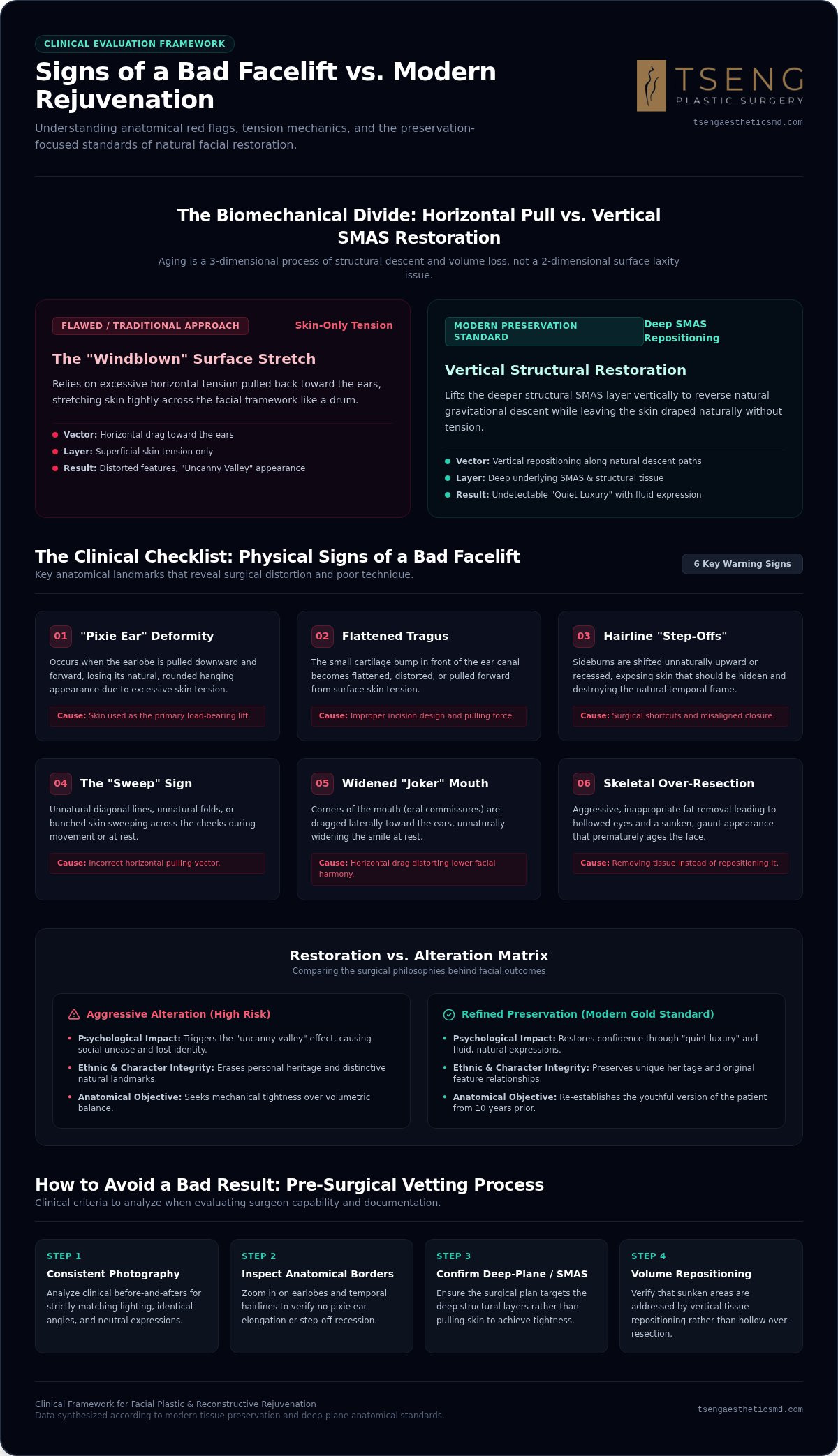
The "windblown" look is perhaps the most recognizable of the signs of a bad facelift. It occurs when a surgeon relies on excessive horizontal tension to smooth wrinkles, essentially stretching the skin across the face like a drum. This mechanical approach ignores the fact that aging is a three-dimensional process involving the loss of fat and bone density. In 2026, the gold standard has shifted away from surgical "tightness" toward the careful restoration of youthful facial volume. A truly successful facelift surgery (rhytidectomy) should remain invisible to the untrained eye; it's a quiet enhancement that preserves the natural positions of your features while softening the shadows of time.
Facial harmony is achieved when the eyes, mouth, and jawline retain their original relationships to one another. When skin is pulled too tight, these relationships are distorted; the mouth may appear wider, or the eyes may look unnaturally slanted. These are clear signs of a bad facelift that stem from a failure to respect the underlying anatomy. By focusing on depth and structural support, a skilled surgeon lifts the tissues vertically, which is how they naturally sag over time, rather than pulling them back toward the ears.
The Psychology of a "Done" Look
When a result feels artificial, it often triggers a sense of social anxiety rather than the intended boost in confidence. In the aesthetic landscape of 2026, patients are increasingly seeking "quiet luxury," a philosophy that prioritizes subtlety and refinement over drastic, recognizable changes. The "uncanny valley" effect in facial plastic surgery describes the psychological discomfort triggered by a face that appears almost natural but possesses subtle, artificial distortions that feel unsettlingly wrong. Avoiding this requires a surgeon who operates as an artist-scientist, ensuring that your expressions remain fluid and authentic.
Restoration vs. Alteration
The goal of modern rejuvenation is to restore the version of yourself from ten years ago rather than creating a new, unrecognizable face. This distinction is vital for maintaining your unique ethnic and personal facial characteristics, which are the hallmarks of your identity. A master craftsman understands that true beauty lies in balance, not in the erasure of your heritage or character. For a deeper look at how these techniques have evolved, you may explore The Modern Facelift: A Comprehensive Guide to Natural Facial Rejuvenation. By focusing on preservation rather than aggressive alteration, you can achieve a result that feels both timeless and entirely your own.
The 2026 Checklist: Physical Signs of a Bad Facelift
Identifying the signs of a bad facelift requires a keen eye for anatomical landmarks that should remain undisturbed. In the aesthetic landscape of 2026, patients are more discerning about these markers, recognizing that a "pulled" look is a failure of technique. One of the most common red flags is the "Pixie Ear" deformity. This occurs when the earlobe is pulled downward and forward, losing its natural, rounded hanging appearance because of excessive skin tension. Similarly, the tragus, which is the small cartilage bump in front of the ear canal, can become flattened or pulled forward. This distortion is a telltale sign that the skin was used as the primary lifting mechanism rather than the deeper tissues.
The hairline often reveals surgical shortcuts that compromise the final result. Look for "step-offs" where the sideburn is shifted unnaturally upward or recession that exposes skin that should be hidden. When tension is applied horizontally rather than vertically, the mouth may take on a "Joker-like" widened appearance. This happens because the corners of the lips are pulled toward the ears, disrupting the natural balance of the lower face. Additionally, inappropriate fat removal is a hallmark of poor technique. While removing excess tissue is sometimes necessary, over-resection leads to "hollow" eyes and a skeletal look that ages the patient prematurely. According to the American Society of Plastic Surgeons facelift guide, successful rejuvenation focuses on repositioning tissue rather than simply removing it.
Anatomical Red Flags in the Mid-Face
The "Sweep" sign is a definitive marker of poor surgical direction. It appears as unnatural diagonal lines or bunching across the cheeks when the patient smiles or speaks. This often occurs when a surgeon ignores mid-face descent and tries to compensate by over-tightening the lower face. A refined result preserves the "ogee curve," which is the elegant S-shaped contour of the cheekbones, rather than flattening it into a generic, pulled surface. Spotting these nuances is essential when evaluating potential outcomes.
Scar Quality and Placement
Scarring should be virtually imperceptible in high-quality work. Hypertrophic or "stretched" scars behind the ears suggest that the skin was closed under too much tension, a common error in traditional methods. The ideal "invisible" incision line in modern facial surgery follows the natural junction of the ear and face so precisely that it disappears even under close inspection. If you notice visible incisions where they should be camouflaged within the temporal hairline, it may indicate a lack of surgical precision. For those seeking a more meticulous approach, exploring preservation-based facial rejuvenation can ensure these delicate details are respected with a master's touch.
Why Poor Outcomes Occur: Tension vs. Tissue Depth
The root cause of most signs of a bad facelift isn't a lack of effort, but a misunderstanding of facial mechanics. When a surgeon relies solely on the skin to provide lift, the result is inevitably a tight or windblown appearance. Skin is an elastic envelope, not a structural support system. It's designed to move and stretch, not to bear the weight of sagging tissues. True rejuvenation requires working within the deeper layers of the face, specifically the Superficial Musculoaponeurotic System (SMAS). This fibrous layer of tissue connects the facial muscles to the skin and serves as the actual foundation for a lasting, natural result.
Deep Plane techniques represent a significant evolution in surgical artistry. Rather than simply tightening the SMAS, a Deep Plane approach involves releasing the natural ligaments that hold facial tissues in place. This allows the surgeon to reposition the fat and muscle vertically without creating tension on the skin itself. One of the greatest dangers in traditional surgery is the over-resection of fat. While removing a double chin is desirable, taking too much volume from the cheeks or temples creates a gaunt, skeletal appearance that often looks older than the original face. In 2026, we understand that volume is the hallmark of youth.
SMAS vs. Deep Plane: A Mechanical Comparison
Understanding the mechanics of these procedures helps clarify why some results look "done" while others remain undetectable. In a standard SMAS lift, tension is often concentrated at the edges of the incision, which can pull the corners of the mouth into an unnatural, wide position. By contrast, a preservation-focused Deep Plane approach maintains the integrity of the ligaments and moves the entire facial unit as one. For those weighing their options, the Deep Plane Facelift vs. SMAS debate often centers on which method provides the most stable structural support without compromising the signs of a bad facelift through artificial tension.
The Importance of Facial Detailing
A harmonious result requires a holistic vision. If a surgeon focuses only on the lower face while ignoring the neck or forehead, the result is a mismatched appearance that draws attention to the work. Dr. Tseng utilizes advanced preservation techniques to maintain vascular health and tissue vitality throughout the procedure. By integrating regenerative cells and meticulous fat grafting, he prevents the flat result that often characterizes older surgical methods. This focus on facial detailing ensures that the transition between different facial zones is seamless and graceful, reflecting a master craftsman’s touch.
How to Avoid a Bad Result: The Pre-Surgical Vetting Process
Choosing a surgeon is more than a clinical decision; it's an act of trust in a professional’s artistic vision and technical precision. To avoid the signs of a bad facelift, your vetting process must be rigorous and methodical. Start by scrutinizing "Before and After" galleries with a critical eye. Look for consistency in lighting and specific 45-degree angles, which reveal the true contour of the jawline and neck. If the photos appear filtered or the angles vary significantly, it may be an attempt to mask surgical shortcomings. The goal is to find patients who look like refreshed versions of themselves, not individuals who have been fundamentally altered.
Verify that your surgeon is board-certified by the American Board of Plastic Surgery (ABPS). This certification ensures a baseline of elite training and adherence to strict safety standards. During your initial meeting, ask specifically about "Preservation" techniques. A surgeon who understands the value of tissue vitality will prioritize maintaining your natural vascular health rather than just aggressive cutting. Ensure they discuss the emotional journey of rejuvenation. A master craftsman understands that your physical transformation is deeply linked to your internal sense of well-being and confidence.
Questions to Ask Your Surgeon
- "How do you ensure my earlobes won’t be pulled downward or develop a pixie ear deformity?"
- "What is your specific approach to maintaining the natural position of my hairline and sideburns?"
- "Do you utilize fat grafting to restore lost volume, or do you rely solely on lifting the skin?"
Evaluating Surgical Philosophy
A conservative approach in 2026 is often the mark of a highly sophisticated surgeon. Beware of any practitioner who promises "perfection" or "drastic" changes, as these claims are often precursors to the signs of a bad facelift. True elegance is found in subtlety and the restoration of balance. The ideal patient-surgeon alignment occurs when both parties prioritize long-term facial harmony over immediate, aggressive tightness. If you are ready to begin this journey with a focus on balanced results, you can schedule a consultation for a preservation-based facelift to discuss your personal vision and aesthetic goals.
The Tseng Philosophy: Preservation and Refined Rejuvenation
The Minimal Invasive Preservation Face and Neck Lift represents a paradigm shift in how we approach facial aging. By prioritizing the preservation of delicate facial structures rather than their aggressive alteration, this technique directly addresses the mechanical failures that lead to the recognizable signs of a bad facelift. Dr. Tseng operates with the precision of a clinical authority and the intuition of a master craftsman, ensuring that every adjustment respects the patient’s unique anatomy. This method focuses on maintaining structural integrity, which results in a subtle, long-lasting improvement that feels authentic and looks entirely natural.
In the aesthetic landscape of 2026, the mantra "less is more" has become a guiding principle for those seeking high-end results. Rather than relying on tension, Dr. Tseng’s preservation-focused approach utilizes the body's natural layers to provide structural support. This prevents the artificial tightness and volume loss discussed in earlier sections, allowing for a rejuvenation that is as healthy for the tissue as it is beautiful for the eye. By safeguarding vascular health and minimizing tissue disruption, the recovery is often more graceful, and the results remain stable for years to come.
A Patient-First Mentality
The journey toward a refreshed appearance begins with an unhurried consultation process where your personal vision takes center stage. Tseng Plastic Surgery avoids the industrial, "one-size-fits-all" surgical trap that often results in generic or over-processed outcomes. With a legacy of over 20 years of surgical experience, Dr. Tseng has refined the ability to listen deeply to a patient's goals before recommending a bespoke plan. This commitment to safety and personalized care ensures that you aren't just another procedure, but a partner in a shared aesthetic vision that prioritizes your long-term well-being.
Next Steps for Your Journey
Moving toward facial rejuvenation doesn't have to be defined by the anxiety of looking "done" or unrecognizable. By focusing on harmony and refinement, you can explore options that enhance your natural character without the fear of the signs of a bad facelift. Preparing for your consultation involves reflecting on the specific features you wish to refresh and identifying the version of yourself you want to see in the mirror. When you're ready to take the next step toward a sophisticated, balanced transformation, we invite you to schedule a consultation with Dr. Tseng to discuss your refined rejuvenation goals.
Embracing a Future of Authentic Rejuvenation
Achieving a refined aesthetic result requires a delicate balance of surgical precision and artistic intuition. By understanding the common signs of a bad facelift, such as distorted hairlines or artificial skin tension, you're now equipped to make an informed decision about your rejuvenation journey. True beauty isn't about drastic alteration; it's about restoring the structural integrity of your features through advanced preservation techniques that honor your unique identity.
Dr. Tseng brings board-certified expertise and over 20 years of surgical experience to every procedure, specializing in methods that yield invisible, natural-looking results. Our practice is dedicated to providing sophisticated, unhurried patient care designed for the discerning individual who values subtlety over excess. You deserve a transformation that feels as authentic as it looks.
Begin your journey toward natural, refined rejuvenation with Dr. Tseng today. We look forward to helping you rediscover a more vibrant, harmonious version of yourself with confidence and peace of mind.
Frequently Asked Questions
Is a bad facelift permanent, or can it be corrected?
While surgical changes are significant, most complications can be addressed through specialized revision surgery. A master craftsman can often reposition underlying tissues or release the excessive tension that caused the initial distortion. However, correction is far more complex than the original procedure and requires a surgeon who understands preservation techniques to restore harmony without causing further trauma. Most experts recommend waiting at least one year for tissues to fully heal before attempting a revision.
How long does it take for a facelift to "settle" into a natural look?
Most patients see their final, settled results between six and twelve months after the procedure. Initial swelling typically subsides within three to four weeks, but the deeper structural layers take longer to achieve their permanent position. During the first few months, the face may feel firm or appear slightly over-corrected. In 2026, refined preservation techniques aim to minimize this phase, allowing you to return to social life with a refreshed appearance much sooner than traditional methods allowed.
Can non-surgical treatments fix a bad facelift outcome?
Non-surgical options like injectables or skin resurfacing can camouflage minor imperfections, but they cannot fix fundamental structural errors. If the primary issues are signs of a bad facelift like a pixie ear or a shifted hairline, surgery is typically the only permanent solution. Fillers might temporarily restore volume to hollow areas caused by over-resection, yet they don't address the underlying tension that creates a windblown or pulled appearance. True correction requires surgical repositioning of the deeper layers.
What is the most common sign of a bad facelift in 2026?
The most prevalent red flag in 2026 is the "Sweep" sign, where unnatural diagonal lines appear across the mid-face during expression. This occurs when a surgeon pulls the skin horizontally rather than lifting the deeper layers vertically. Other frequent indicators include the "Pixie Ear" deformity and an unnaturally widened mouth. These outcomes reflect a failure to respect the three-dimensional architecture of the face, prioritizing surface tightness over genuine structural restoration and youthful volume.
Does a Deep Plane facelift carry more risk of a "bad" result than SMAS?
A Deep Plane facelift actually carries a lower risk of an unnatural result when performed by an expert like Dr. Tseng. Because it repositions the entire facial unit, including muscle and fat, it avoids the artificial tension on the skin that often characterizes a failed SMAS lift. While the technique is more advanced and requires deeper anatomical knowledge, it's the gold standard for avoiding the "windblown" look and ensuring long-lasting, elegant facial harmony that moves naturally.
How can I tell if my surgeon is truly an expert in natural results?
Look for a surgeon with over 20 years of experience who specifically highlights preservation techniques in their philosophy. Analyze their portfolio for consistency in patient identity; the best results show individuals who look like themselves, only refreshed. A true expert will prioritize a patient-first mentality and conduct unhurried consultations. They should emphasize structural integrity and volume restoration rather than just skin removal or aggressive, drastic changes that compromise your unique facial features.
What happens if a facelift is too tight?
Excessive tightness leads to the "uncanny valley" effect, where the face looks almost human but possesses unsettling distortions. This tension can pull the corners of the mouth outward, flatten the tragus cartilage, or cause visible scarring as the skin struggles against the surgical force. Over-tightening also compromises vascular health, which can lead to poor healing and tissue vitality. In severe cases, it creates a frozen expression that lacks the fluid movement of natural human emotion.
Can fat grafting prevent the "windblown" look?
Yes, fat grafting is a critical tool for preventing the flat, stretched appearance often associated with traditional surgery. By restoring lost volume to the temples and cheeks, it adds the three-dimensional fullness that characterizes a youthful face. This technique works in tandem with surgical lifting to ensure that the skin rests gently over a supported foundation. It's an essential part of an artist-scientist’s approach to achieving a balanced rejuvenation that avoids the signs of a bad facelift.

