Preservation Facelift vs. Deep Plane: Choosing the Future of Facial Rejuvenation
By Tseng Plastic Surgery
The most successful facial rejuvenation is the one that leaves no trace of the surgeon's hand, only the restoration of your natural elegance. If you've spent hours researching the preservation facelift vs deep plane approach, you've likely encountered a confusing landscape of marketing terms and surgical jargon. It's completely normal to feel a sense of anxiety about looking "pulled" or facing an exhausting recovery period. You're seeking a result that's authentically you, where the only evidence of surgery is a renewed sense of confidence.
This guide will help you discover the anatomical differences, recovery timelines, and aesthetic outcomes of these two advanced techniques. By the end, you'll understand which method best aligns with your personal vision for a refined, youthful profile that ages gracefully. We'll examine how these procedures respect your unique facial structure while providing the long-lasting results you deserve. This clarity allows you to move forward with quiet confidence, knowing your choice is grounded in both medical precision and artistic harmony.
Key Takeaways
- Understand how modern surgical techniques have shifted from simply tightening the skin to structural modification that restores a youthful jawline and "V-shape."
- Learn how the deep plane approach releases facial ligaments to reposition tissues without tension, resulting in a durable and natural-looking profile.
- Compare the anatomical nuances of a preservation facelift vs deep plane to see how protecting the blood supply and nerves can significantly accelerate your healing process.
- Explore the benefits of the minimal invasive preservation face and neck lift for those seeking elegant, refined results with a recovery period as short as 7-10 days.
- Discover why a personalized approach is essential, as the ideal technique is chosen based on your unique anatomy and specific aesthetic goals.
The Evolution of Facial Rejuvenation: Why Technique Matters
The Evolution of Facial Rejuvenation has transformed from simple skin tightening into a sophisticated discipline of structural engineering and artistic refinement. Early procedures often focused on the surface, pulling the skin taut to mask wrinkles; however, modern science recognizes that aging happens deep within the foundation. Today, the collective goal is to restore a crisp jawline and the classic "V-shape" of youth by modifying deep tissue rather than relying on surface tension. This shift allows for more durable results that respect the underlying anatomy. Because every face ages at its own pace, a single approach no longer serves the diverse needs of modern patients. The preservation movement represents a significant shift toward ligament-sparing surgery, aiming to maintain the face's natural support structures while achieving rejuvenation.
Beyond the Traditional SMAS Lift
Traditional SMAS (Superficial Musculoaponeurotic System) techniques have been the gold standard for decades, yet they often fall short in long-term longevity. These methods typically pull the face horizontally, which can sometimes lead to an unnatural appearance often described as the "wind-tunnel" look. Modern surgery favors a vertical vector lift. This approach works against gravity by lifting tissues upward rather than backward. By addressing the deep-tissue layers, surgeons avoid the excessive tension on the skin that creates a pulled look. This evolution ensures that the results aren't just immediate but also age gracefully over a decade or more. It's about restoring volume where it belongs, not just stretching what remains.
The Role of Anatomy in Surgical Choice
Your unique biological baseline is the most critical factor in deciding between a preservation facelift vs deep plane procedure. Factors such as skin elasticity, bone structure, and fat volume dictate which technique will yield the most harmonious result. The face is held in place by retaining ligaments, which act like anchors for the soft tissue. As these anchors weaken, the face begins to sag. While some patients require a full release of these ligaments for structural repositioning, others benefit from a more conservative approach that keeps them intact. A personalized consultation remains the only way to determine candidacy, as it allows the surgeon to assess your specific anatomical puzzle and recommend a path that ensures balance and safety. This patient-first approach prioritizes your individual journey, ensuring the surgical plan matches your personal vision of beauty.
The Deep Plane Facelift: Restructuring the Foundation
The deep plane facelift represents a masterclass in structural repositioning, moving beyond the surface to address the root causes of facial aging. Unlike traditional methods that merely pull the skin, this technique involves entering the anatomical space beneath the SMAS (Superficial Musculoaponeurotic System) layer. By releasing the rigid retaining ligaments that tether the facial tissues to the bone, the surgeon can glide the entire mid-face and jawline into a more youthful position. This release is crucial; it allows for a tension-free move that eliminates the risk of a "pulled" appearance. When comparing a preservation facelift vs deep plane, the latter is often favored for its ability to effectively correct heavy nasolabial folds and significant mid-face descent.
- Structural Integrity: By moving the muscle and fat as one unit, the results look more natural.
- Ligament Release: Releasing anchors allows for a complete, effortless lift.
- Mid-face Restoration: Effectively lifts the cheeks to soften deep lines around the mouth.
The Vertical Vector: A Youthful Trajectory
Youthful beauty is defined by an upward, vertical orientation of the cheeks and jawline. The deep plane approach mimics this natural trajectory by lifting the underlying structure as a single, cohesive unit. This method provides a profound impact on the lower face, specifically the "jowl" area, where tissue tends to pool over time. By repositioning the deep foundation, the surgeon achieves a smooth neck-to-jaw transition without placing any stress on the skin. This artistry creates a refined profile that looks inherently natural, whether you're in motion or at rest.
Recovery and Longevity Expectations
Patients should prepare for a deliberate healing process, with the first 14 days of deep plane recovery involving the most visible swelling and bruising. While the initial downtime is more extensive than simpler procedures, social recovery typically resolves within 21 days as the tissues settle. The investment in time pays dividends in durability; deep plane results often last 10-15 years, which is significantly longer than surface-level alternatives. This procedure is a cornerstone of The Modern Facelift: A Comprehensive Guide to Natural Facial Rejuvenation, offering a permanent structural shift that ages gracefully alongside you. If you're ready to explore how this structural approach might benefit your unique profile, Dr. Tseng can help you discover your personalized rejuvenation path.
The Preservation Facelift: A Paradigm of Anatomical Respect
The philosophy of preservation is fundamentally different from structural repositioning; it's an approach rooted in protecting the delicate biological network of the face. While we've discussed the deep plane's ability to release and move tissues, the preservation facelift vs deep plane debate often centers on how much anatomy we can leave undisturbed. Dr. Tseng offers a specialized "Minimal invasive preservation face and neck lift" that prioritizes the integrity of blood vessels, nerves, and lymphatic channels. By utilizing smaller, meticulously placed incisions and targeted internal sutures, this technique achieves a lifted appearance without the extensive trauma associated with traditional methods.
A key component of this refined approach is the "Stay Suture" concept. Instead of a wide-scale release of facial ligaments, Dr. Tseng uses these internal anchors to secure tissues in a more youthful position. These sutures act as permanent internal supports, providing a subtle but effective lift while bypassing the need for deep-tissue dissection. It's a sophisticated way to achieve harmony without disrupting the face's natural support systems, ensuring the underlying foundation remains strong and intact.
Minimizing Trauma for Maximum Refinement
Because the preservation method avoids wide skin undermining and maintains the lymphatic drainage system, patients experience significantly less bruising and swelling than with more aggressive techniques. Most individuals can return to their daily routines within 7 to 10 days, a timeline that appeals to those with demanding professional or social schedules. The outcome isn't a "reconstructed" look, but rather a profoundly refreshed version of yourself. It's about elegance through restraint, ensuring that your results look naturally radiant and never overdone.
Who is the Ideal Preservation Candidate?
This technique is perfectly suited for patients in their 40s and 50s who are noticing early to moderate jowling or a loss of jawline definition. We often refer to this as "pre-juvenation," a proactive way to manage the aging process before structural changes become too severe. It's the premier choice for individuals who prioritize a subtle transformation over a drastic change. If your goal is to look like you've simply had a long, restful vacation, the preservation approach offers the precision and artistry to make that vision a reality. This patient-first strategy ensures that the intervention matches the biological needs of your skin and foundation perfectly.
Preservation vs. Deep Plane: A Comparative Framework
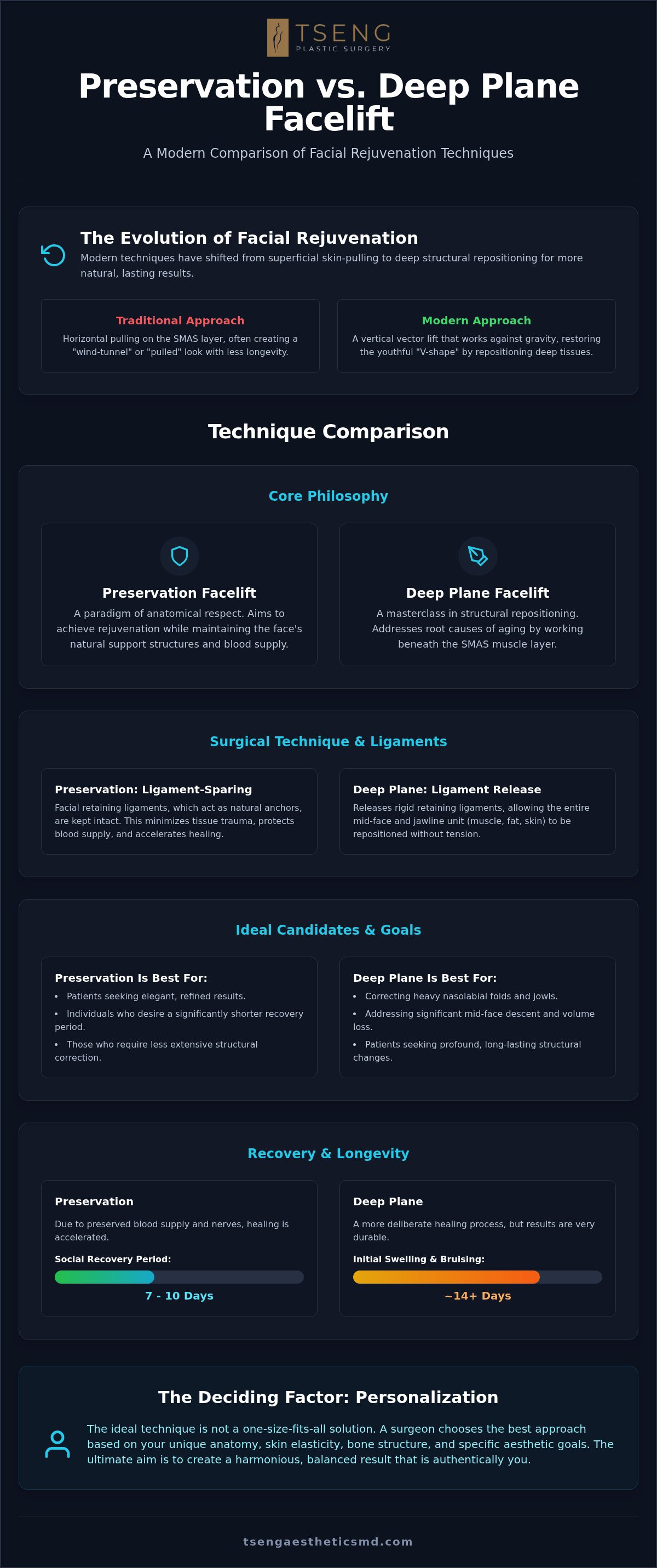
Selecting the ideal path for facial rejuvenation isn't merely a matter of surgical preference; it's a strategic decision based on your unique biological blueprint. While both procedures aim for a more youthful profile, they differ significantly in their anatomical path and surgical depth. The deep plane facelift involves a more extensive dissection to release the retaining ligaments, allowing for a profound structural shift of the underlying foundation. In contrast, the preservation approach utilizes smaller incisions and focuses on ligament-sparing techniques, keeping the face's natural support network largely intact. When evaluating a preservation facelift vs deep plane, the choice often hinges on the balance between your desired level of correction and your lifestyle requirements.
Recovery timelines are frequently a deciding factor for modern patients. Most preservation patients return to their social lives within 7 to 10 days because the technique minimizes trauma to the lymphatic drainage system. Deep plane recovery is more deliberate, typically requiring 14 to 21 days for the initial swelling and bruising to subside. Regarding longevity, the deep plane is celebrated for its structural permanence, with results typically lasting 10 to 15 years. The preservation method offers refined maintenance, often lasting 10 years or more, making it an excellent choice for those looking to stay ahead of the aging process with a less invasive intervention.
The Candidacy Checklist
Evaluating your specific needs is the first step toward a successful and harmonious outcome. Consider these anatomical markers when discussing your goals:
- Mid-face Descent: If you have heavy nasolabial folds or significant cheek sagging, the structural lift of a deep plane is often necessary to reposition the fat pads effectively.
- Skin Elasticity: Patients with good skin quality and early jowling are frequently the most elegant candidates for the preservation approach.
- The Jawline and Neck: For those focused on the lower face, the Minimal invasive preservation face and neck lift bridges the gap by providing a crisp jawline with minimal surgical trauma.
Artistic Outcomes: Subtle Refinement vs. Total Rejuvenation
The aesthetic results of these two techniques offer distinct visual signatures. Preservation outcomes are characterized by softness and harmony, providing a refreshed look that feels effortless and authentically you. Deep plane results deliver more dramatic definition and contour, ideal for those seeking a total rejuvenation of their facial profile. Matching the surgical intensity to your personal aesthetic goals is a collaborative process that respects both medical science and your personal vision. If you're ready to determine which technique best suits your unique anatomy, contact Tseng Plastic Surgery to explore your personalized rejuvenation path.
The Tseng Philosophy: Mastery and Personalization
At Tseng Plastic Surgery, the approach to facial rejuvenation is defined by a belief that every face is a unique anatomical puzzle, requiring a solution that is as individual as the patient themselves. Dr. Tseng approaches each consultation with a "patient-first" mentality, prioritizing your personal history, emotional well-being, and aesthetic vision over a standard surgical template. He views himself as an artist-scientist, a role that demands both rigorous clinical authority and a refined sense of harmony. The ultimate decision in the preservation facelift vs deep plane discussion is never driven by marketing trends; instead, it's a deliberate choice based on your biological baseline and the specific goals you wish to achieve.
Achieving a balance between a significant surgical lift and artistic refinement is the hallmark of a master craftsman. Dr. Tseng ensures that every intervention respects the natural contours of your face while providing the structural support needed for a youthful restoration. By focusing on the harmony between professional expertise and your personal vision, the practice creates a sense of quiet confidence in every outcome. Moving toward a decision is a shared journey, and you can expect a private consultation that is thorough, transparent, and focused entirely on your needs.
Blending Science and Artistry
With over 20 years of surgical experience, Dr. Tseng has refined the ability to blend clinical precision with a sophisticated aesthetic touch. He understands that a successful outcome requires parallel excellence: precision in the deep layers to ensure structural integrity and artistry on the surface to maintain natural expressions. This dual focus ensures that your results don't just look stunning today but continue to age gracefully for years to come. By choosing the technique based on anatomical necessity, he avoids the pitfalls of a one-size-fits-all approach, ensuring your rejuvenation is both safe and enduring.
Your Journey to Refinement
The path toward your desired outcome is a deliberate and unhurried process that begins the moment you enter our practice. Dr. Tseng’s consultation style is methodical, moving at a pace that allows for deep listening and comprehensive education. He believes that true empowerment comes from understanding the intricacies of the procedure, from the placement of incisions to the expected recovery timeline. This transparency builds a foundation of trust and stability, ensuring you feel entirely informed before making a decision. For a deeper look into the post-surgical experience, we encourage you to learn more about the healing process in our Facelift Recovery Guide. Your journey concludes with the sense of possibility that only comes from a masterfully executed, patient-centric plan.
Embracing Your Personal Evolution with Confidence
Choosing between structural repositioning and anatomical preservation is a decision rooted in your unique biological needs and lifestyle goals. Whether you require the profound lift of a deep plane approach to correct mid-face descent or the refined maintenance of a preservation technique to address early jowling, the objective remains a harmonious, natural result that ages gracefully. The nuanced comparison of a preservation facelift vs deep plane highlights that the most effective technique is the one that respects your individual anatomy while delivering long-lasting elegance. There's no single path to beauty, only the one that aligns with your personal vision and biological baseline.
Dr. Mark Tseng brings over 20 years of dedicated surgical mastery to every procedure, offering a specialized focus on minimal invasive preservation techniques that prioritize your comfort and recovery. His practice is built on a legacy of natural, high-end aesthetic results that enhance your features without ever looking "operated." Discover your path to refined rejuvenation and schedule your private consultation with Dr. Mark Tseng to explore the possibilities for your own transformation. Your journey toward a refreshed, authentic version of yourself begins with a single, informed step toward expert care.
Frequently Asked Questions
Is a preservation facelift less effective than a deep plane facelift?
A preservation facelift isn't inherently less effective; rather, it's designed for a different stage of the aging process. While the deep plane approach excels at correcting significant structural descent, the preservation method is exceptionally effective for individuals with moderate laxity. It focuses on internal stabilization using stay sutures rather than a full release of ligaments. This ensures a refined, high-end result that respects your natural features without the need for extensive tissue trauma.
How long do the results of a preservation facelift typically last?
Current clinical data from 2026 suggests that the results of a preservation facelift typically last 10 years or more. This longevity is comparable to many traditional techniques because it secures the underlying foundation with permanent internal supports. While the deep plane facelift may offer 10 to 15 years of structural permanence, the preservation approach provides a durable, elegant refresh that ages gracefully alongside you. Proper skin care and a healthy lifestyle further protect this surgical investment.
Which procedure has a shorter recovery time, preservation or deep plane?
The preservation technique offers a significantly shorter recovery period, typically allowing patients to return to social activities within 7 to 10 days. In contrast, the deep plane facelift involves a more deliberate healing timeline of 14 to 21 days due to the extensive release of facial ligaments. By protecting the lymphatic drainage system and blood supply, the preservation method minimizes the swelling and bruising often associated with facial surgery. This makes it an ideal choice for busy professionals.
Can a preservation facelift address a sagging neck and jawline?
Yes, the specialized "Minimal invasive preservation face and neck lift" is specifically designed to restore definition to the jawline and neck. By utilizing targeted internal sutures, Dr. Tseng can tighten the underlying structures and eliminate early jowling without wide-scale dissection. This approach provides a crisp, youthful profile that addresses the lower face's needs while maintaining a subtle, authentically you appearance. It's an excellent option for those seeking refinement in these specific areas.
What is the difference in scarring between preservation and deep plane techniques?
Both techniques utilize meticulously placed incisions around the ear to ensure scars remain virtually invisible, yet the preservation method often requires smaller entry points. Because this approach involves less skin undermining, there is reduced tension on the incision lines during the healing process. This lower tension is critical for achieving minimal visible evidence of surgery. Dr. Tseng's focus on artistic refinement ensures that any resulting marks are hidden within the natural contours of your hair and ears.
Am I too young for a deep plane facelift, or too old for a preservation lift?
Candidacy is determined by your anatomical baseline rather than a specific number on a calendar. Many patients in their 40s choose a preservation facelift as a form of "pre-juvenation" to stay ahead of the aging process. Conversely, older patients with healthy skin elasticity may still be excellent candidates for this less invasive path. The deep plane approach is reserved for those requiring a total structural shift, regardless of age, to correct heavy nasolabial folds and significant mid-face descent.
Can these surgical techniques be combined with non-surgical treatments?
Surgical techniques are frequently combined with non-surgical treatments to achieve a truly harmonious and comprehensive result. You might choose to pair your facelift with injectables to restore lost volume or a non-surgical facelift to refine the skin's surface texture. Dr. Tseng often integrates these modalities to address every layer of facial aging, from deep structural shifts to fine surface lines. This multi-layered strategy ensures your final profile looks balanced, refreshed, and naturally radiant.
How do I know which facelift technique is right for my specific face shape?
Determining the right path for your specific face shape requires a professional assessment of your skin quality, fat volume, and bone structure. When comparing a preservation facelift vs deep plane, Dr. Tseng views your face as a unique anatomical puzzle. He analyzes how your tissues have shifted over time and recommends the technique that will best restore your natural "V-shape." This personalized consultation is the only way to ensure the surgical plan aligns perfectly with your aesthetic goals.

