Non-Surgical Hair Restoration: The Complete 2026 Clinical Guide
By Tseng Plastic Surgery
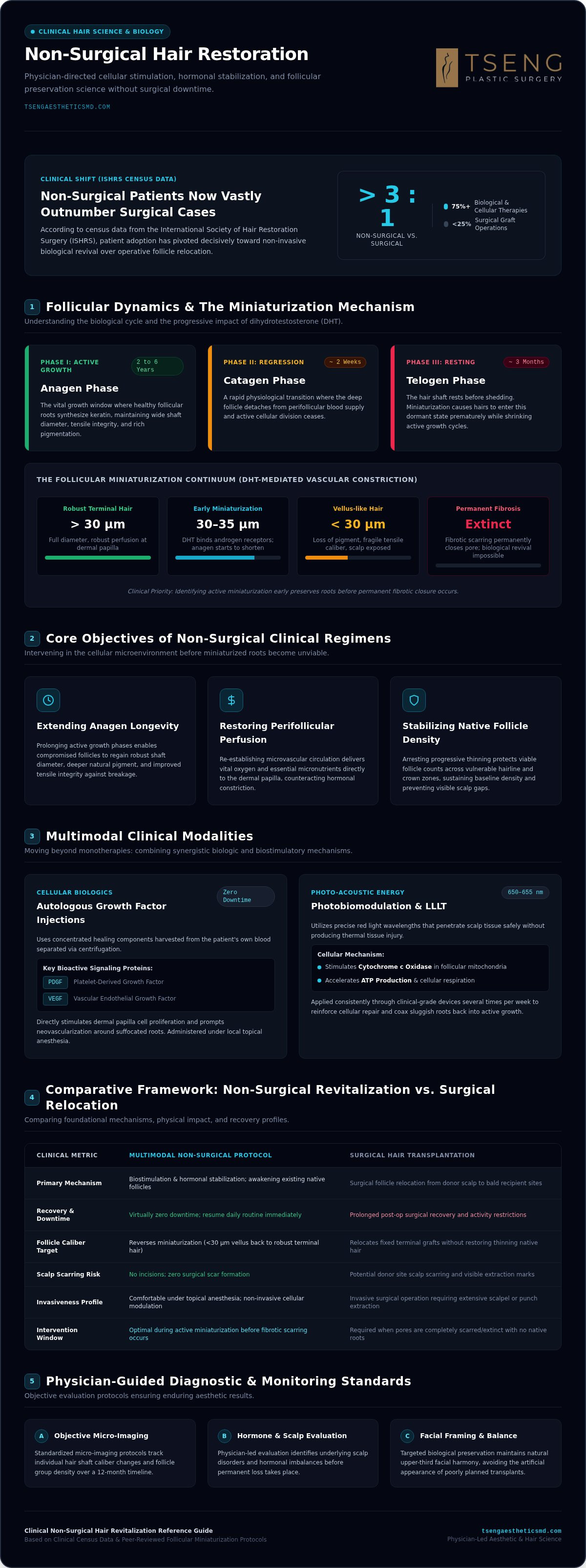
According to clinical census data from the International Society of Hair Restoration Surgery, non-surgical patients now outnumber surgical cases by more than three to one, marking a defining shift toward non-surgical hair restoration. If you've spent months watching a part slowly widen, monitoring receding temples, or growing exhausted with unproven topical serums, that hesitation makes complete sense. Thinning hair deeply impacts how we perceive our vitality, yet the prospect of surgical recovery, scalp scarring, and post-procedure discomfort often feels just as daunting.
You don't have to choose between ineffective cosmetic remedies and an invasive operation to reclaim natural density. True follicular revival succeeds when physician-directed cellular stimulation is paired with systematic hormonal stabilization, awakening dormant roots before miniaturization becomes permanent. In this complete clinical guide, you'll discover how advanced non-surgical hair restoration revives thinning hair, thickens shaft diameter, and restores youthful facial framing without a single day of surgical downtime.
Key Takeaways
- Understand the biological mechanisms of DHT-driven miniaturization and learn why early clinical intervention preserves follicles before permanent fibrosis occurs.
- Discover how multimodal non-surgical hair restoration combines autologous growth factors and cellular biostimulation to revive dormant roots naturally.
- Learn the key distinctions between surgical follicle relocation and non-invasive biological thickening, helping you select the right approach for your degree of thinning.
- Explore the physician-guided diagnostic milestones and objective micro-imaging protocols that track hair shaft caliber improvements across twelve months.
- Recognize the vital importance of physician-led medical evaluation to identify underlying scalp conditions and ensure balanced, enduring aesthetic results.
Understanding Non-Surgical Hair Restoration: Science, Follicular Miniaturization, and Goals
Clinical hair revitalization centers on a distinct biological objective: awakening compromised follicles rather than surgically rearranging tissue. Non-surgical hair restoration encompasses targeted, physician-directed therapies designed to arrest active thinning, reverse follicular shrinkage, and optimize cellular metabolism within viable roots. A healthy, well-proportioned hairline naturally frames the upper third of the face, restoring balanced facial harmony and personal confidence. Halting progressive loss early preserves this aesthetic foundation, offering profound emotional relief before structural depletion demands operative intervention.
The Biology of the Hair Follicle Cycle and Miniaturization
Healthy follicles cycle continuously through anagen (active growth lasting two to six years), catagen (a brief two-week regression), and telogen (a three-month resting phase). In susceptible scalps, systemic dihydrotestosterone (DHT) binds to androgen receptors at the dermal papilla, prompting vascular constriction and signaling the anagen phase to shut down prematurely. Clinical research into pattern hair loss and follicle miniaturization details how robust terminal hairs progressively degrade into fine, vellus-like strands measuring under 30 microns in diameter. Because biological therapies cannot awaken follicles once fibrotic scarring permanently closes the pore, identifying active miniaturization early remains the key to meaningful recovery.
The Primary Objectives of Non-Surgical Treatment
Physician-guided regimens intervene in the cellular microenvironment to reverse progressive thinning before follicles reach the point of extinction. Advanced non-surgical hair restoration focuses on three clear clinical milestones:
- Extending Anagen Longevity: Prolonging the active growth cycle allows compromised shafts to regain robust diameter, rich natural pigment, and improved tensile integrity.
- Restoring Perifollicular Perfusion: Stimulating localized microcirculation delivers oxygen and essential micronutrients directly to the dermal papilla, counteracting hormonal constriction.
- Stabilizing Native Follicle Density: Halting progressive miniaturization protects existing hair counts across vulnerable zones, maintaining full coverage and preventing exposed scalp.
Leading Clinical Modalities in Non-Surgical Hair Restoration
Modern clinical practice has moved decisively away from isolated monotherapies. Today's non-surgical hair restoration relies on synergistic multimodal protocols that combine autologous regenerative biologics, focused energy wavelengths, and medical hormone modulation. Aligning with recognized clinical hair loss diagnosis and treatment protocols, combining these modalities produces markedly higher follicular response rates than any single intervention alone.
Autologous Growth Factor Injections and Cellular Therapies
Autologous biologics utilize concentrated healing components harvested from the patient's own blood. Once separated via centrifugation, blood platelets deliver vital signaling proteins, including platelet-derived growth factor (PDGF) and vascular endothelial growth factor (VEGF). Injected directly into thinning scalp zones, these bioactive molecules stimulate dermal papilla cell proliferation and prompt neovascularization around suffocated roots. Procedures remain comfortable under local topical anesthesia, requiring virtually no downtime so you can resume normal routines immediately.
Photobiomodulation and Low-Level Laser Therapy
Photobiomodulation uses precise red light wavelengths, typically between 650 and 655 nanometers, to penetrate scalp tissue safely without producing heat. Within the cellular matrix, this concentrated energy stimulates cytochrome c oxidase in follicular mitochondria, accelerating adenosine triphosphate (ATP) production and cellular respiration. When applied consistently through clinical-grade devices several times per week, this photo-acoustic biostimulation reinforces weakened cellular repair mechanisms and coaxes sluggish roots back into active cycles.
Targeted Medical Management and Topical Formulations
Halting progressive follicle miniaturization requires systemic control over hormonal triggers. Physician-directed medical therapy accomplishes this through dual mechanisms:
- Hormonal Interruption: 5-alpha reductase inhibitors block the conversion of circulating testosterone into dihydrotestosterone, protecting delicate receptor sites.
- Microvascular Vasodilation: Potassium channel openers such as topical or carefully titrated low-dose oral formulations widen constricted microvessels, flooding roots with nutrient-rich blood flow.
- Mechanical Bio-Induction: Clinical microneedling creates micro-channels across the epidermis, triggering natural wound-healing cascades while enhancing transdermal absorption.
To establish the ideal biological balance for your scalp, exploring customized physician-directed hair restoration provides a tailored clinical framework built specifically around your pattern of loss and aesthetic goals.
Non-Surgical Therapies vs. Surgical Hair Transplantation: A Comparative Framework
Choosing the right clinical path begins with understanding a fundamental biological truth: surgical hair transplantation does not create new hair. Instead, surgical procedures harvest and relocate existing follicular units from the back of the scalp to fill bare regions. Non-surgical hair restoration, by contrast, targets your existing native roots, working biologically to reverse miniaturization and amplify individual shaft diameter. While surgical grafting involves donor excision, local tumescence, and several weeks of careful recovery, biological therapies demand zero surgical downtime, allowing your daily schedule to remain uninterrupted.
Candidacy Criteria: When Non-Surgical Treatment Is the Superior Choice
Determining your ideal approach depends on the degree of active follicular vitality present across the scalp. Non-surgical interventions represent the superior clinical strategy for specific clinical scenarios:
- Early to Moderate Diffuse Thinning: When widening occurs along the central part or crown but pores remain biologically active, biological revitalization produces exceptional visual density.
- A Preference for Subtle, Low-Risk Care: Patients who want to avoid surgical incisions, potential donor-site scarring, and prolonged post-procedure restrictions benefit from non-invasive cellular restoration.
- Limited Donor Reserves: Individuals with fine or sparse hair in the occipital donor zone often lack the graft counts necessary for surgical extraction, making native follicle preservation essential.
Strategic Combination: Protecting Your Aesthetic Investment
Surgical transplantation and biological therapy are often complementary rather than mutually exclusive. Genetic alopecia remains an ongoing, lifelong process. While transplanted donor follicles generally resist dihydrotestosterone, the native hairs surrounding those transplanted grafts remain entirely susceptible to miniaturization.
Without structured non-surgical hair restoration, ongoing loss behind a restored hairline can create disjointed, isolated islands of transplanted hair over time. Integrating ongoing cellular stimulation and targeted medical stabilization protects surrounding native strands, supports donor zone microcirculation, and preserves balanced, natural aesthetic harmony for decades to come.
The Clinical Protocol: Assessment, Milestones, and Growth Timelines
Predictable biological rejuvenation requires methodical diagnostic precision. Rather than guessing at follicular response, an evidence-based non-surgical hair restoration regimen begins with calibrated micro-imaging and standardized serial photography. This rigorous baseline establishes an objective benchmark, tracking authentic changes in follicular unit grouping and caliber over time rather than relying on subjective impressions under variable lighting.
The Comprehensive Initial Consultation and Scalp Mapping
Every successful plan starts with an extensive medical evaluation. We examine family history, systemic health markers, and nutritional profiles to exclude underlying metabolic issues. Using high-resolution dermoscopy and microscopic densitometry, we measure hair shaft diameter and quantify follicular groupings across vulnerable zones. This critical step separates active miniaturization from permanently scarred ostia, ensuring treatment concentrates where biological recovery remains possible while harmonizing density with your overall facial proportions.
Month-by-Month Progress and Biological Growth Milestones
Follicular biology operates on an unhurried, sequential rhythm. Setting clear clinical expectations prevents unnecessary anxiety during the initial stages:
- Months 1 to 2: Many patients experience a transient shedding phase between weeks two and eight. This temporary release occurs because stimulated follicles shed resting telogen shafts to initiate vigorous anagen cycles. It confirms that cellular activation has begun.
- Months 3 to 6: Excessive daily shedding ceases, baseline native density stabilizes, and early fine terminal hairs begin emerging along previously thinning contours.
- Months 6 to 12: Shaft caliber thickens considerably, delivering noticeable visual volume, rich coverage, and refined hairline definition. Periodic maintenance sessions every six to twelve months sustain this renewed cellular vitality over the long term.
If you're ready to evaluate your follicular health with physician-led precision, schedule an in-depth clinical consultation to map your customized path toward lasting density.
The Physician-Led Aesthetic Advantage: Restoring Balance and Confidence
Hair density is never an isolated physical feature; it serves as the defining architectural frame for the upper third of your face. While commercial medspa chains and technician-staffed franchises often view thinning hair through a transactional lens, physician-directed non-surgical hair restoration approaches scalp vitality as a vital component of complete facial harmony. Directed by Dr. Mark H. Tseng, our practice brings over two decades of aesthetic surgical experience to hair restoration, pairing deep clinical diagnosis with a refined artistic perspective to preserve authentic, natural proportions.
Why Clinical Oversight and Diagnostic Accuracy Matter
Safe and effective intervention requires distinguishing common androgenetic loss from complex systemic or inflammatory conditions. Commercial settings frequently apply generic treatments without determining whether shedding stems from hormonal sensitivity, nutritional depletion, acute telogen effluvium, or autoimmune disorders such as alopecia areata or lichen planopilaris. Applying unguided microneedling or mechanical trauma to scarring alopecias can trigger irreversible follicular damage. Direct physician oversight guarantees that your diagnostic profile is thoroughly verified, allowing therapeutic concentrations and delivery methods to be tailored precisely to your unique biological response.
Harmonizing Hair Framing with Comprehensive Facial Rejuvenation
A soft, natural hairline restores balance to the forehead and temples, complementing the structural contours of the midface and jawline. When patients seek to refresh their appearance, stabilizing thinning hair often works in synergy with subtle tissue lifting and contouring. Depending on your anatomical goals, comparing surgical vs. non-surgical facelift options can reveal how structural facial refinement pairs naturally with native follicular density. Combining proactive hair preservation with natural facial rejuvenation ensures that every feature ages in graceful, unforced balance.
If you're seeking a bespoke treatment plan rooted in patient safety and clinical integrity, schedule a private aesthetic consultation with Dr. Tseng to restore balance and confidence to your aesthetic journey.
Your Next Step Toward Natural Follicular Renewal
Reversing early hair loss doesn't require invasive incisions or uncomfortable downtime. Lasting success in non-surgical hair restoration hinges on timely biological intervention: protecting vulnerable roots from hormonal miniaturization, awakening sluggish papilla cells through autologous growth factors, and sustaining microvascular health through multimodal therapies. When initiated before permanent follicular fibrosis sets in, these clinical protocols restore natural shaft diameter and revitalize the essential aesthetic frame of your face.
Tseng Plastic Surgery brings more than two decades of specialized surgical and aesthetic experience led by Dr. Mark H. Tseng. By viewing hair density as an integral element of holistic facial balance rather than an isolated concern, our physician-owned practice ensures every protocol remains safe, disciplined, and bespoke. If you're ready to stabilize thinning and nurture your hair's native vitality with quiet confidence, schedule a personalized hair restoration consultation with Dr. Tseng.
Frequently Asked Questions
Can non-surgical hair restoration regrow hair on completely bald areas?
No, non-surgical hair restoration cannot generate new growth where follicular ostia have completely atrophied and scarred over. Cellular stimulation requires living, miniaturized follicles with intact dermal papillae to respond to growth signals. When the scalp becomes smooth and shiny with zero remaining active roots, surgical transplantation or alternative styling solutions represent the only viable clinical avenues for restoring coverage.
How long does it take to see visible results from non-surgical hair restoration?
Most patients begin observing measurable changes in scalp coverage and hair caliber between three and six months of consistent treatment. Because human hair grows slowly, awakening cellular metabolism takes deliberate time. Initial stabilization of excessive shedding occurs during the first eight to twelve weeks, followed by progressive shaft thickening that reaches peak aesthetic density between nine and twelve months.
Are the results achieved from non-surgical hair restoration permanent?
Results remain durable and stable as long as periodic clinical maintenance continues. Because androgenetic alopecia stems from an ongoing genetic susceptibility to circulating hormones, untreated follicles will eventually slip back into miniaturization if biological support stops completely. Scheduling a physician-guided maintenance session every six to twelve months preserves active microvascular flow and protects your aesthetic investment over the long term.
Is non-surgical hair restoration painful, and is there any recovery downtime?
Discomfort remains very mild, and procedures require zero social or physical downtime. Clinical protocols use topical anesthetic compounds and gentle cooling techniques to ensure patient comfort throughout in-office injections or microneedling. You may notice faint scalp redness or slight tenderness for roughly twenty-four hours, but you can wash your hair and return to normal professional activities the very next morning.
Can women benefit from non-surgical hair restoration as effectively as men?
Yes, women often achieve exceptional cosmetic improvements with non-surgical clinical protocols. Female pattern loss typically presents as diffuse, widespread thinning along the central part rather than sudden hairline recession, making it remarkably responsive to autologous growth factors and cellular biostimulation. Because donor zones in women are frequently too diffuse for surgical harvesting, non-surgical cellular restoration often serves as the premier treatment modality. Alongside biological treatments, many clients also seek gentle styling approaches; for example, you can explore החלקת שיער אורגנית to learn how modern salons manage hair smoothing without compromising delicate strands.
How do in-office regenerative hair injections differ from over-the-counter hair serums?
In-office regenerative injections place concentrated autologous signaling proteins directly into the vascular dermis surrounding the dermal papilla. Over-the-counter cosmetic serums, retail oils, and topical botanical rinses sit primarily on the surface stratum corneum, unable to cross the lipid barrier in therapeutic amounts. Physician-administered treatments introduce bio-identical regenerative factors right at the root level, where cellular replication actually happens. While clinical care targets internal follicular biology, those seeking dedicated salon styling tools and hair care equipment can visit Hair Bar NYC Professional to explore professional salon solutions.
What happens if I decide to pause or discontinue non-surgical maintenance treatments?
Pausing treatment won't cause immediate shedding, but your hair will slowly resume its natural genetic progression. Over several months, vulnerable roots gradually become re-exposed to hormonal miniaturization without supportive cellular stimulation. While you won't lose hair overnight, the cosmetic gains in shaft caliber and density will progressively taper back to your baseline thinning pattern over a twelve to eighteen-month period.

