Non-Surgical Brow Lift: Complete Guide to Elevation Without Surgery
By Tseng Plastic Surgery
Restoring an alert, rested gaze is rarely a matter of pulling skin tighter; true periorbital rejuvenation relies on delicate vector balance. If a descending lateral brow leaves you looking tired or unintentionally stern, you might wonder whether a non-surgical brow lift can genuinely elevate hooded eyelids without the disruption of surgical downtime. It is a practical concern, especially for anyone seeking subtle refinement while maintaining complete, natural facial mobility.
It is completely understandable to feel caught between the desire for an open, refreshed lateral arch and the fear of looking startled or over-treated. Achieving balance across delicate anatomical planes requires surgical-level insight, whether employing conservative non-invasive methods or operative care. You shouldn't have to commit to lengthy recovery periods simply to look like your most rested, authentic self.
This guide reveals how advanced non-surgical modalities, from targeted injectables to skin-tightening energy devices, work to restore youthful periorbital harmony. We will examine realistic elevation limits, compare clinical longevity across treatment options, and provide actionable criteria to help you decide whether non-surgical enhancement or surgical intervention best serves your aesthetic goals.
Key Takeaways
- Discover how a customized non-surgical brow lift rebalances dynamic facial muscles to gently elevate descending lateral arches and refresh hooded eyelids.
- Compare the distinct mechanisms, longevity profiles, and aesthetic capabilities of neuromodulators, dermal fillers, and ultrasound energy devices.
- Identify clear anatomical criteria to evaluate whether non-invasive elevation or surgical repositioning best aligns with your periorbital goals.
- Review practical preparation steps and post-treatment guidelines designed to prevent bruising and ensure an effortless in-office experience.
- Learn why selecting a provider with surgical insight into deep facial planes safeguards natural expression and avoids an overdone appearance.
What Is a Non-Surgical Brow Lift and How Does It Work?
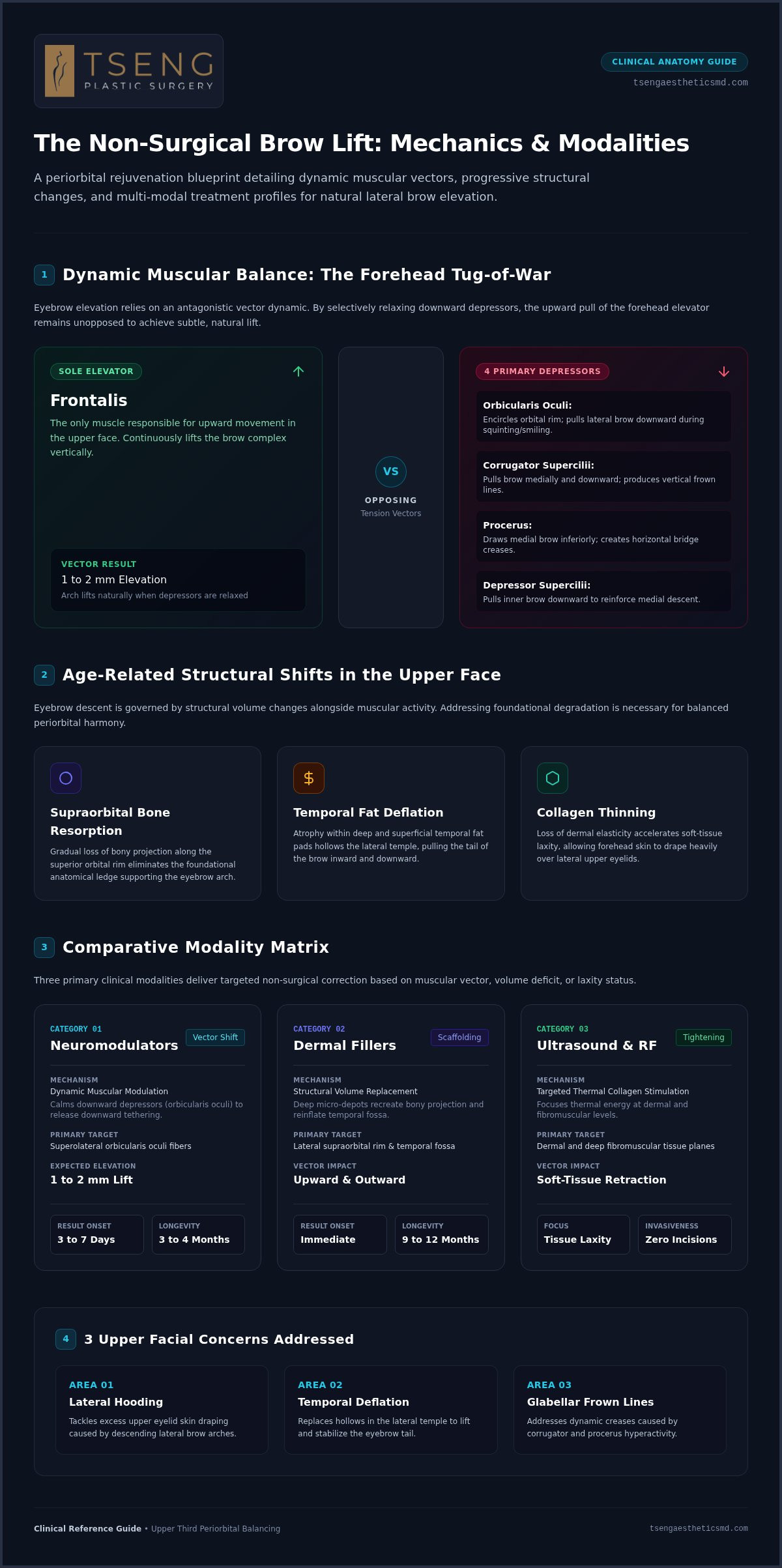
A non-surgical brow lift is a minimally invasive clinical approach designed to elevate descended periorbital tissue and re-establish a youthful arch without scalpel incisions or structural excision. Instead of excising tissue, this approach strategically balances dynamic muscle vectors and restores lost facial volume. As explored in comprehensive clinical overviews of Brow lift procedures, aesthetic enhancement of the upper third of the face addresses three distinct anatomical concerns: lateral hooding of the upper eyelids, temporal volume deflation, and dynamic glabellar frown lines. Clinically defined, a non-surgical brow lift modulates opposing facial muscle groups and reinforces soft-tissue scaffolding to achieve subtle, natural elevation.
The Muscular Balance of the Forehead and Brow
Eyebrow position is governed by a delicate tug-of-war between antagonistic muscle groups. The frontalis muscle acts as the sole elevator of the upper face, continuously pulling the brow complex upward. Working directly against it are four primary depressor muscles:
- Orbicularis oculi: Encircles the orbital rim, pulling the lateral brow downward during squinting or smiling.
- Corrugator supercilii: Pulls the brow medially and downward, forming vertical frown lines.
- Procerus: Draws the medial brow inferiorly, creating horizontal bridge creases.
- Depressor supercilii: Pulls the inner brow downward to reinforce medial descent.
When an experienced physician selectively relaxes these downward depressors with neurotoxins, the upward pull of the frontalis remains unopposed. This dynamic shift allows the forehead elevator to gently raise the lateral brow arch by one to two millimeters.
Age-Related Structural Changes in the Upper Face
Muscular activity is only half the anatomical equation. Over time, predictable structural shifts undermine lateral brow support:
- Supraorbital bone resorption: Gradual loss of bony projection along the superior orbital rim removes the foundational ledge supporting the eyebrow.
- Temporal fat deflation: Atrophy within the deep and superficial temporal fat pads causes the lateral temple to hollow, which pulls the tail of the brow inward and downward.
- Collagen thinning: Loss of dermal elasticity accelerates soft-tissue laxity, allowing skin to drape heavily over the lateral upper eyelids.
Addressing these combined structural factors restores youthful contour and subtle lift, achieving natural periorbital harmony without surgical downtime.
Comparing Non-Surgical Modalities: Neurotoxins, Fillers, and Energy Devices
Achieving refined periorbital elevation without surgery requires choosing the right tool for your specific anatomy. While surgical brow lift procedures physically release and reposition deeper tissue planes, an individualized non-surgical brow lift relies on three primary clinical mechanisms: dynamic muscular modulation, structural volume replacement, and targeted thermal tissue tightening.
Neuromodulators for Dynamic Vector Modulation
Targeted neurotoxin injections deliver 1 to 2 millimeters of elevation by selectively calming the brow's downward depressors. Micro-dosing the superolateral fibers of the orbicularis oculi releases downward tethering on the eyebrow tail, allowing the upward forehead vector to lift the arch naturally. This conservative dosing preserves natural animation while avoiding a heavy brow sensation. Visible results develop within three to seven days and typically endure three to four months.
Dermal Fillers for Temporal and Supraorbital Volume
When descent stems from volume loss rather than muscle pull alone, hyaluronic acid dermal fillers provide crucial scaffolding. Deep micro-depots placed along the lateral supraorbital rim recreate bony projection beneath the eyebrow arch. Reinflating the temporal fossa tightens the overlying skin envelope, drawing the lateral brow upward and outward. This structural restoration delivers immediate improvement, with clinical longevity typically extending nine to twelve months.
Ultrasound and Radiofrequency Collagen Stimulation
Energy-based treatments address laxity at the dermal and fibromuscular levels. Focused ultrasound delivers thermal coagulation points beneath the skin, initiating a wound-healing response that stimulates fresh neocollagenesis without disturbing the surface. In clinical evaluations, micro-focused ultrasound demonstrated a mean brow elevation of 1.7 millimeters at 90 days post-treatment. Tissue firming develops gradually over three to six months, providing a subtle, durable foundation.
While standalone treatments offer targeted benefits, multi-modal rejuvenation frequently yields the most harmonious results. Pairing conservative neuromodulation with precise temporal volume support corrects underlying structural deflation while optimizing dynamic vectors. To explore how customized injectable protocols can restore your facial balance, consider scheduling an anatomical consultation with the team at Tseng Plastic Surgery.
Non-Surgical Brow Lift vs. Surgical Forehead Rejuvenation
Clear anatomical boundaries are essential when choosing between non-invasive refinement and surgical intervention. A non-surgical brow lift excels at restoring subtle periorbital balance, but it cannot duplicate the deeper structural mechanics of operative surgery. Recognizing where non-invasive capabilities end prevents the aesthetic trap of over-treatment, ensuring your expressions stay authentic and relaxed.
Anatomical Capabilities: Millimeter Elevation vs. Structural Repositioning
Non-surgical modalities realistically yield one to two millimeters of vertical elevation. This subtle shift frequently provides enough clearance to open a tired lateral brow and soften early hooding. Surgical rejuvenation, by contrast, releases the periosteum and fibrous retaining ligaments, allowing a surgeon to physically reposition descended tissue planes and excise redundant skin. Attempting to mimic surgical repositioning by over-injecting neuromodulators or dermal fillers distorts periorbital anatomy, creating an unnatural, startled posture or an over-projected forehead shelf.
Identifying the Ideal Candidate for Non-Invasive Care
Tissue laxity and structural descent determine which modality will deliver the most graceful outcome. The best candidates for non-surgical techniques present with:
- Mild to moderate lateral brow descent with preserved skin elasticity
- Early periorbital fatigue that responds well to muscular rebalancing
- A preference for minimal recovery disruption and temporary, adjustable adjustments
When significant cutaneous redundancy gathers over the upper eyelids, non-invasive modalities cannot lift the surplus tissue. Patients experiencing heavier skin laxity or deeper structural descent achieve far more balanced, enduring rejuvenation through definitive procedures such as an upper facial repositioning or a comprehensive facelift.
Longevity, Investment, and Maintenance Demands
Non-surgical treatments offer complete flexibility and rapid integration into a busy schedule, yet they require ongoing maintenance. Neurotoxin effects gently soften after three to four months, and dermal fillers metabolize over the course of a year, requiring periodic visits to preserve the refreshed arch. Surgical options involve a dedicated healing window, yet they deliver lasting anatomical elevation that gracefully ages alongside your facial structure. For a deeper examination of these comparative treatment lifecycles, explore our guide comparing surgical vs non-surgical facelift approaches.
The Procedure Journey: Preparation, In-Office Experience, and Recovery
Undergoing an aesthetic refinement should feel deliberate, structured, and reassuring. Because a non-surgical brow lift avoids general anesthesia and surgical incisions, the entire procedural journey is completed in-office with minimal disruption to your daily schedule. Achieving an optimal result, however, relies just as much on meticulous preparation and disciplined aftercare as it does on the injector's anatomical precision.
Pre-Treatment Guidelines for Optimal Safety
Preparing for an injectable treatment requires minimizing vascular reactivity to prevent bruising and localized swelling. One week before your appointment, pause blood-thinning agents such as aspirin, ibuprofen, fish oil, and high-dose vitamin E supplements in consultation with your physician. Abstain from alcohol for forty-eight hours beforehand, and arrive with skin free of cosmetic pigments, active breakouts, or harsh chemical exfoliants. Full disclosure of your aesthetic history, including previous neurotoxin placements or facial surgeries, ensures your clinician can tailor the approach safely.
What to Expect During Your In-Office Session
Your session generally lasts thirty to forty-five minutes. Your physician begins with comprehensive anatomical mapping, evaluating dynamic muscle pull, lateral brow resting tone, and natural facial asymmetries. Once the treatment vectors are identified, topical numbing agents or ice minimize needle sensation to ensure complete comfort. Strategic micro-injections or focused energy pulses are then delivered along predefined pathways, targeting the exact tissue planes required for balanced elevation.
Post-Treatment Care and Healing Expectations
Recovery after a non-surgical brow lift is swift, allowing most individuals to resume non-strenuous routines immediately. To prevent product migration and protect the symmetry of the lift, keep these essential guidelines in mind:
- Remain completely upright for at least four hours following neurotoxin administration.
- Avoid vigorous exercise, heavy lifting, saunas, and intense heat exposure for twenty-four hours.
- Refrain from massaging, rubbing, or applying firm pressure to the forehead or periorbital area for forty-eight hours.
Minor swelling or pinpoint bruising at injection sites typically resolves naturally within three to seven days. To take the next step toward a refreshed, harmonious appearance, schedule an in-person consultation to design your personalized treatment plan.
Achieving Natural Periorbital Harmony: The Value of Surgical Expertise
Periorbital rejuvenation demands an intimate understanding of deep facial vascular networks and complex muscular interplay. While non-invasive procedures avoid incisions, placing injectable products across delicate facial planes requires surgical-level insight. An architectural perspective ensures that a non-surgical brow lift never produces a frozen, overfilled, or artificially startled expression. The objective is always balance, allowing your refreshed eyes to integrate naturally with forehead dynamics and midface contours.
Why Anatomical Mastery Matters for Minimally Invasive Treatments
Every injection in the upper face carries functional implications. Clinicians with extensive operative backgrounds possess direct knowledge of facial anatomy, navigating subtle variations in nerve branching and high-risk vascular zones with quiet confidence. Diagnostic precision is crucial here. An experienced physician can distinguish true brow ptosis from secondary compensatory elevation or eyelid dermatochalasis. Misinterpreting these dynamics leads to aesthetic errors, such as relaxing a frontalis muscle that was compensating for hooded lids. Conservative adjustments guided by deep anatomical training protect natural animation while achieving balanced elevation.
Designing a Cohesive, Long-Term Rejuvenation Plan
Facial aesthetics evolve gradually, meaning treatments must adapt alongside your structural changes over time. A comprehensive strategy views minimally invasive care as part of a continuous personal aesthetic timeline:
- Pairing precise injectables with medical-grade skin barrier support preserves dermal elasticity over time.
- Establishing a calibrated maintenance schedule prevents over-treatment and maintains soft-tissue integrity.
- Regular anatomical evaluations determine whether non-surgical techniques continue serving your aesthetic goals or if surgical options would yield better harmony.
Consulting a surgeon who routinely performs both non-surgical facial rejuvenation and structural operative lifting ensures completely unbiased guidance. You receive recommendations grounded in what will genuinely achieve balance rather than a restricted treatment menu. Begin building your tailored periorbital plan by scheduling an expert consultation at Tseng Plastic Surgery.
Restoring Balance and Confidence to Your Gaze
Periorbital rejuvenation isn't about freezing expression or chasing exaggerated arches; it's about honoring the natural architecture of your face. By harmonizing dynamic muscle vectors and replenishing subtle structural volume, a well-planned non-surgical brow lift opens tired eyes while preserving genuine facial mobility. Recognizing the honest boundaries between non-invasive refinement and surgical correction ensures you choose the path that best protects your tissue health and aesthetic vision.
With over 20 years of clinical and surgical expertise, Dr. Mark H. Tseng provides physician-directed anatomical evaluations grounded in conservative, balanced rejuvenation. Whether your goals call for subtle injectable adjustments or long-term structural restoration, you deserve an individualized approach that prioritizes your comfort and authentic beauty. Take the next step toward a refreshed, rested appearance and schedule a periorbital rejuvenation consultation today.
Frequently Asked Questions
How long does a non-surgical brow lift last?
The longevity of a non-surgical brow lift depends directly on the treatment modality chosen. Neuromodulator treatments generally maintain their subtle elevation for three to four months before dynamic muscle activity gradually returns. Hyaluronic acid dermal fillers placed along the temporal fossa or lateral rim provide structural support lasting nine to twelve months. Ultrasound energy procedures stimulate gradual collagen remodeling, offering tightening benefits that often endure for twelve to eighteen months.
Can neurotoxin injections raise heavily hooded eyelids?
Neurotoxin injections cannot eliminate heavily hooded eyelids caused by true excess skin laxity. While relaxing downward depressor muscles can yield one to two millimeters of clearance, this subtle elevation rarely resolves moderate to severe eyelid hooding. When redundant upper eyelid skin hangs heavily over the lashes, attempting to lift it with neurotoxins risks over-treating the forehead and causing a heavy, flattened sensation. In these instances, surgical evaluation offers a more effective, harmonious solution.
Is a non-surgical brow lift painful?
Most patients experience minimal discomfort during an in-office brow treatment, describing the sensation as brief, mild pinches. Clinicians use ultrafine needles and apply topical numbing agents or ice to keep the treatment area comfortable. Additionally, many dermal filler formulations include integrated lidocaine to immediately soothe tissues upon injection. Energy-based treatments may create brief sensations of deep warmth, but providers adjust settings carefully to ensure your procedure remains well-tolerated and calm.
What is the difference between a chemical brow lift and an ultrasound brow lift?
The core difference lies in whether the treatment relaxes dynamic muscles or tightens underlying collagen. A chemical brow lift utilizes neurotoxin injections to inhibit downward pull from the orbicularis oculi and corrugator muscles, producing rapid dynamic elevation within days. An ultrasound brow lift delivers focused thermal energy beneath the skin surface to stimulate new collagen production, tightening tissue over several months without needles or affecting muscle movement.
Can a non-surgical brow lift correct noticeable facial asymmetry?
A customized non-surgical brow lift can often soften mild to moderate brow asymmetry through precise micro-dosing. Naturally uneven brow heights frequently stem from unequal muscular pull or asymmetric temporal volume loss. By tailoring neurotoxin units or strategically placing filler on the lower side, an experienced injector can balance resting tension and align periorbital height. However, significant skeletal asymmetries or pronounced unilateral nerve differences usually require surgical adjustment for complete alignment.
What are the common risks or side effects of non-invasive brow procedures?
Common side effects are mild and transient, consisting primarily of pinpoint redness, mild localized swelling, or slight bruising at injection sites. These typical responses resolve naturally within three to seven days. Rare complications include temporary eyelid drooping or unnatural brow arching, which usually occur if injected product migrates into adjacent muscle groups. Choosing an injector with comprehensive surgical knowledge of facial anatomy dramatically minimizes these risks and safeguards your natural expression.
How do I know if I need a surgical brow lift instead?
You are likely a candidate for surgery if you have significant brow descent, deep horizontal forehead furrows, or pronounced skin folding over the upper eyelids. Non-invasive methods provide subtle millimeter adjustments, but they cannot excise excess skin or reposition deeply descended structural tissue planes. When conservative lifting no longer opens your visual field or restores rested balance, a comprehensive surgical evaluation helps determine whether an operative approach will deliver enduring, natural periorbital harmony.

