How to Look Younger at 50: A Realistic Guide
By Tseng Plastic Surgery
What if looking younger at 50 meant looking more refreshed, not trying to erase the years? A useful answer to how to look younger at 50 often starts with steady, everyday care and a clear idea of what you’d like to change.
It’s understandable to feel pulled in different directions by skincare advice, wellness trends, and cosmetic treatments. You may also wonder whether a procedure could make you look unlike yourself. A thoughtful approach doesn’t require an elaborate routine or a dramatic transformation. Start with habits that support skin health and well-being, then consider professional options in light of your own goals.
This guide covers practical daily habits, what non-surgical treatments and surgery may address, and where their limits matter. You’ll also learn how a personalized, surgeon-led assessment can help you consider whether injectables, a non-surgical facelift, or a facelift might fit your preferences. The aim is an informed path toward a balanced, natural-looking result, not a promise to look a certain number of years younger.
Key Takeaways
- Looking refreshed at 50 is a personal goal, not a requirement to reverse or hide aging.
- Build a manageable routine around sun protection, gentle skincare, sleep, movement, and balanced nutrition.
- Everyday habits, injectables, non-surgical facial rejuvenation, and surgery serve different purposes.
- To decide how to look younger at 50, clarify the change you want and choose an approach that fits your preferences and comfort level.
- Dr. Mark H. Tseng’s experience and personalized approach can help inform facial rejuvenation choices.
How to Look Younger at 50 Starts With Understanding What Has Changed
Noticing a change in your reflection can feel personal, especially when it seems to appear gradually or all at once. Skin may look different in texture, lines may be more visible, or your face may seem to have less volume or a changed contour. These observations are valid, but aging itself isn’t a problem that needs to be fixed. Start by identifying what you’re seeing, then decide whether you want to address it.
Appearance is shaped by more than age alone. Genetics, sun exposure, health, and other aspects of daily life can influence how skin and facial features change over time. The overview of skin aging distinguishes intrinsic processes from extrinsic influences, offering useful context without reducing every visible change to a single cause.
That distinction can make the question of how to look younger at 50 more manageable. Rather than treating your whole face as a problem, begin with the specific detail that draws your attention. A clear priority makes it easier to consider an appropriate response, whether that means maintaining a simple routine, learning about professional options, or choosing not to pursue a change.
Which changes are you hoping to address?
Name one or two concerns before considering solutions. This helps keep a specific preference from turning into pressure to overhaul your appearance. It can also clarify whether the concern is mainly about the skin’s surface or the underlying facial shape.
- Skin surface: You may be focused on texture, uneven tone, or fine lines.
- Facial contour or volume: You may notice a shift in fullness or definition in areas of the face.
These categories can overlap, but they aren’t the same concern and may call for different approaches. One person may care most about skin texture; another may be more aware of facial contour. Neither priority is more correct. Let your own perception and preferences guide what, if anything, you choose to explore.
What does a realistic, refreshed result mean?
A realistic goal feels harmonious with your features and reflects what you want, rather than an imagined standard of youth. Daily routines support general skin care and well-being, while professional treatments have distinct purposes and limitations. A routine can’t address every change in facial contour, and a treatment shouldn’t replace habits that support overall health.
A refreshed appearance is one that feels balanced, healthy, and recognizably yours, not one measured by how many years younger you look.
Keep that definition in mind as you learn about your options. It gives you a personal reference point for weighing possible benefits against your comfort with change. It can also help you avoid pursuing a treatment simply because it’s popular or suggested by someone else.
Daily Habits That Support a Healthy, Refreshed Appearance at 50
A sustainable routine is more useful than a crowded bathroom shelf or a sudden, demanding lifestyle reset. Choose a few habits you can repeat and give them time to become part of daily life. Skin changes over time, and the aging changes in skin described by MedlinePlus can include greater fragility, one reason gentle, consistent care matters.
Think of daily care as support, not a promise of cosmetic transformation. Healthy habits can help care for your skin and overall well-being, but they can’t guarantee a particular appearance or erase established facial changes.
Build a simple skincare and sun-protection routine
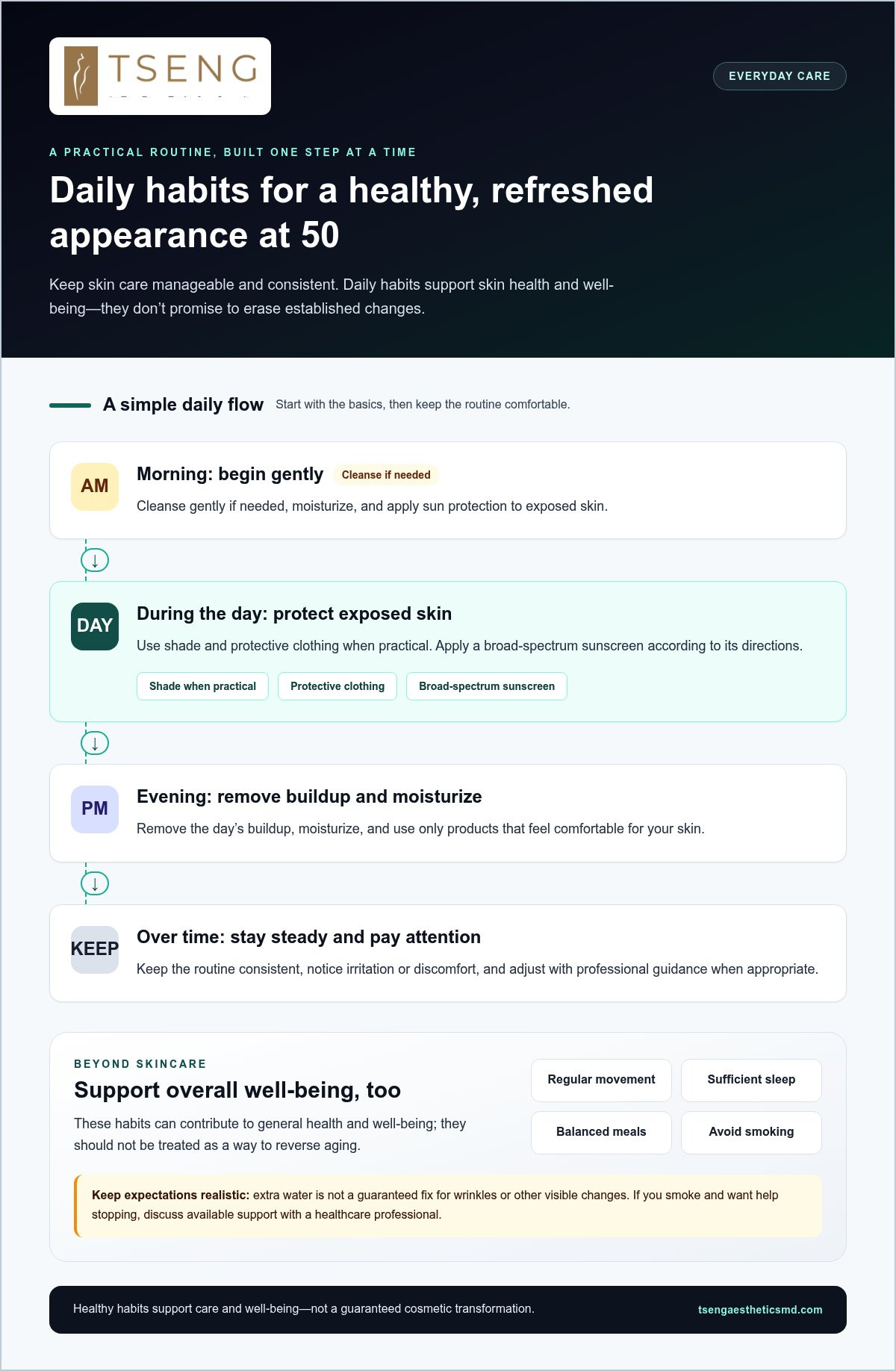
Start with the basics: cleanse gently, moisturize as needed, and protect exposed skin from the sun. Use shade and protective clothing when practical, and apply a broad-spectrum sunscreen according to its directions. Consistency matters more than a long product list. A straightforward routine is easier to maintain than several new products introduced at once.
If you’re considering an active ingredient such as a retinoid, introduce it thoughtfully. Some ingredients can irritate skin, and what suits one person may not suit another. A healthcare professional can help you consider your skin’s needs, sensitivities, and other relevant health factors.
Support well-being beyond skincare
Skin care is only one part of a supportive routine. Regular movement, sufficient sleep, and balanced meals can contribute to general health and well-being, though none should be treated as a way to reverse aging. Avoiding smoking is also a meaningful health consideration. If you smoke and want help stopping, discuss available support with a healthcare professional.
Keep the plan practical. Instead of changing everything at once, choose a realistic bedtime, add movement you can sustain, and build meals around a variety of nourishing foods. Hydration is part of everyday well-being too, but drinking extra water isn’t a guaranteed fix for wrinkles or other visible changes. If you have a health condition, take medication, or have questions about a skincare ingredient or lifestyle change, seek advice suited to your circumstances.
- Morning: Cleanse gently if needed, moisturize, and apply sun protection to exposed skin.
- Evening: Remove the day’s buildup, moisturize, and use only products that feel comfortable for your skin.
- Over time: Keep the routine steady, notice irritation or discomfort, and adjust with professional guidance when appropriate.
This foundation can support a refreshed appearance, but daily habits and professional aesthetic care serve different purposes. If you’d like to understand how options such as injectables or facial rejuvenation procedures relate to your goals, a surgeon-led assessment at Tseng Plastic Surgery can help you explore them in the context of your preferences.
Lifestyle Changes and Aesthetic Treatments: What Can Each Address?
Daily habits and professional aesthetic care can be part of the same personal plan, but they serve different purposes. Skincare and wellness routines support skin care and general health over time. They aren’t substitutes for a clinical assessment of concerns involving facial contour or volume. Knowing the difference helps you choose what feels relevant rather than expecting one approach to address every change.
When everyday care may be the right focus
If you prefer gradual, non-procedural care, consistent habits are a sensible place to begin. Everyday presentation often comes down to small, manageable routines: a repeatable skincare regimen, healthy lifestyle habits, and sharp grooming—such as professional haircut and beard care from shops like samsbarbers.ca—which can help you look refreshed without requiring clinical procedures. Give the routine time to become familiar, then consider whether it fits your needs and preferences. You don’t have to add every product or follow every trend.
Keep expectations grounded. Daily care can support skin health, but it doesn’t reshape facial contours or resolve every concern about volume. If a concern remains important to you, that doesn’t mean your routine has failed; it may simply be a different kind of concern. Revisit your priorities periodically rather than treating each new suggestion as something you must try.
When professional aesthetic options may be worth discussing
Professional options include distinct categories such as injectables, non-surgical facial rejuvenation, and surgery. They aren’t interchangeable, and a treatment label alone doesn’t determine what’s appropriate for an individual. A discussion can clarify what each category is intended to address, its limitations, and how it relates to the concern you’ve identified.
Surgery may be part of the conversation when your goals call for a surgical assessment. A facelift and a preservation face and neck lift are surgical options, while injectables and a non-surgical facelift are separate categories. Exploring the differences doesn’t commit you to treatment. It can simply give you a clearer basis for deciding whether you’d like an individualized assessment.
Treatment choice depends on individual anatomy, personal goals, and clinical evaluation, not age alone. In a surgeon-led assessment, the discussion can begin with what you notice and the kind of refinement you would welcome, then consider whether a non-surgical or surgical approach is relevant. No category guarantees a particular result. An assessment helps put possibilities and limitations in context.
For a more detailed explanation of surgical facial rejuvenation, explore this modern facelift guide. It can help you understand the surgical conversation while keeping the broader question of how to look younger at 50 focused on your preferences, not an age target. Your next step may be continuing your routine, learning about a treatment category, or giving yourself time to decide.
How to Choose a Plan to Look Refreshed at 50
A clear plan begins with your priorities, not a procedure you’ve seen online or a long list of changes someone else recommends. Turning a general wish into a specific goal helps you compare options thoughtfully and decide whether you want to take any next step.
Turn a broad wish into a specific goal
Ask yourself what you’d like to notice when you look in the mirror. You might want your appearance to feel more rested, or you may be focused on one particular feature. Describe the concern in your own words before attaching it to a treatment name. This can help separate your preferences from trends or images that may not reflect what you truly want.
Use this sequence to organize your thinking:
- Identify a concern. Choose one or two details that matter most to you, rather than treating your whole appearance as a problem.
- Define a natural-looking goal. Consider what would feel balanced with your features and preserve the qualities you value.
- Consider relevant categories. Depending on the concern, you may want to learn about daily care, injectables, non-surgical facial rejuvenation, or surgical options.
- Decide whether you want an assessment. A professional discussion can help you understand possible approaches without obligating you to proceed.
This process keeps the question of how to look younger at 50 grounded in your preferences. A useful goal describes the change you hope to explore, not a specific age you expect to look or an outcome anyone can promise.
Prepare for an informed professional conversation
If you choose to seek an assessment, a little preparation can make the conversation more useful. Bring a short list of questions and share relevant health history, medications, and prior aesthetic treatments with the clinician. These details help put your goals in context and support an individualized discussion instead of a one-size-fits-all recommendation.
Ask how different options relate to your concern, what each may not address, and what risks or recovery considerations apply. If maintenance is important to you, include that in the conversation. For a clearer overview of how surgical and non-surgical approaches differ, read this surgical and non-surgical facelift comparison.
A consultation is an opportunity to exchange information and consider possibilities, not a commitment to treatment. At Tseng Plastic Surgery, Dr. Mark H. Tseng brings more than 20 years in practice to a personalized approach focused on natural-looking, balanced results. To discuss your goals, request an individualized facial rejuvenation assessment and explore which options may align with your preferences.
How Tseng Plastic Surgery Approaches Facial Rejuvenation at 50
At Tseng Plastic Surgery, facial rejuvenation is a personal decision shaped by your concerns, preferences, and assessment, not by age alone. The physician-owned practice is led by Dr. Mark H. Tseng, who has been in practice for more than 20 years. Its approach emphasizes natural-looking, balanced results, with the aim of refining appearance while respecting the features that make each face distinctive.
If you’re considering how to look younger at 50 but feel cautious about a result that could look obvious or unlike you, a thoughtful discussion can start with what you hope to address and what you want to preserve. It can also help clarify whether learning about a surgical or non-surgical option makes sense for your goals, without assuming that treatment is necessary.
Match the conversation to the concern
Facelifts and preservation face and neck lifts are surgical options; non-surgical facelifts and injectables are distinct, non-surgical categories. These approaches aren’t interchangeable, and a broad label can’t establish which one, if any, is relevant to an individual. A personalized assessment gives you the opportunity to discuss your concern and understand how different categories may relate to it.
Age by itself doesn’t establish suitability. Your anatomy, health context, priorities, and comfort with the options all matter to the clinical conversation. Procedure-specific questions about potential benefits, limitations, risks, and recovery are best addressed in that individualized discussion. The goal is clarity, not pressure to select a particular treatment.
Explore a considered next step
You can use a conversation to learn, even if you’re not ready to make a decision. It may help to describe the change you’ve noticed, the result that would feel natural to you, and any concerns you have about treatment. Sharing what you’d like to maintain is just as useful as discussing what you hope to refine.
Dr. Tseng’s experience and the practice’s focus on personalized care provide a foundation for discussing surgical and non-surgical facial rejuvenation. The conversation should take your goals seriously, explain options in context, and leave room for you to decide whether any next step feels appropriate. Learning about possibilities doesn’t obligate you to pursue treatment.
If you’re curious about facial rejuvenation, consider discussing your individual goals with Tseng Plastic Surgery. A considered plan is built around informed choices and realistic expectations, with balance and personal preference at its center, not a promise to look a specific number of years younger.
Choose a Next Step That Feels Right for You
The most useful answer to how to look younger at 50 may not be a dramatic change. It may be deciding what matters to you, taking time to consider your options, and choosing a next step that feels considered rather than pressured. Your goals can evolve, and you don’t have to pursue treatment simply because an option exists.
If you’re interested in professional care, a conversation can help you explore whether facial rejuvenation aligns with your preferences. Discuss what you hope to refine, what you’d like to preserve, and which questions matter most to you. The purpose is to make an informed choice, not to chase a particular age or someone else’s ideal of looking younger.
For a personalized discussion of facial rejuvenation possibilities, explore options with Tseng Plastic Surgery. Take the time you need, stay guided by your own goals, and let any decision reflect the features and sense of self you want to honor.
Frequently Asked Questions
Can you really look younger at 50?
You may feel that certain habits or aesthetic treatments help you look more refreshed, but no routine or procedure can promise a specific age reduction. Results and perceptions vary. If you’re wondering how to look younger at 50, begin by identifying the changes that matter to you and separating everyday self-care from professional treatment. If you’re considering a procedure, discuss your goals, relevant personal factors, and the option’s limitations with a qualified clinician.
What skincare routine is best at 50?
There isn’t one skincare routine that suits everyone. A practical starting point may be gentle cleansing, moisturizing, and consistent sun protection, with other products chosen according to your skin and preferences. If you want to try an active ingredient, introduce one change at a time so you can notice how your skin responds. Persistent irritation or a specific skin concern is a reason to seek tailored advice from a healthcare professional.
Does sunscreen help you look younger?
Sun protection is a useful part of caring for your skin, but it can’t reverse existing changes or guarantee a particular appearance. Choose and apply protection according to current dermatology guidance and the product’s directions; shade and protective clothing can also help. If a spot, irritation, or other skin change concerns you, seek advice from a healthcare professional rather than relying on sunscreen or cosmetic products to assess it.
Can exercise or diet make you look younger at 50?
Regular movement and balanced nutrition support general health and well-being, but they can’t guarantee visible age reversal. Be cautious of restrictive diets, supplements, or routines promoted as quick cosmetic fixes. A sustainable eating pattern is generally a more sensible goal than cutting out whole food groups to change your appearance. If you have a medical condition, take medication, or plan a major change, discuss it with your healthcare professional.
Are non-surgical treatments or a facelift better at 50?
Neither option is universally better. Tseng Plastic Surgery offers injectables and non-surgical facelifts as well as facelift and preservation face and neck lift procedures. These categories are different, and age alone can’t determine which is appropriate. An individualized clinical discussion can consider your anatomy, goals, health context, and preferences, then explain relevant limitations, risks, and recovery considerations without promising a particular result.
How do I avoid looking overdone if I consider aesthetic treatment?
Begin by naming the features you value and the specific change you’d like to explore. In a clinical discussion, ask how options relate to your goals, what their limitations are, and what risks or recovery considerations apply. A trend or another person’s result may not suit your anatomy or preferences. Take time, ask questions, and decide whether an approach feels right before moving forward.

