Finding a Facial Procedure Surgeon for Natural-Looking Results
By Tseng Plastic Surgery
A natural-looking result starts with choosing a surgeon whose experience and approach align with your goals. Finding a surgeon specializing in facial procedures means looking for someone who can assess your features, explain suitable options, and shape a plan around the changes you want. The aim is a thoughtful result that feels harmonious with your face, not a different appearance.
It’s understandable to wonder how much surgery may change your appearance. At a consultation, the surgeon assesses your face, discusses your goals and realistic outcomes, and explains potential treatment options. A personalized plan connects those choices to your features and priorities. This guide covers what to consider when choosing a facial plastic surgeon, what to expect at a consultation, and how a tailored plan can help you make an informed decision about facial rejuvenation.
Key Takeaways
- Match the procedure to your goals, since facial surgery options address different features and concerns.
- Consider a surgeon’s facial-procedure focus, training, and relevant experience when assessing fit.
- Use the consultation to discuss your priorities, review suitable options, and understand what results are realistic for you.
- A personalized plan can help align the proposed approach with your features and preference for natural-looking results.
Cosmetic facial procedures, including facelifts, rhinoplasty, and eyelid surgery
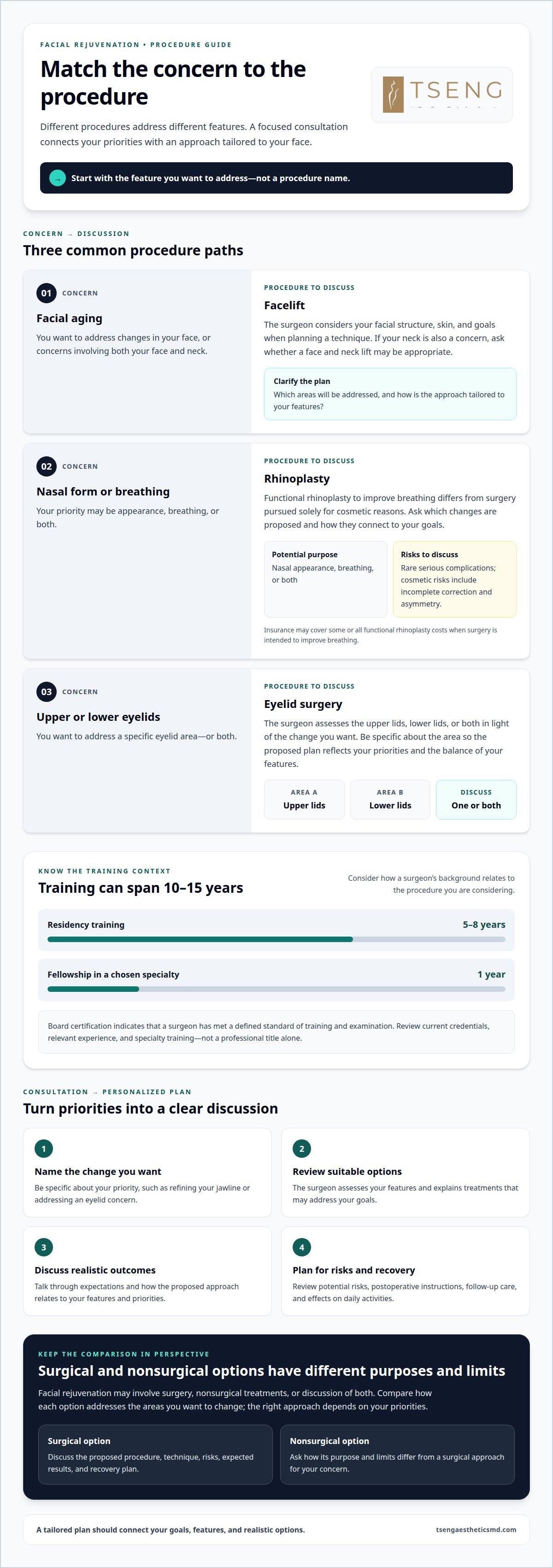
Facial procedures address different features, so start by matching the procedure to your concern. A facelift addresses facial aging, rhinoplasty changes nasal form or function, and eyelid surgery focuses on the upper or lower eyelids. Clarify which feature matters most and what change you hope to achieve.
Facelift techniques aren’t one-size-fits-all. The surgeon considers facial structure, skin, and your goals when planning an approach. If your concerns include your neck as well as your face, ask whether a face and neck lift may be appropriate. The consultation should explain the proposed technique, the areas addressed, and how the approach supports balanced contours. Ask how the plan is tailored to your features instead of assuming one technique suits everyone.
Rhinoplasty may address appearance, breathing, or both. Serious complications, including excessive bleeding and infection, are rare. Cosmetic risks include incomplete correction and asymmetry. Clarify which changes the surgeon proposes and how they relate to your goals. Functional rhinoplasty to improve breathing differs from surgery pursued solely for cosmetic reasons.
Eyelid surgery focuses on the upper or lower eyelids, which the surgeon assesses in light of the changes you want. Be specific about whether your concern involves the upper lids, lower lids, or both. Discussing these areas clearly helps align the proposed procedure with your priorities and the natural balance of your features.
Insurance may cover some or all functional rhinoplasty costs when surgery is intended to improve breathing. Tseng Plastic Surgery does not offer in-house financing.
Recovery planning depends on the procedure. Before surgery, discuss postoperative instructions, follow-up care, and how a facelift, rhinoplasty, or eyelid surgery may affect daily activities during recovery. Understanding these steps helps you prepare, while a clear surgical plan connects the procedure to your goals.
Choosing a facial plastic surgeon
Assess a surgeon’s training, certification, and experience with the procedure you’re considering. Credentials offer useful context, but the fit between the surgeon’s expertise and your goals matters too.
Board Certification and Training
Board certification in facial plastic surgery indicates that a surgeon has met a defined standard of training and examination. Plastic surgery training can take 10-15 years, including residency training that can take 5-8 years and a one-year fellowship in a chosen specialty. Prospective certified plastic surgeons complete residency and specialty fellowship training. Consider how that background relates to your specific procedure, not just the title.
Using a facial plastic surgeon directory to compare providers
A professional directory can help you identify facial plastic surgery providers and compare their stated specialties. Treat a listing as a starting point, not proof of current qualifications. The American Society of Plastic Surgeons (ASPS) does not independently verify member profile information or current licensure and certification status. Compare each provider’s stated focus with your procedure, then review current credentials and relevant training.
Surgeon Type Differences
“Facial plastic surgeon,” “plastic surgeon,” and “cosmetic surgeon” are professional labels, not interchangeable proof of a specific qualification. Board certification in facial plastic surgery reflects a defined training and examination standard; plastic surgery board certification relates to training in plastic surgery. “Cosmetic” describes an aesthetic focus, so assess the surgeon’s actual training and certification rather than relying on a title alone.
Choosing a qualified facial surgeon near you
Start with the procedure you’re considering and the surgeon’s related specialty training. Then assess board certification, relevant experience, and whether the practice’s facial focus matches your priorities for proportion and a natural appearance. ASPS membership has application criteria, but member profiles don’t independently establish current credentials. Use a directory to identify options, not as a substitute for reviewing qualifications.
Surgical consultation and personalized treatment plans
A consultation turns your concerns into a focused discussion of facial appearance, suitable treatments, and realistic goals. The surgeon’s assessment informs a plan tailored to your features.
Individualized Consultation and Planning
During the consultation, the surgeon assesses your face and explains treatment options. Describe the changes you hope to achieve, such as refining your jawline or addressing eyelid concerns, so the discussion focuses on relevant choices. You and the surgeon should also discuss realistic expectations before surgery. The resulting plan connects your priorities with an appropriate procedure and explains how the proposed approach addresses them.
Surgical and Nonsurgical Rejuvenation
Facial rejuvenation may involve surgery, nonsurgical treatments, or a discussion of both. The right approach depends on the areas you want to address and the change you seek. For example, if you’re considering facial and neck rejuvenation, ask how surgical options differ from a nonsurgical facelift. Comparing the purpose and limits of each option helps clarify what best reflects your priorities, without assuming one treatment suits every concern.
Surgeon Leadership and Experience
Relevant surgical experience matters because facial plastic surgery calls for decisions informed by anatomy and aesthetic judgment. Ask how the surgeon’s experience relates to your proposed procedure, including work involving the head and neck or eyelid surgery. Make time to discuss potential risks and how follow-up care is planned. These details help you understand the process beyond the operation itself.
Before surgery, review the proposed plan and expected results together. Medical photographs may support a digital simulation of possible changes, helping you visualize options and understand the treatment plan. Clarify what the images illustrate and how they relate to your goals. The surgeon can then refine the plan around your concerns, whether they involve one feature or several facial areas.
Choosing a surgeon whose practice focuses on facial procedures
A facial focus can be relevant to concerns involving balance, expression, and proportion. Look for clear experience with the specific procedure you’re considering, such as a facelift, eyelid surgery, or revision rhinoplasty. The key is fit: the surgeon’s stated focus should connect directly to your goals, rather than relying on a broad cosmetic title alone.
Facial aesthetic and reconstructive surgery address different needs, though both require careful consideration of facial structures. Reconstructive surgery may address changes after injury or illness, while cosmetic procedures focus on desired changes in appearance. Ask how the surgeon’s experience relates to your concern, whether it involves the eyelid, nose, or lower face. A discussion grounded in the relevant anatomy can clarify the proposed approach.
Certification matters, but it doesn’t by itself show how closely a surgeon’s work aligns with your procedure. Consider specialty training alongside experience with the specific operation and how the surgeon explains its purpose. For a revision procedure, discuss how your prior surgery affects planning and what the surgeon considers achievable. This keeps the conversation specific to your medical history and desired outcome.
A practice may also perform procedures beyond facial surgery. Breast augmentation, for instance, addresses a different area of the body; its inclusion in a practice’s offerings doesn’t show whether the surgeon’s facial work matches your needs. Focus on the facial procedures you’re considering, the surgeon’s explanation of the technique, and whether the plan addresses your priorities. A focused consultation should distinguish an appropriate facial procedure from an unrelated treatment, rather than bundling options without a clear reason.
If you’re considering a facial procedure, discuss your aesthetic goals and the approach that may suit them.
Tseng Plastic Surgery
Tseng Plastic Surgery offers a next step for people considering facial rejuvenation and seeking a plan aligned with their goals. Its facial options include a facelift, a minimal invasive preservation face and neck lift, and a non-surgical facelift. A consultation can help you discuss the changes you hope to achieve and understand which approach may suit your concerns. The conversation can also clarify how facial features and desired results inform a personalized plan, rather than assuming one procedure fits everyone. If you’re weighing surgical and non-surgical options, this is an opportunity to raise your priorities and discuss the available approaches in context. To continue the conversation about facial rejuvenation, contact Tseng Plastic Surgery.
Move Forward With a Clear Personal Vision
Finding a surgeon specializing in facial procedures can also help you clarify what “natural-looking” means to you. Consider which features you want to preserve, what change you hope to see, and how you want your appearance to feel afterward. Putting those priorities into your own words can make conversations more focused and personal.
You don’t need to arrive with a procedure already chosen. Instead, bring your questions and describe the outcome you have in mind. A thoughtful discussion can help connect your vision with a suitable next step while keeping your preferences at the center. If you’re ready to explore that conversation, start a conversation with Tseng Plastic Surgery. Your goals can guide a considered path toward facial refinement that feels true to you.
Frequently Asked Questions
Will I look very different after my surgery?
How much your appearance changes depends on the procedure, the features addressed, and the plan. At consultation, describe what you want to preserve as clearly as what you hope to change. For example, you might want a softer jawline while keeping your familiar facial expression. Specific priorities help the surgeon shape a plan around your appearance rather than a generic ideal.
Which board certifications should a surgeon performing facial procedures have?
Look for board certification relevant to the surgeon’s specialty and the procedure being considered. Certification in facial plastic surgery indicates that a surgeon has met a defined standard of training and examination; plastic surgery board certification reflects a different specialty pathway. Review the exact specialty and current status, then consider whether the surgeon’s procedure-specific experience aligns with your goals. A broad “cosmetic” title alone doesn’t explain that background.
How can I verify a facial surgeon’s license, training, and disciplinary history?
Use the official medical licensing board for the state where the surgeon practices to review license status and available disciplinary records. Compare the name and specialty shown there with the surgeon’s stated credentials, and ask about training institutions and relevant fellowship experience. Professional directories can help identify surgeons, but ASPS member profiles don’t independently verify current licensure or certification, so consult official records for current details.
What experience should I look for in a surgeon specializing in facial procedures?
Focus on experience with the specific operation and facial area involved, rather than relying only on years in practice or a general cosmetic title. If you’re considering eyelid surgery, for example, ask about the surgeon’s experience with the procedure and how they assess the features around the eyes. Review examples relevant to your concern and discuss how the surgeon approaches cases with goals like yours.
What questions should I ask during a facial surgery consultation?
Ask which procedure the surgeon recommends and why it fits your concerns. Clarify which features it will address, what changes are realistic, and what alternatives may be appropriate. You can also ask how your medical history affects planning, what follow-up care involves, and which signs after surgery should prompt a call to the practice. These questions make the proposed plan and care process easier to understand.
What are the risks and complication rates for common facial procedures?
Risks differ by procedure and individual circumstances, so discuss them for the specific operation proposed. For rhinoplasty, serious complications such as excessive bleeding and infection are rare; cosmetic concerns can include incomplete correction and asymmetry. Ask the surgeon to explain the risks most relevant to your health and plan, how complications are handled, and what follow-up is provided. One rate would not describe every procedure or patient.

