Breast Implant Longevity: Safety & Maintenance in 2026
By Tseng Plastic Surgery
What if the traditional "10-year rule" for breast implants was never a definitive expiration date, but rather an outdated benchmark that overlooks modern surgical artistry? For many, the milestone of a decade brings a quiet anxiety regarding the integrity of their results and the potential for silent complications. It's natural to feel concerned about the subtle signs of breast implant rupture, especially when conflicting advice makes it difficult to distinguish between normal aging and a medical necessity for revision.
You'll discover the scientific reality of implant longevity in 2026, moving beyond generalized timelines toward a sophisticated, proactive maintenance strategy. We'll outline a clear monitoring schedule that aligns with current FDA safety standards, ensuring you feel confident in identifying early changes while maintaining the elegant harmony of your original procedure. By understanding the link between precise surgical technique and long-term stability, you can replace fear with the quiet confidence that comes from expert-led care and informed self-awareness.
Key Takeaways
- Shift your perspective from a rigid 10-year replacement rule to a personalized monitoring approach based on the ongoing integrity of your device.
- Learn to identify the subtle signs of breast implant rupture; this includes understanding why modern silicone leaks often require specialized imaging to detect.
- Understand how master-level surgical techniques, such as precise pocket placement and conservative sizing, directly influence the long-term durability of your aesthetic results.
- Establish a proactive maintenance protocol featuring regular clinical examinations and the latest 2026 FDA-recommended imaging schedules for silicone implants.
- View future revision surgeries as a natural evolution of your aesthetic journey; these procedures allow your results to age gracefully alongside your changing body.
The Reality of Breast Implant Longevity: Beyond the 'Ten-Year Rule'
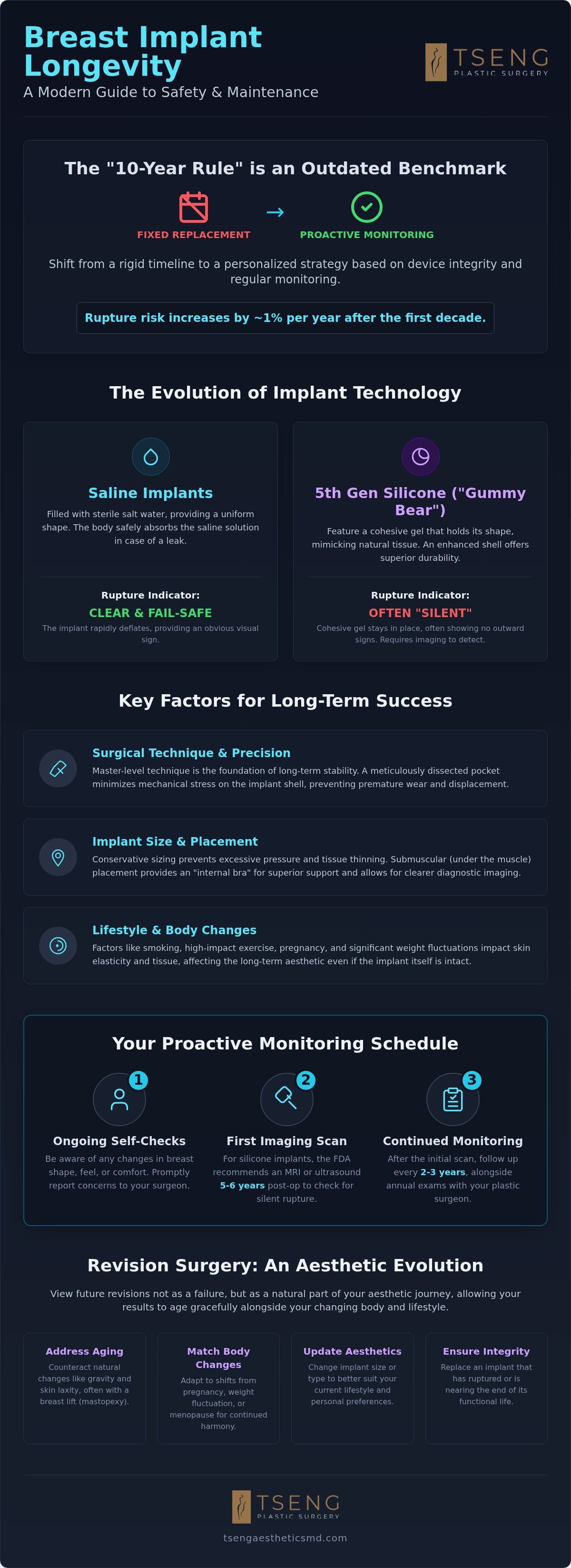
The notion that breast implants possess a rigid 10-year expiration date is one of the most persistent misconceptions in aesthetic medicine. While the FDA classifies these as non-lifetime devices, modern engineering has extended their functional life well beyond previous decades. Monitoring for the signs of breast implant rupture should be a routine part of your long-term wellness, not a source of anxiety. Data shows that the statistical likelihood of rupture increases by roughly 1% per year after the first decade. This gradual shift underscores the importance of a proactive maintenance mindset. Instead of waiting for a physical crisis, we encourage patients to view their augmentation as a long-term relationship with their surgeon, prioritizing shell integrity and visual harmony in equal measure. A master craftsman understands that the initial surgery is just the first step in a decades-long journey of aesthetic preservation.
Mechanical vs. Aesthetic Expiration
A device may remain perfectly intact for twenty years while the aesthetic result reaches its natural conclusion much sooner. Gravity and tissue changes are inevitable. During a Breast augmentation procedure, the initial placement is designed for the patient's current anatomy, yet the body remains a dynamic canvas. Pregnancy, significant weight fluctuations, and the hormonal shifts of menopause all impact skin elasticity and breast volume. You might find that while the implant is safe, the visual balance has shifted. This often leads to a desire for a mastopexy to restore a youthful position or a change in volume to match a changing lifestyle. An implant's lifespan is a variable window influenced by both biology and technology.
The Evolution of Implant Technology
The transition from 4th to 5th generation cohesive gel implants has redefined our expectations of durability. These modern gummy bear devices feature enhanced shell thickness and superior cross-linking of the silicone molecules. This engineering makes the device more resistant to mechanical stress and reduces the risk of gel migration. Saline implants offer a clear, fail-safe indicator of a leak because they deflate rapidly. In contrast, identifying the signs of breast implant rupture in silicone requires clinical expertise and imaging, as the cohesive gel is designed to stay in place even if the shell is compromised. This subtlety is why 2026 safety standards emphasize regular diagnostic checks over simple physical observation. Modern shell technology is robust, yet it's the partnership between technology and regular monitoring that ensures safety.
Variables That Determine How Long Your Implants Will Last
The longevity of your results depends as much on the surgeon’s hand as it does on the device itself. A master craftsman understands that pocket precision is the foundation of structural stability. When a pocket is dissected with meticulous accuracy, it minimizes unnecessary mechanical stress on the implant shell. Conversely, a pocket that is too loose allows for excessive movement, which can lead to premature wear or displacement. Choosing a surgeon who prioritizes these preservation techniques ensures your augmentation remains a harmonious part of your silhouette for years to come.
Implant size and lifestyle choices are pivotal variables in the longevity equation. While volume is a personal choice, excessively large implants exert continuous pressure on the surrounding breast tissue. Over time, this weight can lead to tissue thinning and premature ptosis, or sagging. Similarly, lifestyle factors like smoking or frequent high-impact exercise without proper support can compromise the skin's elasticity. Achieving a balanced silhouette requires a delicate calculation of your existing tissue strength against the forces of gravity and daily activity. It's about finding the intersection where science meets your personal vision.
Submuscular vs. Subglandular Placement
Placement strategy acts as a natural stabilizer for your results. Positioning the implant under the pectoral muscle, often referred to as submuscular placement, creates an "internal bra" effect. This layer of muscle provides additional support against gravity and helps maintain the implant's position. Beyond aesthetics, submuscular placement is highly beneficial for long-term safety. It allows for clearer diagnostic imaging during routine screenings, making it easier for specialists to identify any potential issues or early signs of breast implant rupture. This anatomical advantage often leads to lower rates of capsular contracture, preserving the soft, natural feel of the breast.
Material Integrity: Saline vs. Silicone
The choice between saline and silicone involves understanding their unique wear profiles. Modern 5th-generation silicone implants are renowned for their cohesive gel, which mimics the feel of natural tissue. Because the gel is cross-linked, it maintains its shape and stays contained even if the outer shell experiences a breach. Monitoring for the subtle signs of breast implant rupture is a lifelong commitment that starts with choosing the right material for your lifestyle. Saline implants, while offering a clear fail-safe by deflating if they leak, can sometimes be more prone to visible rippling in patients with thin tissue. Following FDA guidelines on implant risks is essential for any patient, regardless of the material chosen. If you're considering how these variables apply to your unique anatomy, a personalized consultation can provide the clarity you need to move forward with confidence.
Recognizing the Signs: When Your Implants May Need Attention
Recognizing changes in your body requires a blend of intuition and clinical guidance. While some aesthetic shifts are a natural part of aging, others serve as indicators that your implants require professional assessment. Identifying the signs of breast implant rupture or tissue changes early allows for more conservative intervention, preserving both your health and your aesthetic investment. It's about maintaining the harmony between your anatomy and the artistry of the original procedure. Our legacy of experience allows us to guide you through these transitions with quiet confidence, ensuring you never feel uninformed about your long-term wellness.
Stages of Capsular Contracture
Every patient develops a thin layer of scar tissue, or a capsule, around their implant as a normal biological response. However, when this tissue becomes abnormally thick or tight, it results in capsular contracture. Surgeons use the Baker Scale to categorize this progression. Grade I feels soft and looks natural; Grade II is slightly firm but remains aesthetically pleasing. By Grade III, the breast becomes firm and visually distorted. Grade IV represents the most severe stage, where the breast is hard, painful, and significantly misshapen. Early intervention can sometimes manage mild contracture through specialized massage or medication, potentially avoiding a full device replacement. We prioritize surgical sterility, often employing the No-Touch technique, to significantly reduce the risk of biofilm formation and subsequent contracture.
Beyond structural changes, aesthetic shifts like rippling or bottoming out can occur as tissue thins over time. You might notice the Snoopy deformity, where the natural breast tissue slides off the front of the implant, creating a tiered appearance. These are often signs of tissue fatigue rather than device failure. However, sudden changes in symmetry, chronic tenderness, or a new lump should always be evaluated by a board-certified professional. Identifying these signs of breast implant rupture or displacement is a vital part of your long-term maintenance protocol.
The Reality of Implant Rupture
The experience of a shell breach depends entirely on the filler material. Saline implants offer a flat tire effect; they deflate rapidly, making the issue impossible to miss. While this change is dramatic, it's not a medical emergency. Silicone implants, particularly modern cohesive gels, present a different challenge known as a silent rupture. Because the gel is thick and cross-linked, it typically remains within the surrounding scar tissue capsule, showing no outward symptoms. This lack of visible change is why specialized imaging is the gold standard for detecting signs of a ruptured breast implant. A confirmed rupture isn't a medical emergency but serves as a prompt for a surgical consultation to discuss your revision options.
Proactive Care: The Maintenance Protocol for Long-Term Success
Achieving a lasting aesthetic result is rarely a matter of chance; it's the product of a disciplined maintenance protocol. While modern devices are incredibly resilient, your body remains the primary variable in the longevity equation. Regular clinical examinations with a board-certified plastic surgeon are the cornerstone of this care. These visits allow for a professional assessment of tissue health and the detection of subtle changes that might escape a self-exam. By learning the normal feel of your augmented breasts, you become your own first line of defense. This baseline awareness is crucial for noticing the earliest signs of breast implant rupture, such as a localized change in firmness or a shift in the way the tissue drapes over the device.
Practical organization is equally important for long-term peace of mind. Every patient receives a device identification card containing the manufacturer, serial numbers, and warranty details. We recommend digitizing these records and keeping them accessible. Should you ever require a revision or have concerns about your device, having this information ready streamlines the diagnostic process and ensures you can take full advantage of manufacturer replacement programs. It's a simple step that provides a sense of security for decades to come.
Diagnostic Imaging Standards in 2026
The FDA reinforced screening recommendations on February 6, 2025, providing a clear roadmap for silicone implant owners. For those with silicone devices, the first screening MRI or high-resolution ultrasound is recommended 5 to 6 years after the initial surgery, followed by screenings every 2 to 3 years thereafter. While MRI remains the gold standard for detecting the signs of breast implant rupture, high-resolution ultrasound has emerged in 2026 as a radiation-free, cost-effective alternative for routine monitoring. For annual breast health, ensure your radiologist is experienced in Eklund views. These specialized displacement techniques allow for a comprehensive mammogram by moving the implant aside, ensuring the breast tissue is fully visualized without compromising the device.
The Surgeon-Patient Partnership
Maintaining a relationship with a specialized practice ensures a continuity of care that's impossible to replicate through fragmented consultations. A surgeon who understands the nuances of your original procedure is better equipped to manage the evolution of your results. This philosophy is explored further in The Essential Guide to Breast Augmentation, which emphasizes why the initial choice of a master craftsman dictates your long-term success. Proactive monitoring prevents minor issues from escalating into complex, multi-stage reconstructive procedures. If you're due for a professional assessment, you can schedule a clinical evaluation to ensure your results remain as refined and healthy as the day of your surgery.
The Path to Revision: Evolving Your Aesthetic Over Time
Revision surgery shouldn't be viewed as a failure of the original procedure or a medical setback. Instead, it's a natural evolution of your aesthetic journey, reflecting the dynamic nature of the human form as it matures over the decades. Over fifteen or twenty years, your body undergoes significant changes that may necessitate an update to maintain your desired look. While some patients return because they've identified signs of breast implant rupture through routine imaging, many simply want to adjust their volume or address the natural effects of gravity. Dr. Tseng approaches every revision with the precision of a master craftsman, focusing on restoring the balance between your anatomy and the device to ensure a result that feels both modern and timeless. Even in the absence of clinical signs of breast implant rupture, the desire for a refreshed silhouette is a valid and common motivation for surgery.
The experience of a replacement surgery often feels more predictable than the initial augmentation. Because the surgical pockets are already established, the recovery process is frequently more straightforward, though the artistry required is significantly higher. Dr. Tseng prioritizes preservation techniques during these updates, ensuring that the surrounding tissue remains healthy and supported. This careful approach minimizes the risk of future complications while allowing for a seamless transition to your new aesthetic goals, whether you're switching from saline to silicone or simply updating your device generation.
Combining Augmentation with a Breast Lift
As skin loses elasticity over time, implants alone cannot always provide the necessary elevation to counteract the effects of aging. Many patients choose to integrate a mastopexy, or breast lift, during their 15-year implant update to address skin laxity. This surgical synergy allows Dr. Tseng to remove redundant skin while the new implants provide the internal structure. The result is a more youthful perkiness and a refined breast shape that reflects your current lifestyle. It's a comprehensive way to ensure your silhouette ages as gracefully as you do, restoring the harmony that may have shifted due to weight changes or menopause.
Choosing to Explant
Some patients find that their lifestyle goals shift as they enter different stages of life, leading them to consider removal without replacement. If you're exploring this path, our guide on Breast Explant Surgery: Why Patients Choose Removal offers a deep dive into the motivations and outcomes of this choice. Aesthetic expectations after explantation are a common concern, but modern techniques like fat grafting can help maintain a subtle, natural volume. Whether you're switching materials or removing devices entirely, the goal remains the same: a result that reflects your current vision of yourself with quiet confidence.
Empowering Your Long-Term Aesthetic Vision
Your breast augmentation represents a significant investment in your self-confidence and personal vision. By moving beyond the outdated 10-year rule and embracing a proactive monitoring schedule, you transform potential anxiety into enduring empowerment. Longevity isn't merely about the device itself; it's a partnership between biological resilience and the master-level surgical techniques that established your initial results. Whether you're checking for the subtle signs of breast implant rupture through modern imaging or simply assessing how your silhouette has matured, staying informed is the most effective way to preserve your health and your aesthetic harmony.
Dr. Mark H. Tseng brings over 20 years of specialized aesthetic expertise and board-certified surgical precision to every patient's long-term care. His dedication to natural, long-lasting results ensures that your journey remains as refined as your original vision. If you're ready to transition from uncertainty to clinical clarity, schedule a personalized consultation to evaluate your implants with Dr. Tseng. You deserve the peace of mind that comes from expert-led guidance and a master craftsman's touch. Your future self will appreciate the proactive care you choose to invest today.
Frequently Asked Questions
Can breast implants last 30 years?
While some patients safely maintain their results for 30 years, it's statistically uncommon for a device to remain intact that long. The FDA classifies all breast implants as non-lifetime devices, meaning the probability of a shell breach increases as the device ages. Research suggests the risk of rupture rises by approximately 1% each year after the first decade. If your implants remain intact and you're satisfied with the aesthetic harmony, replacement isn't mandatory.
What happens if I never replace my breast implants?
There is no medical requirement to replace implants that are intact and aesthetically pleasing. However, if you choose to never replace them, you must commit to lifelong diagnostic screenings to ensure your safety. Undetected issues can lead to localized inflammation or progressive capsular contracture, which may eventually distort the breast shape. Maintaining a long-term relationship with your surgeon ensures that any changes in tissue health are addressed before they impact your well-being.
How do I know if my silicone implant has ruptured if it is silent?
Identifying the signs of breast implant rupture in silicone devices often requires professional imaging because cohesive gel typically stays within the scar tissue capsule. This phenomenon, known as a silent rupture, usually lacks outward symptoms like pain or visible deflation. Following the 2026 FDA guidelines, you should schedule your first screening MRI or high-resolution ultrasound 5 to 6 years after surgery, with subsequent screenings every 2 to 3 years to ensure continued safety.
Is there a warranty on breast implants if they break early?
All FDA-approved breast implants come with a manufacturer's warranty that typically provides a replacement device at no cost if a rupture occurs. Many of these programs also offer limited financial assistance for surgical fees if the shell fails within the first 10 years of placement. It's vital to keep your device identification card and serial numbers in a secure location. This documentation ensures you can easily access these benefits should you ever experience a complication.
Does a breast implant rupture constitute a medical emergency?
A breast implant rupture is not considered a medical emergency. While a saline deflation or a confirmed silicone breach requires attention, it doesn't necessitate immediate, same-day surgery. Instead, it serves as a prompt to schedule a consultation with a board-certified plastic surgeon to discuss your revision options. You have time to thoughtfully plan your procedure and recovery. The goal is a methodical, unhurried approach to restoring your results rather than a rushed intervention.
Will my insurance cover the cost of replacing old implants?
Insurance providers typically don't cover the cost of replacing implants for purely aesthetic reasons, such as a desire for a different size. However, coverage may be available if the revision is deemed medically necessary. This often includes cases of confirmed rupture or severe capsular contracture that causes physical pain or significant distortion. You should consult with your insurance carrier to understand their specific criteria for medical necessity and what documentation is required from your surgeon.
How many times can you have breast implants replaced in a lifetime?
There is no specific limit on the number of times you can have implants replaced, but each surgery must be balanced against the health of your breast tissue. Every procedure creates new scar tissue and can impact the blood supply to the skin. A master craftsman focuses on preservation techniques to ensure the tissue remains robust enough for future updates. Most patients find that two or three revisions over several decades are sufficient to maintain their appearance.

