Breast Implant Longevity: Safety & Maintenance in 2026
By Tseng Plastic Surgery
What if the 10-year mark isn’t a deadline for replacing your breast implants? If you’ve wondered how long do breast implants last, the answer is more nuanced than a fixed countdown. Implants aren’t lifetime devices, but reaching a particular anniversary doesn’t automatically mean they need to be replaced.
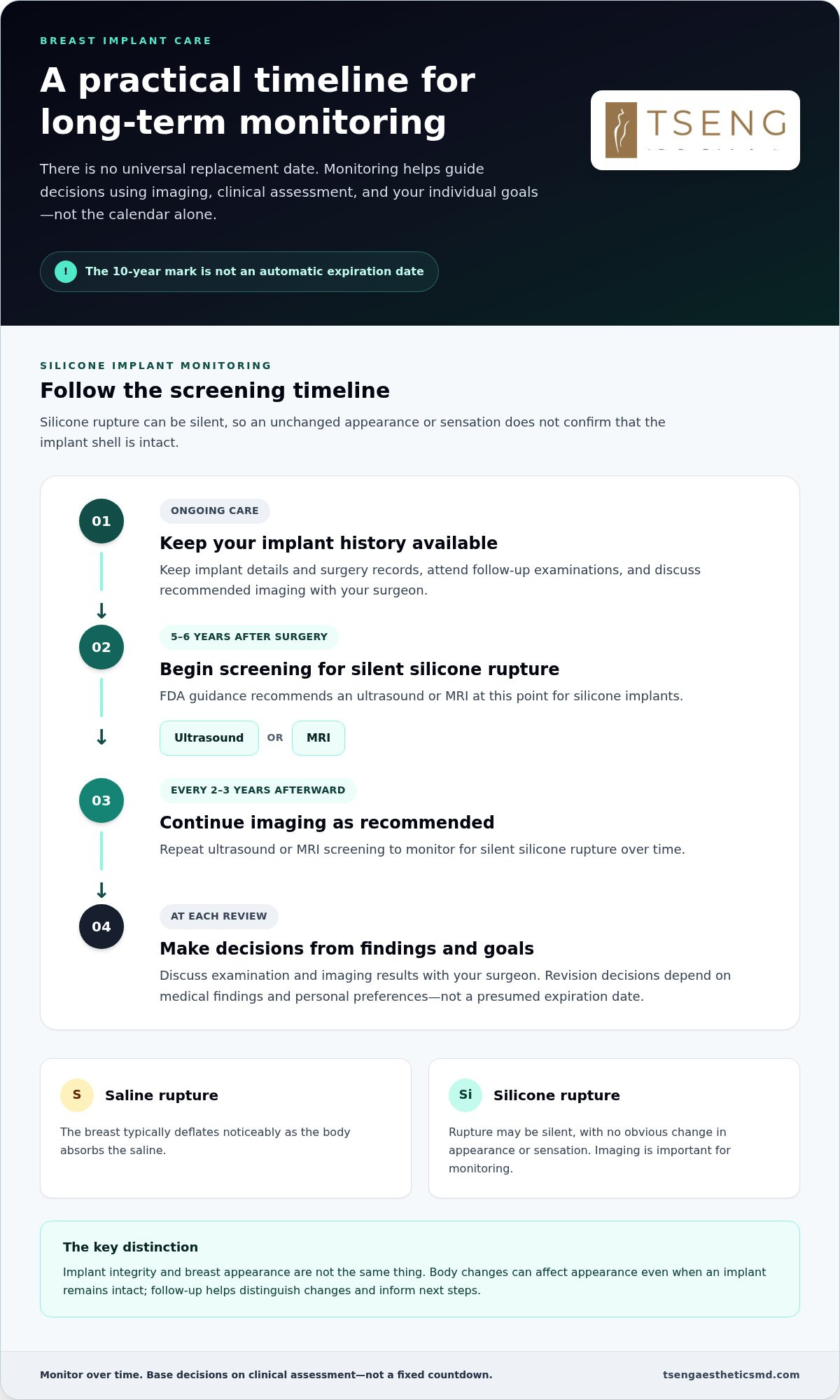
It’s understandable to feel concerned about silent rupture, changing advice, or the prospect of another surgery. Silicone implant rupture may not cause obvious symptoms, which is why the FDA recommends an ultrasound or MRI 5 to 6 years after surgery, followed by imaging every 2 to 3 years. Monitoring helps you make informed decisions instead of relying on a “10-year rule.”
This guide explains typical implant longevity, changes that deserve medical attention, and a practical monitoring schedule to discuss with your surgeon. You’ll also learn how implant placement and surgical planning can influence long-term results. Dr. Mark H. Tseng brings more than 20 years of surgical experience to breast augmentation, with a focus on natural-looking, balanced results.
Key Takeaways
- Learn why the answer to “how long do breast implants last” depends on more than the calendar, and why there’s no universal replacement date.
- Recognize changes such as firmness, discomfort, swelling, or altered breast shape that may warrant medical evaluation.
- Understand how implant size, placement, and changes in your body can influence long-term appearance and implant performance.
- See how revision surgery can address medical concerns or help align your results with your changing aesthetic goals.
- Discover practical habits that support ongoing implant care and help you make informed decisions over time.
The Reality of Breast Implant Longevity: Beyond the 'Ten-Year Rule'
Breast implants aren’t designed to last a lifetime, but that doesn’t mean they come with a fixed 10-year expiration date. The FDA warning means that complications and the possibility of additional surgery increase over time, not that every implant must be replaced after a decade. Some patients may go much longer without a problem; others may need revision sooner because of rupture, scar-tissue changes, or a shift in their preferences.
So, how long do breast implants last? There’s no universal timetable. Rupture risk increases with implant age, but a simple estimate such as “about 1% more each year after year 10” shouldn’t be treated as a personal prediction. Risk varies by implant and patient, and available figures differ across models and studies. The practical takeaway is to monitor implants over time rather than wait for a presumed expiration date.
Mechanical vs. Aesthetic Expiration
Device longevity concerns the implant shell’s integrity; aesthetic longevity describes how the breasts look and feel as the body changes. An implant may remain intact even when the surrounding tissue has stretched, breast position has shifted, or the result no longer feels harmonious. Pregnancy, weight changes, and menopause can affect skin elasticity, breast volume, and tissue support, changing appearance without indicating implant failure.
Implant lifespan is a variable window shaped by both device technology and each person’s changing biology. This distinction helps explain why replacement decisions are based on medical findings and individual goals, not the calendar alone. A patient might choose revision for a changed silhouette while the device is intact; another may keep an older implant when examination and appropriate monitoring show no reason to intervene.
The Evolution of Implant Technology
Implant design has evolved, including fourth-generation cohesive silicone gel devices and fifth-generation, highly cohesive gel implants often nicknamed “gummy bear” implants. Their form and gel characteristics differ, but generation alone can’t promise a particular lifespan or prove an individual implant is problem-free. A Breast implant overview provides background on implant types and development. Decisions about an existing device still depend on its specific history and clinical assessment.
Saline implants offer a more visible warning sign if the shell ruptures: the saline leaks out and the breast typically deflates noticeably as the body absorbs the fluid. Silicone rupture can be “silent,” with no obvious change in appearance or sensation, so an intact-looking breast doesn’t confirm that the shell is intact. That difference is one reason monitoring matters, particularly for silicone implants.
A Proactive Mindset, Not a Crisis Response
Think of maintenance as part of long-term care, not a reason to expect trouble. Keep your implant details and surgery records, attend follow-up examinations, and discuss recommended imaging with your surgeon. The FDA’s current guidance calls for ultrasound or MRI screening for silent silicone rupture 5 to 6 years after surgery, then every 2 to 3 years. Careful planning and continued follow-up help you assess your results and distinguish device concerns from normal changes in the body.
Variables That Determine How Long Your Implants Will Last
Implant longevity reflects more than the device itself. Surgical planning, tissue support, implant dimensions, and changes in your body all influence how the breasts settle over time. The question “how long do breast implants last” therefore has two parts: how well the implant remains intact and how well the overall result continues to suit your body.
Placement is a technical decision with aesthetic consequences. A carefully created pocket should fit the implant rather than allow excess movement or place unnecessary tension on surrounding tissue. Precise sizing and positioning can help reduce avoidable shifting and folding, while thoughtful placement supports a balanced silhouette. No technique can prevent every complication or stop the body from changing, but sound surgical judgment helps establish a considered starting point. Dr. Mark H. Tseng brings more than 20 years of surgical experience to breast augmentation, with a focus on technical precision and natural-looking results.
Submuscular vs. Subglandular Placement
With submuscular placement, the implant sits partly beneath the pectoral muscle; subglandular placement positions it behind breast tissue and in front of the muscle. Submuscular placement is associated with a lower risk of capsular contracture in some comparisons, though individual anatomy and other surgical factors matter. Muscle coverage can also soften implant visibility in patients with less natural tissue. It isn’t a literal “internal bra,” nor does it reliably prevent sagging: muscle support varies, and muscle movement can affect the implant’s appearance.
The choice is individualized. A precise pocket and appropriate plane work together: an implant that is too large for the tissue envelope may stretch the skin and supporting structures, increasing the chance of thinning, lower positioning, or premature ptosis. Selecting a proportionate size is not only an aesthetic choice; it can help avoid placing persistent load on delicate tissue.
Material Integrity: Saline vs. Silicone
Both saline and silicone implants use a silicone outer shell, so material alone doesn’t provide a simple, predictable “wear-and-tear” timetable. If a saline implant ruptures, it typically deflates visibly as the body absorbs the saline. A silicone rupture may be harder to notice, making appropriate monitoring important. Modern cohesive silicone gel is designed to hold together more than a liquid; if the shell is breached, the gel may remain largely within the capsule surrounding the implant. This does not mean leakage or other complications are impossible.
For a balanced explanation of potential concerns, the FDA information on breast implant risks and complications outlines issues patients should understand. Material choice should account for your anatomy, preferences, and follow-up plan, not an assumption that one fill type never needs attention.
Lifestyle choices also influence the tissues that frame the result. High-impact exercise doesn’t automatically damage an implant, but supportive sports bras can limit breast movement and discomfort during activity. Smoking can impair circulation and healing, which matters to tissue health and surgical recovery. Long-term planning begins with a proportionate implant and careful placement, then continues as your body and goals evolve. A personalized breast augmentation plan can account for both the initial result and its care over time.
Recognizing the Signs: When Your Implants May Need Attention
Changes in breast shape, firmness, comfort, or symmetry deserve attention, but they don’t automatically mean an implant has ruptured or needs replacement. Some changes develop gradually as tissue and skin respond to aging, while others may signal a complication. If you notice a persistent difference from your usual appearance or feel, arrange a clinical assessment rather than trying to diagnose the cause yourself.
This is especially important with silicone implants. A rupture can be “silent,” meaning there may be no obvious outward change or discomfort. The gel may remain within the scar-tissue capsule around the implant, so appearance alone can’t reliably confirm its condition. The American Society of Plastic Surgeons’ guidance on breast implant safety provides additional context on monitoring and potential complications. Follow the recommended imaging schedule even if your breasts look and feel unchanged.
Capsular Contracture: Understanding the Baker Scale
A capsule of scar tissue naturally forms around an implant. Capsular contracture occurs when that tissue tightens enough to make the breast feel firm or look distorted. The Baker scale describes the degree of change: Grade I is soft and appears natural; Grade II feels somewhat firm but looks normal; Grade III feels firm and looks abnormal; Grade IV is hard, distorted, and painful. A surgeon’s assessment can help distinguish contracture from other causes of discomfort or shape change.
Mild changes may be monitored, while more significant contracture may call for treatment. The right approach depends on symptoms, examination findings, and implant history. Early evaluation can clarify whether observation or an intervention is appropriate, but it can’t guarantee the implant will be preserved or prevent later surgery.
Rupture and Other Changes to Watch
A saline implant rupture often causes noticeable deflation, sometimes described as a “flat tire,” as the body absorbs the saline. The change is usually visible, but it still warrants timely assessment to confirm what has happened and discuss next steps. It’s generally not the same as a medical emergency, though sudden or severe symptoms should be assessed promptly.
With silicone, cohesive gel may stay largely within the surrounding capsule after a shell breach, which helps explain why rupture can go unnoticed. “Cohesive” doesn’t mean rupture is impossible or that gel can never move beyond the capsule. Imaging is used to assess implant integrity when appropriate; don’t rely on touch or appearance alone.
Other changes worth discussing include rippling, a visible or palpable implant edge, or a lower position that makes the breast look elongated. “Bottoming out” describes an implant settling too low, while a “Snoopy” deformity refers to breast tissue drooping over an implant that sits relatively high. Persistent tenderness, pain, swelling, new firmness, or a change in shape or size also merits evaluation. If redness, warmth, fever, or rapid swelling accompanies these changes, seek prompt medical care.
Knowing how long do breast implants last is only part of long-term care; recognizing changes and responding thoughtfully matters too. Keep a record of new symptoms and when they began, and share it during your assessment. A clinician can determine whether examination or imaging is needed and help you understand the options.
Proactive Care: The Maintenance Protocol for Long-Term Success
Long-term implant care works best as a planned routine, not a response to a sudden change. Regular clinical follow-ups let a surgeon assess breast tissue, implant position, firmness, and any new symptoms. Your schedule should reflect your implant type, surgical history, health, and examination findings. Keep appointments even if everything feels normal, since silicone implant changes can be difficult to detect by touch or appearance alone.
At home, become familiar with how your breasts normally look and feel. During routine self-awareness checks, notice changes in symmetry, shape, firmness, sensation, or comfort. The goal isn’t to diagnose a complication or repeatedly press on the implant; it’s to recognize a persistent difference and share it with your surgeon. Record when you first noticed the change and whether it has progressed.
Diagnostic Imaging Standards
For silicone gel implants, the FDA recommends an ultrasound or MRI 5 to 6 years after the initial surgery, followed by imaging every 2 to 3 years. Ultrasound can be a less costly screening option, while MRI may be recommended depending on symptoms, prior findings, or clinical judgment. Imaging complements, rather than replaces, regular clinical evaluation. If you have a new concern between scheduled screenings, don’t wait for the next routine scan to discuss it.
Saline implants don’t follow the same screening schedule for silent rupture, since deflation is generally more apparent. Your surgeon can help determine what follow-up is appropriate for your specific implants and circumstances.
The Surgeon-Patient Partnership
Returning to the surgeon who performed your augmentation can make follow-up more informed: they may have access to your operative details and understand your original anatomy, placement, and goals. If that isn’t possible, bring your records to a plastic surgeon experienced in breast implant care. A consistent clinical history helps distinguish a new concern from changes that have developed gradually.
Keep a personal implant file, either digital or printed. Include the implant identification card, manufacturer and model, serial or lot numbers, surgery date, operative records, imaging reports, and warranty documents. Warranty terms vary, so retain the original paperwork rather than assuming what a warranty covers. Update the file after each examination or scan, and bring it to appointments.
Thoughtful initial planning and ongoing follow-up are connected parts of breast augmentation care. The Essential Guide to Breast Augmentation can help frame why a surgeon’s judgment matters from the beginning. Dr. Mark H. Tseng brings more than 20 years of surgical experience to breast augmentation, with a focus on balanced, natural-looking results. To discuss a personalized breast augmentation and follow-up plan, schedule a breast augmentation consultation.
The Path to Revision: Evolving Your Aesthetic Over Time
A revision isn’t necessarily a sign that the original augmentation failed. Bodies change, priorities evolve, and an implant that once suited your proportions may no longer reflect the look you want. Skin can gradually lose elasticity, breast tissue can descend, and gravity can alter the breast’s shape even when an implant remains intact. That distinction matters: the device’s condition and the appearance of the result are related, but they aren’t the same.
There’s no single schedule for revision. The decision depends on your health, implant findings, tissue changes, and personal goals, rather than a specific anniversary. Common reasons include addressing rupture or capsular contracture, choosing a different implant size or material, adjusting implant position, or pairing implant surgery with a breast lift. A careful assessment helps clarify which changes are medically advisable and which are aesthetic choices.
Revision as a Refined, Individual Plan
Replacement surgery may involve more than exchanging one implant for another. A surgeon evaluates the existing pocket, surrounding scar tissue, skin quality, and breast position, then plans the procedure around those findings. Some patients need pocket adjustments or treatment of capsular contracture; others are considering a more modest size or a different material. Recovery and surgical details vary with the work involved, so they may differ from the initial augmentation.
A refined result considers the whole breast and chest, not just the implant volume. Discussing what you would like to preserve, change, or simplify helps shape a plan that respects both your anatomy and your current vision.
Combining Augmentation with a Breast Lift
If aging, pregnancy, or weight changes have left the breast tissue lower or the skin looser, replacing an implant alone may not restore the desired position. A mastopexy, or breast lift, removes excess skin and reshapes or elevates the breast tissue; an implant adds or maintains volume. Combining the procedures may be considered when both position and fullness are part of the goal, but the right approach depends on individual anatomy and surgical assessment.
A lift can address sagging that an implant by itself cannot reliably correct. The aim is a more supported, proportionate shape, not simply a larger breast. There is no universal “15-year update” rule; timing and procedure choices should be individualized.
Choosing to Remove Implants
Some patients decide to have implants removed without replacement because their preferences have changed, they want a different breast profile, or they’re responding to implant-related concerns. Removal may be considered with or without reshaping procedures, depending on tissue and skin characteristics. Understanding the possible changes in breast contour beforehand can help set realistic expectations. For a closer look at motivations and considerations, see Breast Explant Surgery: Why Patients Choose Removal.
Questions about how long do breast implants last often lead to a broader conversation about what you want from your results now. Thoughtful follow-up and individualized planning make revision an informed next step, not a verdict on your original choice.
Choose Your Next Step With Confidence
Your next step doesn’t have to be a decision about surgery. It can simply be a thoughtful conversation about what you want to preserve, what has changed, and what would help you feel comfortable moving forward. The question of how long do breast implants last has a personal answer, shaped by your implant history, your health, and how your aesthetic goals evolve.
Dr. Mark H. Tseng brings more than 20 years of surgical experience to breast augmentation care, combining technical precision with an appreciation for natural proportions. A personalized evaluation can help you understand your options and consider a plan aligned with your needs, whether that means continued monitoring or discussing a change.
Schedule a personalized breast augmentation consultation with Dr. Tseng to discuss your goals and follow-up needs.
Frequently Asked Questions
Can breast implants last 30 years?
Yes, an implant can remain in place for 30 years, but that shouldn’t be taken as a predictable lifespan or a reason to skip follow-up. Some people have no detected problem for decades, while others need surgery earlier because of a complication or changing goals. If you’ve had implants for many years, bring your implant records to a clinical appointment and discuss whether an examination or imaging is appropriate.
What happens if I never replace my breast implants?
If your implants remain intact and you’re comfortable with your results, replacement isn’t automatically required just because time has passed. However, the chance of complications can rise as implants age, so choosing not to replace them means continuing appropriate follow-up rather than ignoring them. If a complication develops, a surgeon can explain whether monitoring, removal, or replacement is suitable for your health and preferences.
How do I know if my silicone implant has ruptured if it's 'silent'?
You may not be able to tell from symptoms alone. A change in size, shape, firmness, or comfort can prompt evaluation, but some silicone ruptures cause no noticeable change. Imaging is used to assess implant integrity, so don’t rely on self-examination to rule out rupture. Follow the screening plan recommended for your implants, and arrange an assessment if you notice a persistent change or have a concern.
Is there a warranty on breast implants if they break early?
Some implant manufacturers offer limited warranty or assistance programs, but terms differ by manufacturer, implant model, and circumstances. A warranty may have documentation requirements or cover only specific items, so it doesn’t necessarily pay for every part of a revision. Check the original implant paperwork or identification card, and retain operative records and imaging reports. Your surgeon’s office may be able to help identify the device details needed to review its terms.
Does a breast implant rupture constitute a medical emergency?
An implant rupture by itself usually isn’t an emergency, but it should be evaluated so you can understand the cause and discuss appropriate care. Contact a medical professional promptly if you suspect a change. Seek urgent medical attention for severe or rapidly worsening symptoms, such as intense pain, fever, spreading redness, or sudden major swelling. Those symptoms may point to a problem that needs timely assessment, whether or not rupture is involved.
Will my insurance cover the cost of replacing old implants?
Coverage depends on your insurance plan, the reason for surgery, and how the insurer classifies the procedure. Replacement for a medical complication may be reviewed differently from surgery intended to change appearance or implant size, but coverage isn’t guaranteed. Before scheduling, review your plan’s benefit details and ask the insurer what documentation it needs for a coverage decision. Keep clinical notes and imaging reports, since they may help explain the medical circumstances.
How many times can you have breast implants replaced in a lifetime?
There’s no universal lifetime limit on implant replacement, but each additional operation requires an individualized assessment. Prior procedures can affect scar tissue, skin, breast tissue, and the available options, while overall health and healing history also matter. A surgeon can review your operative records and current anatomy to discuss potential benefits and risks. The aim is not to reach a particular number of replacements, but to make each decision carefully and in light of your needs.

