Which Fillers Can Restore Volume to Hollow Temples
By Tseng Plastic Surgery
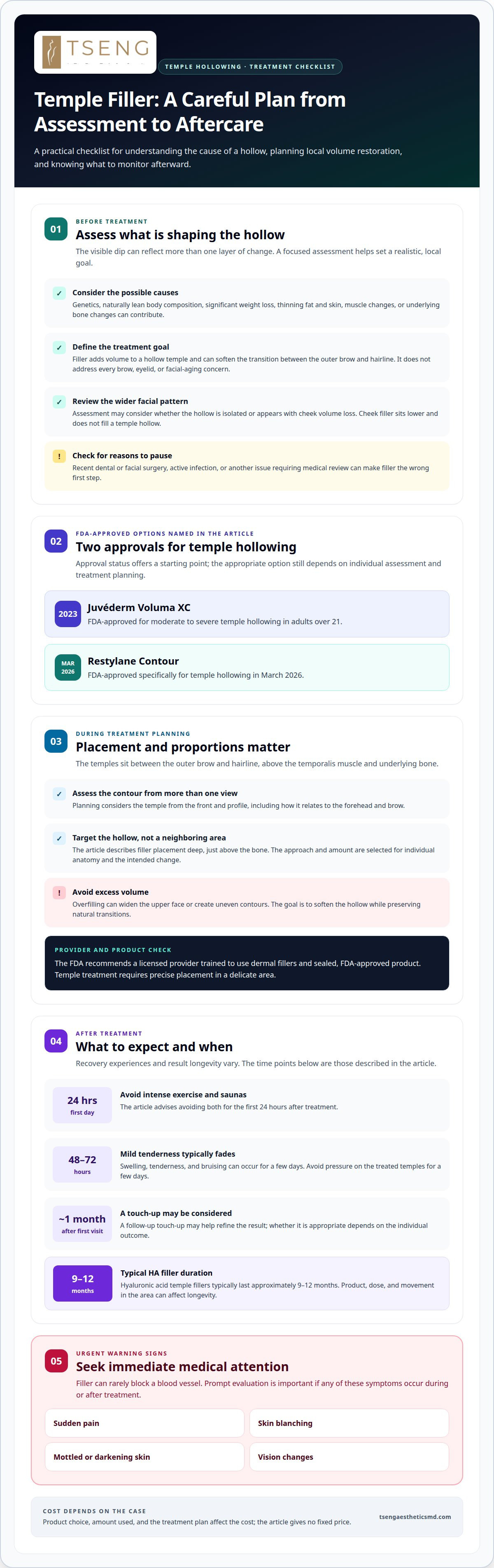
Two fillers now have FDA approval specifically for temple hollowing: Juvéderm Voluma XC, approved in 2023 for moderate to severe hollowing in adults over 21, and Restylane Contour, approved in March 2026. For temple filler for a hollow look, these approvals offer a clear starting point for understanding which options are intended for this area.
It makes sense to want more than a product name when considering treatment. Restoring volume at the temples can soften a hollow contour and support facial balance, but the right approach depends on the shape of the area and the result you hope to achieve.
This guide explains how temple filler for a hollow look works, how hyaluronic acid and collagen-stimulating fillers differ, and what each FDA-approved option is approved to address. You’ll also learn what to expect from treatment and why careful assessment and placement matter in this delicate area.
Key Takeaways
- Temple hollowing can reflect changes in soft tissue, muscle, or bone, as well as genetics or weight loss; understanding the cause helps frame treatment goals.
- Filler can restore volume where the temple dips and support facial balance, but it won’t correct every concern around the brows or eyelids.
- Hyaluronic acid and collagen-stimulating fillers work differently, including in how their results develop and whether treatment can be reversed.
- Learn what careful assessment and placement involve, and which warning signs after treatment call for urgent medical attention.
Why do my temples look hollow?
Hollow temples can result from changes in fat, muscle, skin, or underlying bone. Someone with a visible temple dip who wants to restore upper-face volume may be a candidate for filler assessment.
Common Causes of Temple Hollowing
Temple hollowing is a loss of soft-tissue volume between the outer brow and hairline. Genetics, significant weight loss, and naturally lean body composition can all contribute. A very lean person or endurance athlete, for example, may have hollow temples without age-related changes. Weight loss associated with medications can also reduce volume in the temples and cheeks.
The cause matters because a dip in the contour beside the forehead may reflect more than one type of change. Fat and other soft tissue can thin, while changes in muscle or bone may also affect the shape. Recognizing the pattern helps distinguish temple volume loss from changes elsewhere in the upper face.
Age-Related Temple Volume Loss
Age-related temple hollowing can develop as temporal fat thins, skin becomes thinner, and the temporalis muscle changes. The underlying bone also remodels over time, altering the support beneath the skin. Together, these shifts can make the temples appear more indented, even when the forehead and brows have not changed in the same way.
These changes explain why age-related volume loss isn’t always a single-layer concern. The visible contour reflects several structures, including soft tissue and bone. Collagen and skin quality may affect the surface appearance, while deeper changes shape the hollow itself.
A good candidate for temple filler has a hollow contour they want to address and understands that treatment targets local volume, not every sign of aging. The concern may be age-related, genetic, or associated with weight loss. A careful assessment considers whether the dip is isolated or appears alongside cheek volume loss, since these areas sit at different levels of the face.
Recent dental or facial surgery, active infection, or another issue requiring medical review can make filler the wrong first step. Treatment planning should account for the cause of the hollowing and the condition of the area. This helps set a focused goal: restoring temple volume rather than broadly changing the forehead or mid-face.
What does temple filler do?
Temple filler adds volume to a hollow contour, helping create a smoother transition across the upper face. At an appointment, the medical professional assesses facial proportions, discusses the desired change, and selects a suitable approach. Hyaluronic acid filler is used after assessment; planning also considers weight loss and other changes affecting facial volume.
The average cost of temple filler in the United States depends on the case and is provided after a quote request; factors include product choice, amount used, and the treatment plan.
For qualified care, the FDA recommends a licensed provider trained to use dermal fillers and sealed, FDA-approved product. Training matters because temple treatment requires precise placement in a delicate area.
After injections, swelling, tenderness, and bruising can occur for a few days. Mild tenderness typically fades within 48 to 72 hours, while pressure on the treated temples is generally avoided for a few days. Patients are advised to avoid intense exercise and saunas for the first 24 hours after treatment.
Hyaluronic acid temple fillers typically last approximately 9-12 months. Longevity varies with the product, dose, and movement in the area, so results and maintenance timing differ. A touch-up may be considered about a month after the first visit to refine the result.
Know the urgent warning signs: sudden pain, skin blanching, mottled or darkening skin, or vision changes during or after treatment require immediate medical attention. Filler can rarely block a blood vessel, so prompt evaluation is important if these symptoms occur.
If temple hollowing is one part of a broader facial-aging concern, a non-surgical facelift approach may be worth discussing as part of a wider treatment plan.
How temple filler restores volume and facial balance
Temple filler restores volume in a localized hollow, refining the transition between the outer brow and hairline. Its effect depends on facial anatomy, placement, and the amount used.
Treatment Planning and Temple Anatomy
The temples lie between the outer brow and hairline, above the temporalis muscle and underlying bone. Planning considers the contour from the front and profile, including how the temple relates to the forehead and brow.
After assessment, dermal fillers are placed deep, just above the bone. This position helps address a temple dip directly rather than adding volume to a neighboring area. The injection approach and amount are selected to suit the individual anatomy and intended change.
Temple Volume and Facial Shape
Temple volume influences how the upper face connects visually with the brow and forehead. A hollow can create a shadow at the side of the face, making the contour appear more angular or indented.
Restoring volume can soften that transition and reduce the contrast of the shadow. The goal is to complement the person’s existing facial shape, not create identical contours for different profiles. Cheek filler sits lower and can add mid-face width without filling a temple hollow.
Overfilling and Facial Proportions
Overfilling occurs when excess product creates fullness beyond the natural temple contour. Rather than softening a shadow, too much volume can widen the upper face or create uneven contours that disrupt facial proportions.
Measured placement matters because the temples meet visible landmarks, including the brow and forehead. A balanced result preserves these transitions rather than making the temple prominent. Temporary tenderness can occur after injections, but it does not indicate whether the final contour is proportionate.
Compared with fat transfer, hyaluronic acid filler adds volume through injections, while fat transfer surgically moves a person’s own fat to the temples. Studies of fat transfer report variation in retention and technique, and the procedure can carry serious risks, including vascular injury and visual loss.
FDA-approved fillers for temple hollowing
Two hyaluronic acid dermal fillers have FDA approval specifically for temple hollowing: Juvéderm Voluma XC and Restylane Contour. Their approvals distinguish these products from fillers used off-label in this delicate facial area. For someone considering temple filler for a hollow look, that specific approval is a useful starting point for comparing options.
Juvéderm Voluma XC received FDA approval in 2023 to improve moderate to severe temple hollowing in adults over 21. Restylane Contour received FDA approval for temple hollowing in March 2026. These approvals relate to each product’s specified use, not every filler or degree of hollowing.
In the Restylane Contour temple trial, 86.1% of patients were still responders at 18 months. That finding describes trial participants, not a guaranteed duration or outcome for each person. Facial anatomy, tissue volume, and the intended change still matter. Cheek filler, for example, addresses a lower area and doesn’t fill a temple hollow.
Hyaluronic acid filler can usually be dissolved with hyaluronidase, an enzyme used to break down this type of filler. This distinguishes it from collagen-stimulating products. Poly-L-lactic acid gradually encourages the body’s own collagen, but collagen-stimulating temple fillers cannot be dissolved with hyaluronidase. A randomized trial found improvement with a particular poly-L-lactic acid formulation, but did not establish superiority to hyaluronic acid filler.
When considering temple filler for a hollow look, weigh temple-specific FDA approval, reversibility, and how volume develops. FDA approval doesn’t mean every option suits every face; intended use and individual anatomy remain central to planning. Sculptra’s collagen-stimulating effects can last up to two years or more, but that duration does not make it interchangeable with an approved hyaluronic acid filler.
Discuss temple filler options as part of an aesthetic plan focused on restoring facial balance.
Tseng Plastic Surgery
Tseng Plastic Surgery offers facial rejuvenation procedures that can be discussed in relation to your broader goals. If your concern extends beyond a localized temple dip, a consultation can explore whether a facelift or Minimal invasive preservation face and neck lift is relevant. These procedures address different concerns from temple filler, so the discussion depends on the changes you want to address.
Bring questions about facial balance, treatment approaches, and what each option is designed to change. A focused conversation can clarify whether your priority is a temple-specific concern or broader changes to the face and neck.
Contact Tseng Plastic Surgery to discuss your facial rejuvenation goals.
Choose a next step that fits your goals
Deciding whether temple filler for a hollow look fits your goals starts with the change you want to see, not simply the name of a treatment. Consider whether you’re focused on one contour or seeking broader facial rejuvenation. That distinction can shape a useful conversation about priorities and how different procedures address different areas.
Tseng Plastic Surgery offers a facelift and a Minimal invasive preservation face and neck lift for facial rejuvenation, as well as liposuction. These options address different concerns, so a discussion can focus on what aligns with your goals. The right approach depends on your individual needs.
Contact Tseng Plastic Surgery to discuss your goals and possible next steps. A thoughtful conversation can help you move forward with clarity and confidence.
Frequently Asked Questions
Which fillers are used for temple hollowing, such as hyaluronic acid or Sculptra?
Juvéderm Voluma XC and Restylane Contour have FDA approval specifically for temple hollowing. Sculptra and hyaluronic acid fillers are different treatment options, so they are not interchangeable. A key practical distinction is reversibility: hyaluronic acid filler can usually be dissolved with hyaluronidase, while collagen-stimulating fillers cannot. Product choice depends on the intended use and treatment goals.
How much filler is typically needed for temples and how long do results last?
There isn’t one standard amount for every temple; the volume used depends on the hollow’s shape, the desired correction, and the surrounding facial contours. Hyaluronic acid temple filler typically lasts approximately 9-12 months. Sculptra’s collagen-stimulating effects can last up to two years or more, but it works gradually and is usually given over a series of sessions. Longevity varies by product and dose.
What happens during a temple filler appointment and what is recovery like?
The appointment involves reviewing your goals and assessing the temple contours before selecting a product and injection approach. Treatment can feel like pressure or discomfort; numbing or filler containing local anaesthetic can help. Swelling, tenderness, or bruising may follow. Avoid pressure on the treated area for a few days, and intense exercise and saunas for the first 24 hours. Follow the treating professional’s aftercare guidance.
What are the risks and warning signs of complications from temple filler?
Possible complications include asymmetry, unwanted fullness, lumps, infection, persistent nodules, or delayed inflammatory reactions. Rarely, filler can block a blood vessel. Sudden pain, skin blanching, mottled or darkening skin, or vision changes during or after treatment require urgent medical attention. These symptoms differ from ordinary temporary tenderness, so seek urgent care rather than waiting for them to settle.
Who should avoid temple filler, including people with certain conditions or medications?
Active infection, recent dental or facial surgery, or another issue requiring medical review may make temple filler the wrong first step. No single medication rule applies to every patient. Give the treating professional a complete account of your health conditions and medications so they can assess whether treatment should proceed or be delayed.
What should I do before and after temple filler to reduce risks and support results?
Before treatment, share your medical history, medications, recent dental or facial procedures, and any active infection with the treating professional. Confirm that the injector is licensed and trained to use dermal fillers and that the product is sealed and FDA-approved. Afterward, avoid pressure on the treated temples for a few days and strenuous exercise and saunas for 24 hours. Seek urgent care for vision changes or sudden skin or pain symptoms.

