What to Ask During a Facelift Consultation: A Patient’s Guide
By Tseng Plastic Surgery
What if the most important part of a facelift consultation isn’t choosing a technique, but understanding why a particular plan fits your face and goals? It’s natural to want a refreshed appearance without looking unlike yourself. If you’re unsure what to raise first, knowing what to ask during a facelift consultation can help you turn that uncertainty into a focused discussion.
Useful questions can clarify whether you may be a suitable candidate, which changes a surgeon recommends and why, and how the proposed approach relates to your facial features. They can also help you understand potential risks, recovery expectations, and what a natural-looking result means in the context of your goals. At Tseng Plastic Surgery, Dr. Mark H. Tseng brings more than 20 years in practice to personalized conversations about facial balance and rejuvenation.
This guide covers questions about candidacy, surgical approach, safety, recovery, and expectations. The aim isn’t to make a decision on the spot. It’s to leave feeling informed, heard, and comfortable taking the time you need.
Key Takeaways
- Use what to ask during a facelift consultation to guide a focused conversation about your concerns, facial features, and the changes you hope to see.
- Ask how your goals and individual anatomy shape the recommendation, including whether a facelift addresses the areas that matter most to you.
- Discuss your surgeon’s training and facelift experience, and ask how their approach relates to your circumstances.
- Clarify the recommended technique, potential risks, and recovery expectations so you understand the practical and aesthetic considerations of the plan.
- After the visit, summarize the recommendation, note unanswered questions, and give yourself time to reflect before deciding.
What should you ask at a facelift consultation, and why?
It’s reasonable to want some structure before discussing a decision that can affect both your appearance and daily life. Preparing questions helps you explain what matters, understand the surgeon’s reasoning, and identify where you need more detail. A consultation should be a two-way conversation: you describe your goals and concerns, while the surgeon assesses your facial features and discusses appropriate options. You don’t need medical terminology or a perfect description. Clear, personal observations are a useful starting point.
A useful facelift consultation is a personalized assessment, not a preset plan. The recommendation should connect your priorities with an evaluation of your facial anatomy, rather than treating every concern as the same problem. For general background on facelift surgery and terminology, you can also consult Rhytidectomy (Facelift) on Wikipedia, then ask how those broad concepts relate to your situation.
How do you describe what you hope to change?
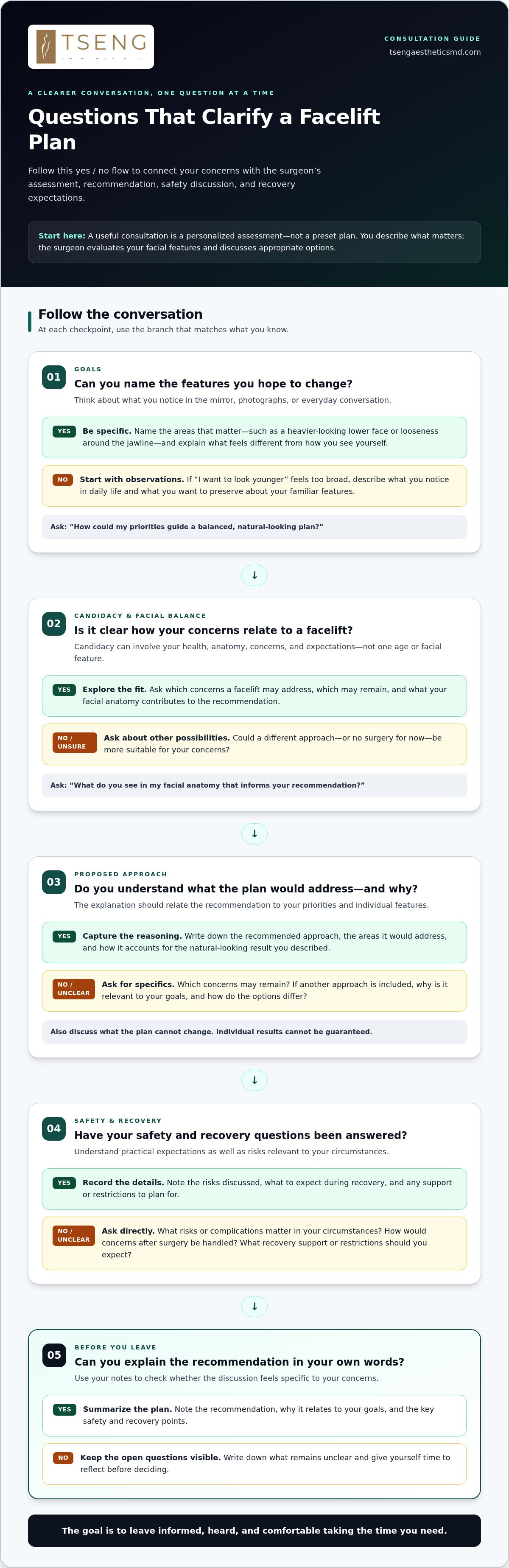
Replace a broad request such as “I want to look younger” with the specific features you notice. You might say, “My lower face looks heavier in photographs,” or “I’m most aware of looseness around my jawline.” Consider which changes affect you in everyday life, including what you notice in the mirror or in conversation. Then ask how those priorities could guide a balanced, natural-looking plan while preserving the features that make your face feel like yours.
Which questions belong at the top of your list?
Use this checklist as a starting point, not a test you have to complete. Prioritize the questions tied to your greatest uncertainties. Bring a printed copy or write them in a notes app, and record the answers in your own words so you can revisit the discussion later.
- Goals: Which of my concerns can a facelift address? How would you define a balanced result for my features?
- Candidacy: Based on my facial anatomy and health history, am I a suitable candidate? Are there concerns that may call for a different approach?
- Proposed approach: What do you recommend for me, and why? Which areas would the plan address?
- Safety: What risks or complications should I understand in my circumstances? How would concerns after surgery be handled?
- Recovery: What should I expect during recovery, and what support or restrictions should I plan for?
As you listen, notice whether the explanation addresses your priorities and leaves room for follow-up questions. If an answer feels too general, ask how it relates to your features or the proposed plan. A thoughtful conversation can help you understand not only what is being recommended, but why it may suit your goals.
How can you discuss facelift goals, candidacy, and facial balance?
A clear recommendation starts with a clear account of what you hope to change. Rather than asking only for a “younger” appearance, identify the features that draw your attention and explain what feels different from how you see yourself. A facelift may address some concerns more directly than others, so ask the surgeon to connect your priorities with an assessment of your facial anatomy, not just a general description of the procedure.
Candidacy isn’t determined by one age or facial feature. Your health, anatomy, concerns, and expectations all inform whether surgery may be appropriate and which approach could be considered. Ask whether your goals might be better addressed another way, or whether no surgery is the most suitable choice for now.
How do you ask whether a facelift fits your concerns?
Name the areas that matter to you, such as the lower face, jawline, or neck, and explain what you notice in daily life. Then ask: “What do you see in my facial anatomy that informs your recommendation?” and “Which of my concerns can a facelift address, and which may remain?” These questions invite a specific discussion of potential benefits and limitations without assuming surgery is the answer.
If the proposed plan includes an approach beyond a facelift, ask why it’s relevant to your goals and how the options differ. You can also ask what the recommendation would be if you chose not to have surgery. The aim is to understand the reasoning, not to steer the conversation toward a predetermined outcome.
How do you discuss natural-looking results?
“Natural-looking” can mean different things to different people. Describe what you want to preserve, such as familiar facial expressions or recognizable features, and what would feel too noticeable or unlike you. For example, you might say you want a refreshed appearance but don’t want your face to look markedly different. Ask how the proposed plan takes those preferences into account, while recognizing that an individual result can’t be guaranteed.
You can explore how a balanced approach to facial rejuvenation is discussed in this modern facelift guide. In the consultation, bring the discussion back to your own features: “How does that idea apply to my face?” A useful answer should explain the rationale in terms you understand, rather than relying on broad promises.
It’s also fair to ask what the plan cannot change and which risks are relevant to your situation. The American Society of Plastic Surgeons’ overview of facelift risks offers general background; your surgeon can discuss how risks relate to your health and proposed procedure. A personalized conversation about facelift goals and facial balance can help you weigh those details alongside your priorities.
What should you ask about your surgeon’s experience and results?
Understanding a surgeon’s background can help you assess how their experience relates to the procedure being discussed. Ask about relevant specialty training, current credentials, and facelift-specific experience. Rather than focusing only on a general number of years in practice, invite the surgeon to explain how their experience with facelifts informs the approach they recommend for your features and goals.
Dr. Mark H. Tseng has been in practice for over 20 years. In your consultation, focus on details that matter to your decision, including his specific experience with facelift procedures and how he evaluates whether a plan is appropriate for you. Questions about credentials and the surgical setting are also part of a careful discussion. Titles can vary, so ask for the exact credential or board certification designation and confirm it through the relevant certifying organization.
Which experience and credential questions are useful?
Bring a few direct questions to keep the conversation clear and specific:
- What specialty training and current board certification do you hold?
- How does your facelift experience relate to the concerns and approach we’ve discussed?
- Where would the procedure be performed, and what safety standards apply to that setting?
- Who would be involved in my care during surgery, and how are their roles explained?
Listen for answers that identify precise credentials and explain the setting in understandable terms. Ask follow-up questions if a title or description is unfamiliar, rather than assuming a professional label means a particular qualification. The goal isn’t to judge experience by a single figure, but to understand its relevance to your proposed care and feel comfortable with the explanation.
How should you review before-and-after photographs?
Photographs can help you understand a surgeon’s aesthetic approach, but they’re examples, not forecasts. Ask to review cases that relate to your main concerns, facial features, and proposed procedure. As you look, ask what changed, which features remained recognizable, and how the surgeon thinks those examples differ from your situation. Similarities can make the discussion useful, but no two faces or outcomes are identical.
Pay attention to whether the photographs help clarify your own preferences. If an example looks too dramatic or too subtle for your taste, say so and explain why. You might ask, “What aspects of this case are relevant to my plan?” or “What differences between us could affect the result?” This turns image review into a conversation about expectations, not a promise that your outcome will match a photograph.
As you consider what to ask during a facelift consultation, notice whether the surgeon connects credentials, experience, and examples to your individual circumstances. Clear explanations can help you evaluate the proposed plan with greater confidence while leaving room to ask more before making a decision.
What questions clarify facelift technique, risks, and recovery?
A recommendation is most useful when you understand its reasoning and trade-offs. Ask what the proposed facelift technique is intended to address in your case, which alternatives were considered, and why the surgeon favors this approach for your anatomy and goals. If you’re comparing surgical and non-surgical options, ask what each is intended to address, what its limitations are, and how the choices relate to your priorities.
Technique, recovery, and risks should be discussed in light of your individual assessment, not as a one-size-fits-all script. Use the questions below to understand how the plan applies to you, rather than simply collecting general facts about facelift surgery.
How do you understand the recommended facelift approach?
Ask the surgeon to explain the purpose of the recommended technique in relation to your concerns. Then explore alternatives: “What other approaches could address these areas, and what are the trade-offs?” A clear explanation should connect the choice to your facial features and priorities, describe what it is intended to address, and help you understand what it may not change. If a term is unfamiliar, ask for a plain-language explanation.
| Topic | Question to ask | What the answer should clarify |
|---|---|---|
| Technique | Why do you recommend this approach for me? | How the method relates to your anatomy and goals, and what alternatives were considered. |
| Risks | Which risks are most relevant to my health and proposed procedure? | Potential complications and how the care team would respond if concerns arise. |
| Recovery | What should I expect as I recover, and what activities may need to be limited? | Individual guidance for healing, daily routines, and practical support. |
| Follow-up | What follow-up care should I expect, and whom should I contact with a concern? | How post-operative questions and planned check-ins are addressed. |
What should you ask about risk and recovery?
Ask the surgeon to distinguish general risks from considerations specific to your health history and plan. You might ask how potential complications are recognized and managed, and what symptoms or changes should prompt you to seek guidance. Make sure you understand the answer and know the appropriate contact process for questions after surgery.
Recovery guidance should be personal, not a fixed promise about when you’ll feel or look a certain way. Discuss what to expect as healing progresses, how activity instructions will be provided, what follow-up is planned, and what help you may need at home. Share any work, caregiving, or travel responsibilities that could affect your planning. The answers can help you assess whether the proposed plan is practical as well as aligned with your aesthetic goals.
A personalized facelift consultation with Tseng Plastic Surgery can cover the proposed approach, recovery considerations, and risks in the context of your individual assessment.
How do you leave a facelift consultation ready to decide?
A consultation can leave you with a lot to consider. You don’t have to make a decision in the room. Give yourself time to review what you heard, check whether the recommendation reflects your priorities, and identify anything you still need explained. A useful next step is to turn your notes into a clear record of the plan and your own response to it.
What should you bring and note during the visit?
Bring a prioritized list of questions and a brief note about the concerns that led you to seek a consultation. Relevant medical history and a current medication list can help inform the clinical discussion. During the visit, write down the proposed approach, alternatives discussed, recovery guidance, follow-up plans, and any questions that remain unanswered. These notes make it easier to review the conversation later.
How can you reflect on the recommendation afterward?
Once you’ve had time to absorb the discussion, compare the proposed plan with the goals you brought in. Consider whether the surgeon explained how it relates to your features and which priorities it addresses. If something feels unclear, note the exact question rather than relying on memory or making assumptions about the answer.
A simple post-visit sequence can help:
- Review your goals. Revisit the concerns you identified before the appointment and note which remain most important.
- Summarize the plan. In your own words, record the recommended approach, its rationale, and any alternatives discussed.
- List what’s unresolved. Separate unanswered questions about risks, recovery, follow-up, or expected results from points you understand.
- Reflect without pressure. Consider whether you feel heard and informed, and take the time you need before deciding.
Dr. Mark H. Tseng has been in practice for more than 20 years. That experience provides context for a personalized discussion, not a guarantee of any particular result. The decision remains yours. If you’re still weighing what to ask during a facelift consultation, use your notes to guide a follow-up conversation and clarify the details that matter to you.
For a considered conversation about your goals and potential facelift plan, you can explore facelift care at Tseng Plastic Surgery.
Take the next step at your own pace
A thoughtful decision doesn’t have to happen during the consultation. Give yourself room to consider whether the conversation left you feeling heard, whether the proposed plan reflects what matters to you, and whether you understand the choices ahead. If questions remain, write them down and seek clear answers before deciding. Feeling ready means having enough information to make a considered, personal choice, not simply reaching a yes or no.
Knowing what to ask during a facelift consultation can help you turn your hopes into a meaningful conversation about facial balance and possible approaches. At Tseng Plastic Surgery, that discussion can include facelift care and a minimal invasive preservation face and neck lift, with recommendations shaped around individual goals.
When you’re ready to continue the conversation, explore a personalized facelift consultation with Tseng Plastic Surgery. Take the time you need and move forward with clarity.
Frequently Asked Questions
How long does a facelift consultation usually take?
Appointment length varies by practice and by how much you need to discuss. A visit may cover your goals, medical history, facial assessment, potential approaches, risks, and recovery planning, so a short prioritized list can help you use the time well. Knowing what to ask during a facelift consultation can also help you decide what needs a full answer first. When scheduling, ask about the appointment format and how to follow up on questions that need more discussion.
Should I bring photos to a facelift consultation?
Yes, reference photos can help you describe qualities you like, such as a refreshed appearance or a particular sense of facial balance. Treat them as a way to communicate preferences, not as a template or promise that your result can match someone else’s. Your features and anatomy are individual. Bring a written list of your concerns too, so the conversation stays anchored in what prompted you to seek an assessment.
Can I bring someone with me to a facelift consultation?
A support person can help you listen and take notes, which may make it easier to recall details afterward, especially if you’re discussing several options or unfamiliar terms. The consultation should still center on your preferences and questions. If you’d like to discuss something privately, say so and request time to speak one-on-one so your comfort and privacy remain part of the visit.
What medical information should I share before discussing facelift surgery?
Share your medical history, prior procedures, allergies, and a current list of medications and supplements. Include details even if you’re unsure they relate to facial surgery, since your surgeon needs a complete picture to assess your individual circumstances. If you have questions about whether a medication should be adjusted, don’t stop or change it on your own. Discuss medication decisions with your treating clinician and surgical team.
Is there an ideal age for a facelift consultation?
No single age determines whether a consultation is appropriate. A surgeon considers your individual anatomy, health history, concerns, and goals rather than relying on age alone. For example, two people of the same age may have different facial features and priorities, leading to different discussions. Ask how your specific concerns inform the recommendation and whether surgery or another approach may be relevant to your situation.
Can I ask about non-surgical options during a facelift consultation?
Yes. Ask whether a non-surgical facelift or another non-surgical treatment may address your particular concerns, and how its purpose and limitations differ from surgery. The discussion depends on your anatomy, goals, and clinical assessment. You might ask, “What would this option address for me, and what concerns might remain?” Understanding the reasoning behind each approach can help you consider choices without assuming one is right for everyone.
What if I still have questions after my facelift consultation?
It’s reasonable to ask for clarification before making a decision. Review your notes and identify the specific point that remains unclear, such as a step in the proposed plan, a risk, or an activity during recovery. Use the practice’s established follow-up process to continue the conversation. Before deciding, make sure you understand the recommendation and its alternatives, and feel comfortable taking the time you need to consider them.

