Questions to Ask to Feel Safe With a Surgeon Before Surgery
By Tseng Plastic Surgery
Every surgery carries some risk, so feeling prepared starts with understanding possible complications, how they’ll be managed, and what recovery may involve. The most useful questions to ask to feel safe with a surgeon cover their experience with your procedure, their credentials, and the facility where surgery will take place. For plastic surgery, board certification is also important to understand: the American Board of Plastic Surgery is the only board recognized by the American Board of Medical Specialties for plastic surgery of the face and body.
It’s reasonable to want clear, personal answers before making a decision. A thoughtful consultation should give you time to discuss your goals, health history, concerns, and alternatives without feeling rushed.
This guide covers what to ask about complications, recovery, a surgeon’s experience and credentials, facility accreditation, and anesthesia. You’ll also find practical ways to prepare for your consultation so you can leave with a clearer understanding of your options and next steps.
Key Takeaways
- Ask about common and serious complications, recovery restrictions, follow-up care, and the support you may need at home.
- Discuss the surgeon’s experience with your specific procedure, including how often they perform it and their relevant credentials.
- Ask whether the operating facility is accredited, who will administer anesthesia, and how your vital signs will be monitored.
- Prepare for your consultation by listing your questions, sharing your health history and medications, and bringing someone to take notes if helpful.
- For plastic surgery, understand what board certification represents and ask specifically about certification by the American Board of Plastic Surgery.
1. Are there possible complications?
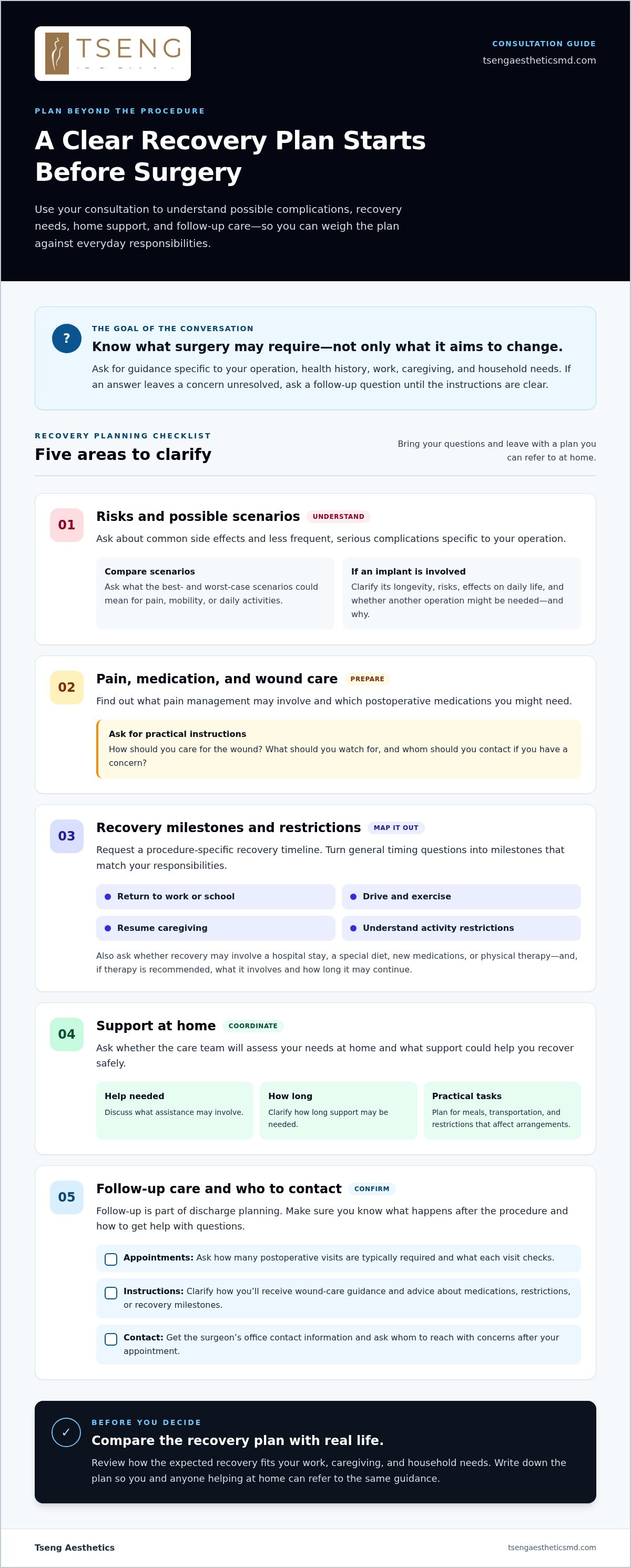
Every surgery, including routine procedures, carries some risk. Ask the surgeon to explain common side effects and less frequent, serious complications specific to your operation. Request a clear account of the best- and worst-case scenarios, including how complications could affect pain, mobility, or daily activities. These questions help you set realistic expectations before weighing benefits against risks.
Recovery matters as much as the procedure itself. Ask what pain management may involve, which postoperative medications you might need, and how to care for your wound. If the operation involves an implant, ask about its longevity, risks, and possible effects on daily life. Ask whether you might need another operation in the future, and why.
What should you expect during recovery, and whom can you contact with concerns? Ask for a procedure-specific recovery timeline, including activity restrictions and expected follow-up appointments. Before leaving your consultation, get the surgeon’s office contact information and ask whom to reach with questions after your appointment.
Turn general timing questions into practical milestones. Ask when you may return to work, drive, exercise, attend school, or resume caregiving. Find out whether recovery may involve a hospital stay, a special diet, new medications, or physical therapy. If therapy is recommended, ask what it involves and how long it may continue. The surgeon’s guidance should reflect your operation and everyday responsibilities.
Plan for home before surgery. Ask whether the care team will assess your needs at home and what support could help you recover safely. Discuss whether you’ll need help, what that assistance may involve, and how long it may be needed. Identify practical tasks you may need support with, such as preparing meals or arranging transportation. Clarify any restrictions that could affect those plans.
Follow-up care is part of discharge planning. Ask how many postoperative visits are typically required, what each visit checks, and how you’ll receive wound-care instructions. Confirm how to contact the office if you’re unsure about a medication, restriction, or recovery milestone. If an answer doesn’t address your concern, ask a follow-up question until the instructions are clear. Write down the plan so you and anyone helping at home can refer to the same guidance.
Before deciding, compare the expected recovery with your work, caregiving, and household needs. A clear discussion of risks, pain management, home support, and follow-up care helps you understand what surgery may require, not only what it aims to change.
2. Surgeon experience
A surgeon’s experience with your specific procedure is more informative than a broad claim of expertise. Ask how many times they have performed the operation and over how many years. Then ask whether they perform it regularly now, and how their experience relates to your goals and health history. Their answers should help you understand the reasoning behind their recommendation, not just provide a procedure count.
Make the conversation specific. Ask what approach they recommend for your procedure, what factors shape that choice, and what alternatives they considered. You might ask, “What details of my case make this technique suitable?” Their explanation can show how they connect technical judgment with your desired outcome. If you receive instructions or educational materials, review them and note any terms you want explained before deciding.
Ask about training and qualifications relevant to the operation. For plastic surgery, clarify board certification: the American Board of Plastic Surgery is the only board recognized by the American Board of Medical Specialties for plastic surgery of the face and body. Ask which board issued the surgeon’s certification and whether it applies to plastic surgery. Certification indicates that a surgeon meets standards of education, ethics, and patient care.
How can you check a surgeon’s license and disciplinary history? Ask for the surgeon’s full name and state license details, then review the public profile maintained by the state medical board. Look at the listed license status and any disciplinary information, and discuss anything you don’t understand during your consultation.
Questions about experience can also reveal how a surgeon handles challenges. Ask what complications they have encountered with the procedure and how they approach prevention, recognition, and care. Infection is one example: ask what signs patients should watch for and what steps the care team takes if concerns arise. The goal is to understand the surgeon’s process, not to expect a complication-free operation.
Ask how the surgeon evaluates results and adapts recommendations when a patient’s anatomy or medical history differs from the usual case. Request an explanation using a diagram or procedure-specific educational material if that would make the details clearer. You can also ask what outcome is most realistic for your circumstances and which factors depend on your healing.
Before you leave, summarize what you heard: the recommended procedure, the surgeon’s relevant experience, and the qualifications that support their practice. Ask follow-up questions whenever an answer feels unclear. For a more focused discussion, you can continue exploring questions about surgeon experience as you prepare for your consultation.
3. Is the facility accredited and fully staff?
Ask whether the facility is accredited and fully staffed for your procedure. Find out which organization accredits it and what the accreditation covers. Accreditation and staffing are separate matters, so ask who will be present throughout your operation and recovery. Find out where the procedure will take place, whether in a hospital or another surgical facility, and what care is available there. Clear answers help you understand the setting, the team, and the plan if your needs change.
Anesthesia may be local, regional, or general, depending on the procedure and your health. Ask which type the surgeon recommends and how it may affect your experience during surgery. Ask who will administer it, whether that person is a certified anesthesiologist or nurse anesthetist, and whether you’ll meet them beforehand. A preoperative conversation gives you the chance to discuss your medical history and understand the anesthesia plan before surgery.
Discuss medications and allergies directly with the anesthesia professional. Provide a complete list of prescription medicines, over-the-counter drugs, supplements, and known allergies. Ask whether any medication could interact with anesthesia and what instructions apply before surgery. For example, clarify which prescribed medicines to take on the morning of the procedure. Don’t change or stop a medication based on guesswork; make sure the care team’s directions are clear.
Ask how your vital signs will be monitored during surgery and who is responsible. You can ask which measures the team tracks and how they respond if a reading changes. This makes the monitoring plan easier to understand without relying on technical shorthand. If the explanation is unclear, ask the team to describe it in everyday language and relate it to your procedure.
Ask directly about overnight monitoring. Find out whether your planned procedure involves a hospital stay, who will oversee your care overnight, and what determines discharge. If you’ll go home, ask how the team decides you’re ready to leave and what instructions you’ll receive. The answers should distinguish routine recovery arrangements from steps taken if your care needs change.
Before choosing a facility, summarize what you’ve learned: its accreditation, who will administer anesthesia, the monitoring plan, and whether overnight care is expected. Ask how anesthesia could affect your recovery and what support is available after discharge. If you’re considering a minimal invasive preservation face and neck lift, include the same facility and anesthesia questions in your discussion. Understanding the setting and the team’s roles can help you assess the plan and its likely outcome.
4. Preparing for a surgical consultation
Arrive with a concise account of your goals and health history. Write down your medical conditions, allergies, previous surgeries, and every medication or supplement you take. Include what matters most to you in the outcome, such as a particular change or daily activity. These details help your surgeon consider your circumstances rather than discuss the procedure in general terms.
Bring a written list of questions, and take notes during the conversation. Questions to ask to feel safe with a surgeon include how the proposed procedure works, what it aims to change, and why it suits your goals. Ask your surgeon to explain the steps involved. Request a diagram or educational handout if helpful, then review it at home. A trusted person can listen and help you remember the answers.
Discuss alternatives before deciding on surgery. Ask what non-surgical treatments may suit your goals, what benefits and limitations they have, and what may happen if you delay or decline surgery. Depending on the condition, alternatives may include medication, physical therapy, lifestyle changes, injections, minimally invasive treatments, or monitoring. A clear comparison helps you understand why one approach may better fit your priorities.
Ask your surgeon to explain complications relevant to the proposed operation and how the care team would respond if one occurred. Clarify the likely outcome for your health and medical circumstances, how the procedure could affect daily life, and what may influence healing. Ask which steps, such as improving your health or quitting smoking, may reduce complication risks. Note unfamiliar terms so you can request plain-language explanations.
Questions to ask to feel safe with a surgeon should also cover consent and time to decide. Before you consent, ask the surgeon to review the procedure, expected benefits, possible complications, alternatives, and what may happen without surgery. You may seek another opinion, and another consultation can help you compare recommendations for elective surgery.
Before the appointment ends, ask whether the procedure is urgent or can be delayed, and request educational materials to review. If the surgeon’s recommendation changes after discussing your health history, ask what information prompted the change. For plastic surgery, consulting two surgeons can help you compare proposed approaches and prepare focused follow-up questions.
Use your notes to identify unanswered questions after the visit. Contact the surgeon’s office and ask for clarification whenever an instruction or explanation is unclear. If you record the consultation for later review, tell the doctor you’re recording. A prepared, unhurried discussion gives you a clearer basis for weighing surgical and non-surgical options.
5. Plastic surgery board certification
Board certification is a specific credential to ask about, not a substitute for discussing experience with your procedure. For plastic surgery of the face and body, the American Board of Plastic Surgery is the only board recognized by the American Board of Medical Specialties. Certification indicates that a surgeon meets standards of education, ethics, and patient care. Ask which board issued the surgeon’s certification and what the credential covers.
Use precise language in your consultation. Ask, “Are you certified by the American Board of Plastic Surgery?” Then ask how that training relates to the recommended operation. A surgeon may perform several types of procedures, but your discussion should clarify their experience with the specific one you’re considering. For example, ask how often they perform it and how their approach reflects your anatomy and goals.
Certification and experience answer different questions. Certification speaks to professional standards; experience with the specific procedure helps you understand the surgeon’s familiarity with the planned operation. Ask what training prepared them to perform it, how they choose between approaches, and what factors could change their recommendation. Invite the surgeon to explain the expected outcome and relevant risks in terms you understand. Clear answers help you make an informed decision.
Prepare for the conversation by writing down the credential’s exact name and your questions. Ask how to understand the certification, whether it applies to plastic surgery, and how it relates to your proposed procedure. If an answer uses unfamiliar terminology, request a plain-language explanation. You can also ask for educational materials to review after the appointment, then note any questions that arise. A thoughtful discussion should connect training, judgment, and your individual goals without treating certification as a promise about results.
When comparing recommendations, keep credentials separate from personal preference. Note whether each surgeon explains the same procedure, its alternatives, and the reasoning behind their recommendation. If two surgeons suggest different approaches, ask what clinical considerations led to each plan. For elective plastic surgery, consulting two surgeons can help you compare perspectives and prepare focused follow-up questions. The takeaway is straightforward: ask about recognized board certification, then discuss the surgeon’s experience with your specific operation.
For a considered next step, explore plastic surgery options and bring your questions about credentials and procedure experience to your consultation.
Tseng Plastic Surgery: Facelift
Tseng Plastic Surgery offers facelift procedures for people considering facial rejuvenation and seeking a personalized discussion of their goals. The practice also offers a minimal invasive preservation face and neck lift, which may be relevant if you’re exploring different surgical approaches.
Bring your questions about experience with your procedure, board certification, possible complications, and recovery to a consultation. Ask how the recommended approach relates to your priorities, what alternatives may suit your goals, and what the care plan involves. A clear conversation can help you understand your options and decide what to consider next.
To continue the conversation about facial rejuvenation, visit tsengaestheticsmd.com.
Take the Next Step With Clarity
Your consultation is an opportunity to shape a decision around your priorities, not simply agree to a proposed plan. Let the questions to ask to feel safe with a surgeon guide a conversation about what you hope to change, what matters most in your care, and whether the recommended approach aligns with those goals. Take time to reflect and bring any further questions before deciding.
For facial rejuvenation or body contouring, Tseng Plastic Surgery offers facelift, minimal invasive preservation face and neck lift, and liposuction procedures. A conversation can help you explore whether one of these options relates to your goals and what you want to understand before moving forward.
Contact Tseng Plastic Surgery to discuss your questions and possible next steps. You deserve to make your decision with care, understanding, and confidence.
Frequently Asked Questions
Are there possible complications?
Yes, surgery can involve complications, and specific risks depend on the procedure and your health. Ask which signs after surgery need prompt attention, who should assess them, and what to do if they appear outside office hours. For example, clarify the difference between an expected change during healing and a symptom that needs urgent evaluation. Ask for these instructions in writing so you and your support person can refer to them.
How long will the benefit last?
How long a surgical benefit lasts varies with the procedure, the result sought, and changes over time. Ask what the operation can reasonably change, what it cannot prevent, and which factors may affect the result later. For a procedure involving an implant, discuss its expected longevity and whether future surgery may be needed. Request an explanation tailored to your goals rather than relying on a general promise about lasting results.
How will the anesthesia work?
The anesthesia plan depends on the operation and your health history. Ask which type is proposed, who will administer it, and what you may experience before and after the procedure. Tell the anesthesia professional about allergies, prior reactions, and all medications or supplements you take. For example, mention nausea or an unusual response after a previous anesthetic. Ask how the team will account for that history and what instructions apply before surgery.
How will the recovery be?
Recovery depends on the operation, your healing, and the activities you need to resume. Ask what the first stage may feel like, which daily tasks may require help, and how your progress will be assessed. If you care for children, manage stairs, or have a physically demanding job, describe those demands before planning time away. Ask which changes should prompt a call to the care team, and keep the response instructions accessible at home.
How will the surgery be performed?
The surgeon should explain the planned technique in terms you can follow. Ask what will be changed, where incisions may be placed, and how the approach relates to your goals and anatomy. A diagram or written procedure description can make unfamiliar steps easier to understand. If the plan includes more than one technique, ask what each part is intended to address and whether the plan could change during surgery.
Is everything covered by insurance?
Coverage depends on your insurance plan, the procedure’s purpose, and your policy terms. Before scheduling, ask your insurer whether the surgeon, facility, anesthesia, and related services are covered, and whether prior authorization is required. Request a written explanation of any exclusions or costs you may be responsible for. If the procedure is elective, ask the practice for an itemized estimate of its charges, then compare it with your insurer’s written coverage decision.
Is the facility accredited and fully staffed?
Ask which organization accredits the facility and whether the accreditation applies to the location where your operation will take place. Clarify which clinicians will be present, who oversees anesthesia, and who monitors you after the procedure. If you’ll be discharged the same day, ask how readiness is assessed and who receives the discharge instructions. These details help you understand the care arrangement, including whether overnight observation is planned.
Is there prep?
Yes, preparation may include tests, fasting instructions, medication adjustments, or lifestyle changes. Ask which steps apply to your operation and when to complete them. Bring an up-to-date medication and supplement list, and clarify what to take on the morning of surgery. If you receive instructions that conflict with advice from another clinician, contact the surgical team before making changes. Arrange transportation and home support according to the discharge plan.

