PRP for Hair Thinning: How It Works and How Long Results May Last
By Tseng Plastic Surgery
PRP can support thinning hair, but it doesn’t address every cause of shedding. For PRP for hair thinning, a clinician draws a small blood sample, processes it in a centrifuge to concentrate platelets, then injects the plasma into thinning areas of the scalp. The treatment may help slow hair loss or improve hair density when follicles are still active; according to MDCS Dermatology, improvement often begins within approximately 3-6 months.
It’s understandable to want a clear timeline and to know whether temporary shedding means treatment isn’t working. The cause of hair loss matters: PRP does not permanently resolve the underlying causes of most forms of hair loss, and results vary. This article explains how PRP is prepared and injected, who may benefit, how long improvement may last, and what can contribute to shedding during treatment.
Key Takeaways
- Understand why PRP may be more suitable when thinning areas still have active hair follicles, and what temporary scalp effects can follow treatment.
- Learn how a specialist processes a blood sample and injects the platelet-rich plasma into targeted areas of the scalp.
- Set realistic expectations for when changes may become visible and why maintenance can affect how long improvement lasts.
- Explore how different causes of hair thinning and shedding can shape the approach to treatment.
How Does PRP Work for Hair Loss?
PRP for hair thinning concentrates platelets from a person’s blood and injects them into areas of the scalp. Platelets release growth factors, signaling proteins that may support follicle activity and hair growth. The aim is to improve existing hair or slow hair loss, not create follicles in completely bald areas.
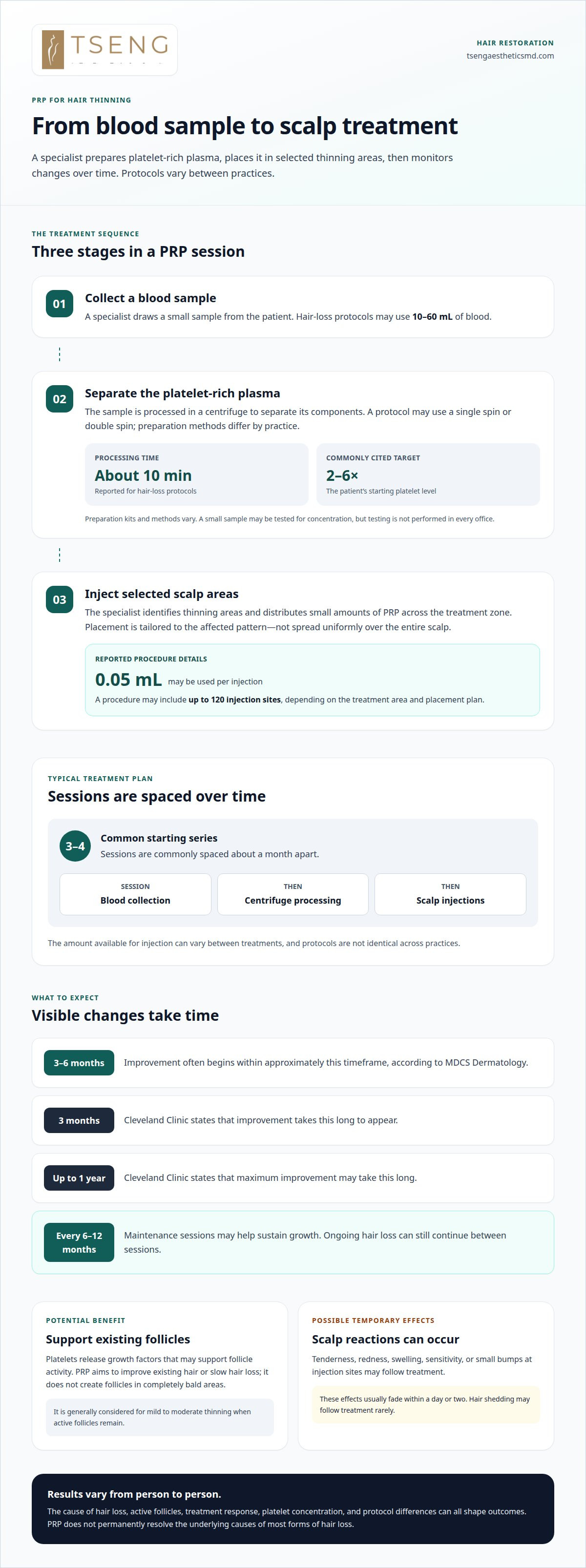
A specialist draws a small blood sample and processes it in a centrifuge to separate its components. Hair-loss protocols may use 10 to 60 milliliters of blood, spun for about 10 minutes. The platelet-rich portion is then injected into thinning areas. Preparation methods vary, and a commonly cited target concentration is 2-6 times the patient’s starting platelet level.
PRP is generally considered for mild to moderate thinning when active follicles remain, including some cases of patterned hair loss. It may be more useful for androgenic alopecia than for hair loss related to certain medications or hormonal imbalances. Unlike PRP, topical minoxidil and oral finasteride are medications used for nonsurgical hair restoration. A specialist evaluates the hair-loss pattern, medical history, and medications before deciding whether PRP fits the treatment plan.
Temporary effects can include tenderness, redness, swelling, sensitivity, or small bumps at injection sites; these usually fade within a day or two. Rarely, hair shedding follows treatment. Blood disorders or blood-thinning medications may affect suitability. Patients may be advised to avoid nonsteroidal anti-inflammatory drugs within 48 hours of treatment; some steroid injections may increase side-effect risk if given within 2 to 4 weeks. These factors belong in the pre-treatment review.
There is no single U.S. average cost that applies to every PRP plan. Cost depends on the treatment area, preparation approach, and number of sessions, with pricing determined for the individual case after a quote request. Insurance coverage depends on the policy’s terms, so the specific plan benefits determine whether treatment is covered.
How a Specialist Prepares and Injects PRP for Hair Thinning
A specialist prepares platelet-rich plasma from the patient’s blood, then injects it into selected scalp areas. Preparation and placement matter because treatment protocols vary, and thinning patterns differ.
PRP Preparation
PRP preparation separates platelet-rich plasma from other components in a blood sample. A centrifuge may use a single-spin or double-spin protocol, and preparation kits and methods vary between practices. The specialist collects the plasma fraction intended for injection, and platelet concentration influences the treatment’s composition. A small sample may be tested, although concentration testing isn’t performed in every office. These details help explain why PRP protocols aren’t identical.
Hair-Thinning Injection Technique
For injection, a specialist identifies thinning scalp areas and places small amounts of PRP across the treatment zone. Individual injections may use as little as 0.05 milliliters, allowing up to 120 injection sites during a procedure. The placement pattern is tailored to the affected areas, rather than applied uniformly across the entire scalp. Precise distribution helps target follicles where thinning is present while keeping the procedure focused.
Preparation quality also depends on how consistently a protocol produces its intended platelet concentration. Blood samples can be processed using different spin methods, so the resulting plasma may vary. Concentration testing can provide an additional measure of the prepared product, but it isn’t used in every office. For people considering PRP for alopecia, these differences help explain why the treatment may be delivered differently between practices.
A treatment plan commonly begins with 3 to 4 sessions spaced about a month apart. Each session follows the same broad sequence: blood collection, centrifuge processing, then scalp injections. The amount of PRP available for injection can vary between treatments. A discussion of individualized hair treatment planning can help clarify how the treatment area and protocol shape the procedure.
How long PRP results may last
Visible changes can take months, and improvement may fade without maintenance. The timeline depends on treatment response and the pattern of ongoing hair loss.
Expected Results and Timing
PRP results may include thicker existing hair, increased density, slower shedding, or regrowth. According to MDCS Dermatology, patients often begin seeing improvement within approximately 3-6 months. Cleveland Clinic states that improvement takes three months to appear, while maximum improvement may take one year. This gradual timeline matters: early appearance alone may not reflect the full response.
A 2020 review of 13 studies found that PRP may increase hair thickness and density. Those findings describe potential benefits, not a uniform outcome for every patient. PRP may stimulate follicles and improve existing hair, but it doesn’t permanently cure the underlying causes of most hair loss.
Variability in Results
Results vary with the cause of hair loss, the presence of active follicles, and treatment response. PRP appears more useful for androgenic alopecia than for some hair loss linked to medications or hormonal imbalances. Platelet concentration and treatment protocols may also differ. These factors help explain why one patient sees thicker hair while another mainly experiences slower shedding.
Duration is variable, too. One physician reports that PRP effects are generally lost by 12 months, and a study of 20 people found hair density began decreasing six months after its three-month peak. The researchers in a 2014 study recommended treatment every 6 months. Maintenance sessions every 6 to 12 months may help sustain growth, though ongoing hair loss can continue between sessions.
For patients weighing the likely benefit, timing and maintenance belong in the same discussion. Follow-up assessments can show whether density is improving, holding steady, or declining. That pattern helps distinguish gradual change from temporary fluctuations in shedding and provides a clearer basis for deciding whether ongoing PRP treatments remain worthwhile.
Causes of hair thinning and shedding
Hair thinning describes reduced density, but its causes influence which treatments may help. Androgenic alopecia, also called pattern hair loss, is one cause for which PRP may be more effective than for some other forms. Hair loss linked to hormonal imbalances or medications may respond differently, so identifying the pattern and likely cause matters before treatment begins.
Active follicles are central to PRP’s potential role. The treatment uses platelets from the patient’s own blood, processed in a centrifuge and injected into thinning scalp areas. It may support hair growth where follicles remain active, but is less effective for completely bald patches. PRP also doesn’t permanently address the underlying causes of most hair loss, so thinning may continue even after treatment.
Shedding after PRP is reported rarely, while temporary tenderness, redness, or swelling can occur at injection sites. Consider a change in shedding alongside the broader pattern: whether thinning is localized or widespread, whether density continues to decline, and whether medications or hormonal factors may be involved. These distinctions help separate a temporary treatment effect from ongoing hair loss that needs a different approach.
A hair transplant is another context in which PRP may be used, including to support hair after transplantation. It remains distinct from surgery: PRP involves injections of concentrated platelets, while a transplant moves a patient’s own hair follicles. Because these approaches address hair loss differently, the cause, location, and condition of existing follicles all shape the discussion of treatment options.
For a focused assessment, discuss your hair-thinning concerns and how the pattern, possible contributors, and treatment goals fit together. An informed plan starts with understanding what may be driving the change, rather than treating every kind of shedding as the same condition.
Tseng Plastic Surgery: Hair Restoration
Tseng Plastic Surgery offers Hair Restoration for people considering professional options for thinning hair. It may be a natural next step when you want to discuss how the pattern of hair loss, the condition of existing follicles, and your goals relate to possible treatment approaches. Understanding these factors can help frame a realistic conversation about whether restoration fits your needs.
If you’re ready to discuss your hair restoration goals, contact Tseng Plastic Surgery.
Make Your Next Step a Thoughtful One
A considered plan for PRP for hair thinning starts with the outcome you value, whether that means addressing visible changes or understanding your options before deciding. Bring your priorities into the conversation, including what matters to you about your appearance and what kind of approach feels appropriate. This can help shape a discussion around your individual goals rather than a one-size-fits-all expectation.
Whether PRP is the right fit depends on your hair-loss pattern, health history, and treatment goals. A consultation can help you understand how those factors relate to possible hair restoration and address questions before you decide. You deserve space to weigh the options without pressure.
Contact Tseng Plastic Surgery to discuss your hair restoration goals and possible next steps. A clear conversation is a meaningful place to begin.
Frequently Asked Questions
When can I see result of PRP?
Visible changes often take several months. Cleveland Clinic says improvement from PRP for hair loss takes three months to appear, while maximum improvement may take one year. A practical way to assess progress is to compare scalp photographs taken under similar lighting and angles over time. Changes in thickness or density can be gradual, so a single early comparison may not show the full response.
Who’s a Good Candidate for PRP?
People with mild to moderate thinning and active follicles in the affected area are generally more suitable candidates than those with completely bald patches. The cause also matters: PRP may be more useful for androgenic alopecia than hair loss related to some medications or hormonal imbalances. Blood disorders and blood-thinning medications can affect suitability, so medical history is part of the assessment.
How Many PRP Treatments Are Needed?
A common starting course is three to four treatments, usually spaced about a month apart. Schedules can differ: Cleveland Clinic describes one treatment monthly for three months, followed by treatments every three months for a year. The number and spacing depend on the treatment plan and response. Maintenance may be considered later, since ongoing hair loss can affect how long improvement lasts.
What is PRP Therapy?
PRP therapy uses a concentrated portion of a patient’s own blood, which contains platelets and growth factors. A specialist prepares the plasma and injects it into selected scalp areas as a nonsurgical approach to hair restoration. It’s intended to support existing follicles, not replace them. For example, a thinning crown with active follicles differs from a fully bald area when considering potential benefit.
Why Treat Hair Thinning Early?
An early assessment can clarify the cause while thinning areas may still contain active follicles. PRP is less effective on completely bald patches, so the condition of the scalp matters when considering this treatment. Early evaluation also helps distinguish pattern hair loss from shedding associated with medications or hormonal changes. That distinction can guide a more suitable discussion of treatment options and expectations.
Can I do shampoo after PRP?
Wait 24 hours before washing your hair or using hair products after PRP treatment. After that interval, gentle shampooing can help keep the scalp clean without unnecessary rubbing around injection sites. For example, use a light touch rather than vigorous scrubbing during the first wash. Follow the specific aftercare instructions provided for your treatment, since they reflect the procedure performed and your scalp’s condition. Once healed, pairing healthy hair habits with comprehensive salon care from specialists such as Ritz Cabelo e Estética can help ensure hair looks vibrant and well-styled for milestone events.

