Preservation Facelift vs. Traditional Facelift: How to Compare Your Options
By Tseng Plastic Surgery
The name of a facelift technique may tell you less than the surgical plan behind it. If you’re comparing preservation facelift vs traditional facelift, it’s understandable to look for a clear distinction, especially when surgeons may use the same terms differently. A more useful starting point is to ask how the proposed approach addresses your concerns and supports the result you want.
A natural-looking outcome isn’t determined by a label alone. Your skin, underlying facial tissues, degree of laxity, health, and personal goals all help shape which approach may be appropriate. Dr. Mark H. Tseng has more than 20 years of experience and offers both facelift surgery and minimally invasive preservation face and neck lifts, with care tailored to the individual.
This guide explains how the approaches may differ, why recovery and longevity claims shouldn’t be treated as guarantees, and which personal factors can inform a recommendation. It also offers practical questions for a consultation, so you can discuss the proposed technique, your anatomy, and the balance of results you hope to achieve.
Key Takeaways
- With preservation facelift vs traditional facelift, the labels alone don’t tell you exactly what a surgeon plans to do.
- Compare the proposed technique and treatment goals rather than assuming an approach guarantees a natural result or easier recovery.
- Your facial concerns, anatomy, health, and recovery priorities all help shape which approach may be appropriate. Preservation isn’t automatically right for everyone.
- Prepare to discuss the diagnosis, recommended plan, potential benefits and limitations, risks, and individualized recovery expectations.
- At Tseng Plastic Surgery, traditional facelift surgery and minimally invasive preservation face and neck lifts are considered as part of personalized planning focused on balanced, natural-looking results.
Preservation Facelift vs. Traditional Facelift: What Do the Terms Mean?
“Traditional facelift” isn’t a single, universally defined operation. Surgeons and practices may use the term for different approaches, so similar descriptions can refer to different ways of treating skin and the supportive tissues beneath it. “Preservation facelift” also doesn’t identify one standardized technique. In the preservation facelift vs traditional facelift comparison, the operative plan matters more than the label.
Both approaches aim to address visible changes such as sagging around the cheeks, jawline, or neck by refining and repositioning facial tissues. A facelift can refresh facial contours, but it doesn’t stop the natural aging process. As a general guide, a preservation facelift emphasizes preserving more of the natural tissue connections during surgery, while “traditional facelift” may refer to a range of established techniques. Neither label explains exactly what a surgeon will do.
What does “preservation facelift” mean?
“Preservation” describes an overall surgical concept, not a universally standardized operation. In general, it refers to an approach that aims to limit disruption of certain connections between the skin and underlying tissues while addressing deeper facial support. The precise tissue planes, ligaments, and extent of dissection depend on the technique being performed. The term alone can’t establish the details of an individual procedure.
Tseng Plastic Surgery offers a minimally invasive preservation face and neck lift. The broader phrase “preservation facelift” may describe approaches with different operative details, so ask how the specific procedure is performed.
What does “traditional facelift” include?
Traditional facelift is a broad label, not a synonym for one fixed method or for skin tightening alone. Depending on the surgeon’s approach and a patient’s needs, a facelift may address skin as well as supportive tissues beneath it. The general Rhytidectomy overview describes a range of surgical techniques, including SMAS and deep-plane approaches. This variety illustrates why the label needs clarification.
It’s useful to understand the distinction, but not to turn it into a simple “old versus new” ranking. The word “traditional” doesn’t reveal whether or how deeper tissues will be treated, just as “preservation” doesn’t specify every surgical step. To compare recommendations, ask which tissues the proposed operation will address and how that plan relates to your concerns and desired result.
How Preservation and Traditional Facelift Techniques May Differ
The clearest comparison is between the surgical plans, not the names. “Preservation” generally describes an approach intended to limit disruption to selected tissue connections while addressing facial support, but the specific dissection and tissue handling can differ. “Traditional facelift” is a broad term that may encompass different techniques, including approaches that address both skin and deeper support. A clinical discussion of preservation facelift techniques can provide additional context, but it can’t determine what an individual surgeon will recommend.
Procedure names alone can’t predict your result or recovery. The operative details, your anatomy, and your healing response matter.
| Area of comparison | Preservation approach | Traditional facelift |
|---|---|---|
| Surgical approach | Generally aims to preserve selected natural tissue connections while addressing facial support. Exact tissue planes and extent of dissection vary. | A broad label for facelift methods. Depending on the plan, surgery may address skin and deeper supporting tissues in different ways. |
| Treatment goals | May be planned to refine facial and neck contours while retaining a balanced appearance. | May also aim to improve visible laxity and contour. The specific goals depend on the concerns being treated. |
| Candidate considerations | Suitability depends on facial anatomy, concerns, health, and goals, not the preservation label alone. | The same individual factors guide whether a particular traditional technique is appropriate. |
| Recovery | Recovery expectations depend on the actual procedure and individual healing. | Recovery expectations also depend on surgical details and individual healing, rather than the broad label. |
Which facial tissues and concerns may each approach address?
Jowling, loose skin, or a less defined jawline can help clarify what you’d like to improve, but a visible concern doesn’t automatically point to one technique. During assessment, the surgeon considers the face and neck as a whole, including skin and underlying support, then develops a plan based on your anatomy, examination, and clinical judgment. Ask how the technique relates to the areas you want to address and what the plan is intended to change.
Do the approaches differ in recovery or visible results?
Recovery varies with the procedure, the person, and the body’s healing response. Visible results vary as well. A natural, refreshed appearance may be the goal, but no label guarantees a particular aesthetic or recovery experience. Discuss the expected benefits, limitations, and recovery for the specific operation being proposed rather than relying on general claims about either category.
At Tseng Plastic Surgery, traditional facelift surgery and a minimally invasive preservation face and neck lift are considered within personalized planning. Learn more about individualized facelift planning and how facial concerns and goals inform the discussion.
Who Might Consider a Preservation or Traditional Facelift?
Neither approach is automatically safer, less invasive, or suitable for every patient because of its name. A preservation plan may involve a different approach to tissue handling, but the label alone can’t establish the extent of surgery or the risks involved. Likewise, “traditional facelift” can describe more than one technique. Candidacy depends on an individualized examination by a qualified surgeon, not an online checklist or a promise attached to a procedure name.
When comparing preservation facelift vs traditional facelift, consider what you’d like to change, your overall health, and what kind of recovery experience you can accommodate. These factors help guide a conversation, but they can’t determine the appropriate technique without an assessment.
| Consideration | What to reflect on |
|---|---|
| Facial concerns | Are you focused on jowling, loose skin, changes around the neck, or a combination? These concerns guide assessment, but don’t automatically point to one approach. |
| Anatomy | Skin and underlying support are considered together. The surgeon evaluates how your individual features relate to your goals. |
| Health history | Share relevant health information and discuss how it may affect surgical planning and recovery. |
| Priorities | Describe the appearance you hope to achieve, what “natural” means to you, and how you weigh potential benefits against limitations and recovery demands. |
| Recovery expectations | Consider the time and support you may need to set aside, then discuss expectations for the specific proposed operation. |
Which goals and concerns should guide the comparison?
Begin with the changes you notice and the result you’d feel comfortable seeing in the mirror. You might be concerned about jowling, looseness along the jawline, or neck contours. Those descriptions help frame the consultation, but they aren’t a diagnosis or a recommendation for a particular technique. Your expectations and health history matter too, so share both clearly during surgical planning. If you're also exploring hair and scalp health as part of your broader aesthetic goals, Terra Medical offers specialized medical hair restoration.
When might a different facelift approach be discussed?
After examining your anatomy and discussing your goals, a surgeon may recommend a method different from the one you initially expected. That doesn’t make one technique universally better. It reflects the balance of potential benefits, limitations, surgical scope, and recovery considerations for your circumstances. A consultation helps determine whether facelift surgery is appropriate and what scope of treatment best aligns with your needs.
At Tseng Plastic Surgery, traditional facelift surgery and a minimally invasive preservation face and neck lift are considered within an individualized approach focused on natural-looking, balanced results.
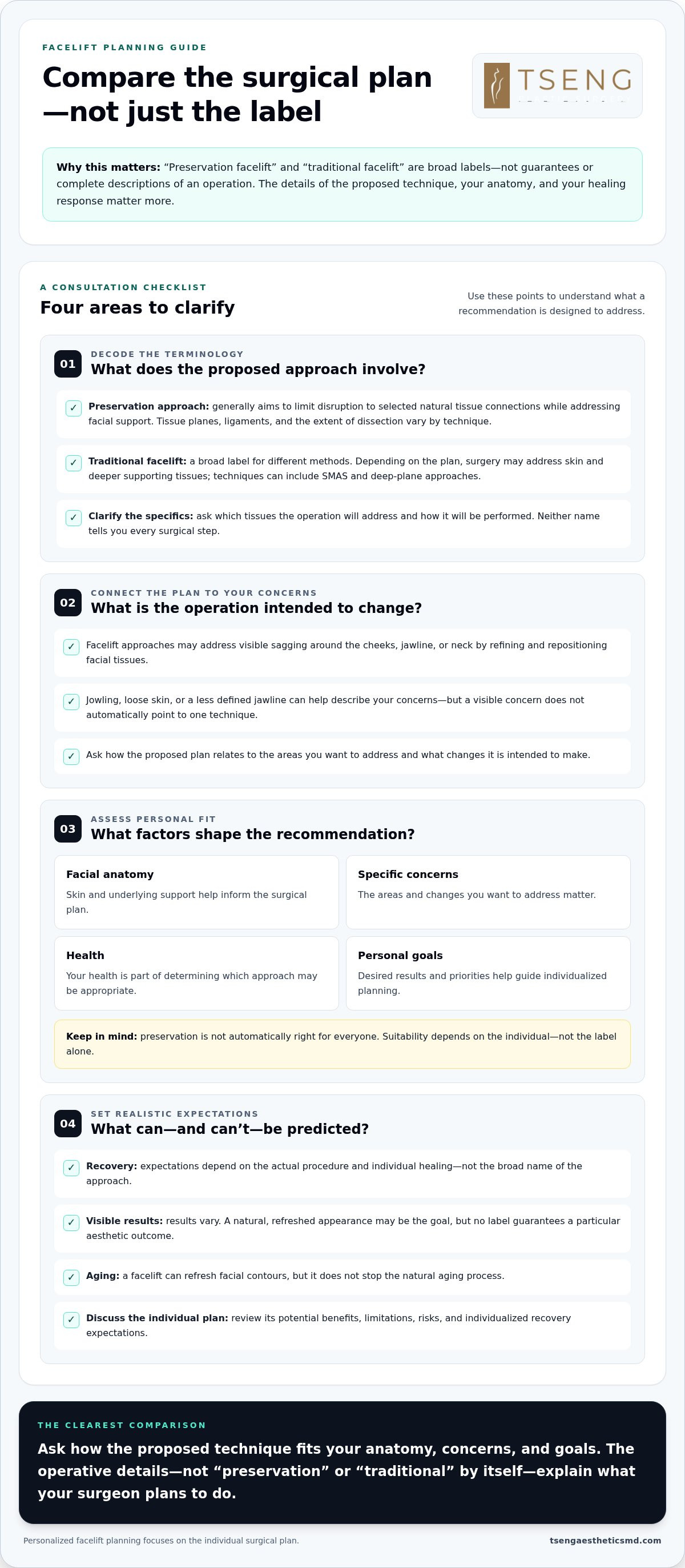
Questions to Ask Before Choosing a Facelift Approach
A thoughtful consultation should clarify more than whether a procedure is called “preservation” or “traditional.” Ask how the recommendation relates to your facial concerns, what the operation involves, and what it can and can’t accomplish. Informed consent means understanding the proposed treatment, alternatives, material risks, and realistic expectations before deciding.
What should the surgeon explain about the proposed technique?
Use these questions to make the conversation specific to your anatomy and goals:
- Diagnosis: Which features or areas are contributing to the concerns I’ve described?
- Technique: What will the operation involve, and why do you recommend this approach for me?
- Treatment area: Which parts of my face or neck are included, and what is the procedure not intended to change?
- Alternatives: What other approaches might be considered, and why is this plan preferable for my situation?
- Benefits and limits: What changes are reasonable to expect, and what concerns may remain?
The answers should explain the reasoning behind the surgical plan, not rely on a technique name to speak for itself. For additional background on facial rejuvenation, see The Modern Facelift: A Comprehensive Guide to Natural Facial Rejuvenation.
How can you discuss safety, recovery, and expectations?
Ask about your individual risk factors, recovery planning, follow-up, and whom to contact if you have concerns or symptoms that may require medical attention. Your surgeon can explain how recovery may vary based on the procedure and your health, rather than promising a specific timeline or experience.
- What risks are relevant to my health history and proposed procedure?
- What should I plan for during recovery, and what support might I need?
- What follow-up care is part of the plan, and what signs should prompt me to seek medical guidance?
- How might the result change over time, and what limitations should I understand?
If you’re weighing surgery against nonsurgical options, Surgical vs. Non-Surgical Facelift: The Comprehensive 2026 Guide to Facial Rejuvenation offers another perspective to discuss. Clear answers can help you compare preservation facelift vs traditional facelift in terms that matter to you: the actual technique, its intended benefits, its limitations, and the recovery involved.
For an individualized discussion of facelift options and your goals, schedule a facelift consultation.
How Tseng Plastic Surgery Personalizes Facelift Planning
Choosing between a preservation and traditional facelift begins with understanding the person behind the procedure. At Tseng Plastic Surgery, Dr. Mark H. Tseng considers each patient’s facial concerns and goals when developing a surgical plan. The practice offers traditional facelift surgery and a minimally invasive preservation face and neck lift as options for that discussion.
How does individualized planning shape the recommendation?
A useful consultation gives you space to explain what you’d like to address, what a natural-looking result means to you, and what questions or concerns you have about surgery. Your facial assessment, priorities, and health history help inform the proposed plan. Dr. Tseng has been in practice for more than 20 years, bringing experience to a process centered on personalized care and balanced results. Experience doesn’t guarantee a particular outcome, so the recommendation should also include realistic expectations about potential benefits and limitations.
It may help to bring a short list of questions:
- Which of my concerns would the proposed procedure address?
- Why does this approach fit my anatomy and goals?
- What risks, recovery considerations, and limitations should I understand?
- What changes are realistic, and what might remain unchanged?
What is a useful next step if you are comparing techniques?
Use the consultation to understand the plan rather than choosing based on a label alone. Ask the surgeon to explain the proposed technique in clear terms, including what it’s intended to change and how recovery may vary for you. You can also discuss whether a traditional facelift or minimally invasive preservation face and neck lift better aligns with the concerns you’ve raised. The goal is to make an informed decision at your own pace.
In the preservation facelift vs traditional facelift comparison, the right questions connect surgical details to your priorities. A consultation is an opportunity to review your options, discuss your expectations, and decide how you’d like to proceed without committing to a particular approach in advance.
To discuss your goals and facelift options with Dr. Tseng, schedule a facelift consultation.
Make Your Next Step an Informed One
The most useful takeaway from comparing preservation facelift vs traditional facelift is that the technique name alone can’t determine what’s right for you. Surgeons may use these terms differently, and the details of the proposed operation matter. Your facial anatomy, concerns, health history, and goals all help shape the recommendation.
A consultation gives you the opportunity to understand how a plan addresses your priorities, what changes may be realistic, and what risks and recovery considerations to discuss. Dr. Mark H. Tseng has been in practice for over 20 years. At Tseng Plastic Surgery, traditional facelift surgery and minimally invasive preservation face and neck lifts are considered as options within individualized planning focused on natural-looking, balanced results.
Bring your questions and take the time you need to understand your choices. Schedule a consultation to discuss your facelift options and explore a plan tailored to your goals. An informed conversation is a thoughtful first step toward deciding what feels right for you.
Frequently Asked Questions
What is the difference between a preservation facelift and a traditional facelift?
A preservation facelift generally describes an approach that aims to preserve selected natural tissue connections while treating facial support, but it isn’t one standardized operation. “Traditional facelift” is a broad term that can refer to different techniques. In the preservation facelift vs traditional facelift comparison, the meaningful distinction depends on the surgeon’s specific plan and tissue handling. Labels alone don’t determine candidacy or results. An individualized assessment helps clarify what each approach would involve for you.
Is a preservation facelift less invasive than a traditional facelift?
Not necessarily based on the name alone. The word “preservation” doesn’t establish how extensive an operation is, which areas it treats, or how it compares with a particular traditional facelift technique. The planned procedure and your individual circumstances matter. Ask your surgeon to describe the steps, treatment areas, and rationale for the recommendation, and to explain potential benefits, limitations, and risks without relying on broad claims about safety or recovery.
Can a preservation facelift look more natural than a traditional facelift?
Natural-looking results are a surgical goal, not a guarantee attached to a technique name. The appearance of a result depends on your anatomy, the surgical plan, how the procedure is performed, and how you heal. Tell your surgeon what “natural” means to you, such as a refreshed appearance that preserves your facial character. Discuss realistic expectations, possible limitations, and relevant examples during consultation, while remembering that another person’s outcome can’t predict yours.
Who is a good candidate for a preservation facelift?
There isn’t a reliable online checklist for candidacy. A surgeon considers your facial anatomy and concerns, health history, goals, and examination findings before discussing whether a preservation approach fits your plan. It may be considered when its approach aligns with your needs, while another facelift method may be recommended after assessment. Share your priorities and relevant health information openly so the discussion can address suitability, potential benefits, risks, and alternatives.
Does a preservation facelift have a shorter recovery than a traditional facelift?
Recovery can’t be reliably predicted from the label alone. It may depend on the operation performed, areas treated, your individual healing response, and how closely you follow postoperative instructions. Ask your surgeon what recovery may involve for the specific plan, including activity restrictions, follow-up care, and factors in your personal circumstances that could affect healing. A general comparison between labels can’t promise a faster or easier recovery for an individual patient.
How do I choose between a preservation facelift and a traditional facelift?
Compare the proposed surgical plan, the concerns it’s intended to address, its limitations and risks, and the recovery expectations for your circumstances. Ask why the surgeon recommends that approach for your anatomy and goals, and what alternatives may be appropriate. The preservation facelift vs traditional facelift decision is best informed by an individualized examination and a clear discussion of the options, rather than a general online ranking or assumptions based on procedure names.

