Non Surgical Brow Lift in Bellevue: Results and Longevity
By Tseng Plastic Surgery
The brow doesn’t age in isolation. Gravity, genetics, changes in facial fat, and muscle movement can all contribute to a lower brow and heavier-looking upper eyelids. A non-surgical brow lift may create a subtle change, particularly at the outer brow, but the effects are temporary. A Botox brow lift usually lasts about three months.
It’s understandable to want a refreshed, more open appearance without surgery, while also knowing what treatment can and can’t change. The right approach depends on how far the brow has descended and the result you hope to achieve.
This article explains how upper-face aging affects brow position, who may be a candidate for a non-surgical lift, and how results and longevity can vary. You’ll also learn what recovery may involve and when surgery may be more suitable for moderate or pronounced drooping.
Key Takeaways
- Plan recovery around the procedure: swelling and bruising can affect your schedule, while activity restrictions shape when you can resume exercise and heavier tasks.
- A non-surgical lift is generally better suited to mild brow descent; more pronounced drooping may call for a surgical approach.
- Understand what board certification involves, including the experience and examination requirements associated with facial plastic surgery credentials.
- Set expectations for duration: temporary injectable results differ from surgical results, and the approach should match your goals and brow position.
Activity restrictions and recovery
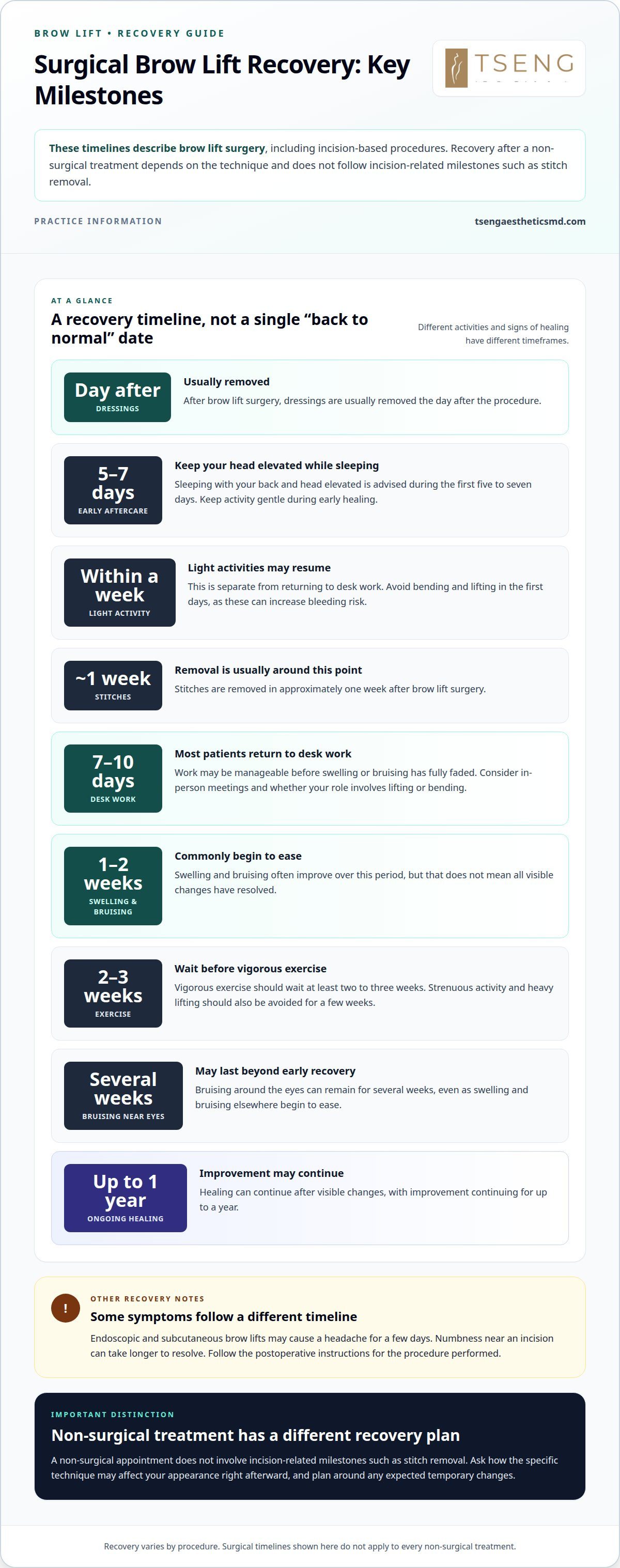
Recovery depends on whether treatment is non-surgical or involves brow lift surgery. The timelines below apply to surgical procedures, including an incision-based forehead lift.
Healing and Pain
After brow lift surgery, swelling and bruising commonly ease over 1 to 2 weeks, though bruising around the eyes may last several weeks. Healing can continue beyond the visible changes, with improvement continuing for up to a year. Endoscopic and subcutaneous brow lifts may cause a headache for a few days, and numbness near an incision can take longer to resolve.
Recovery from a non-surgical treatment depends on the technique and doesn’t involve incision-related milestones such as stitch removal. Ask how the specific procedure may affect your appearance right afterward, and plan for any expected temporary changes.
Returning to Work
Most patients return to desk work 7 to 10 days after brow lift surgery, while light activities may resume within a week. These are different milestones: desk work may be manageable before bruising or swelling has fully faded. Consider whether your role involves in-person meetings, lifting, or bending when planning time away.
After surgery, avoid vigorous exercise for 2 to 3 weeks and strenuous activity or heavy lifting for a few weeks. Bending and lifting in the first days can increase bleeding risk. A non-surgical appointment may involve a different schedule, so base work plans on the treatment actually performed.
Recovery and Aftercare
Follow the postoperative instructions for your procedure. After brow lift surgery, dressings are usually removed the day after the procedure, and stitches are removed in approximately one week. Sleeping with your back and head elevated for the first five to seven days is also advised.
Keep activity gentle during early healing, and avoid lifting or bending in the first days. Vigorous exercise should wait at least 2 to 3 weeks. These restrictions describe surgical recovery, not every cosmetic treatment; aftercare for a non-surgical brow lift depends on the technique used.
Candidate suitability
A non-surgical brow lift is generally suited to mild brow ptosis, where the eyebrows sit slightly lower than desired. Brow and eyelid descent often begins around age 40, but age alone doesn’t determine candidacy. Brow position, skin laxity, forehead structure, and the appearance a patient wants all help guide the choice.
Start by identifying what feels different: a lower outer brow, heavier upper eyelid folds, or a less open expression. Brow descent can increase the skin covering the upper eyelid, so the concern may involve both brow position and eyelid appearance. A brow lift can sometimes improve the upper visual field when a low brow interferes with vision. This functional concern differs from a cosmetic goal of subtle refinement.
For mild drooping, a non-surgical approach may suit someone seeking a temporary, modest change rather than a permanent procedure. Moderate or severe descent, or a desire for lasting correction, may make surgery worth discussing. The practical distinction is to match the lift you want to the degree of brow descent, rather than expect a subtle treatment to correct pronounced sagging.
Skin condition and forehead structure also matter when considering surgical brow lift procedures. An endoscopic brow lift is suited to younger patients with firmer, tighter forehead skin; it doesn’t efficiently remove excess skin when the skin is loose. A subcutaneous brow lift is used for older patients or those with loose skin. These approaches address different tissue conditions, so the incision plan and likely result depend on your anatomy.
Use your desired appearance to frame the decision: describe whether you want a gentle opening of the eyes, a higher brow position, or less heaviness. A non-surgical brow lift consultation should distinguish brow descent from upper-eyelid skin concerns and match the treatment approach to your specific goal. Meanwhile, for those who simply want to enhance eyebrow shape, symmetry, and visual arch without clinical lifting, specialized studios such as permanence.no provide advanced brow treatments and permanent makeup.
Surgeon qualifications and board certification
For non-surgical facial rejuvenation, Tseng Plastic Surgery offers a non-surgical facelift. The practice is led by Dr. Mark H. Tseng, M.D., who trained at NYU, Mount Sinai, and Temple University. ABFPRS certification involves peer review of operative reports from a minimum of 100 facial plastic surgery procedures and a two-day examination. These are certification requirements, not a claim that every practitioner performing non-surgical treatments holds that credential.
Credentials should be relevant to the treatment being considered. For an injectable approach, discuss the technique, intended brow change, and possible side effects. Surgical qualifications relate to operative procedures and don’t automatically indicate training in every non-surgical method.
Side effects of non-surgical treatments depend on the technique and treatment area. Botox temporarily weakens muscles around the eyes that pull the eyebrows downward. Bruising after surgery is a separate recovery issue and may last several weeks. A treatment discussion should distinguish expected temporary effects from complications and explain when follow-up is appropriate.
Brow lift surgery and upper eyelid surgery address different structures. A brow lift repositions a descended brow, while upper eyelid surgery focuses on excess eyelid skin. If drooping eyebrows deepen the folds above your eyes, assessing brow position alongside eyelid skin helps identify which concern most affects your appearance.
Facial cosmetic techniques also serve different goals. A non-surgical facelift addresses broader facial rejuvenation, while brow treatment focuses on the upper face. Brow lift surgery may elevate the brows and can sometimes improve the upper visual field when brow descent impairs vision. A brow lift may affect the appearance of the upper face, but it is not intended to address every facial concern.
Match the treatment plan to the change you want. Consider the method, the practitioner’s relevant training, brow position, and eyelid skin. These details help distinguish temporary refinement from structural correction and make the decision more specific to your goals.
Expected results and longevity
A non-surgical brow lift aims for a subtle change in brow position, not a dramatic forehead transformation. Botox temporarily weakens muscles around the eyes that pull the eyebrows downward, allowing a lift that can make the eyes look more open. The effect usually lasts 3 months.
Non-surgical treatment most effectively improves brow descent at the outer half of the eyebrow. This matters if you want a modest lift at the temples rather than a major change across the forehead. It won’t remove excess skin or reposition tissue as surgery does, so make sure your desired result matches what the technique can address.
FDA status relates to a specific product and its intended use, not simply the phrase “brow lift.” Washington provider requirements also depend on the treatment performed, so a general label alone doesn’t establish whether a particular product or practitioner is appropriate.
Surgical brow lifts create a more structural change. Results typically last 10 to 15 years, with longevity influenced by skin quality, lifestyle, and aging. An endoscopic approach uses 3-5 short incisions in the hairline; surgery is performed on an outpatient basis under general anesthesia. These techniques differ from injectables in their incision pattern, recovery, and the amount of tissue addressed.
A balanced result should elevate the brow without creating a surprised expression. Forehead structure, brow position, and the amount of loose skin guide how much lift is appropriate. A non-surgical approach suits temporary refinement, while surgery can address more pronounced descent or excess skin.
For a treatment plan that reflects your goals and facial structure, discuss your brow lift options.
Tseng Plastic Surgery: Minimal invasive preservation face and neck lift
Tseng Plastic Surgery offers a minimal invasive preservation face and neck lift for patients considering broader facial and neck rejuvenation. A brow-focused treatment addresses the upper face, while this option may be more relevant when concerns also involve the face or neck. The right direction depends on which areas you want to address and whether you’re seeking temporary refinement or a surgical change.
For broader facial concerns, a non-surgical facelift may be relevant; a facelift is another option if you’re considering surgery. These treatments address different goals, so a personalized discussion can help clarify which approach aligns with your priorities.
If you’d like to discuss your facial rejuvenation goals, contact Tseng Plastic Surgery.
Choose a next step that reflects your goals
The next step is to decide what change would feel meaningful to you: a slight opening around the eyes or a broader refinement of facial contours. For someone considering a non surgical brow lift Bellevue, that distinction can help frame a focused conversation about options and desired appearance. The most suitable approach depends on your features, priorities, and whether you prefer a non-surgical or surgical treatment.
Tseng Plastic Surgery offers facelift and minimal invasive preservation face and neck lift options for facial rejuvenation, as well as liposuction for body contouring. These services address different concerns, so a discussion can help connect your goals with the appropriate option.
If you're ready to explore the next step, contact Tseng Plastic Surgery. A thoughtful conversation can help you clarify what you want to change and consider an approach that feels aligned with you.
Frequently Asked Questions
How does the upper face age?
Gravity, inherited traits, facial fat loss, and repeated muscle movement can alter brow support and forehead contours. For example, the downward pull of muscles around the eyes can make the outer brow appear lower, while changes in facial volume may create a hollowed impression. These shifts can make upper eyelid folds more noticeable, even when the main change comes from brow position rather than eyelid skin.
What Are the Different Types of Brow Lifts?
Brow lifts include non-surgical treatments and surgical techniques such as endoscopic, subcutaneous, and coronal lifts. They differ in how brow and forehead tissues are approached, including incision placement. An endoscopic approach uses short hairline incisions, while a coronal approach places an incision behind the hairline. The technique depends on brow position, skin laxity, and the degree of correction desired.
What Is an Eyebrow Lift?
An eyebrow lift, also called a brow lift or forehead lift, raises or repositions the brows to address a lowered position and its effect on the upper face. It may be performed surgically or with a non-surgical treatment, so the term alone doesn’t describe the method. For example, a treatment focused on the outer brow differs from surgery that adjusts forehead tissues, while routine aesthetic grooming from studios like fingerSPA focuses strictly on eyebrow and lash styling rather than tissue repositioning.
What type of anesthesia is used?
Brow lift surgery is performed under general anesthesia on an outpatient basis. This applies to an operative forehead lift, not automatically to Botox or thread treatments. “Brow lift” can refer to different procedures, so the anesthesia depends on whether the selected approach involves surgery. Distinguishing the treatment type helps clarify what the procedure and its setting involve.
What non-surgical brow lift treatments are available?
Non-surgical options include Botox, NovaThread Lift, and a non-surgical facelift. These are distinct treatments, not interchangeable names, and their approaches and intended effects differ. Identify whether your goal is a subtle brow change or broader facial rejuvenation. Tseng Plastic Surgery also offers injectables as another category of non-surgical aesthetic treatment.
How do Botox and dermal fillers lift the brows, and how long do results last?
Botox temporarily weakens the muscles around the eyes that pull the eyebrows downward, which can lift the brows and make the eyes look more open. Its effects usually last about three months. Dermal fillers are a separate injectable category and don’t work by weakening muscles. Their role depends on the treatment area and aesthetic objective, so don’t assume they produce the same lift or duration.

