Male Plastic Surgery: A Thoughtful Guide to Options and Results
By Tseng Plastic Surgery
What if a natural-looking result begins by setting aside the idea that men need a separate formula for plastic surgery? Male plastic surgery is best considered in light of your anatomy, concerns, and goals, not a template for changing how you look. It’s understandable to want to know which options may address a particular concern while avoiding a result that feels obvious or unlike you.
This guide covers common surgical and non-surgical options, how planning can differ from person to person, and what to ask during a consultation. You’ll also learn how to discuss aesthetic preferences, candidacy, and recovery considerations so you can weigh options carefully and without pressure.
From facial rejuvenation and body contouring to hair restoration and injectables, a useful conversation starts with what you hope to address. A thoughtful consultation connects your goals with relevant options, explains their considerations, and recognizes that treatment may not be right for everyone. The aim is an informed next step guided by your priorities.
Key Takeaways
- Male plastic surgery planning should reflect your anatomy and personal goals, not assumptions about how men should look.
- Connect your concern with relevant procedure categories, then clarify what each option can and cannot address.
- Compare surgical and non-surgical approaches by purpose, invasiveness, and recovery considerations. They aren’t interchangeable.
- Prepare for a more informed consultation by noting your goals, health history, medications, prior procedures, and questions.
- Explore whether options such as facial rejuvenation, liposuction, hair restoration, and injectables may fit your needs with individualized guidance.
What Does Male Plastic Surgery Include and What Are Men Often Seeking?
Male plastic surgery is a broad term for surgical and non-surgical aesthetic procedures that address appearance-related concerns. Some people explore facial rejuvenation as signs of aging become more noticeable. Others want to discuss localized body contour, changes in hair, or a feature they have long wanted to address. Goals are personal. Not every man wants a sharper jawline, stronger features, or a more masculine appearance.
Aesthetic treatment can address a specific appearance concern, but it can’t guarantee greater confidence or a change in life circumstances. Plastic surgery includes both reconstructive and cosmetic work, as outlined in this overview of Plastic surgery. This article focuses on aesthetic options. A clinician should explain the purpose, possible benefits, and limitations of any treatment you are considering.
Which concerns may lead men to explore aesthetic procedures?
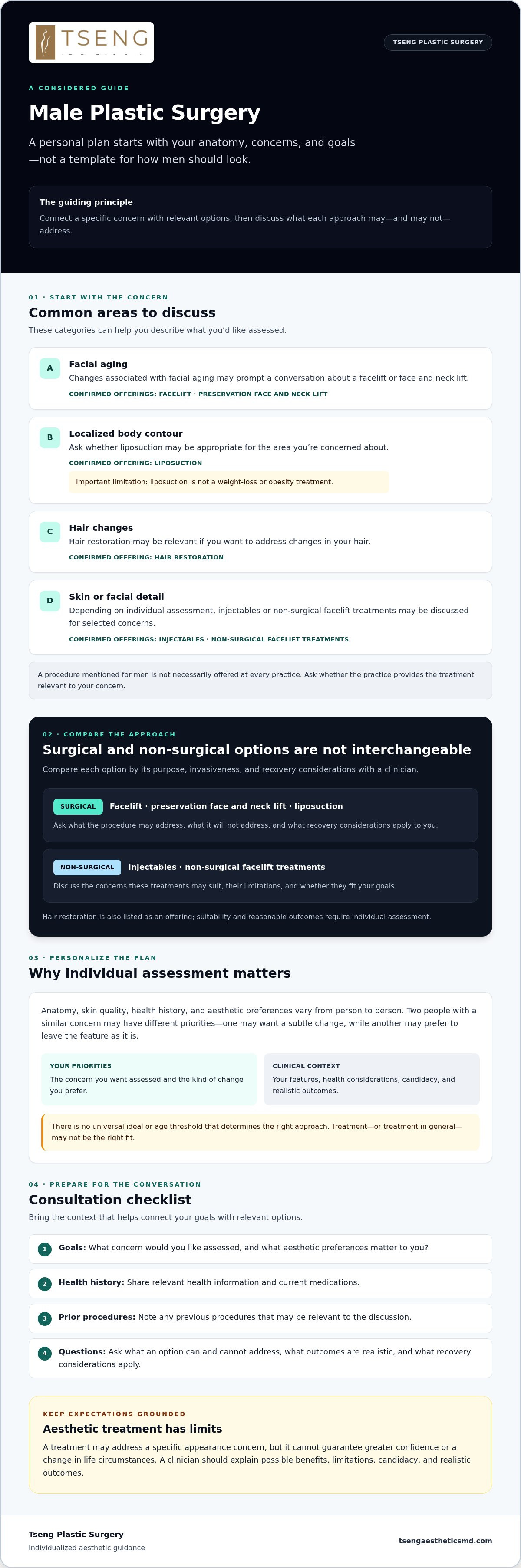
Concerns often fall into several broad areas. Use these categories to describe what you would like assessed, but remember that not every procedure is available at every practice.
- Facial appearance: Changes associated with facial aging may prompt a conversation about facelift or face and neck lift options.
- Body contour: If you are concerned about a localized area, ask whether liposuction may be appropriate. It is not a weight-loss or obesity treatment.
- Hair changes: Hair restoration may be relevant if you are seeking to address changes in your hair.
- Skin or facial detail: Injectables or non-surgical facelift treatments may be discussed for selected concerns, depending on an individual assessment.
Tseng Plastic Surgery lists these options among its offerings, but that does not mean every procedure commonly discussed for men is available there. Ask directly whether the practice provides a treatment that relates to your concern.
Why is individualized planning more useful than a “male” template?
Anatomy, skin quality, health history, and aesthetic preferences vary from person to person. Two men with a similar concern may have different priorities. One may want a subtle change, while another may prefer to leave the feature as it is. There is no universal ideal or age threshold that determines which approach is right.
A clinician should assess candidacy and discuss realistic outcomes, including what a procedure may not change. A useful consultation connects your stated goal with your features and health considerations rather than presuming a preferred masculine look. It should also allow for the possibility that a particular treatment, or treatment in general, is not the right fit.
How Male Plastic Surgery Options Differ by Concern and Treatment Approach
Procedure choice depends on anatomy, goals, health, and clinical assessment, not gender alone. Some options involve surgery; others are non-surgical and have different purposes and limitations. The American Society of Plastic Surgeons outlines common plastic surgery procedures for men, including procedures that are not offered by every practice. The categories below distinguish Tseng Plastic Surgery’s confirmed services from general examples.
| Concern | Possible approach | Questions to ask | Key limitation |
|---|---|---|---|
| Facial aging | Surgical options include facelift or preservation face and neck lift, both confirmed offerings. Non-surgical options include non-surgical facelift treatments or injectables, also confirmed offerings. | Which features can this approach address, and what changes are realistic for me? | Surgical and non-surgical treatments are not interchangeable. They differ in approach and potential results. |
| Localized body contour | Liposuction is a confirmed surgical offering. Other procedures sometimes discussed for men, such as gynecomastia surgery, are general examples and are not confirmed practice offerings. | Is my concern appropriate for liposuction, and what will it not address? | Liposuction is not a substitute for weight management or treatment for obesity. |
| Hair changes | Hair restoration is a confirmed offering. | What approach may suit my situation, and what outcomes are reasonable to discuss? | Suitability and results require individual assessment. Don’t assume a specific outcome or permanence. |
| Skin or facial detail | Injectables are a confirmed non-surgical offering. Eyelid surgery is a general example, not a confirmed practice service. | What concern would treatment target, and what are its limitations? | Different treatments address different concerns and may not produce the same degree or type of change. |
Which facial options may be discussed for aging concerns?
A consultation may compare the practice’s facelift and preservation face and neck lift options with its non-surgical facelift treatments or injectables. Each approach has distinct characteristics. Ask what it is intended to address, what trade-offs apply, and how the plan would account for your features. For more context, read this modern facelift guide.
When might body contouring, hair restoration, or injectables come up?
Liposuction may be discussed for selected contour concerns, while hair restoration or injectables may relate to other goals. None is automatically appropriate for every person, and you should not assume a particular recovery experience or result without procedure-specific guidance. Talking through your priorities can help clarify which available options merit further assessment. For individualized guidance, explore aesthetic treatment options.
Surgery or Non-Surgical Treatment: How to Compare the Trade-Offs
Choosing an option isn’t simply a matter of selecting the least invasive treatment. A non-surgical approach may suit some goals, while another concern may call for a different discussion. Neither category is automatically better. Surgical and non-surgical treatments differ in purpose, how they’re performed, and recovery considerations. Don’t assume a non-surgical treatment will produce changes equivalent to surgery.
When considering male plastic surgery, compare options based on the concern you want to address, the degree of change you are seeking, and your health circumstances. The American Society of Plastic Surgeons’ Plastic surgery procedural statistics offer broader context about procedure trends, but population-level information can’t determine which treatment is appropriate for an individual.
What questions help clarify surgical versus non-surgical options?
Ask the clinician to explain what each option is intended to address, what it can’t reasonably change, and why it may or may not fit your goals. A clear comparison should cover alternatives, treatment-specific risks, recovery considerations, and any maintenance that may be involved. If an answer depends on the procedure or your circumstances, ask for a specific explanation instead of relying on general examples.
Your preferences matter, too. Describe how much change you hope to see and what would feel natural to you. Consider asking:
- What are the likely benefits and limitations of each suitable option?
- What risks and recovery considerations apply in my case?
- Could the outcome require ongoing maintenance, and what uncertainties should I understand?
- What might happen if I choose to wait or not proceed?
How can a reader assess expectations and potential limitations?
Discuss your health history and any factors the clinician considers relevant to treatment-specific risks and candidacy. Benefits, risks, limitations, durability, and recovery can vary by procedure and person. General timelines or examples are not a promise of your experience. Another patient’s outcome cannot guarantee your result or predict your recovery precisely.
Facial treatment is one area where it can be useful to explore the differences between approaches. A surgical and non-surgical facelift comparison can help you prepare questions, then a clinician can discuss how your anatomy, goals, and health inform the conversation. A considered decision should leave you with a clear understanding of the trade-offs, not pressure to choose the most extensive or least invasive option.
How to Prepare for a Male Plastic Surgery Consultation
A well-prepared consultation gives you room to explain what you hope to change and hear an informed assessment. Treat it as a discussion, not a commitment. A clear sequence can help you make the most of the visit and assess whether a recommendation reflects your priorities.
What should patients bring and discuss at the first visit?
Before the appointment, write down your main concern, what you would like to be different, and what you do not want to change. Be specific. For example, you might want to look less tired while preserving features that feel distinctive to you. If you bring reference images, use them to describe details you like, not as a promise or exact template for your result.
Prepare a concise account of relevant health information, including:
- Medical history, current medications, supplements, and allergies
- Previous procedures or treatments and how you responded
- Health habits the clinician should know about, such as tobacco use
- Your questions about clinician training and experience with the procedure being discussed
Ask who would perform the procedure, where it would take place, what anesthesia may be involved, and how risks and follow-up are handled. You can verify credentials through appropriate official sources. Don’t rely on a title or marketing statement alone. The clinician may recommend a different option, suggest taking more time, or determine that no procedure is appropriate.
How can patients evaluate whether recommendations feel appropriate?
Before deciding, make sure you understand the expected benefits and limitations, relevant risks, alternatives, recovery considerations, and follow-up plan. Ask how your health and individual circumstances affect the recommendation, and request clarification if an answer feels vague. You should have time to consider the information without pressure.
Be cautious about guaranteed outcomes or recommendations that do not address your questions. A responsible conversation should leave room for uncertainty and for you to decide whether the proposed change fits your preferences. If you’re unsure, pause and seek clarification before moving forward.
Before consenting, understand what is proposed, why it may suit you, its risks and alternatives, what recovery and follow-up involve, and what results cannot be promised.
For a personalized discussion of available options, you can request guidance on your aesthetic goals from Tseng Plastic Surgery.
Explore Personalized Male Plastic Surgery Options with Tseng Plastic Surgery
Exploring male plastic surgery doesn’t mean you need to choose a procedure in advance. Tseng Plastic Surgery is a physician-owned aesthetic practice led by Dr. Mark H. Tseng, who has been in practice for over 20 years. Its offerings include surgical and non-surgical options, and the practice describes its approach as personalized, with a focus on natural-looking, balanced results.
How does a personalized approach support natural-looking goals?
A considered plan starts by listening to what you want addressed, what you hope to preserve, and how much change feels right to you. Rather than applying a fixed idea of how men should look, the clinician can discuss whether a relevant option aligns with your goals, anatomy, health, and clinical evaluation. The practice’s stated focus on balance can inform that conversation, but no result should be assumed or guaranteed.
Depending on the concern, options offered by the practice include:
- Facial rejuvenation: Facelift and preservation face and neck lift procedures
- Body contour: Liposuction
- Hair changes: Hair restoration
- Non-surgical aesthetic care: Injectables
These are distinct services, not a single treatment plan or a recommendation for every patient. A clinician can explain which options, if any, are relevant and discuss alternatives when a requested treatment doesn’t fit your needs.
What is a sensible next step if you are considering treatment?
If you’re interested in learning more, bring your concerns and questions to a conversation with the practice. Discuss what you would like to change, what you would prefer to keep, and what uncertainties you want addressed. Ask how the clinician evaluates suitability and what alternatives may be appropriate. It’s reasonable to take time to consider the information before making a decision.
A consultation is an opportunity to explore, not an obligation to proceed. Treatment may not be suitable or necessary for everyone, and a recommendation should reflect your individual circumstances rather than assumptions based on gender. If you’d like to discuss your goals and the available options, Discuss your aesthetic goals with Tseng Plastic Surgery.
Take a Thoughtful Next Step Toward Your Goals
The right approach to male plastic surgery starts with your priorities, not a preset idea of how you should look. A consultation can help clarify which options may suit your concerns, what their limitations are, and whether proceeding makes sense for you. You’re entitled to take time, ask questions, and decide without pressure.
At Tseng Plastic Surgery, Dr. Mark H. Tseng brings over 20 years of practice experience to a setting offering both surgical and non-surgical aesthetic treatments. The practice emphasizes personalized care and natural-looking, balanced results, with recommendations shaped by each person’s goals and clinical evaluation.
If you’re ready to explore possibilities, discuss your aesthetic goals with Tseng Plastic Surgery. A thoughtful conversation can be a useful first step, whether you’re considering treatment or simply seeking clearer information. Your next decision can be informed, individual, and entirely your own.
Frequently Asked Questions
What is male plastic surgery?
Male plastic surgery is a broad term for surgical and non-surgical aesthetic procedures men may consider to address personal appearance concerns. Goals can include facial aging, body contour, or hair changes, but there’s no single preferred look or treatment plan for men. A clinician should assess individual anatomy, health, and priorities, then explain suitable options and realistic limitations. Treatment may address appearance, but it can’t guarantee changes in confidence or life circumstances.
What plastic surgery procedures are common for men?
Commonly discussed procedures include liposuction, eyelid surgery, rhinoplasty, and surgery for enlarged male breasts. Hair restoration and facial rejuvenation treatments may also interest some men. These are general examples, not a list of services available at every practice. Tseng Plastic Surgery’s confirmed offerings include facelift, preservation face and neck lift, liposuction, hair restoration, and injectables. Ask a practice directly which procedures it provides and whether a particular option may suit your concern.
Is plastic surgery different for men and women?
The principles of careful assessment and individualized planning apply to everyone, but anatomy and aesthetic priorities differ from person to person. A clinician may account for features such as skin quality, facial structure, and the degree of change you want. Gender alone shouldn’t dictate a treatment plan, and there’s no universal ideal for masculine or feminine appearance. Discuss what you want to address and what you would prefer to preserve.
Can men get a facelift and still look natural?
Men can explore facelift options with the goal of a balanced, natural-looking appearance, but no result can be guaranteed. The approach and likely outcome depend on individual features, health, and clinical assessment. In consultation, explain what you hope to change and what you want to keep, then ask about potential benefits, limitations, and risks. Tseng Plastic Surgery offers facelift and preservation face and neck lift procedures; suitability requires an individual evaluation.
How do I choose a plastic surgeon for male plastic surgery?
Look for a qualified clinician whose training and experience are relevant to the procedure you’re considering, and verify credentials through appropriate official sources. Ask who will perform the procedure, where it will take place, what anesthesia may be involved, and how risks and follow-up are addressed. Review examples of relevant work if available, while remembering that another patient’s result can’t predict yours. Clear, patient-specific answers matter more than broad promises.
What should men expect during a plastic surgery consultation?
Expect to describe your concerns, desired changes, health history, medications, prior procedures, and relevant health habits. The clinician can assess your situation, explain options and limitations, and discuss risks, recovery considerations, and follow-up. Prepare questions about training, procedure-specific experience, facility, and anesthesia. A recommendation may involve another approach, taking more time, or no procedure. A consultation is a discussion, not a commitment to proceed.
Are non-surgical treatments an alternative to male plastic surgery?
Non-surgical treatments may be appropriate for some aesthetic concerns, but they aren’t interchangeable with surgery or guaranteed to create equivalent changes. Their purpose, limitations, risks, maintenance considerations, and expected results vary by treatment and individual. Tseng Plastic Surgery offers non-surgical facelift treatments and injectables alongside surgical options. Ask a clinician which approaches could address your specific concern, what each cannot change, and how your health affects suitability.

