Is Cosmetic Surgery Covered by Insurance? What Patients Should Know
By Tseng Plastic Surgery
What if the procedure you’re considering isn’t the deciding factor in whether insurance pays? If you’re asking, “is cosmetic surgery covered by insurance,” the answer usually depends less on the procedure’s name than on why it’s being performed, the medical evidence, and the terms of your specific plan. Aesthetic goals and insurance eligibility are separate questions, so don’t assume coverage.
It’s understandable to want a clear answer before weighing your options. Exclusions, documentation requirements, and prior authorization can all affect what you owe. Cosmetic surgery generally aims to change appearance, while reconstructive care is intended to restore function or address changes caused by illness, injury, or a congenital condition. Even when a procedure may have a medical purpose, the insurer’s definition of medical necessity and its coverage rules still apply.
This guide explains how insurers commonly distinguish cosmetic from reconstructive care, what documentation and prior authorization may involve, and how to verify benefits and potential out-of-pocket costs before deciding. It also covers questions to ask your insurer and care team, without treating an initial answer as a guarantee of payment.
Key Takeaways
- When asking “is cosmetic surgery covered by insurance,” consider the procedure’s purpose and your plan’s terms, not its name alone.
- Reconstructive care may be assessed differently when it addresses injury, functional impairment, or breast reconstruction after mastectomy.
- Symptoms or a clinician’s recommendation don’t guarantee payment. The insurer may require specific documentation and review.
- Before scheduling, review exclusions and medical-necessity criteria, then ask about the exact procedure, indication, and prior authorization.
- If an aesthetic procedure is excluded, separate the coverage decision from your personal goals and consider your next steps carefully.
Is Cosmetic Surgery Covered by Insurance? Start With the Purpose of Treatment
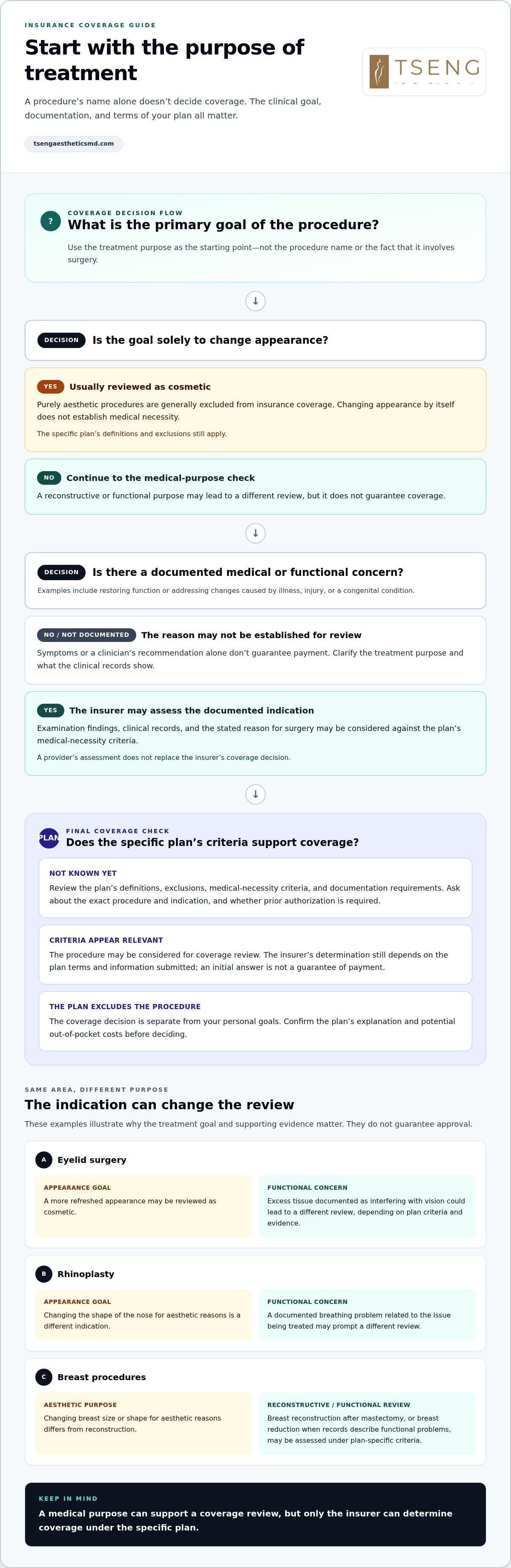
Purely aesthetic procedures are generally excluded from insurance coverage, but the answer to “is cosmetic surgery covered by insurance” depends on the purpose of treatment and the terms of the plan. Cosmetic surgery is primarily intended to change appearance rather than diagnose or treat a medical condition. Reconstructive or functional treatment, by contrast, may address a deformity, restore function, or respond to a health concern. That distinction can guide a coverage review, but it doesn’t determine the outcome.
The procedure’s name alone doesn’t determine how an insurer will assess it. A breast procedure intended solely to change size or shape has a different purpose from reconstruction after mastectomy, even if both involve surgery in the same area. The distinction between Reconstructive Surgery and cosmetic surgery helps explain why the clinical goal matters. An aesthetic benefit may accompany treatment, but appearance improvement by itself doesn’t establish medical necessity.
What insurers generally mean by cosmetic surgery
In a coverage review, the primary goal of treatment helps distinguish elective aesthetic enhancement from care intended to address a medical or functional concern. Insurers apply the definitions and exclusions in each plan, so general descriptions aren’t a substitute for reviewing your own policy. A clinician’s recommendation may explain why a procedure is appropriate, but it doesn’t automatically mean the plan considers it medically necessary or covered.
Cosmetic intent describes the goal of changing appearance; medical necessity depends on documented clinical need and the insurer’s criteria. When discussing a procedure with your care team, describe the concern you want addressed and whether it affects function, not only the appearance you hope to refine. The insurer makes its determination under the applicable plan, based on its terms and the information submitted.
Why the same procedure can receive different coverage decisions
Consider eyelid surgery. If the goal is a more refreshed appearance, the procedure may be reviewed as cosmetic. If excess eyelid tissue is documented as interfering with vision, the functional concern could lead to a different review, depending on the plan’s criteria and supporting evidence. Rhinoplasty can present a similar distinction: changing the shape of the nose for aesthetic reasons is different from addressing a documented breathing problem.
Symptoms alone don’t settle the question. An insurer may consider examination findings, clinical records, the stated indication for surgery, and the policy’s specific requirements. Plans can apply different criteria, and a provider’s assessment doesn’t replace the insurer’s coverage decision. Before making assumptions, clarify the treatment purpose and how it is documented. That helps distinguish whether the discussion is about aesthetic preference, functional care, or both, while leaving the final coverage determination to the plan.
Which Procedures May Be Considered Reconstructive or Medically Necessary?
Some procedures may be reviewed as reconstructive or medically necessary when their purpose is to restore function or address a documented medical concern. That doesn’t make a procedure category automatically eligible: coverage depends on the patient’s documented indication and the specific plan’s criteria. Examples from Medicare policies or another insurer’s guidance aren’t universal rules. Plans may define covered services, required evidence, and exclusions differently.
Reconstruction after illness, injury, or a congenital difference
Reconstructive surgery may restore form or function following disease, trauma, or a physical difference present from birth. Breast reconstruction after mastectomy is a distinct example, with coverage requirements that depend on the applicable plan and circumstances. It isn’t the same as breast augmentation performed to change breast size or shape for aesthetic reasons. The treatment area may be similar, but the clinical purpose differs. Kaiser Permanente’s explanation of cosmetic and reconstructive surgery offers examples of how treatment purpose can affect a coverage review.
Correction after an injury may also be reviewed if surgery is intended to address resulting damage or restore function. A congenital difference may prompt a similar assessment when it affects function or requires correction. These examples describe reasons an insurer might evaluate a procedure; they don’t establish that it will be approved or paid for.
Functional concerns that may prompt an insurance review
Documented functional impairment can make the reason for treatment more specific. For instance, eyelid surgery may be reviewed differently if examination findings show that excess tissue obstructs vision. Rhinoplasty may be considered for review if a documented breathing difficulty relates to the issue being treated. Breast reduction or removal of excess skin may also prompt review when records describe functional problems, but plan criteria vary. A preference for a different appearance is a different indication.
A medical evaluation helps distinguish a documented functional concern from a cosmetic preference or a self-reported symptom alone. The care team can record findings and explain the proposed treatment, while the insurer applies its own plan terms. Keep the indication precise: what function is affected, what does the examination show, and what treatment is being requested? Those details can matter more than the procedure’s familiar name.
Facial rejuvenation pursued for a refreshed appearance has a different goal from surgery intended to address a functional impairment. Tseng Plastic Surgery’s modern facelift guide discusses aesthetic facial rejuvenation, while insurance eligibility remains a separate question. If you’re considering a facelift for personal aesthetic goals, you can discuss your goals and treatment considerations without assuming that insurance will cover the procedure.
The Main Coverage Misconception: A Medical Benefit Does Not Guarantee Payment
A procedure may relate to a medical concern and still be excluded by a particular insurance policy. That distinction is central to understanding “is cosmetic surgery covered by insurance”: a possible medical indication may justify asking for a review, but it isn’t the same as confirmed coverage or payment. Symptoms and a clinician’s recommendation provide context; they don’t override plan terms or establish that every requirement has been met.
The table below illustrates why an insurer considers both the reason for treatment and the details of the plan.
| Treatment context | Possible medical indication | What still needs insurer review |
|---|---|---|
| Appearance-focused eyelid surgery | Excess tissue is documented as obstructing vision | Plan criteria, clinical evidence, exclusions, and authorization requirements |
| Rhinoplasty for aesthetic refinement | Documented breathing difficulty or correction after injury | Whether the plan covers the stated indication and proposed treatment |
| Breast procedure for a changed appearance | Reconstruction following mastectomy | Applicable benefits, eligibility, documentation, and plan conditions |
Possible coverage versus confirmed coverage
Possible coverage means there’s a reason to investigate benefits, not that the claim is approved. A plan may require specific documentation or prior authorization before a procedure. Prior authorization is a review before treatment, not a promise that every later claim will be paid. Even written authorization may be subject to conditions, such as the approved service, provider, or circumstances, and may not resolve every claim issue.
Ask the insurer for a plan-specific answer using the exact procedure and treatment indication. Record the representative’s name, date, reference number, and any written response. If authorization is issued, read its scope and conditions carefully, and ask what patient costs or other claim requirements may remain. Clear records help you understand the decision, but they don’t change the policy’s terms.
How Medicare guidance differs from private insurance
Medicare is a separate federal program with its own coverage rules and processes; its guidance shouldn’t be applied automatically to employer-sponsored or individual private plans. Medicare generally doesn’t cover cosmetic surgery. Its stated exceptions include certain procedures to repair damage after an accidental injury, improve the function of a malformed body part, or reconstruct a breast after mastectomy. The details depend on Medicare’s rules and the circumstances.
If you have Medicare, review the current official Medicare cosmetic surgery coverage information and confirm how the rules apply to your coverage. For private insurance, consult your plan documents and insurer. Separate eligibility for review, prior authorization, and the final payment decision. Each step answers a different question, so don’t treat one as a guarantee of the next.
How to Check Your Insurance Benefits Before Scheduling a Procedure
If you’re asking “is cosmetic surgery covered by insurance,” verify the exact service and reason for treatment under your current plan before scheduling. A procedure label alone may not match the insurer’s terminology or explain the clinical indication. Written benefit confirmation is more useful than assuming coverage from a procedure name. It can help you understand what the plan says, though it isn’t a guarantee of final payment.
Use this sequence to make your inquiry specific and keep a clear record of what you learn:
- Review your benefits. Find the current plan documents or member portal and note how surgical services, reconstructive care, and medically necessary treatment are described.
- Identify exclusions. Look for language about cosmetic procedures, the treatment you’re considering, and any limits or conditions that could apply.
- Ask about criteria. Use the insurer’s terminology. Ask whether the exact procedure is covered for the specific medical indication, and what clinical standards must be met.
- Gather records. Ask what clinician notes, photographs, test results, or referral documents the plan requires to assess the indication.
- Check authorization and costs. Confirm whether prior authorization is required, how to obtain the written response, and what patient responsibility may remain.
Questions to ask the insurer
Have your member identification and plan information available, then describe both the procedure and its intended purpose. Ask for an answer based on your current plan, not just a general explanation of the procedure. Record the date, the representative’s name, and any reference number, and request written information when available.
- Is this exact procedure covered for the medical indication my care team has documented?
- Which clinical records, photographs, tests, or referral documents are needed?
- Is prior authorization required, and what written response will show the decision and its conditions?
- Are the surgeon, facility, and anesthesia services in network for my plan?
- How do my deductible and coinsurance apply, and what patient responsibility could remain?
Documentation and financial planning
Clinical notes and relevant test results can help explain why treatment is being considered, but the insurer decides whether that documentation meets its criteria. Ask how the plan handles charges for the surgeon, facility, anesthesia, and follow-up care, including whether each is reviewed separately. Your personal responsibility depends on plan benefits and how claims are processed, so don’t rely on a verbal estimate as a final amount.
Keep copies of plan documents, authorization letters, and written communications together. If your goals are aesthetic, benefit verification and the decision about whether a procedure feels right for you are separate steps. You can discuss your aesthetic goals while continuing to confirm coverage directly with your insurer.
When Insurance Does Not Cover an Aesthetic Procedure: Make an Informed Next Move
An insurer’s decision doesn’t determine whether an aesthetic goal matters to you. If a procedure is excluded, you can still consider whether the change you’re seeking feels meaningful and fits your priorities. Coverage and personal choice are separate questions: confirming benefits helps clarify potential financial responsibility, while deciding on elective care calls for reflection about your goals, expectations, and readiness.
Name the purpose plainly. Are you seeking an aesthetic change, addressing a functional concern, or considering both? An elective procedure such as breast augmentation is distinct from breast reconstruction after mastectomy, even though both involve the breasts. Similarly, aesthetic facial rejuvenation has a different purpose from treatment intended to restore function. The facelift recovery guide offers context on recovery for an elective aesthetic procedure, while insurance eligibility remains a separate matter.
Questions to consider when planning elective aesthetic care
Before making a decision, take time to articulate what you hope will change and what a satisfying result would mean to you. A thoughtful conversation with your surgeon can help you understand suitable options, realistic expectations, recovery considerations, and relevant risks. It’s also an opportunity to discuss how the proposed approach relates to your individual features and whether it aligns with your goals.
- What personal concern or aesthetic goal is leading me to consider this procedure?
- Is my reason primarily aesthetic, functional, or a combination?
- What options may address my concern, and what outcomes are realistic?
- What risks, recovery considerations, and possible limitations should I understand?
- Have I verified insurance benefits separately from deciding whether I want the procedure?
These questions don’t require an immediate answer. Take time to weigh the information, review your insurer’s decision, and consider your next step without treating coverage as the measure of whether your goal is valid.
A personalized conversation about aesthetic goals
At Tseng Plastic Surgery, care is individualized, with attention to natural-looking, balanced results. Dr. Mark H. Tseng has been in practice for over 20 years, bringing experience to conversations about surgical and non-surgical aesthetic options. A consultation is an opportunity to share what you hope to achieve, discuss suitable approaches, and raise questions about expectations and risks. It doesn’t establish insurance eligibility or guarantee reimbursement; your insurer determines coverage under your plan.
If the procedure is elective, thoughtful planning can still help you make a considered, personal decision. Once you’ve reviewed your benefits and clarified your priorities, you’re welcome to schedule a consultation to discuss your aesthetic goals and explore care options at a pace that feels right for you.
Choose Your Next Step With Clarity
Insurance can shape the practical side of a procedure, but it doesn’t have to define what you value or decide. Once you have a clear response from your insurer, consider the personal question: does this change feel right for you, and are you comfortable with the expected benefits, risks, and recovery?
If you’re still asking “is cosmetic surgery covered by insurance,” keep the coverage conversation with your insurer and the aesthetic conversation focused on your individual goals. A thoughtful consultation can help you explore options, clarify expectations, and decide whether moving forward aligns with your priorities. A consultation isn’t a commitment; it can simply be a chance to ask questions and consider what feels appropriate.
Discuss your aesthetic goals with Tseng Plastic Surgery and take the next step at a pace that feels comfortable. With clear information and a personalized conversation, you can move forward with greater confidence in the choice that’s right for you.
Frequently Asked Questions
Is cosmetic surgery ever covered by insurance?
Purely aesthetic surgery is generally excluded, while reconstructive or function-focused treatment may qualify under some policies. If you’re asking “is cosmetic surgery covered by insurance,” the answer depends on your exact plan, the documented medical indication, and the records submitted for review. Even when a procedure appears medically relevant, the insurer makes the coverage decision under its rules. Confirm benefits and requirements directly with your plan before scheduling.
Can a cosmetic procedure be covered if it improves function?
It may be considered for coverage review if there’s a documented functional concern, but improved function doesn’t guarantee payment. For example, eyelid surgery might be assessed differently if clinical findings show vision is obstructed; rhinoplasty might receive review when records describe a breathing concern. The insurer may require specific examination findings or other evidence, and its policy criteria determine the outcome. Ask which documentation is needed for the exact procedure and indication.
Does insurance cover breast reduction?
Some insurance plans may consider breast reduction when specific medical criteria are documented, but coverage isn’t automatic. Requirements can differ, including the clinical information or other records the insurer expects before reviewing a request. Ask your plan for its breast-reduction policy, the criteria that apply to your circumstances, and whether prior authorization is required. Request the information in writing when possible, and clarify what the plan’s response does and doesn’t confirm.
Does Medicare cover cosmetic surgery?
Medicare generally excludes cosmetic surgery, though certain medically necessary or reconstructive situations may be treated differently under its rules. Examples can include care to repair damage after an accidental injury, improve the function of a malformed body part, or reconstruct a breast after mastectomy. These Medicare provisions aren’t universal rules for private insurance. If you have Medicare, consult current official Medicare coverage guidance and confirm how it applies to your specific situation.
What happens if my insurance denies coverage for cosmetic surgery?
Start by reading the denial notice to identify the stated reason, any appeal deadline, and the instructions for submitting additional information. Ask the insurer which policy criteria were applied and what records were reviewed or missing. You can discuss the clinical documentation and possible next steps with your care team and plan representatives. An appeal may provide another review, but it doesn’t guarantee that the original decision will change.
How do I know if my cosmetic surgery needs prior authorization?
Prior authorization requirements depend on your plan and the specific procedure. Before scheduling, ask the insurer whether authorization is required, who must submit the request, which records or forms are needed, and how you’ll receive the decision in writing. Confirm the procedure and medical indication being reviewed, then keep the response for your records. Authorization is an advance review, but it may not guarantee that the final claim will be paid.
Will insurance cover cosmetic surgery after weight loss?
Not automatically. A procedure to remove excess skin after weight loss may receive a different review if medical concerns are documented, but coverage varies by plan. The insurer may require clinical records and apply specific criteria to the requested treatment. Ask which policy applies and what evidence is needed before making assumptions about benefits. A goal focused on appearance alone shouldn’t be assumed to meet a plan’s coverage requirements.

