How to Reduce Scarring After Surgery: A Practical Guide
By Tseng Plastic Surgery
If you’re wondering how to reduce scarring after surgery, start by protecting the incision while it heals. The first priority is not a cream or home remedy. Applying products or massaging the area too soon can irritate healing skin, so the right timing matters as much as the treatment.
It’s understandable to worry that a scar will remain prominent, especially when advice about silicone, oils, and scar creams can conflict. Scars change over time, and their early appearance doesn’t necessarily show the final result. Your procedure, skin, and healing process all affect which care is appropriate.
This guide covers care at each stage, from following incision-care instructions to considering silicone after the wound has closed and protecting the area from sun exposure. You’ll also learn what to keep in mind about common remedies and when a change in healing deserves a conversation with your surgical team. Thoughtful care can support healing, but no routine can guarantee a scar-free result.
Key Takeaways
- Understand how collagen remodeling shapes a scar over time, and why early healing and scar maturation are different stages.
- Learn how to reduce scarring after surgery by matching care to the incision’s healing stage, rather than relying on product hype.
- Compare silicone, sun protection, and common home remedies so you can make informed choices with your surgical team’s guidance.
- Build a practical routine around incision protection, follow-up appointments, and asking before adding products or massage.
- Prepare for an individualized scar-care discussion by sharing your healing history and concerns before surgery.
How surgical scars form, and what you can realistically influence
A surgical scar is the visible result of the body repairing an incision. After the wound edges close, the body lays down collagen, a structural protein that helps strengthen the area. Over time, that collagen is reorganized and partly replaced in a gradual process called remodeling. Repaired tissue is not identical to the original skin, so a line may remain even after healing is complete. For a foundational overview of this process, see How Scars Form.
Healing and scar maturation are related but distinct. Healing refers to the incision closing and the tissue repairing itself. Maturation is the slower period when the scar may change in color, firmness, texture, and visibility. A scar can become softer or flatter as it matures, but this takes time, and the final appearance varies. Its early look is not necessarily its settled appearance.
Why scars look different from one person to another
The location and direction of an incision, along with movement or tension across healing skin, can influence how a scar looks. Surgical planning considers incision placement, while procedure-specific aftercare helps protect the incision during recovery. Your healing history is also useful context to share. A past raised scar does not predict exactly how every future incision will look, but it can help inform a discussion about your care.
Some raised scars are hypertrophic: they thicken but stay within the original wound boundaries. Keloids can extend beyond those boundaries into nearby skin. These are different scar patterns, and neither can be diagnosed by appearance alone without appropriate clinical assessment. Skin characteristics, including tone, may be part of a broader discussion, but no single trait determines an individual outcome. Scar formation reflects several influences together, not a simple one-factor equation.
What scar care can, and cannot, change
During early healing, the priority is helping the incision close safely by following the operating surgeon’s instructions. This is different from later scar care, which may focus on the appearance or comfort of a healed scar. Adding products or manipulating an incision before it is ready can interfere with the care plan, so let your surgical team guide the timing.
Once the incision has healed, a clinician can discuss options suited to the scar’s characteristics and your history. No topical product can promise a particular result, and a product that works for one person may not be appropriate for another. The goal is thoughtful care, not a guarantee of erasure.
Scar care may support healthy healing and help refine appearance, but it cannot guarantee that a surgical scar will disappear. Scars can soften and become less noticeable as they mature, yet they may remain visible. Knowing what can be influenced, and what cannot, helps set realistic expectations for care.
Surgical scar healing stages: care as incisions mature
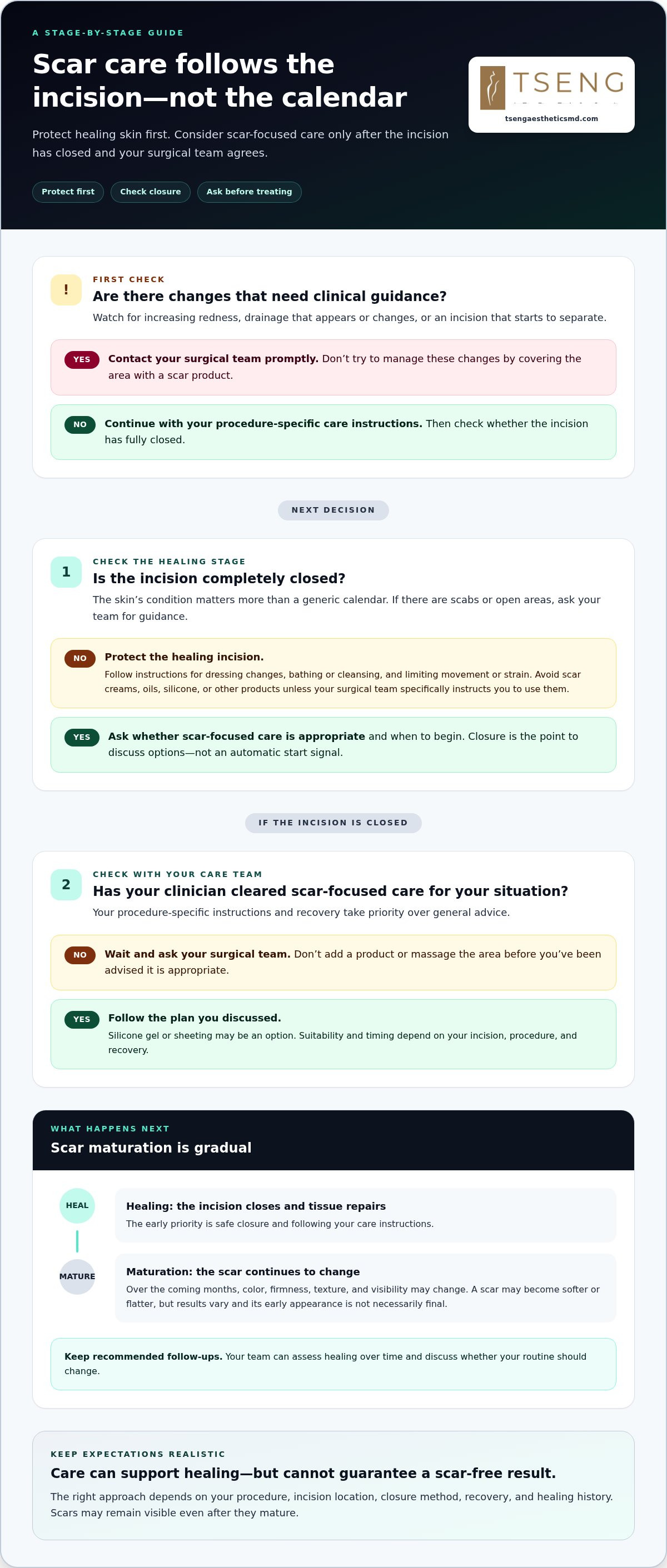
Approach scar care in sequence: protect the incision first, then consider scar-focused care once the skin has closed and your surgical team agrees it’s appropriate. Timing differs from person to person. Your procedure, incision location, closure method, and recovery all affect what’s suitable, so use your surgeon’s instructions rather than a generic calendar.
- Early healing: Follow the dressing, cleansing, and activity directions provided for your procedure. Avoid applying scar creams, oils, silicone, or other products to an incision that hasn’t fully healed unless your surgical team specifically instructs you to do so.
- After the incision closes: Ask whether scar-focused care is appropriate and when to begin. Silicone gel or sheeting may be an option to discuss, but the incision should be fully closed and your procedure-specific instructions take priority.
- Scar maturation: Keep following your care plan and attend recommended follow-ups. The scar can continue to change gradually over the coming months. Assessment over time can help determine whether to adjust your routine.
Early incision healing: protect the wound first
At this stage, the goal is uncomplicated healing, not immediate scar treatment. Follow the instructions you received for dressing changes, bathing or cleansing, and limiting movement or strain. Advice that suited someone else’s incision may not fit yours, so don’t add a product or change your wound care based on online tips alone.
Contact your surgical team promptly if redness is increasing, drainage appears or changes, or the incision starts to separate. These changes need clinical guidance. Don’t try to manage them by covering the area with a scar product.
After closure: discuss scar-focused care with the surgical team
Once the incision is completely closed, your surgeon can advise whether silicone or another approach is suitable and when to start. The calendar alone isn’t enough: timing depends on the skin’s condition and your recovery instructions. If there are scabs or any open areas, wait for guidance rather than applying a product over them.
Scar appearance doesn’t settle overnight. The tissue may remain firm or discolored while it matures, and follow-up visits give your team a chance to assess the incision and discuss next steps. A useful rule is: consider scar-care products only after the incision has fully closed and your clinician has cleared them for your situation.
If you’re planning surgery, discuss incision placement and aftercare to understand what to expect. At Tseng Plastic Surgery, Dr. Mark H. Tseng performs aesthetic procedures including facelifts, minimal invasive preservation face and neck lifts, liposuction, and breast augmentation. A conversation about surgical healing expectations can help you raise questions about recovery as part of planning.
Silicone, sun protection, and scar products: compare options carefully
Once an incision has healed, scar care may include silicone, sun protection, or simply leaving the area undisturbed. These options serve different purposes, and none is right for every scar. If you’re researching how to reduce scarring after surgery, first consider whether the skin is ready for topical care. Then discuss any next step with your surgical team.
Silicone gel and sheets: timing and practical considerations
Silicone gel and sheets are commonly discussed for raised scars. Gel can be easier to apply on curved or visible areas, while sheets cover the scar with a flexible layer. Consider comfort, how securely a product stays in place, and whether it fits a routine you can follow consistently. Silicone doesn’t guarantee a particular cosmetic result, and your clinician can help determine whether it suits your scar and routine.
Wait until the incision is fully closed and follow your surgical team’s instructions before starting. Topical scar care belongs on healed skin, and clinician guidance helps ensure the incision is ready for it.
Sun protection and popular home remedies
Sun exposure may darken a healing scar, so protecting healed skin with clothing, shade, or broad-spectrum sunscreen of at least SPF 30 can help limit discoloration. Ask your team when sunscreen is appropriate for your incision, especially if the skin is still sensitive or recovering.
Take a measured approach to home remedies. Vitamin E and oils are often promoted for scars, but benefits aren’t assured, and topical ingredients can irritate some skin. Avoid applying them to an unhealed incision. Don’t start exfoliating acids, scrubs, vigorous massage, or other active ingredients without clearance. Irritation or friction may be counterproductive.
| Option | What it may offer | What to keep in mind |
|---|---|---|
| Silicone gel or sheets | A commonly discussed option for managing raised scars after closure. | Use only when approved; fit, comfort, and consistent use affect practicality, not guaranteed results. |
| Sun protection | May help reduce the risk of a healed scar becoming darker with sun exposure. | Ask when sunscreen is safe; clothing and shade can protect the area as it heals. |
| Vitamin E, oils, and other home remedies | May feel soothing to some people, but evidence of scar benefit is uncertain. | They can irritate skin. Avoid open or unhealed areas and check before use. |
| Exfoliants, massage, or active ingredients | May be considered in some care plans at an appropriate stage. | Don’t begin without clinician guidance, since timing and suitability vary. |
A simple, appropriate routine is more useful than layering multiple products. If a product causes burning, a rash, or worsening irritation, stop using it and ask your surgical team how to proceed.
A safe, practical routine for reducing scarring after surgery
A steady routine is more useful than adding multiple scar products at once. If you’re considering how to reduce scarring after surgery, start with the instructions for your own procedure. Incision care and activity limits can differ based on the operation, the incision, and your recovery. Follow-up visits also give your surgical team a chance to assess healing and adjust guidance if needed.
Daily habits that support uncomplicated healing
Keep your care simple and consistent. Follow the prescribed directions for dressings and cleansing, and avoid activities your surgeon has restricted. Don’t add creams, silicone, massage, or other treatments without asking whether the incision is ready. Once it has healed, use sun protection only when your clinician approves. If you smoke or use nicotine, discuss it with your surgeon as part of planning and recovery.
Use this sequence as a practical reminder, not a substitute for your individualized instructions:
- Follow your care plan. Use the dressing and cleansing method your surgical team recommends. If an instruction is unclear, ask for clarification rather than changing the routine yourself.
- Protect the incision. Avoid unnecessary friction, pulling, or strain in the area, and observe any activity restrictions you were given. These limits depend on your procedure and healing.
- Attend follow-ups. Keep scheduled appointments even if the incision seems to be healing well. Your team can assess progress and advise when it’s appropriate to consider scar-focused care.
- Ask before adding products. Check before applying silicone, creams, oils, sunscreen, or other topical products, and stop using anything that causes irritation until you’ve received guidance.
When a scar or incision needs professional attention
Some changes deserve prompt clinical advice, especially if they are new, getting worse, or causing concern. Contact your surgical team about increasing pain, spreading redness, warmth around the incision, drainage, fever, or wound separation. These signs don’t establish a diagnosis on their own, but they should be assessed rather than managed with scar products or left until a routine visit.
- Worsening or newly increasing pain
- Redness that spreads or continues to intensify
- Increasing warmth, drainage, or a fever
- Any opening or separation along the incision
Seek urgent medical attention for severe or rapidly worsening symptoms. Don’t wait for a scheduled follow-up if you feel the situation is urgent.
Healing expectations are most useful when they reflect your procedure and personal recovery, not a generic timeline. At Tseng Plastic Surgery, Dr. Mark H. Tseng performs aesthetic surgery, including facelifts, minimal invasive preservation face and neck lifts, liposuction, and breast augmentation. Discuss your surgical healing expectations as part of planning, so you can raise questions about recovery and understand which changes warrant prompt clinical advice.
Plan for scar care before surgery with individualized guidance
Scar care can start with a conversation before an incision is made. The procedure, planned incision, your anatomy, and your personal healing history all help shape expectations and aftercare. Discussing these details in advance gives you a clearer understanding of what the surgical plan can consider and what remains individual to your healing.
Share any history of raised scars, prolonged healing, or concerns about how a previous incision looks or feels. Mention relevant medical history and bring questions about recovery. These details don’t predict exactly how a new scar will mature, but they help the surgical team understand your experience and tailor guidance to your situation.
Questions to discuss during a surgical consultation
Use your consultation to understand how the incision relates to your procedure and what care will involve. Consider asking:
- Where will the incision be placed, and how does that location support the procedure?
- What should I share about past scars or my healing history?
- Which incision-care and activity instructions will apply to my recovery?
- When are follow-up visits planned, and what changes should prompt me to get in touch sooner?
- When might scar-focused products be appropriate, and which ones should I avoid?
These questions help distinguish general information from advice that reflects your procedure. They also make space to discuss concerns that may feel personal, including how visible a scar could be in clothing or during everyday activities.
How individualized planning supports a considered result
Incision placement is one element of surgical planning, considered alongside the procedure, your anatomy, and your goals. Aftercare guidance is also part of the conversation, since appropriate care depends on the operation and the way your incision heals. Thoughtful planning can support a considered result, but it can’t ensure that a scar will be invisible or heal in a particular way.
Tseng Plastic Surgery, led by Dr. Mark H. Tseng, provides aesthetic care with a focus on natural-looking, balanced results. A conversation about your priorities can help clarify how a procedure and recovery relate to your goals. If you’re weighing how to reduce scarring after surgery, bring your questions to a surgical consultation rather than relying on a one-size-fits-all promise.
Discuss your aesthetic goals with Tseng Plastic Surgery and include procedure-specific healing expectations in your planning.
Make your next step a thoughtful conversation
Concern about a future scar can feel personal, especially when you’re considering a change that matters to your confidence. Use that concern to shape a candid conversation about your priorities, comfort with recovery, and what a considered outcome means to you. This can help ground decisions before surgery and throughout the healing process.
Knowing how to reduce scarring after surgery isn’t about finding a single product or perfect routine. It’s about getting guidance that reflects your procedure and individual goals, then understanding how to respond as recovery unfolds. Bring forward the questions that matter most to you; a clear discussion can make the path ahead feel more manageable.
Discuss your procedure and healing goals with Tseng Plastic Surgery. The practice offers aesthetic procedures including facelifts, minimal invasive preservation face and neck lifts, liposuction, and breast augmentation. Take the next step by scheduling a conversation about your goals and procedure-specific healing expectations.
Frequently Asked Questions
Can you prevent a scar after surgery?
No, an incision generally leaves a scar, though careful planning and appropriate aftercare may support healing and influence its appearance. The goal of how to reduce scarring after surgery is not to promise invisible skin, but to give the incision a favorable environment to heal. For example, follow activity limits that reduce pulling on the area, and tell your surgeon about prior raised scars before the procedure.
When can I start using silicone gel or sheets on a surgical scar?
Start only after the incision is fully closed and your surgical team says silicone is appropriate. This is often around two weeks after surgery, but timing can vary, and the skin should have no open areas or scabs. If you’re unsure whether a spot is completely healed, wait and ask rather than testing a product on it. Follow the product’s directions and your clinician’s specific advice.
How long does it take for a surgical scar to fade?
Scar maturation can take 12 to 18 months, and changes happen gradually rather than on a fixed schedule. A scar may look more noticeable in the first weeks before it softens or its color settles; early appearance alone doesn’t establish the final result. Compare changes over time under similar lighting, and bring concerns about persistent discomfort, thickening, or unexpected changes to a follow-up visit.
Does vitamin E help reduce surgical scars?
Vitamin E hasn’t been shown to reliably improve every surgical scar, and it can irritate or cause a skin reaction in some people. Don’t apply it to an incision that’s still healing or assume a “natural” ingredient is automatically gentle. If you’re considering it for closed skin, ask your surgical team whether it fits your care plan, particularly if you’ve reacted to topical products before.
Can sun exposure make a healing scar darker?
Yes, ultraviolet exposure can contribute to lasting darkening of a new scar. Once the incision is healed and sunscreen is approved for the area, use broad-spectrum SPF 30 or higher and reapply as directed on the label. Clothing and shade can also limit direct exposure. If the skin is still open, scabbed, or tender, ask your team how to protect it before applying sunscreen.
What are signs that a surgical incision may need medical attention?
Contact your surgical team promptly if pain is worsening, redness is spreading, the area feels increasingly warm, drainage develops, you have a fever, or the incision separates. These signs need professional assessment and shouldn’t be treated with scar cream. If symptoms are severe or worsening rapidly, seek urgent medical attention rather than waiting for a scheduled appointment. When in doubt, describe what has changed and when it began.
Are keloid scars different from hypertrophic scars?
Yes. A hypertrophic scar is raised but remains within the original incision’s boundaries, while a keloid can grow beyond them into nearby skin. Both can feel firm or look prominent, so appearance alone may not be enough to identify the type. If a scar keeps enlarging or causes discomfort, have it assessed; the distinction can help guide which management options a clinician considers.

