How to Avoid Looking Overfilled with Balanced Filler Choices
By Tseng Plastic Surgery
More filler doesn’t always create a more balanced result. The best way to avoid looking overfilled is to assess your face as a whole, start conservatively, and add volume gradually instead of focusing on one feature in isolation.
It’s understandable to worry that filler might look puffy, heavy, or unlike you. A natural-looking result should preserve your facial character and proportions, with treatment tailored to your features rather than adding volume for its own sake.
This article explains why filler can look unnatural, what balanced treatment involves, and which visible changes may suggest an overfilled appearance. You’ll also learn why allowing time between treatments and reassessing the result can support a more refined look.
Key Takeaways
- A balanced assessment considers how cheeks relate to the jawline and how lips fit with the chin and nose, rather than judging one feature alone.
- Natural-looking treatment respects your bone structure, enhances your existing features, and avoids adding projection where it isn’t needed.
- Because hyaluronic acid filler can last 6-18 months, previous treatment may still affect the face when considering more volume.
- Watch for changes such as softened facial contours or features that appear overly projected in motion or photographs.
1. Holistic facial assessment and balanced treatment
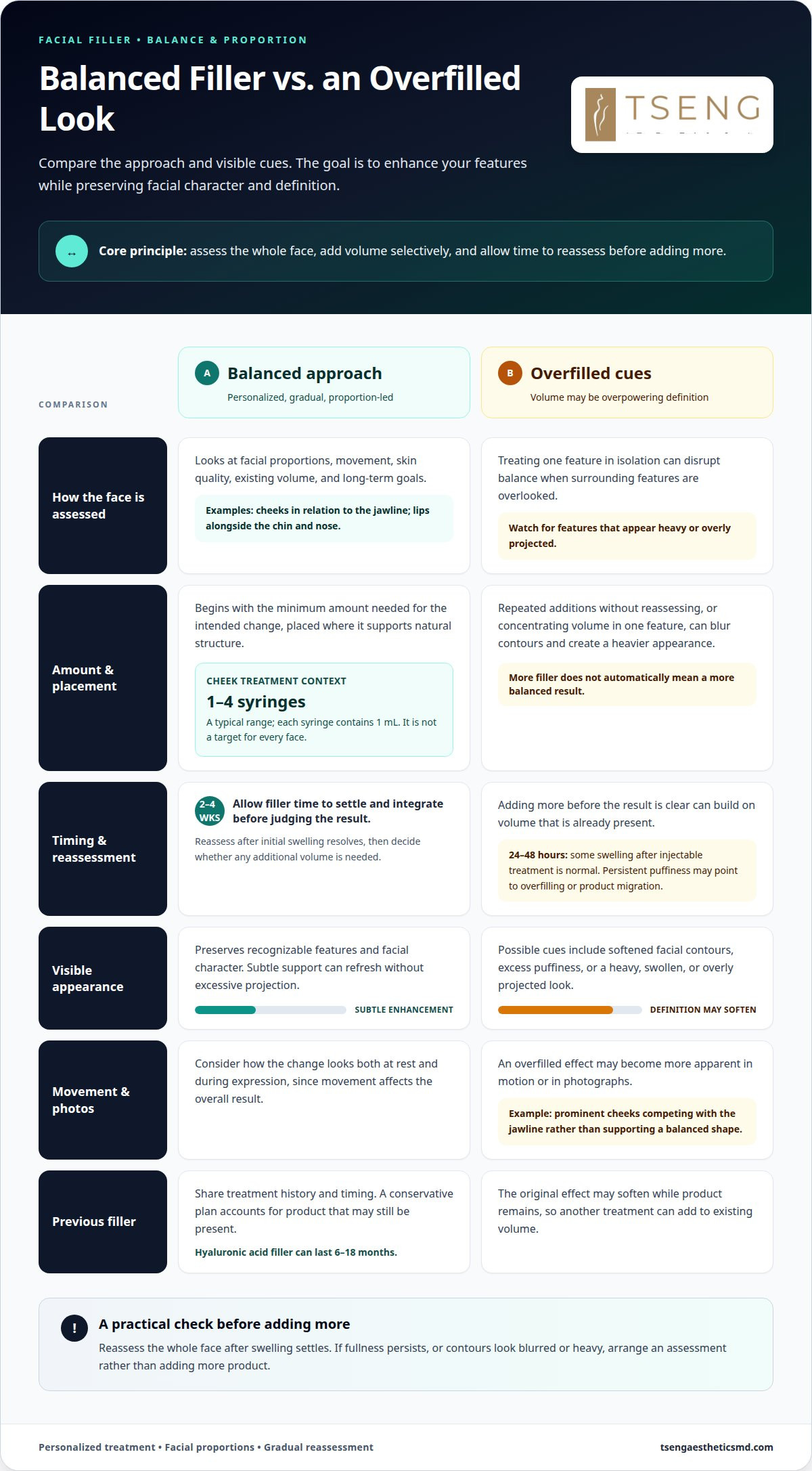
A balanced filler plan starts with the whole face, not a single line or hollow. Assessment considers facial proportions, muscle movement, skin quality, existing volume, and long-term goals. For example, a clinician may consider how your cheeks relate to your jawline before planning cheek treatment. This broader view helps guide the amount, placement, and technique.
Facial features work in relation to one another. Lips should be considered alongside the chin and nose, while the under-eyes should be assessed in relation to midface support. Restoring cheek support may soften nasolabial folds without injecting them directly. Treating only the lips or cheeks can disrupt facial balance if surrounding features are overlooked.
Cheek filler amounts vary with anatomy and the intended change. A typical cheek treatment may use 1 to 4 syringes, with 1 mL in each syringe. That range isn’t a target for every face. The relevant question is how much support a particular area needs, and whether adding volume there will keep nearby features in proportion.
Placement matters as much as quantity. Filler placed too superficially or without regard for natural facial structure may not integrate smoothly. A thoughtful technique uses small amounts in appropriate areas instead of concentrating volume in one feature. Repeated additions without reassessing the face can blur contours and create a heavier appearance.
In the United States, injector credentials and rules depend on state law and the clinician’s professional scope. Credential requirements are not identical in every state and setting. Appropriate licensure, scope of practice, and training in facial anatomy are important considerations, while educational industry resources like skincandy.shop discuss how aesthetic practitioners navigate clinical standards and patient consultation practices.
Wait until initial swelling resolves before deciding whether to add more. Hyaluronic acid filler typically settles and integrates over 2-4 weeks, so reassessment after that period can give a clearer view of the result. A conservative approach to how to avoid looking overfilled means allowing the face to respond before planning another treatment.
2. What Does a Natural Result Look Like?
A natural result preserves the features that make your face recognizable. Filler should enhance, not replace, your natural structure. For example, subtle cheek support can refresh the face without creating excessive projection. A skilled injector considers how a proposed change will look both at rest and during expression, since facial movement affects the overall result.
Experience matters, but so does judgment. An experienced injector understands facial anatomy, considers skin quality and bone structure, and recognizes when an area does not need treatment. The goal is not to fill every line or hollow, but to create a personalized plan that respects your proportions and avoids a uniformly enlarged or overdone appearance.
During an assessment, notice whether the injector asks what you hope to change and discusses how your features relate. A request for fuller lips, for instance, should be considered in relation to the chin and nose. A natural aesthetic also means explaining which areas may benefit, which may not, and why restraint could better support your desired result.
Ask how treatment will be staged. A conservative approach may begin with the minimum amount needed for a visible change, then allow time to assess the result before adding more. This helps distinguish a refreshed appearance from simply adding volume. The injector should also consider previous filler, since product may remain even after its initial effect seems to fade.
Look for clear, individualized reasoning rather than a fixed treatment pattern. The injector should explain the proposed placement, how it relates to facial structure, and what change that technique aims to create. If your goal is a more natural-looking appearance, a personalized aesthetic assessment can help frame treatment around your features and preferences.
3. How can I avoid looking overfilled?
Overfilling can happen when filler is added repeatedly without reassessing the whole face. Product may remain after its visible effect seems to fade, so another treatment can build on existing volume. Treating the lips, cheeks, under-eyes, and jawline together may create a heavy look. Staging treatment gives each change time to be assessed.
Start with the minimum amount needed to create the intended change. Then reassess before adding more, rather than treating every area in one appointment. For example, someone seeking cheek definition may need a plan that considers overall facial proportions, not simply more cheek volume. Gradual treatment can help preserve definition while enhancing your features.
Some swelling is normal for 24-48 hours after injectable treatment. Swelling usually improves, while persistent puffiness may point to overfilling or product migration. Because appearance can change as filler settles, judge the result after the initial swelling has resolved, not immediately after treatment. If fullness persists, arrange an assessment rather than adding more product.
Signs of an overfilled appearance include blurred facial contours, excess puffiness, and features that look heavy or overly projected. The effect may be more apparent in motion or in photographs. For instance, unusually prominent cheeks can compete with the jawline instead of supporting a balanced facial shape. These changes are cues to reassess placement and volume.
You can support a more natural aesthetic by sharing your filler history and treatment timing. Existing product may still be present even if the original effect has softened. A conservative plan accounts for that history and allows time between sessions. If you’re wondering how to avoid looking overfilled, the principle is simple: enhance selectively, then reassess before adding volume.
4. Signs of an overfilled face
Excess facial volume can soften contours that once gave your face definition. For example, unusually full cheeks can make the transition toward the jawline less distinct. Too much volume can also create a heavy or swollen appearance rather than subtly restoring support. Consider how the cheeks, under-eyes, and lower face relate, not just one feature on its own.
Projection is another visible clue. Lips or cheeks that seem prominent from the side may look less harmonious with the nose, chin, or jaw. Excessive volume can make expressions look less natural in motion and create a rounded or puffy outline in photographs. Compare different angles and expressions instead of relying on a single close-up selfie.
Timing helps distinguish early swelling from a result that remains too full. Some swelling is normal for 24-48 hours after injectable treatment. Persistent puffiness after that period can indicate overfilling or product migration, particularly when it changes facial contours. Hyaluronic acid filler typically settles over 2-4 weeks, so assess the appearance after that settling period.
Consider whether the change looks consistent across your face. A fuller cheek that competes with the jawline, or under-eye volume that looks disconnected from midface support, may signal imbalance. Keep a record of previous filler treatments and their timing, since existing product can affect your appearance. A medical consultation can assess placement and remaining volume, and whether further treatment is appropriate.
If fullness persists after filler has settled, avoid adding volume before reassessment. A conservative evaluation can distinguish swelling, product placement, and facial proportions, then guide a measured next step. For a focused review of facial volume and contour, schedule an aesthetic consultation.
Tseng Plastic Surgery
Tseng Plastic Surgery offers facial rejuvenation options to consider in the context of your features and aesthetic goals. If persistent fullness or softened contours concern you, a personalized discussion can help clarify which approach may suit your priorities. Depending on your goals, options include a non-surgical facelift, facelift, or minimal invasive preservation face and neck lift. These treatments differ from filler and may be relevant when your concern involves broader facial changes rather than adding volume to one feature. A measured conversation can help you understand the approaches and decide what feels right for you. Contact Tseng Plastic Surgery to discuss your facial rejuvenation goals.
Choose a next step that fits your goals
Aesthetic decisions do not need to be made all at once. If you’re still considering how to avoid looking overfilled, use your next consultation to clarify what feels like you, which changes concern you, and whether adding volume is the right direction. The aim is a thoughtful plan that respects your features, not a prescribed amount of treatment.
Tseng Plastic Surgery offers facial rejuvenation options for concerns that extend beyond a single area treated with filler. These include a facelift and a minimal invasive preservation face and neck lift. The practice also offers liposuction for body contouring, a separate concern from facial filler. A personalized conversation can help you discuss your priorities and which approaches may suit them.
Taking time to consider your preferences is a meaningful part of the process. Contact Tseng Plastic Surgery to discuss your goals and possible next steps. You can move forward with clarity, at a pace that feels right for you.
Frequently Asked Questions
Why do fillers look fake?
Filler can look unnatural when an enhancement draws attention away from your natural features. For example, treating one crease without considering nearby contours may create a noticeable contrast. A result can also feel unfamiliar if facial expressions look different afterward. During planning, describe the specific change you want and whether you prefer subtle refinement or more noticeable definition.
Can overfilled filler be fixed?
Some overfilled results can be addressed, depending on the filler type and where it was placed. Hyaluronidase can dissolve hyaluronic acid filler within 24-48 hours. That doesn’t mean every case should be treated the same way. A medical assessment can establish what product was used, whether it remains, and whether dissolving it is appropriate for the concern.
Can overfilled results be corrected?
Correction may be possible in some cases, but the plan depends on the product and the specific concern. A clinician may consider whether the issue is excess volume, uneven placement, or lingering swelling before discussing next steps. Bring details of previous treatments, including product names if available, so the assessment can account for what was injected and when.
Cheek Fillers: Youthful Lift or Age-Defying Risk?
Cheek filler may restore support and refine facial contours, but excess volume can make cheeks look prominent or heavy. The desired effect depends on how cheek shape relates to the rest of the face, including the lower facial outline. A useful consultation focuses on the change you want from the front and in profile, rather than treating cheek fullness as an isolated goal.
How Much Is Too Much?
There isn’t one syringe amount that defines “too much” for every face. The relevant amount depends on the treatment area, existing product, facial structure, and desired change. An amount that creates subtle definition for one person may look excessive on another. A better measure is whether added volume maintains your proportions and the appearance you want.
How can I avoid looking overfilled?
To understand how to avoid looking overfilled, plan treatment around your priorities rather than asking for a preset amount. Share your treatment history, explain which feature concerns you most, and agree on what change would feel sufficient before proceeding. If you’re considering more filler soon after treatment, pause for a fresh assessment instead of deciding based only on an early impression.

