How to Avoid a Windswept Look After a Facelift
By Tseng Plastic Surgery
What helps you avoid a windswept look after a facelift? It depends less on choosing a particular technique and more on how carefully the plan accounts for your face. It’s understandable to worry about looking overly tight or unlike yourself. If you’re researching “how to avoid a windswept look facelift,” consider how the direction of tissue movement, skin tension, and your facial proportions may affect the overall appearance.
A windswept appearance may include features that seem pulled sideways, such as a widened-looking mouth or diagonal tension toward the ears. No single approach guarantees a particular outcome. Facial anatomy, the areas being addressed, and surgical judgment all matter. This article explains what can contribute to a pulled appearance, how individualized planning can support facial balance, and what questions can help you express a preference for subtle rejuvenation. You’ll also find practical ways to prepare for a consultation and set informed, realistic expectations.
Key Takeaways
- A windswept look describes an overly taut or sideways-pulled impression, but it isn’t an inevitable facelift outcome.
- Skin tension, tissue repositioning, facial anatomy, and surgical planning can all influence the overall appearance.
- When considering how to avoid a windswept look facelift, focus on individualized planning rather than treating a technique name as a guarantee.
- Prepare for your consultation by outlining your goals, concerns, visual references, and the features you want to preserve.
- Traditional facelifts and preservation face and neck lifts are options to discuss in relation to your individual goals.
What Does a Windswept Look After a Facelift Actually Mean?
Worrying that a facelift might leave you looking unlike yourself is understandable. “Windswept look” describes a possible aesthetic concern, not an inevitable result. People use the phrase for facial features that seem overly tight or drawn sideways, rather than refreshed in a way that still feels familiar.
A windswept appearance after a facelift is an overly taut or laterally pulled impression, in which facial features seem drawn toward the sides of the face.
This is different from temporary swelling or tightness during healing. The face may look or feel different as it recovers, and early changes alone don’t establish what the lasting appearance will be. A photograph captures one moment, angle, and expression. It can’t explain why a feature looks a certain way or determine whether a result is developing as expected. Your operating surgeon is best placed to assess your healing and concerns.
Facelifts, also called rhytidectomies, can involve different approaches and considerations. The Rhytidectomy (Facelift) overview on Wikipedia provides general background, but it can’t account for an individual’s anatomy, surgical plan, or recovery. Those details matter when interpreting a particular appearance.
How a pulled appearance may show around the face and ears
A face may appear unusually taut, with lines or contours seeming to angle toward the ears. Skin near the ears may look stretched, or an earlobe’s contour may appear altered. These are possible visual cues, not proof of a particular surgical error. Facial anatomy, healing, and the plan for lifting and redraping tissue all affect how features look. One sign viewed alone doesn’t tell the whole story.
Why natural-looking results matter to patients
For many people, facial rejuvenation is about looking rested while keeping the features and expressions that make their face recognizable. But “subtle” isn’t a fixed standard. One person may hope to soften changes around the jawline, while another may prioritize preserving a familiar expression. The aim is considered balance, not the removal of every sign of aging. If you’re exploring how to avoid a windswept look facelift, describe what you want to preserve as clearly as what you hope to change.
Why Can a Facelift Look Windswept? The Role of Tension and Planning
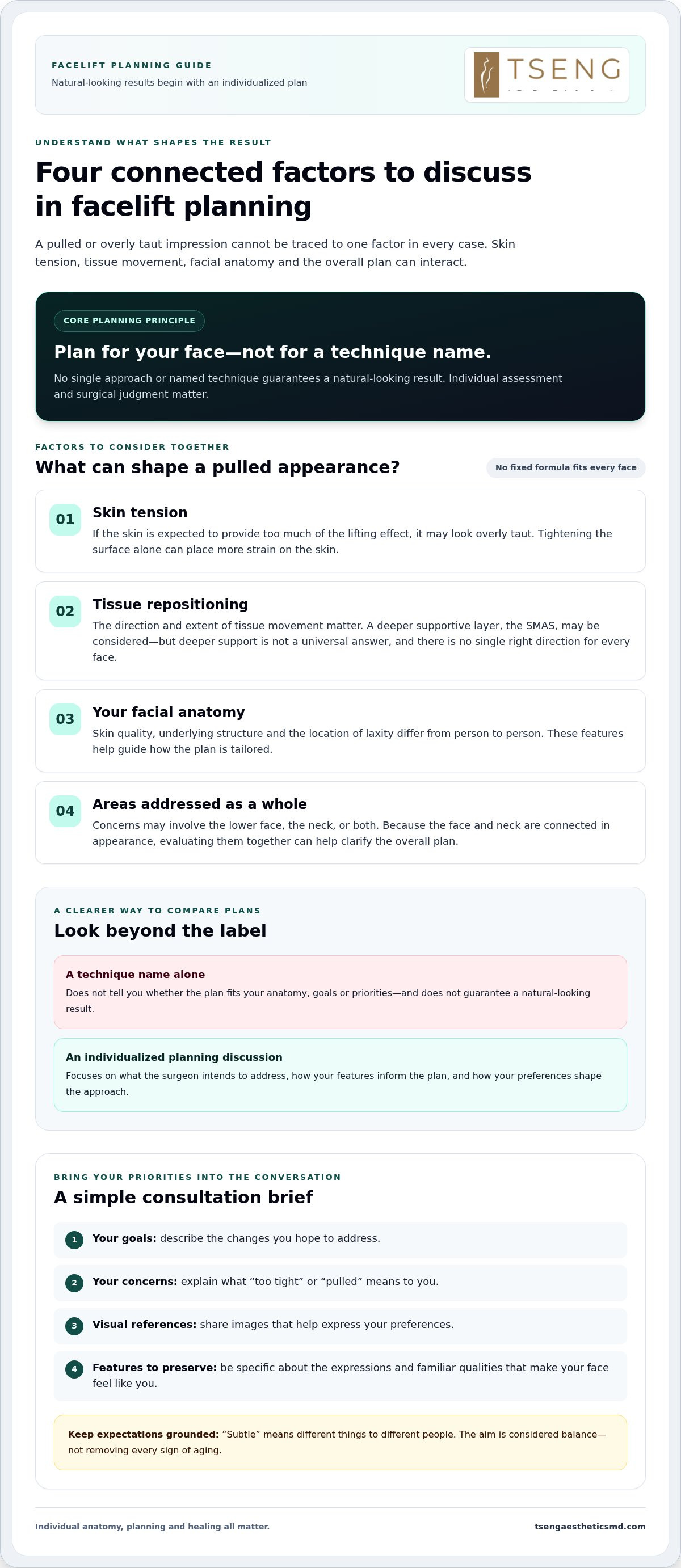
A pulled appearance can’t be traced to one factor in every case. Skin tension, how facial tissues are repositioned, a person’s anatomy, and the overall surgical plan can interact to shape the result. If the skin is expected to provide too much of the lifting effect, it may look overly taut. The direction and extent of tissue movement matter too, but no single direction is right for every face.
Facelift planning considers how to address visible laxity while respecting the structures and proportions that make each face distinct. The American Society of Plastic Surgeons facelift overview offers general information about the procedure. Applying broad information to an individual still requires a personal assessment.
How skin tension and tissue support affect the result
Skin is the visible covering, but it isn’t the only tissue involved in facial aging. Tightening the surface alone can place more strain on the skin and may contribute to a stretched impression. Beneath it is the SMAS, a supportive layer of tissue associated with facial muscles. A surgeon may consider this deeper layer as part of a plan to address looseness without relying solely on skin tension.
Deeper support isn’t a universal answer. The extent and direction of repositioning need to be considered alongside facial proportions, tissue quality, and the changes a patient wants. An upward movement may suit some cases, while another person’s anatomy and goals may call for different decisions. The objective is to assess the face as a whole, not apply a fixed vector or formula.
Why facial anatomy changes the surgical plan
Faces differ in skin quality, underlying structure, and where laxity is most noticeable. One person may be concerned mainly about the lower face, while another may have changes that extend beneath the jawline into the neck. These differences affect what needs attention and how the surgeon balances one area with another.
The face and neck are connected in appearance, so evaluating them together can help clarify the overall plan, even when a patient’s main concern is one specific area. The surgeon determines appropriate adjustments through an individual evaluation of anatomy and priorities. No named technique, including a SMAS or deep-plane approach, guarantees a natural-looking result. The plan, the surgeon’s judgment, and the individual’s anatomy all matter.
That’s why the question of how to avoid a windswept look facelift is better answered through careful planning than by choosing a technique name alone. At Tseng Plastic Surgery, facelift planning is individualized around natural-looking, balanced results. You can learn about facelift planning as a starting point for considering how your goals and facial features may guide the discussion.
How to Evaluate Facelift Plans Without Chasing a Technique Name
A technique name can sound like a shortcut to a natural result, but it can’t tell you whether a plan fits your face. A more useful discussion focuses on what the surgeon intends to address, how the plan accounts for your anatomy, and how your priorities shape the approach. No named technique guarantees a natural-looking result; individualized assessment and surgical judgment matter.
Use this comparison to organize the conversation, not to rank approaches or decide which one is right for you:
| Planning emphasis | What it considers | Question to explore |
|---|---|---|
| Skin-only emphasis | How the surface is tightened or redraped | How will the plan avoid relying on skin tension alone? |
| Deeper support | Underlying facial tissues as well as the visible surface | How does this fit my anatomy and concerns? |
| Individualized planning | Facial features, areas of laxity, and personal goals together | What parts of the plan are specific to me? |
What to look for in before-and-after photographs
Photographs can help you discuss an aesthetic direction, but they show prior patients, not a forecast of your result. When available, compare images with similar angles, lighting, expressions, and follow-up timing. Consider whether the overall face still appears expressive and recognizable instead of judging a result by one feature alone. Images are most useful when they help you describe what feels balanced to you. The modern facelift guide offers additional context on planning for natural-looking facial rejuvenation.
How to think about technique and complementary options
Traditional facelifts and preservation face and neck lifts are different approaches to facial rejuvenation, but a label alone doesn’t explain how a specific plan will address your features. Ask how the recommendation relates to the areas you’d like to improve and the qualities you want to preserve. If you’re weighing surgical and nonsurgical options, discuss what each is intended to address and how it relates to your goals.
For people researching how to avoid a windswept look facelift, the practical takeaway is to evaluate the reasoning behind a plan, not simply its title. Bring photographs that express your preferences, note what looks natural to you, and ask how your anatomy informs the recommendation. A thoughtful plan should make clear what may change and what the approach aims to preserve.
How to Prepare for a Facelift Consultation About Natural Results
A focused consultation starts with more than naming a feature you’d like to change. Describe the look you hope to retain, the changes that concern you, and what “natural” means in your own words. This gives the surgeon a clearer foundation for discussing how your priorities relate to facial anatomy and a possible plan.
Use this short sequence to prepare:
- Goals: Write down the changes you hope to see, such as a softer impression along the jawline, and the features you want to remain recognizable.
- Concerns: Note specific worries, including excessive tightness, a pulled direction, altered ear contours, or whether the face and neck will look balanced together.
- References: Bring images that convey an aesthetic quality you like, such as relaxed contours or preserved expression. Use them as conversation aids, not templates for an exact outcome.
- Questions: List what you want clarified about the proposed approach, including its trade-offs, limitations, and how it relates to your anatomy and goals.
- Discussion: Share your notes and invite the surgeon to explain how the plan addresses your concerns, including what may not change.
Describe the result you want in precise, personal terms
Try replacing broad phrases like “I want to look younger” with specific details: “I’d like a refreshed lower face, but I want my expression and familiar facial character to remain.” If ear contours or the relationship between your face and neck are on your mind, say so directly. Reference images can help communicate mood and proportion, but your anatomy is different. Be candid about concerns around tightness or looking unlike yourself.
Questions that make the surgical plan easier to understand
Clear questions can turn an aesthetic preference into a productive discussion. Consider asking:
- How does the proposed plan account for my facial structure, skin quality, and the areas I’ve identified?
- How will you consider balance between my face, ears, and neck?
- What trade-offs or limitations should I understand about this approach?
- How might healing affect my early appearance, and what changes should I expect to discuss during follow-up?
These questions aren’t a way to demand a particular technique or guarantee a particular appearance. They help you understand the reasoning behind the plan and communicate what matters to you. If you’re considering how to avoid a windswept look facelift, make preservation part of the conversation: explain what you hope to change and what you’d like to keep. A thoughtful exchange should make room for your preferences as well as the surgeon’s individualized judgment.
To discuss your natural-looking goals in a personalized facelift consultation, schedule a consultation with Tseng Plastic Surgery.
How Tseng Plastic Surgery Approaches Individualized Facelift Planning
A natural-looking facelift plan begins with the person, not a preset technique. At Tseng Plastic Surgery, Dr. Mark H. Tseng brings more than 20 years in practice to facial rejuvenation planning, with an emphasis on balanced results shaped around individual goals. That experience provides context, not a promise of a particular appearance. Each person’s facial features, concerns, and preferred degree of change help frame the discussion.
Matching facial rejuvenation options to individual goals
Tseng Plastic Surgery offers traditional facelifts and preservation face and neck lifts. These are options to discuss, not a one-size-fits-all recommendation. A personalized conversation can consider what you hope to address, what you want to preserve, and how your face and neck relate in overall appearance. The appropriate approach depends on individual evaluation, so your anatomy and priorities should guide the discussion.
It can help to explain your aims in practical terms. You might want a refreshed appearance while retaining familiar facial character, or you may have specific concerns about balance around the lower face and neck. Share both the changes you’re seeking and the features you value. This gives the discussion a clearer focus and connects possible options to your aesthetic goals, rather than to a technique label alone.
Moving forward with informed expectations
Careful planning helps guide decisions, but it can’t guarantee a specific appearance. Individual anatomy and surgical judgment remain central, and even a considered plan has limits. A useful discussion makes space for questions about the reasoning behind an approach, what it is intended to address, and what it may not change. Understanding those distinctions can help you consider facial rejuvenation with realistic expectations.
If you’re considering how to avoid a windswept look facelift, bring concerns about tension, facial balance, or preserving your expression into the conversation. You don’t need to arrive with a procedure already chosen. A personalized discussion can help clarify whether facial rejuvenation aligns with your goals and what options may be appropriate to explore.
To take a considered next step, explore facelift options with Tseng Plastic Surgery and begin a conversation about your goals.
Take the Next Step Toward a Result That Feels Like You
As you consider facial rejuvenation, take time to define what “natural” means for you. It may mean keeping a familiar expression, maintaining balance between your face and neck, or making a refined rather than dramatic change. Those priorities can guide a thoughtful conversation without requiring you to arrive with a technique already chosen.
The question of how to avoid a windswept look facelift has no universal formula. A useful next step is to discuss your concerns and expectations openly, then consider whether a personalized plan aligns with the features you want to preserve and the changes you hope to make. Dr. Mark H. Tseng’s approach centers on individualized planning, with facelift and preservation face and neck lift options considered in relation to each patient’s goals.
If you’re ready to explore whether facial rejuvenation fits your priorities, discuss your facial rejuvenation goals with Tseng Plastic Surgery. A clear conversation can help you move forward with greater confidence and a vision that remains your own.
Frequently Asked Questions
Is a windswept look after a facelift permanent?
Not necessarily, and the phrase itself isn’t a diagnosis. Early swelling or tightness can affect how the face appears, while a lasting concern needs to be assessed in light of the procedure and individual healing. If you’re concerned about your recovery, contact your operating surgeon and describe what you’re noticing, when it began, and whether it has changed. Online photographs can’t establish what’s happening in your case.
Can a deep plane facelift prevent a windswept appearance?
No technique can guarantee a particular aesthetic result. A deep-plane facelift is one method, and whether it’s appropriate depends on your anatomy, goals, and the surgeon’s assessment. In a consultation, discuss how the plan addresses tissue support and tension, along with its limitations and trade-offs. If you’re researching how to avoid a windswept look facelift, consider the reasoning behind a recommendation rather than relying on the technique name alone.
Does a facelift always pull the ears or change their appearance?
No, ear changes aren’t inevitable. Ear contours may be a concern to raise during planning, but appearance can be affected by anatomy, the surgical plan, tension, and healing. If you’re worried about a particular contour, explain what you want preserved and ask how that concern will be considered. Online examples may help you describe your preference, but differences between people mean they can’t predict your result.
How can I tell if a facelift looks too tight?
A very taut or sideways-drawn impression may prompt that concern, but a photograph can’t reveal its cause. Angle, lighting, facial expression, and healing stage can all influence how features appear. When viewing before-and-after images, look at the overall facial character across comparable views rather than treating one feature as proof. For a personal concern, seek an assessment that considers your history and current appearance.
What should I bring to a facelift consultation if I fear looking unnatural?
Bring a short written list of what concerns you, what you hope to change, and what you want to preserve. Reference images can help explain preferences, such as wanting to retain a familiar smile, but they aren’t templates for an exact result. You might also note questions about how the proposed plan relates to your features, what its limitations are, and how the face and neck will be considered together.
Can revision surgery correct a windswept facelift?
Whether another operation is appropriate depends on factors such as the original procedure, current anatomy, healing, and your goals. An online description can’t establish candidacy or indicate what options may be suitable. A surgeon would need to evaluate your individual situation and discuss potential benefits, limitations, and risks before any decision. If you have a concern after surgery, begin by discussing your symptoms and history with your operating surgeon.
Does choosing a conservative facelift mean the result will be less effective?
Not automatically. “Conservative” can mean different things, and it doesn’t define how much improvement is appropriate for a particular person. The discussion should clarify what change is realistic for your anatomy and priorities, along with the limitations of the proposed plan. For example, ask what the approach is intended to address and what features it aims to preserve, so expectations are specific rather than based on a label.

