Hair Loss Treatment for Women: Minoxidil, Laser Therapy and Surgery
By Tseng Plastic Surgery
A widening part or thinning crown can signal more than a change in appearance. Hair loss in women means noticeable shedding or thinning that may follow a pattern or stem from hormonal changes, stress, medical conditions, medicines, or hair-care practices. The right hair loss treatment for women depends on the cause and the pattern of loss, so identifying what’s happening is an important first step.
When hair changes are difficult to explain, it is natural to want a clear path forward. Minoxidil, low-level laser therapy, and hair transplant surgery work differently, and none is right for every cause of hair loss. This guide explains common patterns of female hair loss and compares these options, including how they work, what to expect, and when a professional assessment can help inform your decision.
Key Takeaways
- Understand why hair loss can happen and why identifying its pattern and possible cause helps shape the next step.
- Learn what to consider with minoxidil, including the time it may take to see changes and possible early shedding.
- Compare low-level laser therapy with other approaches, including its gradual timeline and role as part of a treatment plan.
- See why hair transplant surgery depends on the pattern of thinning and careful candidate selection.
Are there side effects of minoxidil?
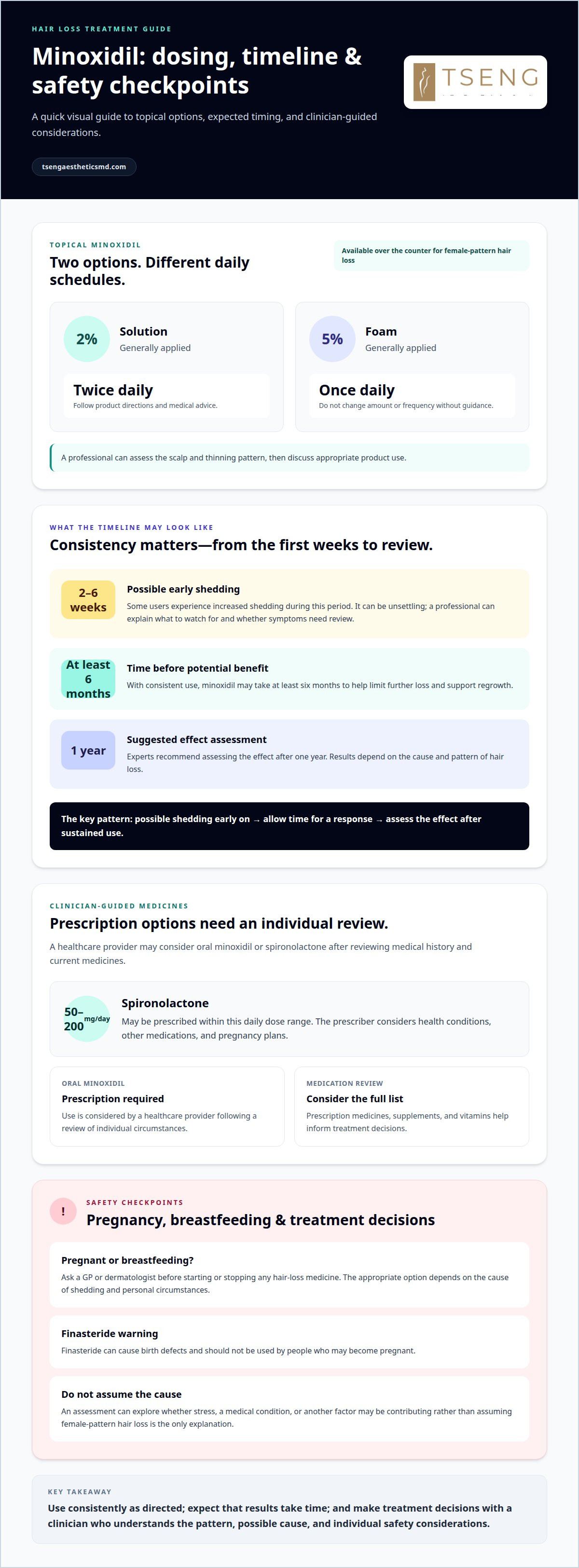
Topical minoxidil is available over the counter for female-pattern hair loss as a 2% solution or 5% foam. A professional assesses the scalp and the pattern of thinning, then discusses appropriate product use. The 2% solution is generally applied twice daily, while 5% foam is applied once daily. Follow the product directions and medical advice rather than changing the amount or frequency yourself.
Some users experience increased shedding during the first 2-6 weeks. This early change can be unsettling, so a professional can explain what to watch for and whether symptoms need review. Minoxidil needs consistent use: it may take at least six months to help limit further loss and support regrowth, and experts recommend assessing its effect after 1 year.
A healthcare provider may prescribe oral minoxidil or spironolactone for a woman’s hair loss, after reviewing her medical history and current medicines. Oral minoxidil requires a prescription; spironolactone may be prescribed at doses ranging from 50 to 200 milligrams daily. These medicines have individual risks, so the prescriber considers health conditions, other medications, and pregnancy plans before recommending either.
Use minoxidil alongside other medicines only with appropriate medical guidance. Tell the clinician about prescription medicines, supplements, and vitamins, as your full medication list helps inform treatment decisions. An assessment can also explore whether stress, a medical condition, or another factor may be contributing, rather than assuming female-pattern hair loss is the only explanation.
If you are pregnant or breastfeeding, ask a GP or dermatologist before starting or stopping any hair-loss medicine. The appropriate option depends on the cause of shedding and your circumstances. Finasteride can cause birth defects and should not be used by people who may become pregnant. A clinician can discuss suitable next steps and whether evaluation or treatment should wait.
Low-level laser therapy
Low-level laser therapy, also called low-level light therapy, uses light energy to stimulate hair follicles. A low-level laser device has FDA approval for hereditary hair loss in men and women. For a hair loss treatment for women, this may be considered when thinning follows a genetic pattern, though approval doesn’t mean every device or type of alopecia responds equally. Some studies found increased hair density after 24 to 26 weeks; reviews list 4-6 months as a possible time to see results.
Effectiveness, timing, and expense vary by approach. When considering whether light therapy is appropriate as a hair loss treatment for women, a provider will consider the diagnosis, thinning pattern, and your ability to follow the treatment consistently. Because results develop gradually, weigh the ongoing commitment against other options rather than choosing a method based on speed alone.
PRP, low-level laser therapy, and microneedling aren’t recommended as standalone treatments by the experts cited in the research. A clinician may consider how these approaches fit within a broader plan for persistent shedding. Microneedling commonly involves 3 to 6 sessions spaced 1 month apart. PRP may involve treatment for 3 to 4 months, followed by booster sessions every 6 to 12 months.
Nutrition may also be relevant to an assessment. Blood tests can identify iron, zinc, or vitamin D levels that may need attention before supplements are considered. Biotin and other vitamins support hair growth when a deficiency is present, while excess selenium and vitamins A or E have been linked to hair loss. A clinician can consider nutrition alongside your medical history and medicines such as finasteride or spironolactone. Light therapy may be one part of care, but it is not a universal solution.
What is hair loss in women?
Women naturally shed hair, but changes in density, shedding, or scalp coverage can have different causes. The pattern and timing offer important clues.
Common Types of Female Hair Loss
Female hair loss includes patterned thinning, temporary shedding, traction alopecia, and scarring alopecia. Female-pattern hair loss is often inherited and commonly appears as gradual thinning across the scalp. Non-scarring alopecia is more common than scarring alopecia, where damaged hair follicles cannot regrow hair in affected areas. This distinction matters because cause and pattern influence which treatments may be appropriate. Tight hairstyles that repeatedly pull hair can cause traction alopecia, and continued tension may lead to lasting loss. Sudden patches can point to a different process than gradual thinning.
Causes, Hormones, and Risk Factors
Hair loss can be associated with hormonal changes, genetics, medical conditions, medicines, nutritional deficiencies, and physical or emotional stress. Women may notice increased shedding for up to 3 months after giving birth or during hormonal transitions like perimenopause; functional health resources from Living Well Dallas highlight how shifting hormones such as progesterone and DHEA impact overall well-being. Inherited female-pattern thinning tends to develop gradually. Chemotherapy is another recognized cause. Hair-care choices also matter: frequent tight styles can strain follicles, and repeated use of curling irons, flat irons, or hot combs can weaken hair. Too little iron or protein, very low calorie intake, and excess selenium or vitamins A and E are also linked to hair loss. Identifying a likely trigger helps guide appropriate evaluation.
Diagnosing Hair Loss
Diagnosis draws on the shedding pattern, a scalp examination, medical history, and appropriate tests to identify the likely cause. A dermatologist may use trichoscopy to examine the scalp and follicles, followed by a pull test, gently drawing several dozen hairs to assess shedding or breakage. They may ask about recent childbirth, medicines, illness, stress, and hair-care practices. Seek dermatology assessment for sudden, rapid loss, patchy spots, scalp pain, itching, or redness. This evaluation can help distinguish patterned thinning from other forms of alopecia and identify what may be causing the change.
Hair transplant surgery
Hair transplantation moves a person’s own follicles from a donor area to regions affected by thinning. In modern surgical practice, techniques such as an FUE hair transplant extract individual follicular units from a stable donor zone. Surgery may be considered as part of hair loss treatment for women when the pattern and donor supply make transplantation suitable. Diffuse thinning may make someone less suitable for transplantation than localized loss, so assessing the type of hair loss is important.
Careful selection matters because transplantation redistributes existing follicles and does not prevent ongoing loss elsewhere. A surgical plan considers the thinning pattern, donor supply, scalp condition, and desired distribution of coverage. More than one hair-transplant surgery may be needed to achieve the desired effect. Newly grown hair may also differ in texture or color from surrounding hair, so discuss the expected appearance as part of planning.
Other approaches address different goals. PRP is a nonsurgical treatment option, while scalp micropigmentation creates the appearance of denser coverage without transplanting follicles. Neither is surgery. Shampoo may affect hair’s appearance or care, but it does not move follicles into thinning areas. The comparison depends on whether your priority is adding hair, addressing shedding, or creating the appearance of a fuller scalp.
A doctor’s assessment can clarify whether transplantation fits the pattern and donor supply, or whether another approach better matches the concern. Patients should also discuss how continued female-pattern thinning may affect the visual result over time. For a considered discussion of hair loss treatment for women and your goals, discuss your hair restoration goals with a professional.
Tseng Plastic Surgery: Hair Restoration
Tseng Plastic Surgery offers Hair Restoration for women considering professional care for thinning or hair loss. After learning how minoxidil, laser therapy, and transplantation differ, you can use a consultation to discuss which concerns matter most and whether restoration is an appropriate direction for your goals.
Consider an individualized discussion if hair changes persist, affect your confidence, or raise questions about procedural options. The conversation can focus on your pattern of loss, desired appearance, and the approaches you are considering, without assuming one treatment suits every woman. Understanding the cause matters, as some types of hair loss need medical evaluation before aesthetic treatment is considered.
To discuss Hair Restoration and your options, contact Tseng Plastic Surgery for a consultation.
Choose a next step that feels right for you
Hair changes can affect how you feel about your appearance, but you can approach the next steps thoughtfully. Consider what you hope to address, what you have already tried, and whether you want to explore medical or procedural options. A focused conversation can clarify your priorities and whether professional hair restoration fits your goals.
The right hair loss treatment for women depends on the cause of thinning, individual health considerations, and the outcome you want. You do not need to arrive with a decision already made. Start by describing what has changed and the questions you want answered, then discuss the options with a qualified professional.
For a personal conversation about your goals, contact Tseng Plastic Surgery. An informed next step can help you move forward with greater clarity and confidence.
Frequently Asked Questions
Can you grow your hair back if it’s thinning?
Hair may regrow in some cases, but the likelihood depends on the cause and whether the follicles can still produce hair. For example, hair may grow back without treatment within a year in some conditions, including patchy alopecia areata. A clinician can assess the pattern and likely cause, then explain whether treatment may support regrowth or focus on limiting further thinning.
What are the cycles of hair growth?
Scalp hair moves through growth, transition, and resting phases. The anagen growth phase can last two to eight years; the catagen transition phase takes about two to three weeks, and the telogen resting phase lasts about two to four months. Hair sheds after resting, making room for new growth. These timelines help explain why changes in shedding or treatment may not be visible immediately.
What is alopecia?
Alopecia is the medical term for hair loss. It includes different patterns and causes, from gradual female-pattern thinning to patchy loss. One useful distinction is whether the condition is scarring: scarring alopecia destroys follicles, so hair cannot regrow in affected areas, while non-scarring alopecia does not destroy follicles in the same way. The specific type guides evaluation and care.
When should I see a healthcare provider?
Arrange an assessment for sudden, rapid hair loss, distinct bald patches, or scalp pain, itching, or redness. These signs can point to causes that need evaluation rather than cosmetic management alone. A dermatologist can examine your scalp and shedding pattern. If hair has not begun to grow back after a few months, seek medical advice about what may be prolonging the loss.
Which treatments are FDA-approved for female pattern hair loss?
A low-level laser device has FDA approval for hereditary hair loss in men and women. Topical minoxidil is available over the counter and is used for female-pattern hair loss, while oral minoxidil requires a prescription. These options differ in how they are used and who they suit. A healthcare professional can clarify which treatment matches the diagnosis and review its use in light of your medical history.
What blood tests or nutritional deficiencies should be checked for women with hair loss?
Testing may assess iron, zinc, and vitamin D levels, as these nutrients play a role in hair health. A blood test can help identify low levels before you take a supplement. Supplements are most likely to support hair growth when a deficiency exists; excess selenium and vitamins A or E have also been linked to hair loss.

