Fat Transfer to Breasts vs Implants: Risks and Eligibility
By Tseng Plastic Surgery
The right choice in fat transfer to breasts vs implants depends on the change you want and the trade-offs you’re comfortable with. Fat transfer uses your own fat and is suited to modest enhancement, while implants can create a more substantial, predictable increase in breast size. Neither option is risk-free, and each involves different considerations.
It’s understandable to weigh natural-looking results against a more noticeable change, while also considering recovery and long-term care. This comparison explains how each procedure works, potential risks, and factors that affect suitability. Donor-fat availability, your desired volume, and your preferences about implants all help shape the decision, so you can better understand what each option involves.
Key Takeaways
- Match the approach to your desired change: fat transfer suits modest enhancement, while implants can provide a more substantial increase.
- Compare the distinct risks, including implant-related complications and possible firmness or contour changes after fat transfer.
- Consider whether you have enough donor fat for transfer, since the procedure relies on harvesting fat from another area of your body.
- Understand the techniques before deciding: one uses harvested and injected fat, while the other places an implant in the breast.
Benefits and limitations of fat transfer
Fat transfer and implants both add breast volume, but they do so in different ways. Your choice often depends on the scale of augmentation you want, how the volume is created, and whether you prefer an implant or your own tissue.
Fat transfer advantages
Fat transfer uses liposuction to collect your own fat, which is then grafted into breast tissue. This approach can refine breast contour while adding volume, and it avoids placing an implant. Smaller incisions than implant surgery can mean less noticeable scarring. The trade-off is that some transferred fat is reabsorbed, so the final outcome can vary and may require another procedure.
Fat-transfer size limits
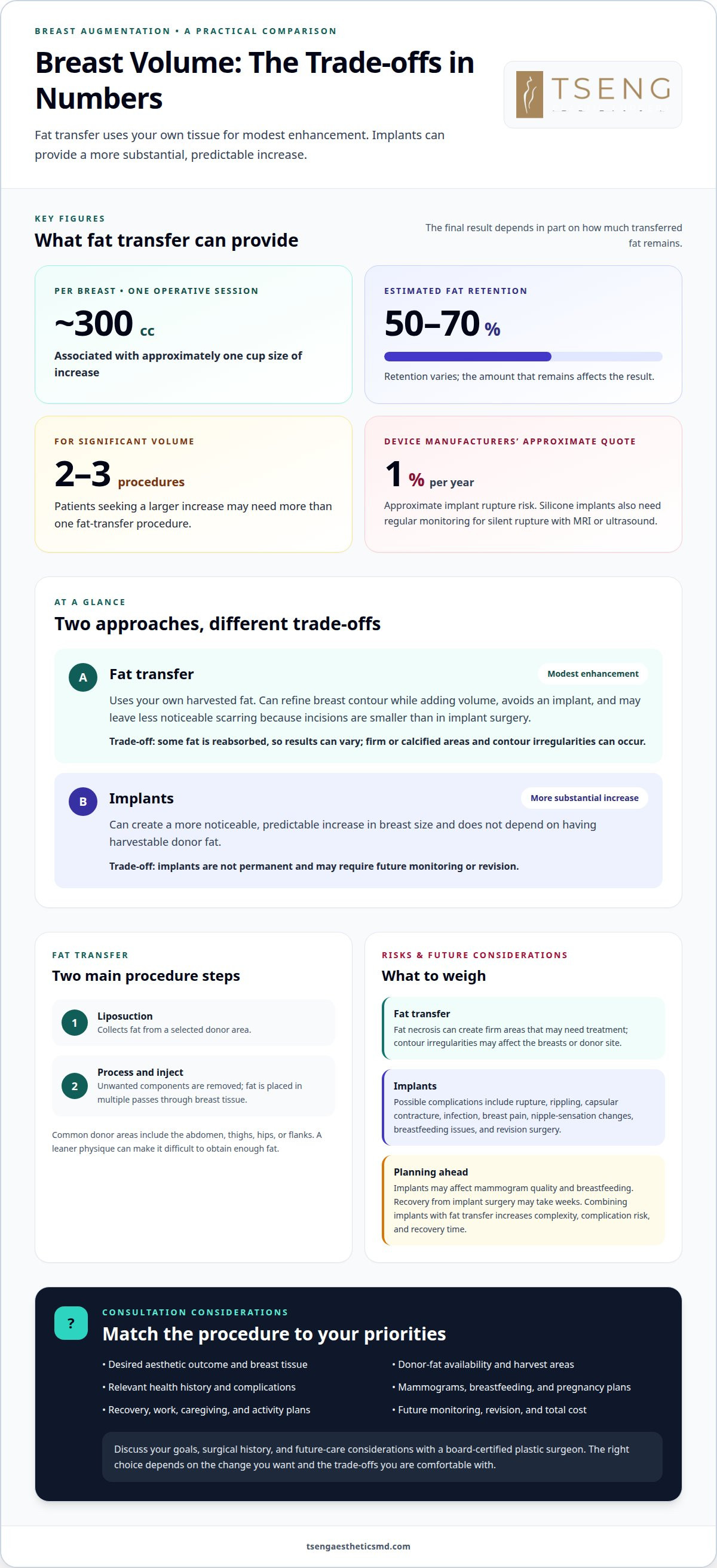
Fat grafting is suited to modest breast-size changes, rather than a large increase in one surgery. About 300 cc of fat per breast in one operative session is associated with approximately one cup size of increase. Fat retention is estimated at 50 to 70 percent, so the amount that remains affects the result. Patients seeking significant volume may need two to three procedures.
Implants offer a different balance of volume and future care. They can create a more substantial, predictable increase in size, making them an option for patients seeking a more noticeable change. However, implants aren’t permanent and may require future monitoring or revision. Fat transfer adds volume but not breast structure, so it may not suit goals that depend on a more substantial change in shape or support.
| Option | Volume potential | Material | Key limitation |
|---|---|---|---|
| Fat transfer | Modest enhancement | Your own fat | Retention varies |
| Implants | More substantial increase | Implant | Not permanent |
Choose fat transfer for modest enhancement using your own tissue; consider implants for a more substantial, predictable increase.
What are the Risks of Implants and Fat Transfer?
Fat transfer can create a subtle change using your own tissue, while implants provide a more defined increase in volume. When comparing fat transfer to breasts vs implants, weigh these outcomes alongside their different risks: transferred fat can form firm or calcified areas, while implants can rupture, ripple, or cause capsular contracture.
Implant complications can include infection, breast pain, nipple sensation changes, breastfeeding issues, and revision surgery. Device manufacturers quote an approximate rupture risk of 1% per year. Silicone implants also need regular monitoring for silent rupture with MRI or ultrasound. Fat transfer avoids implant-specific complications, but fat necrosis can create firm areas requiring treatment, and contour irregularities may affect the breasts or donor site.
Appearance and future care matter. Implants can affect mammogram quality and may interfere with breastfeeding. Discuss pregnancy plans, prior breast procedures, imaging, and possible future surgery with your surgeon. Recovery from implant surgery may take weeks. Combining implants with fat transfer can increase procedural complexity, complication risk, and recovery time.
Consider practical priorities, too. Compare each technique’s recovery demands with your work, caregiving, and activity plans. Dedicated recovery and wellness centers like My Health 360 illustrate how targeted physical recovery strategies can help individuals manage downtime and support the body during healing. For budget planning, consider the procedure and possible future monitoring or revision; total cost depends on the approach, surgical complexity, and whether procedures are combined. Weighing fat transfer to breasts vs implants also means considering future implant care versus using your own tissue.
During a consultation, ask a board-certified plastic surgeon:
- Which technique best matches my desired aesthetic outcome and breast tissue?
- What complications are most relevant to my health and surgical history?
- How could implants affect future mammograms, breastfeeding, or additional surgery?
- What recovery steps and follow-up care should I plan for?
Weigh your desired volume against the risks, recovery, and long-term considerations before choosing an approach.
Fat transfer procedure and eligibility
Breast fat transfer is a surgical augmentation that uses liposuction to collect fat, which is then injected into breast tissue. Fat transfer and implants can be combined, but using both techniques increases procedural complexity, complication risk, recovery time, and cost compared with either approach alone.
Fat transfer eligibility
Suitability depends in part on whether you have enough donor fat for harvesting and whether your goals fit the volume fat transfer can provide. A leaner physique can make it difficult to obtain enough fat. During consultation, the plastic surgeon considers your body, breast tissue, donor areas, and desired outcome together. Implant augmentation, by contrast, doesn’t depend on a reserve of harvestable fat.
Donor fat
Donor fat is commonly collected from areas such as the abdomen, thighs, hips, or flanks. Liposuction removes fat from the selected area, so planning accounts for both the amount available and the contour of the donor site. This distinguishes fat transfer from implant surgery: the procedure changes a harvest area as well as adding volume to the breasts.
Procedure steps and anesthesia
The procedure has two main steps: liposuction collects fat, then the surgeon processes and injects it into breast tissue. Processing removes unwanted components before grafting. The surgeon places the fat in multiple passes to distribute it through the breast. Unlike implant placement, this method transfers your own tissue rather than adding a manufactured device.
Breast fat transfer is often performed without general anesthesia. The surgical plan and anesthesia approach are discussed during consultation, along with the harvest and injection sites. If you’re considering a combined procedure, planning must account for both implant placement and fat grafting, which adds complexity and recovery considerations.
At your consultation, discuss the available donor areas, the volume you hope to gain, and whether a combined approach fits your goals. These factors help clarify whether fat transfer alone, implants, or both align with your preferred breast enhancement and surgical plan.
How breast implants and fat transfer work
The methods differ in how they add volume to the breast. In implant breast augmentation, a surgeon creates a pocket and places a saline or silicone implant above or below the pectoralis major muscle. Placement affects how the implant sits beneath breast tissue and muscle, shaping the surgical plan and final contour.
Fat-transfer breast augmentation instead moves your own tissue. After liposuction, the collected fat is processed, often through centrifugation or filtration, to separate blood, oil, and water. The surgeon then injects the prepared fat into the breasts in multiple passes. This places small amounts throughout the target area rather than positioning a single device.
The injection technique matters. A cannula smaller than 3 mm is used to distribute fat through breast tissue, supporting careful placement across the treated area. Transferred fat must establish a blood supply to remain; some is naturally reabsorbed. This biological process helps explain why the final look and feel can differ from an implant’s more defined volume.
For a practical comparison, consider the sequence and material: implants are inserted as a device, while fat transfer involves harvesting, processing, and grafting. Both methods aim to change breast shape, but they use different surgical techniques and relate differently to existing tissue. An implant provides structure; transferred fat adds volume without adding breast structure.
Discuss how placement, material, and your preferred look and feel shape the surgical plan. Plan your breast augmentation approach with these method differences in mind.
Tseng Plastic Surgery: Facelift
Tseng Plastic Surgery offers Breast Augmentation for patients weighing implant placement against fat transfer. A consultation can bring together your desired breast volume, available donor fat, tissue characteristics, and preferences about implants to clarify your options and their trade-offs.
Breast Augmentation may be relevant if you’re considering an implant-based change or want to explore how augmentation fits your aesthetic priorities. A thoughtful discussion can also distinguish modest contour refinement from a goal that calls for more substantial volume, while addressing the risks and future considerations covered above.
Contact Tseng Plastic Surgery to discuss your breast augmentation goals and the approaches you’re considering.
Choose a path that reflects your priorities
Start by defining what a successful change means to you. Consider the silhouette you want, your comfort with an implant, and how you feel about using your own tissue. The decision about fat transfer to breasts versus implants can become clearer when you describe your priorities in practical terms, including the changes you hope to see and the trade-offs you’re prepared to consider.
Bring your preferences and questions about future care to a personalized discussion. Tseng Plastic Surgery offers Breast Augmentation and Liposuction, as well as Facelift and Minimal invasive preservation face and neck lift for patients considering other aesthetic goals. These procedures address different concerns, so start with the change that matters most to you.
Contact Tseng Plastic Surgery to discuss your goals and possible next steps. An informed choice can help you move forward with greater clarity and confidence.
Frequently Asked Questions
How Does Fat Transfer to the Breasts Work?
Fat transfer moves your own fat into the breasts after it’s collected from another area of your body. For example, abdominal fat may be used to refine breast contour as well as add volume. The surgeon considers the donor area and where the graft should go. Final results generally become visible within a few months, once swelling subsides and the transferred fat stabilizes.
How long do breast implants last?
Breast implants commonly last between 10 and 15 years under normal circumstances, but that isn’t an automatic replacement date. An intact implant that causes no issues doesn’t need removal solely because it has reached ten years. Implants aren’t permanent, and replacement may become necessary if problems arise. The relevant consideration is the implant’s condition and the patient’s needs, not simply its age.
Is fat transfer permanent?
Fat that successfully establishes a blood supply in the breasts can remain permanently. However, some transferred fat is naturally reabsorbed, so the lasting change reflects the fat that survives rather than the full amount initially injected. This is why the early appearance differs from the settled result. Final fat-transfer results typically become visible within a few months, as swelling subsides and the fat stabilizes.
How much breast size increase can fat transfer achieve versus implants?
Fat transfer can provide a modest increase, with a maximum of about 1.5 cup sizes. Transferring about 300 cc of fat to each breast in one session is associated with approximately one cup size of increase. Implants can create a larger volume change, with breast-volume increases of up to 800 cc per breast. Your desired size helps distinguish the more subtle option from the higher-volume approach.
How long do fat transfer breast augmentation and implants last?
Fat that establishes a blood supply can last permanently, while implants aren’t permanent devices. Some transferred fat is reabsorbed, so the lasting volume is less than the initial amount grafted. Implants can remain in place for many years without replacement when complications don’t occur, but may need replacement if issues arise. The methods differ in what lasts: surviving tissue or an implant that may need ongoing attention.
What is the average cost of breast fat transfer versus implants in the United States?
There isn’t one cost that applies to every breast augmentation case. The price depends on the procedure and is provided after a quote request; factors include whether the plan uses implants or fat transfer, the liposuction areas involved, and whether procedures are combined. For pricing specific to your goals and surgical plan, contact Tseng Plastic Surgery and request a quote.

