Choosing Breast Implant Size: A Guide to Balance and Artistry (2026)
By Tseng Plastic Surgery
What if the secret to a perfect silhouette isn't found in a bra cup or a specific volume of silicone, but in the unique architecture of your own anatomy? For many women, the process of choosing breast implant size feels like a high-stakes guessing game played between cubic centimeters and desired aesthetics. You might worry about the phenomenon of "breast greed" or fear that the final result will look unnatural against your frame. It's a common anxiety, especially when you're trying to visualize how a specific volume will interact with your existing tissue or a potential breast lift.
We understand that you're looking for more than just a change in volume; you're seeking a sense of harmony and renewed confidence. This guide provides a clear path through the technical complexities of modern augmentation, balancing clinical precision with the artistry required for a refined result. We'll examine how your physical dimensions dictate the ideal implant diameter and how the latest 2026 innovations, such as Motiva's sixth-generation implants, offer a dynamic feel that mimics natural movement. By the end of this article, you'll have the knowledge to collaborate effectively with your surgeon and select a size that truly complements your lifestyle and body type.
Key Takeaways
- Understand why cubic centimeters (cc) serve as the universal medical standard for precision, offering far more consistency than traditional bra cup sizes.
- Learn how a breast lift refines the skin envelope, a critical architectural step that determines the volume your anatomy can gracefully support.
- Discover the role of implant profiles in shaping your silhouette, from low to ultra-high projections that dictate how the breast extends from the chest wall.
- Gain confidence in choosing breast implant size by utilizing a combination of home visualization techniques and professional in-office sizers.
- Explore the "art-meets-science" philosophy that prioritizes anatomical symmetry and natural-looking results over temporary aesthetic trends.
Understanding Volume: Why Cubic Centimeters (cc) Matter More Than Cup Size
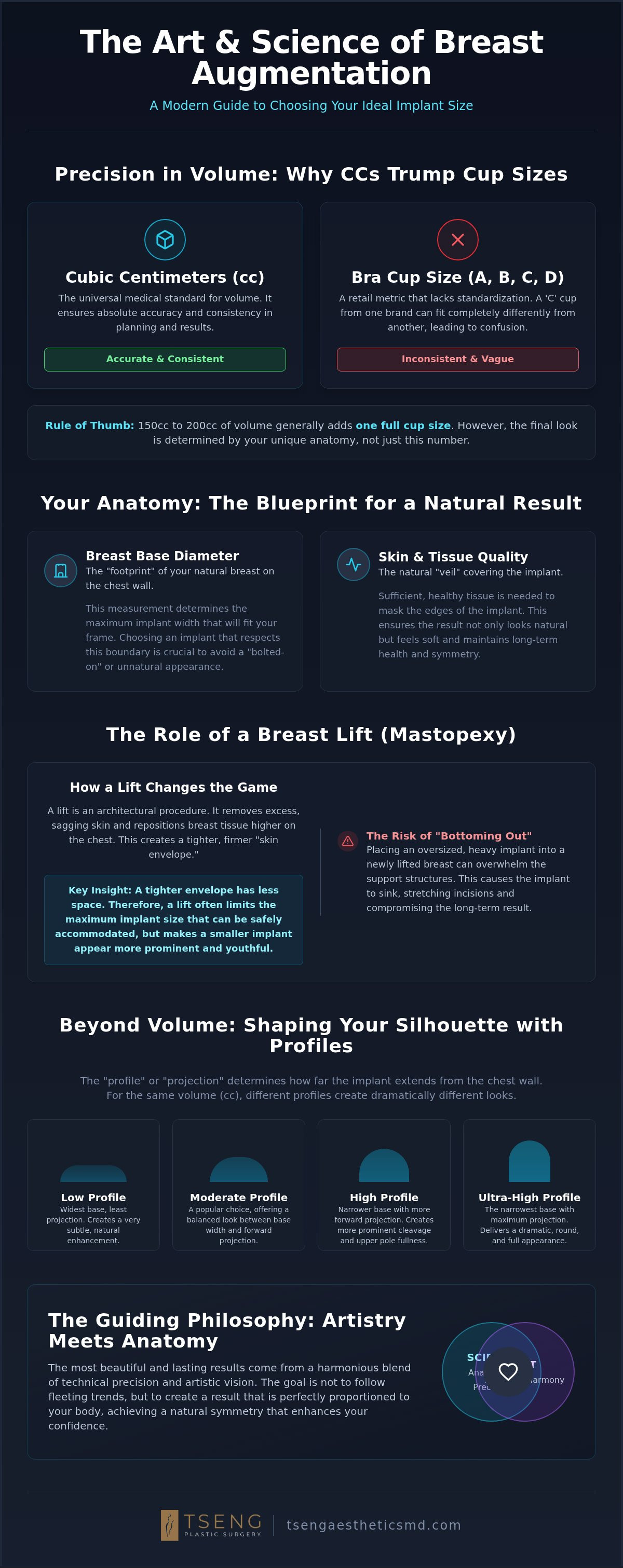
In clinical aesthetics, the familiar alphabet of bra sizes is replaced by the precision of cubic centimeters. While most patients arrive for a consultation with a specific cup size in mind, surgeons utilize "cc" as the universal metric for volume to ensure absolute accuracy. This shift is essential because the lingerie industry lacks a standardized sizing system. A "C cup" from one designer often fits like a "D cup" from another, creating a landscape of confusion for women seeking a specific look. When you're choosing breast implant size, relying on these retail labels can lead to results that don't align with your personal vision.
A common guideline suggests that 150cc to 200cc adds approximately one cup size, but this is merely a starting point. The actual impact of that volume depends heavily on your chest wall width and the elasticity of your skin. Professional Breast augmentation is an exercise in displacement. The final aesthetic is the sum of your natural breast tissue and the implant volume working in tandem. This interaction determines how the breast occupies space and how it will eventually settle into a natural, balanced silhouette.
The Problem with the "Cup Size" Goal
Targeting a specific letter often ignores the reality of body proportions. A "D cup" on a petite, narrow frame can appear overwhelming and heavy, whereas the same volume on a taller woman with a broader torso might result in a subtle, athletic enhancement. Rather than focusing on alphabet-based targets, we encourage patients to describe their desired aesthetic outcomes, such as cleavage density or upper pole fullness. It's also vital to remember that bra styles, from balconettes to sports bras, significantly influence the perceived size and shape of the breast in daily life.
The Science of Tissue Displacement
Achieving a refined result requires a meticulous assessment of your breast base diameter, which serves as the "footprint" of your natural anatomy. Choosing breast implant size is a collaborative process of finding an implant that fits within these anatomical boundaries. If an implant is too wide for your base, it can lead to complications like palpable edges or a "bolted-on" appearance that lacks sophistication. The thickness of your existing tissue also acts as a natural veil. Sufficient tissue coverage is necessary to mask the transition of the implant, ensuring the result feels as natural as it looks while maintaining long-term health and symmetry.
The Role of the Breast Lift: How the Skin Envelope Affects Size Selection
A mastopexy-augmentation is a specialized architectural procedure that addresses both volume and position. While a standard augmentation adds fullness, the lift reconstructs the foundation by removing excess skin and repositioning the breast tissue higher on the chest wall. When you choose to undergo a lift, you're essentially tightening the skin envelope. This surgical refinement naturally limits the available space for an implant. If you're choosing breast implant size while planning a lift, it's crucial to understand that a tighter envelope cannot always accommodate high-volume devices without compromising the integrity of the results.
Gravity is relentless. When an oversized implant is placed into a newly lifted breast, the weight can stretch the fresh incisions and cause the device to sink. This complication, known as "bottoming out," occurs when the internal support structures can't sustain the heavy load of a large implant. Paradoxically, a lift often makes a smaller implant look more prominent and youthful. By removing sagging skin and creating a firmer shape, the lift provides the projection that many patients mistakenly think requires more volume. Choosing a conservative size often leads to a more sophisticated, long-lasting aesthetic.
Managing the Skin Envelope
The relationship between skin elasticity and weight support is a primary factor in surgical planning. Patients with significant skin laxity or "thin" skin must be particularly careful. Heavy implants in a compromised envelope will inevitably lead to recurrent sagging. According to FDA information on breast implants, the choice of device must respect the biological limits of the patient's tissue. We often recommend smaller, lighter implants for these cases to ensure the lift remains crisp and the results stay "perky" for years rather than months.
Symmetry and the Combined Procedure
Natural asymmetry is common, and a combined procedure offers a unique opportunity for correction. We may use different sized implants to balance the breasts while simultaneously adjusting the nipple-areola complex (NAC) to a more symmetrical position. The placement of the NAC is vital; if the nipples are positioned correctly, even a modest increase in volume can look remarkably transformative. For those exploring a full rejuvenation, our Mommy Makeover Checklist offers a broader perspective on how these procedures integrate. We invite you to explore our approach to breast augmentation to see how artistry and anatomy meet.
Beyond the Number: Evaluating Implant Profiles and Projections
While volume determines the weight of the breast, the profile dictates its three-dimensional silhouette. In clinical terms, the "profile" refers to how far the implant extends forward from the chest wall, also known as projection. When you're choosing breast implant size, it's a common misconception that more volume always leads to more projection. In reality, two implants with identical cc measurements can produce entirely different visual outcomes based on their profile. A low-profile 300cc implant is wide and flat, offering a broad base with minimal forward extension, while a high-profile 300cc implant is narrower and projects much further from the body.
This distinction is vital for patients with a narrow chest wall. If a patient with a petite frame selects a low-profile implant to achieve a specific volume, the device may be too wide for her anatomy, potentially extending into the armpit area. By selecting a high or ultra-high profile, the surgeon can provide the desired volume while keeping the implant's footprint within the natural boundaries of the breast tissue. This cosmetic surgery guide to breast augmentation emphasizes that matching the implant's base width to the patient's unique anatomy is the foundation of a balanced, sophisticated result.
Choosing Your Profile Based on Body Type
The choice of profile should be a collaborative decision that reflects your lifestyle and aesthetic goals. A Moderate profile is often the preferred choice for those seeking a classic, subtle look with a natural slope. It provides a gentle curve that mimics the anatomy of a natural breast. High-profile implants are ideal for patients who desire more significant "top-pole" fullness or more pronounced cleavage. For those with exceptionally narrow frames who still want noticeable volume, Ultra-High profiles offer maximum projection without overextending the width of the breast base.
Round vs. Teardrop (Anatomical) Shapes
The evolution of implant technology has shifted the conversation around shape. While teardrop, or anatomical, implants were once the standard for a "natural" look, modern round implants often provide more reliable results. Round implants naturally settle into a soft teardrop shape when the patient is upright, yet they maintain a consistent appearance even if the device rotates slightly within the pocket. Today's sixth-generation "Gummy Bear" cohesive gels are designed to maintain their shape and integrity regardless of the profile chosen, ensuring that the projection remains stable and the feel remains supple and natural over time.
Practical Methods for Visualizing Your Results
Moving from the technical data of cubic centimeters and profiles to a tangible vision of your future silhouette is a pivotal step in your journey. While medical measurements provide the necessary framework, visualization tools bridge the gap between clinical planning and your personal aesthetic goals. Choosing breast implant size requires a transition from abstract numbers to a physical understanding of how volume interacts with your daily life. By utilizing both home-based exploration and advanced in-office technology, you can build the confidence needed to make a definitive selection.
The Limitations of the Rice Test
The "Rice Test" is a frequent starting point for many patients. This method involves filling a nylon stocking or plastic bag with dry rice and placing it inside a sports bra to simulate volume. To perform this accurately, remember that approximately 1/8 cup of rice equals 30cc. While this provides a rudimentary sense of how extra weight feels, it's a limited tool. Dry rice is static and lacks the "flow" or density of medical-grade silicone. It doesn't mimic how an implant settles into the breast pocket or how it projects from the chest wall, making it a helpful but ultimately imprecise exercise. It's best used as a way to determine a general volume range before transitioning to a professional clinical assessment.
Communicating with Your Surgeon
Effective communication is the cornerstone of a successful outcome. The word "natural" is deeply subjective; what feels subtle to one patient might feel underwhelming to another. We encourage you to bring "goal photos" to your appointment, including images of results you admire and, equally important, those you don't. This visual vocabulary helps align your vision with the surgeon's technical capabilities. During The Consultation: Preparing for Your Aesthetic Journey, we also discuss your lifestyle factors. Your daily exercise routine, professional attire, and even your preferred clothing styles all influence the ideal size selection.
In the office, we utilize surgical sizers and 3D imaging to refine your choice. Surgical sizers are specialized external implants that you can "try on" in a professional bra, allowing you to see how different volumes look under a standard t-shirt. For a more sophisticated view, 3D imaging technology simulates potential outcomes directly on a scan of your own body. This allows us to adjust profiles and volumes in real time, providing a clear preview of how the implants will harmonize with your unique frame. If you're ready to move beyond guesswork, we invite you to schedule a personalized sizing session to explore these tools in a supportive environment.
The Tseng Philosophy: Achieving Natural Harmony in Breast Augmentation
The Tseng Philosophy is rooted in the belief that true beauty is found in the delicate balance between clinical precision and artistic intuition. Choosing breast implant size is not merely a technical decision; it's an architectural commitment to your future self. While temporary trends often favor exaggerated volumes, our patient-first mentality prioritizes results that remain sophisticated and comfortable for decades. We approach every procedure from the perspective of an "art-scientist," ensuring that the physical transformation enhances your natural symmetry rather than overpowering your frame.
Conservative adjustments frequently lead to the most enduring satisfaction. By selecting a size that respects the biological limits of your skin and existing tissue, we minimize the risk of long-term complications like thinning or premature sagging. This philosophy extends beyond the breasts to the entire silhouette. We consider how your new proportions will harmonize with your facial features and overall body contour, ensuring a cohesive aesthetic that feels authentic to your identity. Whether you're choosing breast implant size for a standalone augmentation or as part of a broader plan involving liposuction or facial rejuvenation, the goal is a look that feels like a natural extension of yourself.
A Legacy of Experience
Dr. Tseng’s 20+ years of surgical expertise provide a foundation of quiet confidence for every patient. This extensive background allows for a nuanced understanding of how different implant types and volumes age over time. As a board-certified specialist, Dr. Tseng navigates the complexities of combined procedures, such as augmentation with a lift, with a refined and careful touch. Our practice is committed to a methodical, unhurried approach, where safety and individual well-being are the primary metrics of success. This legacy of care ensures that your journey is supported by professional prestige and elite training at every step.
Next Steps in Your Journey
Your personalized size consultation is designed as a collaborative session rather than a high-pressure meeting. We'll explore sizers and 3D imaging together, but our goal is to help you find the "feeling" of the result you desire. While cubic centimeters provide a necessary medical framework, the ultimate success of the procedure is measured by how you feel in your favorite clothes and how your confidence translates into your daily life. We invite you to join us in this artistic process, where your vision and our clinical expertise create a lasting, elegant harmony. Focus on the vision of your best self, and let us handle the technical precision required to get you there.
Embracing Your Vision of Refined Balance
The process of choosing breast implant size is a significant investment in your long-term confidence, requiring a delicate blend of anatomical science and aesthetic vision. By looking beyond the limitations of retail bra cup sizes and understanding the architectural role of your skin envelope, you can select a volume that feels both natural and transformative. We've examined how profiles dictate your three-dimensional silhouette and how modern visualization tools, such as 3D imaging, replace uncertainty with clear expectations. Ultimately, the most sophisticated results come from a partnership that respects your unique frame and prioritizes enduring harmony over fleeting trends.
With over 20 years of aesthetic expertise, Dr. Tseng applies board-certified surgical precision to ensure every patient achieves a balanced, personalized outcome. Our practice is dedicated to helping you navigate this journey with clarity and unhurried care, focusing on the artistry of the result and your emotional well-being. If you're ready to define your ideal silhouette and discover a look that truly harmonizes with your body, we're here to guide you. Schedule your personalized breast augmentation consultation with Dr. Tseng today. Your vision of a more confident, refined self is within reach, and we look forward to helping you realize it with grace and integrity.
Frequently Asked Questions
How many cc is one cup size?
One cup size is approximately 150cc to 200cc of volume, though this varies significantly based on your unique anatomy. A wider chest wall may require more volume to achieve a visible increase than a petite frame. Because bra manufacturers don't follow a universal standard, focusing on these numbers is less reliable than assessing how the volume interacts with your tissue. We prioritize anatomical measurements to ensure the result is balanced and sophisticated.
Will a breast lift make my breasts look smaller?
A breast lift removes excess skin and tightens the tissue, which can sometimes result in a slightly smaller overall volume. However, the procedure often makes the breasts appear more prominent and youthful by repositioning the tissue higher on the chest wall. Many patients find that the improved projection and perkiness create a more aesthetically pleasing silhouette, even if the actual cc volume is slightly lower than before the surgical intervention.
What is the most common breast implant size?
Most patients choose breast implant size ranges between 300cc and 400cc, as this volume often provides a noticeable yet natural enhancement for the average frame. While this range is statistically common, the ideal size is entirely dependent on your base diameter and existing tissue thickness. We focus on finding the specific volume that harmonizes with your proportions rather than following general trends, ensuring your results remain elegant and tailored to your body.
Can I choose different sizes for each breast to fix asymmetry?
You can certainly use different sized implants to correct natural breast asymmetry. It's very common for women to have slight differences in volume or shape between their breasts. By selecting implants with different cubic centimeter volumes, we can create a more symmetrical and balanced appearance. This personalized approach is a cornerstone of our philosophy, as it allows us to address the unique structural needs of each individual patient for a refined result.
How long do breast implants last before they need to be replaced?
Breast implants are not considered lifetime devices and typically need to be replaced or removed after 10 to 20 years. Current FDA guidelines and manufacturer data suggest that the risk of rupture or other complications increases over time. For silicone implants, the FDA recommends a first ultrasound or MRI screening 5 to 6 years after surgery, followed by screenings every 2 to 3 years to monitor the integrity of the device and ensure long-term safety.
Will larger implants cause back pain or sagging over time?
Larger implants carry more weight, which can place additional strain on the back and neck muscles over time. This increased weight also accelerates the effects of gravity on the skin envelope, potentially leading to premature sagging or a loss of upper pole fullness. We often recommend conservative sizes that respect the biological limits of your tissue. This approach helps maintain a youthful, lifted appearance while minimizing the risk of long-term discomfort or structural changes.
What is the difference between high profile and moderate profile implants?
The primary difference lies in projection versus width. A moderate profile implant is wider and flatter, providing a natural, gentle slope that mimics anatomical curves. In contrast, a high profile implant has a narrower base and projects further forward from the chest wall. High profiles are often ideal for patients with narrow frames who desire significant fullness without the implant extending too far toward the armpits, allowing for a more focused aesthetic enhancement.
Can I breastfeed after getting breast implants and a lift?
Most women can successfully breastfeed after a breast augmentation or lift, especially when the incisions are placed in the fold under the breast. These techniques are designed to preserve the milk ducts and nerve sensation in the nipple-areola complex. While individual results vary based on the specific surgical approach and your body's healing process, we prioritize techniques that maintain the functional integrity of the breast tissue while achieving your desired aesthetic goals.

