Choosing a Plastic Surgeon: Credentials, Fit, and Thoughtful Care
By Tseng Plastic Surgery
If you searched for a qualified plastic surgeon, you may be comparing credentials, safety, recovery, and the possibility of natural-looking results. It’s understandable to feel uncertain when the decision is personal and the information can be difficult to evaluate.
Choosing a plastic surgeon means looking beyond polished images. Verify relevant qualifications through reliable sources, ask about experience with the procedure you’re considering, and notice whether your priorities are heard rather than assumed.
This guide offers practical criteria for comparing surgical and non-surgical options, discussing risks and recovery, and preparing useful consultation questions. Tseng Plastic Surgery, led by Dr. Mark H. Tseng, who has been in practice for over 20 years, offers surgical and non-surgical aesthetic treatments. The practice describes its treatment plans as tailored to individual anatomy and goals. Use the guidance here to enter a consultation informed, ask thoughtful questions, and set realistic expectations for care.
Key Takeaways
- Start with the procedure you’re considering, then verify the surgeon’s license and relevant specialty credentials through reliable sources.
- Ask about experience with your specific procedure. Experience alone can’t guarantee a particular result.
- Compare surgical and non-surgical options by their purpose, limitations, risks, and recovery considerations.
- Bring questions about candidacy, alternatives, potential complications, follow-up, and fees to your consultation. Share relevant health history and medications as directed.
- Look for a treatment discussion that considers your goals and anatomy. Tseng Plastic Surgery describes its approach as individualized and balanced.
How to Evaluate a Plastic Surgeon Before Choosing a Procedure
Choosing a surgeon can feel consequential because the decision involves more than a procedure. You’re weighing safety, recovery, appearance, and whether your concerns will be understood. Assess credentials, experience with the procedure, communication, and treatment fit together rather than relying on a polished profile or a single claim. If you’re searching “plastic surgeon Bellevue,” treat search results as a starting point, not proof of qualifications.
A qualified surgeon is one whose credentials and relevant experience you can independently verify. Testimonials and before-and-after images may help you understand a practice’s aesthetic approach, but they can’t replace checking qualifications or discussing your circumstances. For context on the breadth of the field, plastic surgery covers both cosmetic and reconstructive procedures, which can differ in purpose and treatment considerations. A profile that appears in a search still warrants the same careful checks as any other.
Which qualifications should you verify?
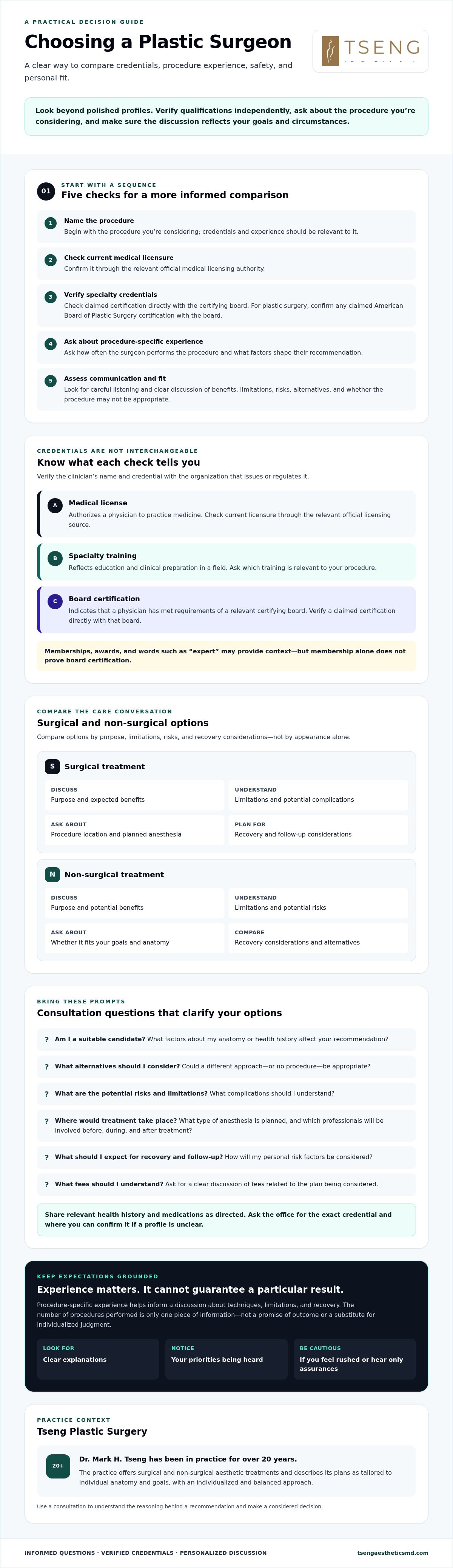
Start by identifying the procedure you’re considering. Then distinguish three separate credentials: a medical license authorizes a physician to practice medicine; specialty training reflects education and clinical preparation in a field; and board certification indicates that a physician has met the requirements of a relevant certifying board. Each answers a different question, so don’t assume one confirms the others.
Check current licensure through the relevant official medical licensing authority, and verify specialty certification directly with the certifying board. For plastic surgery, confirm any claimed certification with the American Board of Plastic Surgery. Professional memberships, awards, or phrases such as “expert” can provide context, but membership alone isn’t proof of board certification. If a profile is unclear, ask the office for the exact credential and where you can confirm it.
How do experience and communication affect fit?
Ask how often the surgeon performs the specific procedure you’re considering and what factors shape their recommendation. Procedure-specific experience matters because techniques, anatomy, and recovery needs vary. Still, a number of past procedures can’t promise an outcome or establish that a particular surgeon is right for you.
Pay attention to the conversation. Does the surgeon listen to what you hope to change, ask relevant questions, and explain options in language you understand? A thoughtful discussion should include potential benefits, limitations, risks, and alternatives, including the possibility that a procedure may not be appropriate. Be cautious if you feel rushed or hear only assurances.
Use the consultation to assess both clinical judgment and personal fit. The goal isn’t to find the most persuasive presentation. It’s to understand the reasoning behind a recommendation and feel equipped to make a considered decision.
Plastic Surgeon Credentials and Safety: What to Check Beyond a Profile
A profile can introduce a surgeon’s background, but it can’t replace independent verification or a clear conversation about safety. Use a simple sequence: identify the procedure you’re considering, check the surgeon’s current medical license, verify relevant specialty credentials, and ask about experience with that specific procedure. Each step answers a different question. Together, they provide a more useful basis for comparison.
Confirm credentials through the issuing or licensing organization, not by inferring them from advertising. If a surgeon states they’re certified by the American Board of Plastic Surgery, verify that claim directly with the board. Check current medical licensure through the relevant official licensing source, and make sure the name and credential match the clinician you’ll see. A professional membership or award may offer context, but it doesn’t establish board certification.
Why ask about procedure-specific experience?
Experience with the procedure you’re considering can help you understand a surgeon’s familiarity with its techniques, limitations, and recovery considerations. Ask about their experience with that procedure and how your anatomy and health history affect their recommendations. The number of procedures performed is only one piece of information, not a guarantee of results or a substitute for individualized judgment.
What safety questions belong in your comparison?
Ask where the procedure would take place, what type of anesthesia is planned, and which professionals will be involved before, during, and after treatment. Then discuss your personal risk factors, expected follow-up, and whom to contact if you have concerns during recovery. Specific answers matter. A credential or facility designation alone can’t guarantee safety, so look for a clear explanation of how the care plan addresses your needs.
The American Society of Plastic Surgeons offers patient safety guidelines to help people think through surgeon qualifications and procedural safeguards. Use reputable resources to prepare, then ask the surgeon to explain how those considerations apply to your proposed treatment. If you’re reviewing Tseng Plastic Surgery, you can also learn more about the practice and bring questions about credentials, procedure setting, or care arrangements to your consultation.
Choosing a Plastic Surgeon Whose Treatment Plan Fits Your Goals
A treatment recommendation should begin with a conversation, not a preset procedure. Describe what you hope to change and what you want to preserve, such as familiar facial features or a preference for subtle refinement. A thoughtful assessment also considers your anatomy, medical history, and how much recovery time you can reasonably accommodate. Ask why an option may or may not be suitable for you.
How should a surgeon connect your goals to an option?
Be specific about what concerns you, but remain open to clinical feedback. A surgeon may explain that your anatomy or health history affects candidacy, the technique considered, or the balance between possible benefits and risks. Ask how those factors shape the recommendation and what alternatives could address your priorities. You should leave with a clear explanation, not pressure to accept a particular plan.
Photographs and testimonials can offer a sense of a practice’s aesthetic perspective and may help you frame questions. They show other people’s experiences, however, not a forecast of your result. Differences in anatomy, starting point, and treatment choices mean another person’s outcome can’t establish what you should expect.
When should you compare surgical and non-surgical care?
Compare approaches by purpose, degree of intervention, limitations, and recovery rather than treating them as interchangeable. Surgical options may involve a procedure and a recovery period. Non-surgical treatments have different aims and constraints. Ask how long results may last in your case, whether maintenance could be part of the plan, what recovery involves, and what each option cannot address. The right comparison depends on your priorities and clinical assessment, not simply on which option sounds less involved.
For facial rejuvenation, a surgeon may discuss surgical and non-surgical approaches as distinct choices, each with its own considerations. Ask how the options differ in their intended purpose, limitations, and recovery, and which factors in your assessment inform the recommendation.
Keep the discussion grounded in your own goals. A well-matched plan should connect what you want to change with what your anatomy can support, while making limitations and recovery expectations clear. That clarity helps you compare options without mistaking photographs, testimonials, or a popular treatment for a personalized recommendation.
Questions to Ask a Plastic Surgeon at Your Consultation
A consultation is a chance to understand your options, not a commitment to proceed. Bring a written list and share relevant health history, including medications and supplements, as directed by your clinician. Don’t stop or change medication unless the clinician managing it advises you to do so. Clear answers can help you weigh the recommendation at your own pace.
What should you ask about the procedure and recovery?
Questions about candidacy, alternatives, risks, and recovery can reveal how carefully a treatment plan has been considered. Adapt these prompts to your situation:
- Am I a suitable candidate, and what about my health history affects the recommendation?
- What can this procedure address, what can’t it address, and what alternatives should I consider?
- What risks or complications are relevant to me, and how would they be managed?
- What should I expect during recovery, and what follow-up care is planned?
- Which symptoms or concerns should prompt me to contact the care team, and whom should I contact?
Ask for explanations in language you understand, including what additional care might be needed if recovery doesn’t follow the expected course. Details vary by procedure and individual circumstances, so a general description isn’t a substitute for guidance tailored to you.
How can you assess communication and transparency?
Notice whether responses are clear, specific to your concerns, and consistent throughout the discussion. You can ask for the proposed treatment plan in writing and request an itemized explanation of fees, including what is and isn’t included. If an answer feels incomplete, it’s reasonable to ask again or take time to review the information before deciding.
You should feel heard and respected, without pressure to book or make an immediate decision. Informed consent means understanding the proposed treatment and its relevant risks and alternatives before agreeing to it. If recommendations differ between clinicians, or important questions remain unanswered, a second opinion can offer another perspective. Bring your notes and relevant records so the discussion can address the same goals and medical context.
To organize your questions before a discussion about aesthetic care, review Tseng Plastic Surgery’s practice information and consider which points you’d like clarified. Use your list to guide a measured conversation and decide only when you feel informed.
How Tseng Plastic Surgery Approaches Individualized Aesthetic Care
After comparing credentials, safety considerations, and consultation questions, you can look at how a particular practice describes its approach to care. Tseng Plastic Surgery is a physician-owned aesthetic practice led by Dr. Mark H. Tseng. Practice information states that Dr. Tseng has been in practice for over 20 years. Verify current professional credentials independently before making a decision.
The practice describes its approach as individualized, with treatment plans shaped around a person’s anatomy and aesthetic goals. It also emphasizes natural-looking, balanced results without promising that a specific outcome is possible for every patient. Those principles are useful starting points for discussion, not a substitute for an assessment of your needs, health history, and expectations.
What services does the practice offer?
Listed surgical options include facelift, minimal invasive preservation face and neck lift, liposuction, and breast augmentation. The practice also lists non-surgical facelift, hair restoration, and injectables. Having both surgical and non-surgical options available can make an individualized assessment especially important. Treatments differ in purpose, limitations, and recovery considerations, and no single option is right for everyone.
Ask which options, if any, may be appropriate for your goals and why. You can also discuss what each approach may not address, the risks and recovery involved, and whether an alternative or no treatment is more suitable. A recommendation should reflect your circumstances rather than assume that every listed service fits every patient.
What is a useful next step if you are considering care?
Before contacting the practice, write down what you hope to change, what you want to preserve, and what questions remain. Bring relevant health information and ask about candidacy, alternatives, individualized risks, recovery, and realistic expectations. Take time to consider the answers. A consultation is an opportunity to gather information, not an obligation to proceed.
If you’d like to discuss your goals and questions directly, request a consultation with Tseng Plastic Surgery. A thoughtful conversation can help you understand the options and decide whether the proposed approach feels appropriate for you.
Make Your Next Step an Informed One
A sound choice rests on more than a compelling profile. Verify credentials through authoritative sources, ask about experience with the procedure you’re considering, and look for a treatment discussion shaped by your goals, anatomy, health history, and recovery needs. Surgical and non-surgical options have different purposes and limitations, so clear explanations matter.
Tseng Plastic Surgery offers surgical and non-surgical aesthetic services. Practice information states that Dr. Mark H. Tseng has been in practice for over 20 years. Verify this claim and any current credentials independently before making a decision. Ask about candidacy, alternatives, risks, and realistic expectations, then give yourself time to consider the information without pressure.
If you’re ready to discuss your goals and questions, request a consultation with Tseng Plastic Surgery. Careful research and an open, thoughtful conversation can help you take the next step with greater clarity.
Frequently Asked Questions
How do I know if a plastic surgeon is qualified?
Check the surgeon’s current medical license through the official licensing authority, then verify any claimed specialty training and board certification with the relevant organization. For plastic surgery, you can independently check a claim of certification with the American Board of Plastic Surgery. A search for “plastic surgeon Bellevue” can help you find profiles, but confirm credentials directly and ask about experience with your specific procedure. Memberships and testimonials aren’t substitutes for verification.
Is board certification important when choosing a plastic surgeon?
Yes, relevant board certification is an important qualification to verify, but it’s one part of your decision. If you’re comparing results for “plastic surgeon Bellevue,” confirm any claimed certification in plastic surgery directly with the American Board of Plastic Surgery rather than relying on a profile or membership listing. Also check licensure, ask about experience with your procedure, and discuss the surgeon’s approach to your goals, risks, and recovery. No credential guarantees a particular outcome.
What should I ask a plastic surgeon during a consultation?
Ask whether you’re a suitable candidate, what the procedure can and can’t address, and what alternatives may fit your goals. Discuss risks specific to your health history, anesthesia and care arrangements, recovery expectations, follow-up, and whom to contact with concerns. Request a written treatment plan and an itemized explanation of fees. Share relevant health information and medications as directed by your clinician, and take time to consider the answers.
Can a plastic surgeon recommend a non-surgical treatment instead of surgery?
Yes. A surgeon may discuss a non-surgical option if it aligns more closely with your goals and circumstances. Surgical and non-surgical treatments differ in purpose, degree of intervention, limitations, recovery, and expected longevity, so they aren’t interchangeable. Ask what each option could realistically address, what it can’t, whether maintenance may be involved, and why the recommendation suits your anatomy and health history. The right plan should follow an individual assessment.
How much does it cost to see a plastic surgeon?
Consultation fees vary by practice and appointment type, so contact the office directly to confirm the fee and what it includes before scheduling. If you’re discussing a procedure, ask for a written, itemized estimate that clarifies which professional services and other related charges are included. Don’t assume the consultation fee is part of a procedure’s cost. Comparing estimates is most useful when you understand what each one covers.
What happens if I am not sure which procedure I need?
You don’t need to choose a procedure before meeting with a surgeon. Describe what you hope to change, what you’d like to preserve, and how much recovery you can accommodate. The surgeon can assess your anatomy and relevant health history, then explain suitable options, limitations, and whether treatment is appropriate. It’s reasonable to leave with questions, review a written plan, and take time before deciding.
Should I get a second opinion before plastic surgery?
A second opinion can be helpful if recommendations differ, you’re uncertain about the proposed approach, or important questions remain unanswered. It gives you another perspective on candidacy, alternatives, risks, recovery, and expected results. Bring relevant medical information and the proposed treatment plan so the discussion has useful context. Compare how clearly each surgeon explains the reasoning and whether you feel informed and unpressured before making a decision.

