Chin Filler for a Weak Chin: How It Compares With an Implant
By Tseng Plastic Surgery
The least invasive option isn’t automatically right for every profile concern. Chin filler for weak chin concerns can add projection and refine facial balance, but may not create the degree of structural change someone wants. A chin implant offers a different, more substantial approach, with the considerations that come with surgery.
It’s understandable to want a result that looks proportionate rather than obvious, while also wondering how long it may last, whether it can be reversed, and what recovery and risks involve. The right choice depends on your anatomy and goals, not simply on which treatment is trending.
This article explains what filler can realistically change, how it compares with an implant, and what to consider around longevity, reversibility, recovery, and safety. At Tseng Plastic Surgery, Dr. Mark H. Tseng brings more than 20 years of practice experience to a personalized approach focused on natural-looking balance. An individualized medical consultation can help clarify which option, if any, aligns with the structural change you want.
Key Takeaways
- Chin filler for weak chin concerns may refine contour by adding soft-tissue volume, but its role depends on the change you want.
- Filler and implants differ in the degree of projection they can provide and in other important trade-offs.
- Consider duration, recovery, reversibility, and potential risks as part of an individualized treatment discussion.
- Describe the profile changes you hope to see in your own words rather than starting with a fixed treatment or look.
- A careful assessment of facial proportions can help align your anatomy, expectations, and priorities with an appropriate approach.
What Does Chin Filler for a Weak Chin Actually Change?
A chin that appears recessed can affect the impression of the entire profile, changing how the nose, lips, jawline, and lower face seem to relate to one another. That doesn’t necessarily mean the chin needs to be larger. Chin filler for weak chin concerns is usually considered as a way to explore whether carefully placed volume could create a more balanced contour, based on a person’s anatomy and goals.
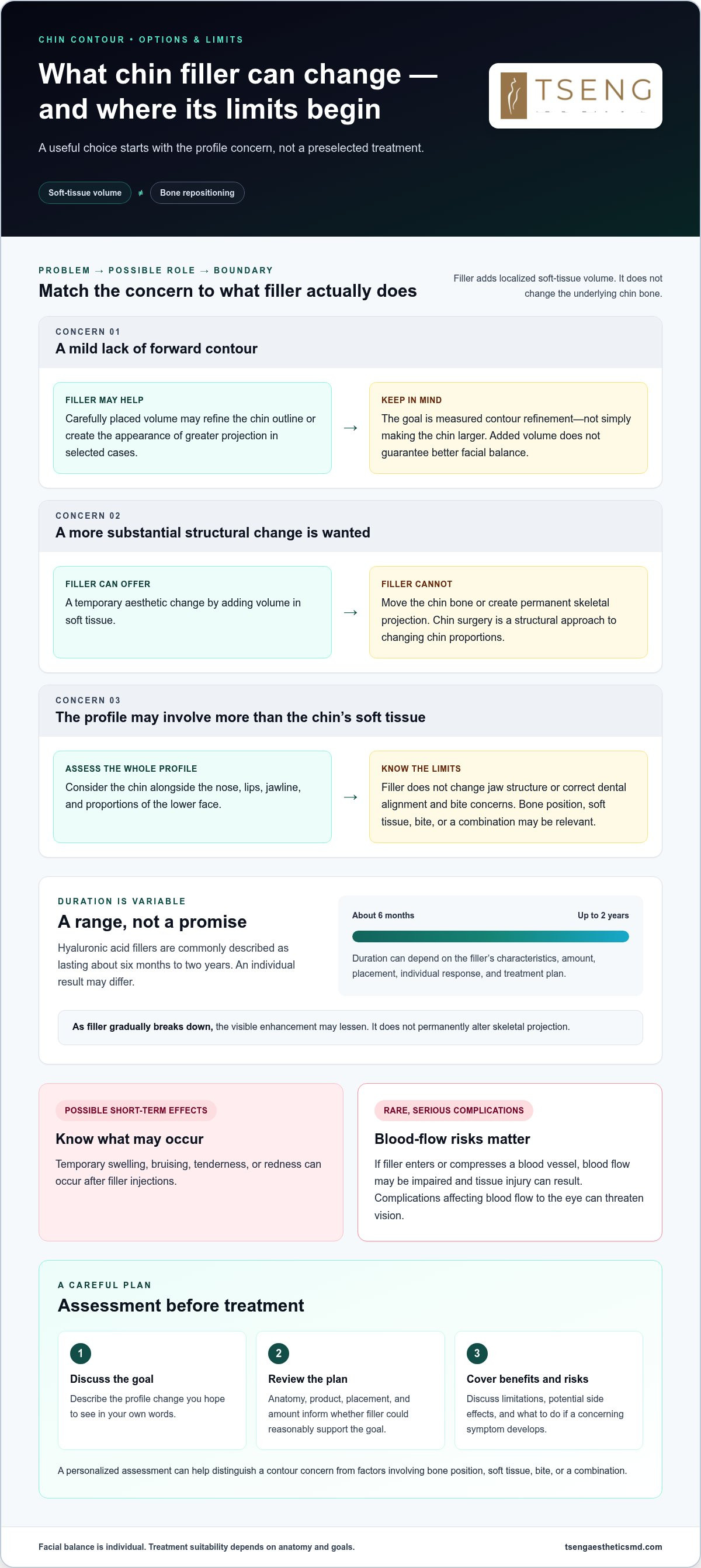
Chin filler is an injectable treatment that adds soft-tissue volume to refine the chin’s contour; unlike structural surgery, it doesn’t reposition the underlying bone. This distinction matters: filler may provide a subtle change in appearance, while a concern involving more substantial skeletal projection calls for a broader discussion of options. The overview of chin augmentation describes both injectable and surgical approaches.
How chin projection influences facial balance
A thoughtful profile assessment considers the chin in relation to the nose, lips, jawline, and proportions of the lower face. For example, a mild lack of forward contour may be the main aesthetic concern, while a more recessed chin could be one part of a broader facial or dental pattern. Looking at the chin in isolation can overlook these relationships.
A single selfie, camera angle, or online proportion rule can’t establish what is causing a profile concern. Perspective and head position can change how prominent the chin appears, and facial features vary naturally. A clinician’s assessment can help distinguish an aesthetic contour concern from factors that may involve bone position, soft tissue, bite, or a combination of them.
What injectable filler can and cannot do
Filler can add localized volume, which may help refine the chin’s outline or create the appearance of greater projection in selected cases. The effect depends on facial anatomy, the product chosen, and the clinician’s judgment. There’s no single shape or degree of change that suits everyone, so an appropriate plan should account for how the chin fits the full profile.
There are limits. Injectable filler doesn’t move the chin bone, change jaw structure, or correct dental alignment and bite concerns. If the desired change depends on a larger structural adjustment, adding soft-tissue volume may not address the underlying issue. An assessment should clarify what an injectable approach can reasonably change and whether another type of evaluation may be relevant.
The practical question isn’t simply, “Can filler make my chin bigger?” It’s whether a measured contour adjustment could bring the profile closer to the balance you want without creating disproportion elsewhere. Understanding what contributes to the appearance of the chin is a useful first step.
How Chin Filler Works, and Where Its Limits Begin
A good plan begins before any injection. The clinician assesses your facial anatomy and listens to what you’d like to change, then discusses whether filler could reasonably support that goal. If treatment is appropriate, planning considers the product, placement, and amount. Follow-up can help assess the result and determine whether any next step is suitable. The process is individualized, not a formula based on the phrase “weak chin.”
Carefully planned, modest changes may refine contour without making the chin look disconnected from the rest of the face. But the result can’t be predicted from a generalized online description. Anatomy and response vary, and adding more volume doesn’t necessarily create better balance. Filler also isn’t bone augmentation: it adds volume in soft tissue rather than creating a permanent structural change to the chin.
What shapes the result and its duration?
Duration depends on several factors, including the filler’s characteristics, amount used, placement, individual response, and overall treatment plan. Hyaluronic acid fillers are commonly described as lasting from about six months to two years, but that range isn’t a promise for an individual or a particular treatment. An in-person assessment can frame expectations more usefully than an online timeline because it considers your anatomy and proposed approach.
It’s helpful to distinguish a temporary aesthetic effect from lasting change to facial structure. As filler gradually breaks down, the visible enhancement may lessen; it doesn’t reposition bone or permanently alter skeletal projection. The American Society of Plastic Surgeons describes chin surgery as a structural approach to changing chin proportions, which differs in purpose from injectable volume.
Safety, side effects, and informed consent
Temporary swelling, bruising, tenderness, or redness can occur after filler injections. Less commonly, complications can be serious. If filler enters or compresses a blood vessel, blood flow may be impaired and tissue injury can result. Complications involving blood flow to the eye can also threaten vision. The possibility of rare serious harm is one reason filler shouldn’t be treated as risk-free or automatically suitable for everyone.
An informed discussion should cover the product being considered, expected benefits and limitations, potential side effects, and what to do if a concerning symptom develops. Anatomical knowledge matters for both planning injection placement and recognizing complications that need prompt attention. Product-specific information and current safety guidance should be reviewed as part of clinical care rather than assumed to apply equally to every filler.
If you’re considering chin filler for weak chin concerns, a thoughtful consultation can connect your goals with an assessment of anatomy, realistic duration, and potential risks. A personalized conversation about injectable treatment options can help clarify whether a temporary contour change aligns with your priorities.
Chin Filler vs. Chin Implant: Which Trade-Offs Matter Most?
Both approaches can change the appearance of chin projection, but they do so differently. Filler adds soft-tissue volume for selected contour goals, while an implant is a surgical option intended to create a more structural change. Comparing the practical trade-offs can help you describe what matters most before discussing options with a clinician.
Purpose: Filler may refine contour or add a modest appearance of projection. An implant may be considered when the goal involves a more substantial structural change.
Structural change: Filler adds volume in soft tissue; it doesn’t reposition the chin bone. An implant changes the chin’s profile through surgery.
Duration: Filler results are temporary and vary with the product, treatment plan, and individual response. An implant is intended to provide a longer-lasting change, though results and future needs vary.
Recovery: Filler generally involves less recovery than surgery, but temporary reactions and medical risks remain possible. Implant surgery requires recovery and may involve swelling, discomfort, and activity guidance from the surgical team.
Reversibility: Some hyaluronic acid fillers can be dissolved with an enzyme, but this isn’t a universal feature of all fillers. An implant isn’t dissolved; changing or removing it requires a surgical assessment and may involve another procedure.
The right option depends on your anatomy, the change you want, and your tolerance for risk and recovery. Less invasive doesn’t mean risk-free or automatically more appropriate. Filler can have complications, and surgery carries its own risks. Both should be discussed in the context of your health and treatment goals.
When filler may align with a patient’s goals
Filler may be worth discussing if you’re seeking a restrained contour adjustment and prefer to avoid surgery while accepting a temporary result. That preference alone doesn’t establish suitability. A clinician needs to assess your anatomy, goals, and relevant medical factors to determine whether an injectable approach is reasonable and what its limits may be.
When a surgical approach deserves discussion
If you want a more structural or potentially longer-lasting change, chin surgery may merit discussion. An implant involves an operation, recovery, and risks such as infection, bleeding, changes in sensation, or the need for future revision. It isn’t universally better: weigh the potential benefit against the surgical commitment and your individual circumstances.
For someone exploring chin filler for weak chin concerns, the most useful starting point is the desired change, not a favored procedure. An individualized consultation can clarify whether the goal is primarily contour refinement or a greater structural shift, then weigh the options and their trade-offs.
How to Decide Whether Chin Filler Fits Your Face and Priorities
A chin that feels out of balance doesn’t automatically need treatment. Start by clarifying what you notice, then consider the chin in relation to your other features and discuss options without assuming filler is the answer. For chin filler for weak chin concerns, the goal is an informed choice that reflects your anatomy and priorities, not a borrowed ideal or a fixed online proportion rule.
- Define the concern. Describe what you’d like to change in your own words, such as a softer chin contour or a profile that feels more balanced. You don’t need to arrive with a treatment plan.
- Look at overall proportions. Assessment may consider your profile and front-facing balance, chin shape and soft tissue, jawline, and lower-face proportions.
- Review suitable options. Discuss what each approach could realistically address, as well as alternatives or the choice to do nothing.
- Weigh the trade-offs. Consider your preferences around the extent of change, duration, recovery, risks, and follow-up before making a decision.
What an individualized assessment should consider
A clinician’s evaluation can consider facial proportions from more than one angle, along with the chin’s shape and the soft tissue over it. Medical history and previous injectable treatments also matter because they help inform a personalized assessment and treatment plan. Be open about past procedures, relevant health conditions, and your expectations.
Jaw position and dental bite can influence how the lower face appears. If you have concerns about your bite or jaw function, mention them; an aesthetic evaluation alone may not explain every factor involved. Assessment is meant to understand the concern in context, not to label every recessed-looking chin as a problem requiring correction.
Questions to bring to a consultation
Clear questions can make the conversation more useful. Consider asking:
- Which specific feature is contributing to the concern I’ve described?
- What change is realistically achievable for my anatomy, and what would remain unchanged?
- What alternatives should I consider, including no treatment?
- What duration, recovery, risks, and follow-up should I understand for the options discussed?
- How would the proposed plan support a natural result in harmony with my whole face?
Good planning makes room for your preferences and for clinical judgment. Explain what you hope to see while staying open to a different approach, or to the conclusion that treatment isn’t needed. An individualized consultation can align anatomy, expectations, and personal priorities before you decide. Schedule a personalized consultation to discuss your goals and aesthetic options.
A Thoughtful Next Step for Chin Filler and Facial Balance
A concern about chin projection can prompt you to seek information, but it doesn’t mean you need a procedure. Begin by identifying what feels out of balance and what kind of change would still feel like you. The decision should follow a careful clinical assessment, not a predetermined choice of filler or surgery.
Turning an aesthetic concern into a clear treatment discussion
It may help to describe your concern in everyday terms: perhaps your profile seems less defined than you’d like, or you’re hoping for a subtle shift in how your chin relates to your lower face. You don’t need to name a procedure or request a particular look. Sharing what feels natural to you gives the clinician a clear starting point for discussing options in light of your anatomy and goals.
At Tseng Plastic Surgery, care is centered on individual priorities and natural-looking, balanced results. Dr. Mark H. Tseng has practiced for over 20 years, bringing experience in aesthetic care to a conversation that should account for the whole face, not just one feature. The aim is to understand your concern and expectations before considering an approach. After an informed discussion, choosing no treatment remains a valid outcome.
What a patient-centered plan should clarify
A considered plan should explain what change an option may offer, where its limits lie, and what risks and follow-up may involve. Ask how the proposed approach fits your anatomy and what alternatives are reasonable, including waiting or deciding against treatment. Clear answers help you weigh the likely experience against your priorities without feeling committed to a procedure.
For chin filler for weak chin concerns, technical precision and aesthetic judgment should work together. A treatment discussion should consider whether a change would support facial harmony rather than create an exaggerated or disconnected appearance. The clinician should also explain what the plan cannot change, so expectations stay grounded in what the approach can realistically address.
Take time to reflect on the conversation. A useful next step leaves you with a clearer understanding of your options, not pressure to act. If you’re ready to explore your aesthetic goals with an individualized assessment, schedule a consultation to discuss your goals.
Move Forward With a Clearer Picture of Your Goals
Your next step doesn’t have to be choosing a procedure. It can simply be getting clearer about what you’d like to feel different, what would still look natural to you, and which questions you want answered before making a decision. That perspective can make a conversation about chin filler for weak chin concerns more personal and grounded in your priorities.
A thoughtful discussion leaves room for uncertainty. You can explore possibilities, consider their implications, and take time to decide whether any change feels right. The aim isn’t to pursue a particular treatment at all costs; it’s to make a choice that feels informed and genuinely your own.
If you’re ready to talk through your aesthetic goals and appropriate next steps, request a personalized consultation. A considered beginning can help you move forward with greater confidence and a vision that feels true to you.
Frequently Asked Questions
Can chin filler fix a weak or recessed chin?
Chin filler can improve the appearance of a mildly recessed chin for some people, but it can’t correct every cause of limited projection. Added soft-tissue volume may refine a contour, while a pronounced difference related to jaw position or bite may need a broader clinical assessment. Filler won’t move bone or correct dental alignment, so the achievable change depends on what contributes to your profile and what you hope to alter.
How long does chin filler last?
Hyaluronic acid fillers used for facial contouring are generally reported to last about six months to two years, but that range isn’t a guarantee for an individual chin treatment. The specific product, amount, placement, and your body’s response can affect how long the result remains visible. Your clinician can explain the expected duration for the proposed treatment and how to recognize when the effect is changing, rather than relying on a generalized timeline.
Is chin filler reversible?
Some hyaluronic acid fillers can be treated with hyaluronidase, an enzyme that breaks down this type of filler. Reversal isn’t a universal feature of all injectable products, and dissolving filler is a medical treatment that may have its own risks or limitations. Before proceeding, confirm which type of filler is being considered and whether it can be dissolved. Don’t assume an injectable result can always be removed completely or immediately.
Is chin filler safer than a chin implant?
Neither option is automatically safer for every person. Filler avoids an operation, but injections can still cause complications, including rare serious problems involving blood flow. An implant involves surgery and its associated risks, such as infection, bleeding, or changes in sensation. The relevant comparison depends on your health, anatomy, desired change, and the risks of each proposed approach. A clinician can explain how those factors apply to your circumstances.
What happens if I do not like my chin filler result?
Contact the clinician who treated you to discuss the result and appropriate next steps. Early swelling or bruising can affect how the chin looks, so an assessment may need to account for healing rather than rely on an immediate impression. If the filler is hyaluronic acid, dissolving may be an option, but it isn’t suitable for every product or concern. Seek urgent medical attention for vision changes, severe pain, or unusual skin color changes.
Does chin filler hurt, and is there downtime?
Discomfort varies, and you may feel brief pinching, pressure, or tenderness during or after injections. Temporary swelling and bruising can occur, so the chin may look different while it settles. Downtime is generally less involved than recovery from surgery, but that doesn’t mean there are no after-effects or activity considerations. Ask what to expect for the specific treatment plan and how to manage symptoms during recovery.

