Breast Augmentation in Bellevue: Benefits, Options and Goals
By Tseng Plastic Surgery
The right result is not simply a larger size; it’s a shape that feels balanced with your body and aligned with your goals. Breast augmentation can add volume, refine proportions, or restore fullness. Options include saline or silicone implants and fat grafting. The best fit depends on the change you want and your individual anatomy.
It’s natural to want a clear picture of the benefits and decisions involved before considering surgery. Your goal might be subtle, such as improving balance, or a more noticeable change in fullness. Understanding what each option can achieve helps you bring your preferences into an informed conversation.
This article explains potential benefits, candidacy, and how personal goals shape implant or fat-grafting choices. It also covers key considerations when choosing a surgeon and practice, so you can approach the next step with a clearer sense of what to discuss and what matters most to you.
Key Takeaways
- Compare implants with fat grafting by the kind of change each approach can create and the trade-offs that matter to you.
- Clarify your goals and consider how your anatomy and health shape whether breast augmentation may be an appropriate choice.
- Explore implant choices and placement considerations to understand how they can influence your planned result.
- Use your consultation to discuss your priorities and learn how Tseng Plastic Surgery approaches breast augmentation.
What Are The Benefits Of Breast Augmentation?
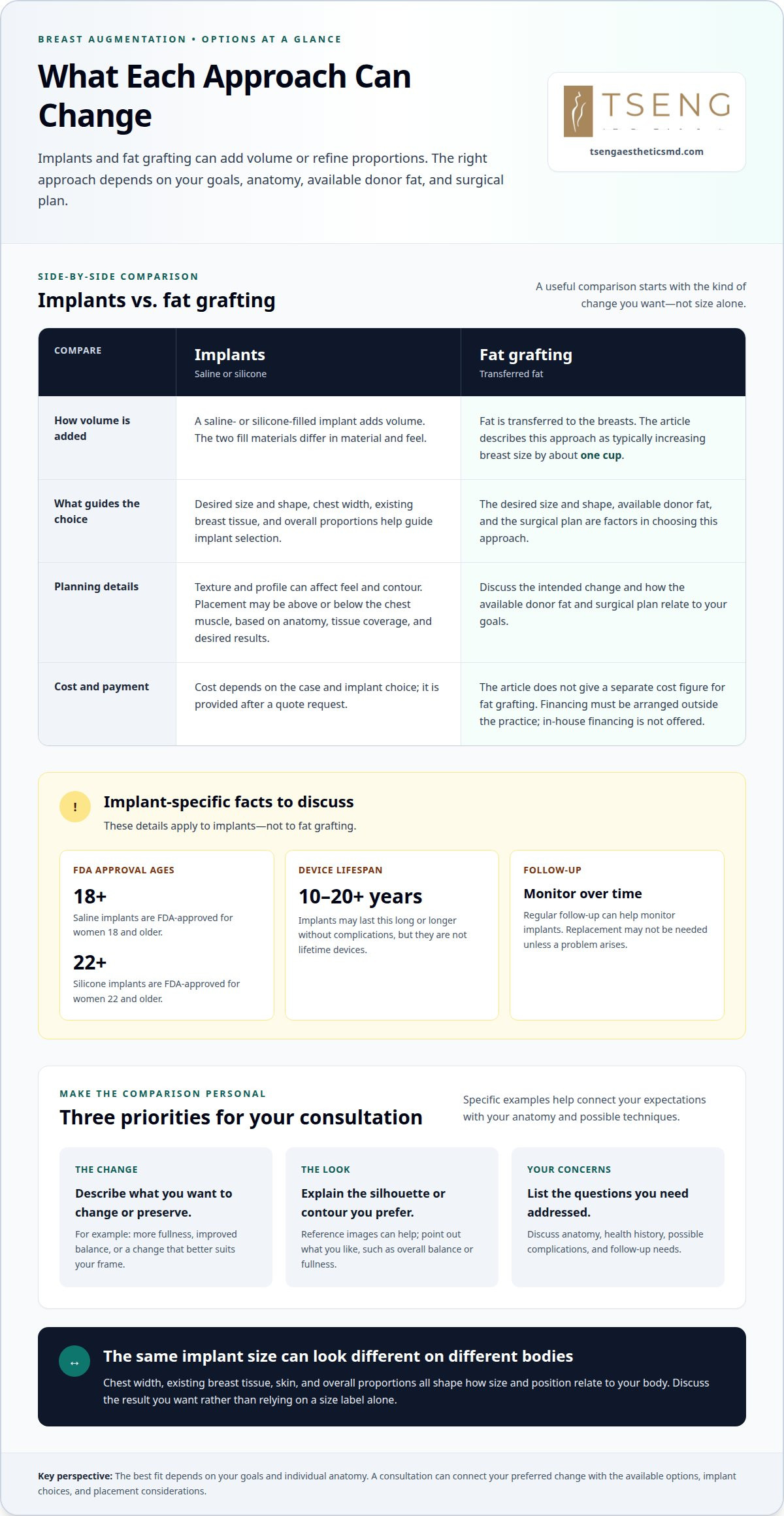
Breast augmentation can add volume or refine proportions through implants or fat grafting. Implants are available in saline or silicone, while fat grafting uses transferred fat and typically increases breast size by about one cup. The approach depends on your desired size and shape, available donor fat, and surgical plan.
Saline and silicone implants differ in fill material and feel, while safety depends on appropriate selection and follow-up. Implants may last 10 to 20 years or longer without complications, but they aren't lifetime devices. Cost depends on the case and implant choice, and is given after a quote request.
The FDA has approved saline breast implants for women 18 and older and silicone breast implants for women 22 and older. Regular follow-up can help monitor implants, and replacement may not be needed unless a problem arises.
Implant makers include Natrelle and Inspira by Allergan, as well as Mentor. Texture and profile affect how an implant feels and contributes to the intended contour, so selection should reflect your goals and anatomy. The same implant size can look different across body types. Chest width, existing breast tissue, and overall proportions help guide the choice.
Placement above or below the chest muscle is another technique decision. Your surgeon considers tissue coverage, anatomy, and desired results when planning placement. Discussing a specific goal, such as fuller upper-breast contour, helps clarify priorities for size, profile, and placement. Implants carry risks, so planning includes understanding possible complications and follow-up needs.
Breast augmentation financing must be arranged outside the practice because in-house financing isn't offered. Payment planning is separate from selecting an implant, but both should be considered before scheduling surgery.
Surgeon and practice in Bellevue, Washington
Ask about your surgeon’s training, credentials, experience with breast enhancement, and approach to complications. To verify a credential, check it with the organization that issued it. During the consultation, discuss where procedures take place, who provides anesthesia, and how your health history shapes the plan. Specific questions help you understand the process before making decisions.
For a productive consultation, organize your priorities into three points: the change you want, the look you prefer, and the concerns you need addressed. For example, explain whether you value a subtle increase in fullness or a more defined contour. The surgeon can connect your expectations to your anatomy, implant choices, and placement options, without treating one size as right for every patient.
Surgery typically takes 1-2 hours and is performed on an outpatient basis. Before the procedure, the care team reviews the agreed plan and anesthesia arrangements. Afterward, follow the instructions provided for rest, movement, and follow-up. Recovery is generally estimated at 1-2 weeks, although normal activities may resume within 3-7 days.
Recovery unfolds in stages, not as a single date on the calendar. Plan for two to three days of rest, and arrange practical help for that period. Avoid strenuous workouts for 4-6 weeks after surgery. Your activity plan should reflect the procedure and your progress, rather than a fixed return-to-exercise date. For general wellness and returning to fitness safely over time, dedicated recovery programs like those at My Health 360 demonstrate how structured care can support long-term healing and physical performance.
Start by defining the change you want, using specific examples rather than a cup-size label alone. You might want fuller upper contours, improved balance between your breasts, or volume that better suits your frame. Bring those priorities to a consultation and explain what you want to preserve, too. A clear goal gives the plastic surgeon at Tseng Plastic Surgery a practical basis for discussing proportion, breast size, and possible techniques.
If you’re considering breast augmentation Bellevue patients rely on for exceptional care, a personalized surgical consultation can help clarify the procedure, anesthesia plan, and recovery steps.
Breast augmentation candidacy and goals
Your current shape and tissue affect how a desired result may look. For example, someone with a narrow chest may need a different implant width than someone with a broader frame. Skin and existing breast tissue also influence how an implant’s size and position relate to your proportions. Weight loss can change breast volume, so discuss past changes and expectations for future weight stability.
A candidacy discussion considers your health history, anatomy, and reasons for seeking surgery. Share relevant medical information and any concerns about healing or activity. The plastic surgeon can explain how those factors relate to the procedure and whether your goals align with a surgical approach. A specific example, such as wanting a modest rather than dramatic change, helps clarify your priorities without treating any size as universally suitable.
Think through everyday comfort as well as appearance. Consider how your preferred breast size may fit clothing, exercise, and your body’s proportions. If you’re considering saline implants, discuss how the implant’s dimensions and placement would support your goal; the material alone doesn’t determine the final look. Bring reference images that show your preferred silhouette, then identify what you like about each, such as overall balance or fullness. This helps translate visual preferences into a more precise conversation about realistic expectations and options.
Think through everyday comfort as well as appearance. Consider how your preferred breast size may fit clothing, exercise, and your body’s proportions. If you’re considering saline implants, discuss how the implant’s dimensions and placement would support your goal; the material alone doesn’t determine the final look. Bring reference images that show the silhouette you prefer, then identify what you like about each image, such as overall balance or fullness. This step helps translate visual preferences into a more precise conversation about realistic expectations and options.
Breast augmentation options
Choosing an implant involves more than selecting a volume. A general guide is about 200 cc for roughly one cup size, but that estimate doesn’t predict an individual result. Chest width, existing tissue, and the desired profile all influence how an implant may look. A plastic surgeon can compare dimensions and proportions during planning, using your frame rather than a cup label alone.
Placement above or below the chest muscle also affects the plan. Your surgeon considers tissue coverage, chest structure, and the intended aesthetic when recommending a position. Muscle involvement can affect recovery and activity planning, so discuss exercise habits and the demands of your work. Share any weight changes that have affected your breast appearance, since future changes may alter proportions after enhancement.
Symmetry is a planning goal, not always a matter of choosing identical sizes. Natural differences in breast shape or position can influence implant dimensions on each side. During the consultation, compare reference images and describe the details you prefer, such as upper fullness or a balanced silhouette. Ask how each proposed combination of size, shape, profile, and placement supports that goal. Your surgeon’s credentials and experience with these options are relevant parts of the conversation.
Symmetry is a planning goal, not always an identical-size decision. Natural differences in breast shape or position can influence implant dimensions on each side. During the consultation, compare reference images and describe the details you prefer, such as upper fullness or a balanced silhouette. Ask how each proposed combination of size, shape, profile, and placement serves that goal. A certified surgeon’s credentials and experience with these options are relevant parts of the conversation.
To explore which approach aligns with your aesthetic goals, discuss breast augmentation options in a consultation.
Tseng Plastic Surgery: Breast Augmentation
Tseng Plastic Surgery offers breast augmentation for people considering a change in breast volume, shape, or proportion. If you’ve weighed the benefits, options, and recovery considerations, a consultation is a natural next step for discussing your goals and the procedure. Bring your priorities, such as a subtle increase in fullness or a more noticeable change, so the conversation can focus on what matters to you. The surgical plan can be tailored to your anatomy and aesthetic preferences, including the implant choices and techniques discussed in this guide. Breast augmentation may not suit every person or goal, and a thoughtful discussion can help clarify whether it fits your needs. Contact Tseng Plastic Surgery to discuss breast augmentation and your goals.
Make Your Next Step Personal
You don’t need to arrive with every decision made. Bring your questions and describe what would feel like a meaningful, natural-looking change. The discussion can help you understand the considerations behind a surgical plan and decide whether you feel ready to proceed. Your preferences should guide the conversation, without pressure to choose a particular size or outcome.
Breast augmentation is surgery intended to change breast volume or shape, commonly using implants. For example, someone seeking more fullness may discuss an implant, while someone wanting a modest change may explore fat grafting. The aim is to align the planned enhancement with personal preferences and body proportions, rather than assume one breast size or shape suits everyone.
If you’d like to discuss your goals with the practice, contact Tseng Plastic Surgery. Take the next step when it feels right for you, with a clearer sense of the result you hope to pursue.
Frequently Asked Questions
How long do breast implants typically last?
Breast implants may last 10 to 20 years or longer without complications, but they aren’t lifetime devices. Their lifespan varies, so there isn’t one replacement date that applies to everyone. Keep a record of your implant type and surgery details; these help inform future monitoring and discussions if your breast appearance changes or you have concerns.
Are Silicone Implants Safe?
Silicone implants are an FDA-approved option for women 22 and older, but approval doesn’t mean an implant is risk-free or permanent. Consider safety as an ongoing part of care: understand the monitoring recommendations, keep your implant information, and discuss your medical history and concerns during planning. This helps you make an informed choice about silicone compared with saline.
Enhance Your Natural Figure: What Is Breast Augmentation?
Implants don’t have a routine replacement schedule; replacement is typically considered if an issue develops. For silicone implants, the FDA recommends an initial MRI three years after surgery, followed by scans every two years. Monitoring is different from automatic replacement. Keep follow-up imaging and exam records together so changes over time can be considered alongside your implant history.
How Often Do Implants Need to Be Replaced?
Discuss your desired appearance in concrete terms, then review implant dimensions with your surgeon. Instead of relying only on a cup-size label, describe how you want clothing to fit or what proportions you hope to achieve. Bring reference images and explain the features you like, such as overall fullness or a balanced silhouette. This gives the sizing discussion useful context.
How do I make sure that I get the size that I want?
Placement depends on your anatomy, tissue coverage, and desired contour. Above-the-muscle placement positions the implant over the chest muscle; below-the-muscle placement positions it beneath the muscle. Ask your surgeon to explain how each option relates to your chest structure and planned result. A useful consultation question is how the recommended placement supports your priorities for shape and proportion.
Implant placement: above or below the muscle?
The placement of an implant depends on your anatomy, tissue coverage, and desired contour. Above-the-muscle placement positions the implant over the chest muscle; below-the-muscle placement positions it beneath the muscle. Ask your surgeon to explain how each option relates to your chest structure and planned result. A useful consultation question is how the recommended placement supports your priorities for shape and proportion.

