Alternatives to a Full Facelift: Options, Results, and Trade-Offs
By Tseng Plastic Surgery
A full facelift isn’t the right answer to every sign of facial aging, but a less extensive treatment isn’t automatically the right one either. The best alternatives to a full facelift depend on what you want to change: skin quality, expression lines, lost volume, loose skin, or a combination of concerns.
It’s understandable to want a noticeable, natural-looking result without committing to more surgery or downtime than you need. Nonsurgical treatments can address selected concerns, but they don’t reproduce the lifting effect of surgery or remove significant excess skin. Less extensive surgical options offer a different balance of change and recovery. This guide compares what these approaches can and cannot address, and what to consider when weighing them. At Tseng Plastic Surgery, Dr. Mark H. Tseng brings more than 20 years of experience to individualized facial rejuvenation, including nonsurgical treatments and minimal invasive preservation face and neck lifts. Clarifying your concerns and desired degree of change can help make a consultation more productive.
Key Takeaways
- Identify whether your main concern is skin quality, expression lines, volume, or laxity before considering a treatment.
- Alternatives to a full facelift serve different purposes. Compare each option with the specific change you hope to see.
- Weigh the treatment target, invasiveness, recovery, and maintenance rather than assuming a less extensive approach is automatically the best fit.
- A limited surgical approach is still surgery and should be considered in light of your anatomy and goals.
- Clarify what you want to improve and what you want to preserve to make an individualized consultation more productive.
Alternatives to a Full Facelift: What Can They, and Cannot, Address?
Wanting a visible refresh without choosing a full facelift is a reasonable place to start. First, identify what you hope to change. Facial aging can affect skin texture, expression lines, facial volume, and the tissues that support the face. These concerns may appear together, but they don’t all respond to the same treatment.
Alternatives to a full facelift are options with different goals, levels of invasiveness, and limitations, not interchangeable versions of one procedure. Some focus on a particular surface concern or expression line. Others address volume or tissue laxity through surgery. A treatment that refines one area may not change another concern that matters to you.
Improving skin quality can refine the surface, but it does not reposition lax facial tissues. Keep that distinction in mind when setting expectations: a smoother-looking complexion and a more defined lower-face contour are different goals, even if both contribute to a refreshed appearance.
What does a full facelift address?
A facelift generally focuses on lax facial tissues and lower-face contour. The changes it can address, and the approach considered, depend on individual anatomy and concerns; no single plan fits every face. For a foundational overview of Rhytidectomy (Facelift Surgery), including general techniques and variations, see the linked reference. A modern facelift guide can also help explain how surgical rejuvenation may be approached with attention to natural-looking results.
What people usually mean by a facelift alternative
“Alternative” can mean avoiding surgery, choosing an approach with a different recovery profile, or addressing one specific concern rather than several at once. A nonsurgical treatment and a less extensive surgical approach are different categories. One avoids an operation; the other remains surgery, even if its scope differs from a full facelift. Each has distinct considerations, and neither is automatically a substitute for the other.
Someone focused on skin appearance may have a different starting point from someone concerned about loose tissue along the jawline. If your concerns span texture, volume, and laxity, a single focused treatment may address only part of what you notice. An individualized assessment connects your goals and anatomy with an appropriate degree of change and explains what an option is, and is not, designed to do.
Nonsurgical Facelift Alternatives: Match to Concern
Nonsurgical facial rejuvenation is best considered by the concern you want to address, rather than as one treatment expected to refresh every feature. Skin texture, fine lines, expression lines, and changes in facial volume call for different approaches. Some treatments can soften or refine a specific feature, but they don’t reposition lax facial tissues the way surgery can.
Choose a treatment for the concern in front of you, not because it’s currently a trend. This keeps expectations grounded and supports a more personal plan. If you have several concerns, an assessment can help clarify which matters most and whether a targeted approach makes sense.
When the main concern is skin quality or fine lines
If your primary concern is uneven texture or visible fine lines, selected nonsurgical treatments may be considered to improve the skin’s appearance. The appropriate approach depends on the specific concern, your skin, and a clinical assessment. A surface-focused treatment may refine texture, but it shouldn’t be expected to correct substantial tissue laxity or create the contour change associated with surgery.
Describe what you see as specifically as you can. For example, note whether you’re most bothered by rough texture, fine lines at rest, or skin that seems less firm. These details offer a clearer starting point than a broad request to “look younger.” They also help distinguish a skin-quality goal from a concern involving deeper structural changes.
When volume changes or expression lines stand out
Injectables can serve different purposes depending on the feature being treated. Some are used to address selected expression lines by relaxing muscle activity; others may restore or support facial volume where fullness has changed. Those aims aren’t interchangeable: relaxing a muscle doesn’t replace lost volume, and adding volume doesn’t reposition loose tissues. A careful plan considers facial balance and the degree of refinement you want, rather than treating every visible line or hollow in isolation.
For a broader comparison of surgical and nonsurgical approaches, the surgical versus nonsurgical facelift guide offers helpful context. The key question is not simply which option is less involved, but whether its purpose matches your concern. If you’re considering alternatives to a full facelift, describe what you want to preserve as well as what you’d like to refine.
A personalized discussion can connect your concerns with an appropriate treatment scope. At Tseng Plastic Surgery, facial rejuvenation options are considered in light of individual anatomy and aesthetic goals. Explore personalized facial rejuvenation as you consider what kind of change feels right for you.
Mini or Limited Surgery vs. Nonsurgical Options: Compare the Trade-Offs
The word “alternative” can make treatments sound more alike than they are. A nonsurgical approach may target a specific feature, while a limited surgical procedure may address facial tissue laxity within a defined scope. Neither is simply a smaller version of every other option, and less invasive does not automatically mean equivalent results.
Use this comparison as a starting point, not a prediction of what a treatment can achieve for you.
| Approach | Treatment target | Invasiveness | Recovery considerations | Maintenance |
|---|---|---|---|---|
| Nonsurgical treatment | Selected skin, line, or volume concerns | Doesn’t involve a surgical operation | Depends on the treatment and individual response | May involve ongoing treatment planning |
| Limited surgical approach | Selected areas of facial tissue laxity | Surgery, with scope tailored to the case | Requires recovery planning; needs vary by procedure and patient | Discuss expected care and future needs individually |
| Full facelift | Facial tissue laxity and lower-face contour | Surgery | Requires recovery planning | Discuss expectations and ongoing care as part of assessment |
The table shows broad differences, not a ranking. A nonsurgical treatment may suit a focused concern, while pronounced laxity may call for a different discussion. A less extensive operation is still surgery, with its own candidacy considerations, risks, and recovery needs. An assessment should take your anatomy, health, and goals into account.
How treatment scope changes from one option to another
Scope matters. A treatment directed at skin appearance or a particular area of volume may refine that feature without addressing loose facial tissues. Surgical approaches may be considered when laxity and contour are central concerns, though the area and degree of change depend on the planned procedure and the individual.
If you’re concerned about one feature, a targeted option may be worth discussing. If several changes affect your overall appearance, treating one feature alone may not address the full picture. That doesn’t mean you need a more extensive procedure. It means the discussion should include how your concerns relate to one another and what degree of change you’re seeking.
What to weigh beyond the word “alternative”
Consider your comfort with surgery, your ability to plan for recovery, your willingness to maintain treatment, and how noticeable a change you hope to achieve. Nonsurgical care may involve a plan that is revisited over time, while surgery involves a procedure and its associated recovery. Neither category guarantees a particular result.
Risks and candidacy vary by treatment and individual health. Discuss these factors alongside your priorities rather than relying on the label “less invasive.” When weighing alternatives to a full facelift, consider which option’s scope and trade-offs align with your anatomy and goals.
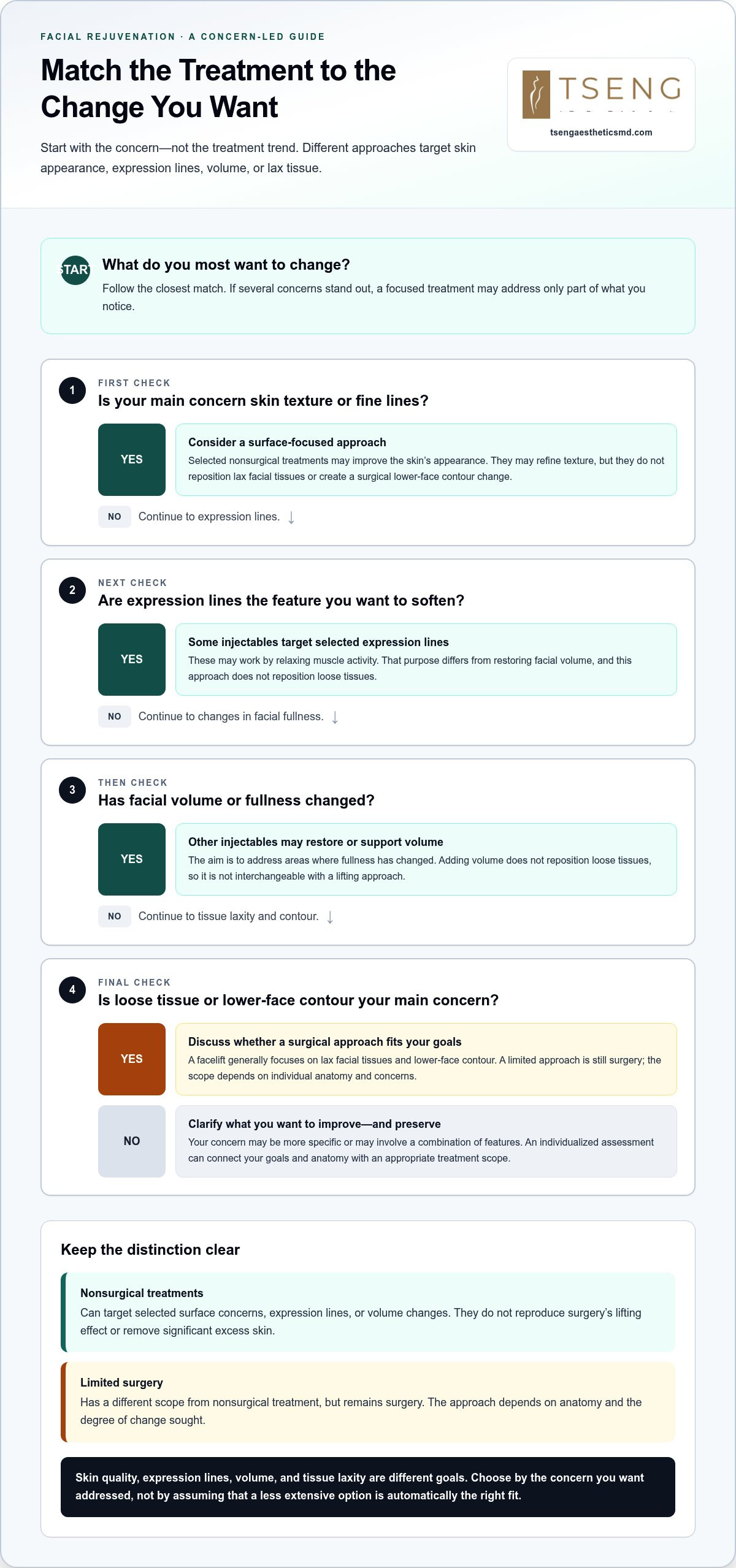
How to Decide Which Facelift Alternative Fits Your Goals
A useful decision starts with your priorities, not a procedure name. Use this four-step framework to organize your thoughts before a consultation:
- Name the concern. Identify the area and feature that draws your attention, such as skin texture, lines, volume changes, or laxity.
- Define the desired change. Describe what you hope will look or feel different, and what you want to preserve about your natural expression and facial character.
- Weigh the trade-offs. Consider your comfort with surgery, recovery needs, ongoing treatment planning, and the degree of change you’re seeking.
- Discuss your options. Review how each approach may fit your anatomy, goals, and health, including its scope and limitations.
This process can turn a general wish for a refresh into a more focused conversation. It also gives a clinician the opportunity to explain when a concern may involve more than one feature and how that affects the options under consideration.
Start with the facial change you want to address
Notice where your concern is most apparent and describe it plainly. Is it a change in skin texture, lines that show with expression, reduced fullness, or looseness that affects contour? More than one may apply. You don’t need to diagnose the cause yourself. The goal is to share what you see and how it affects your sense of balance.
Be specific about the result you hope for. “I want to look less tired” can be a helpful starting point, but noting which features contribute to that impression makes the discussion more useful. Realistic goals consider the face as a whole, including the features you value and want to retain, rather than focusing on changing one detail in isolation.
Prepare for an informed consultation
Bring questions that clarify both the potential benefit and the commitment involved. Ask what concern a proposed treatment is intended to address, what it may not change, what risks and recovery considerations apply, and whether ongoing maintenance is part of the plan. Discuss your medical history, previous aesthetic treatments or procedures, and your capacity to plan for recovery.
Your preferences matter, too. Share whether avoiding surgery is a priority, whether you’re comfortable with treatment that may need to be revisited, and what degree of visible change feels appropriate. These details connect the options to your life as well as your anatomy.
Online information can help you prepare, but it can’t determine candidacy or replace an examination. A consultation is a collaborative decision-making conversation, not a commitment to proceed with a procedure. For individualized guidance on alternatives to a full facelift, schedule a facial rejuvenation consultation with Tseng Plastic Surgery.
Explore Personalized Alternatives to a Full Facelift with Tseng Plastic Surgery
Understanding the differences among treatment options is a useful first step. The next is considering how those differences relate to your anatomy, preferences, and desired degree of change. At Tseng Plastic Surgery, Dr. Mark H. Tseng brings more than 20 years of experience to individualized facial rejuvenation, with surgical and nonsurgical approaches considered in light of each patient’s goals.
The practice offers injectables, nonsurgical facelift treatments, and minimal invasive preservation face and neck lifts. These options have different purposes and levels of invasiveness. A nonsurgical treatment isn’t a substitute for surgical tissue repositioning, and surgery isn’t automatically the right choice for every concern. The aim is to understand what you hope to improve, what you wish to preserve, and which treatment category may fit after clinical evaluation.
A tailored conversation about surgical and nonsurgical options
A thoughtful discussion starts with the concern that brought you in. Is your priority a particular facial feature, a change in skin appearance, or laxity affecting contour? Describe the result you hope for and how much change feels appropriate. These details help frame a conversation about whether injectables, nonsurgical facelift treatments, a minimal invasive preservation face and neck lift, or another approach should be considered.
Dr. Tseng’s experience informs the evaluation, but no general description can predict an individual result. Recommendations depend on your anatomy, aesthetic goals, and clinical assessment. It’s also reasonable to discuss what a proposed treatment is not designed to address, so expectations remain clear and the plan reflects your priorities rather than a one-size-fits-all ideal.
What a thoughtful next step can clarify
A consultation can help you examine the benefits and limitations of relevant options, along with risks, recovery considerations, and potential maintenance. Bring questions about the intended treatment scope and how it relates to your concern. Sharing previous procedures, health history, personal preferences, and practical recovery needs can make the discussion more specific to you.
You don’t need to arrive with a procedure already chosen. An informed conversation can clarify which options may warrant consideration and which may not align with your goals. It can also help distinguish a focused concern from a broader desire for facial rejuvenation, allowing you to consider alternatives to a full facelift with greater confidence and perspective.
If you’re ready to explore what may suit your anatomy and preferences, explore facial rejuvenation options through a personalized consultation with Tseng Plastic Surgery.
Take the Next Step with Confidence
The right next step isn’t choosing a procedure before you’re ready. It’s turning what you’ve noticed into a clear conversation about the kind of change that feels appropriate, the features you hope to preserve, and the trade-offs you’re comfortable weighing. That perspective can make a discussion of alternatives to a full facelift more personal and purposeful.
At Tseng Plastic Surgery, Dr. Mark H. Tseng brings more than 20 years in practice to individualized facial rejuvenation. Surgical and nonsurgical options are considered in relation to each patient’s anatomy and aesthetic goals, without assuming one approach suits everyone. A consultation can help you explore what may be appropriate and understand the considerations involved before deciding how to proceed.
Explore personalized facial rejuvenation options and take a thoughtful first step toward a plan that reflects your preferences.
Frequently Asked Questions
Can nonsurgical treatments replace a full facelift?
No. Nonsurgical treatments may improve selected concerns, but they don’t reproduce the tissue repositioning of facelift surgery. A treatment aimed at expression lines, for example, won’t necessarily address loose skin along the lower face. If your goals involve several changes, discuss each one separately to understand which concerns a nonsurgical approach may help and which may call for a different treatment category.
What is the best alternative to a full facelift?
There isn’t one best option for everyone. The right choice depends on the feature you want to address, the degree of change you’re seeking, and your preferences about surgery, recovery, and maintenance. Someone focused on a specific line may have different needs from someone concerned about facial volume or laxity. A clinical assessment can connect your goals and anatomy with suitable alternatives to a full facelift.
Are facelift alternatives permanent?
No single answer applies to every alternative. Nonsurgical treatments may require ongoing planning, while surgical procedures involve a different treatment and recovery process. None can stop the face from changing over time, and individual results vary. During an assessment, ask how long a proposed approach may be expected to serve your goals, whether follow-up treatment could be part of the plan, and what factors may affect the result.
Can injectables lift sagging skin?
Injectables don’t lift sagging skin in the same way surgery can reposition facial tissues. Depending on the concern, an injectable may address selected expression lines or changes in volume, but those purposes are distinct from correcting pronounced laxity. If loose skin or a change in facial contour is your main concern, describe the area and the change you hope to see during a clinical evaluation.
Is a mini facelift a nonsurgical alternative?
No. A mini or limited facelift is a surgical approach, even if its scope differs from a full facelift. It involves a different level of treatment and requires an assessment of your anatomy, health, goals, and ability to plan for recovery. The term “mini” doesn’t mean the procedure is nonsurgical or suitable for everyone, so ask what areas it is intended to address and what limitations may apply.
What happens if nonsurgical treatments do not address my concerns?
If the result doesn’t match your goals, review which concerns remain rather than assuming that more treatment is automatically appropriate. A clinician can reassess the original objective, discuss whether expectations align with the treatment’s scope, and consider whether another approach is more suitable. Depending on your anatomy and preferences, that discussion may include surgical options, including a facelift or a minimal invasive preservation face and neck lift.
How do I know which facelift alternative is right for me?
An examination and discussion of your goals are needed to determine which options may fit. Before your appointment, note the areas you’d like to improve, the features you want to preserve, previous aesthetic treatments, relevant health history, and your recovery preferences. Ask what each option is designed to address, along with its risks and limitations. Online guidance can help you prepare, but it can’t determine your candidacy.

